








Overview
AI in Aviation Statistics: Artificial Intelligence is taking aviation beyond traditional operations. From the cockpit to the airport terminal, AI is helping airlines and airports work smarter and respond faster. Airlines are using AI to predict maintenance issues, improve flight routes, reduce delays, and automate routine tasks. Airports are also using AI for security, baggage handling, passenger services, and smoother operations. These technologies can help companies save time, control costs, and make better decisions using real-time data.
As passenger numbers and operational demands continue to rise, AI is becoming an important part of the aviation industry. Its growing use is shaping how airlines manage aircraft, serve passengers, and plan for the future.
Best Overall
- The global AI in aviation market was valued at USD 3.1 billion in 2025, and it is expected to reach USD 4.2 billion in 2026.
- Predictive maintenance led applications with a 28.45% market share in 2025.
- According to Ttrweekly, 98% of Asia-Pacific airlines used AI in 2026, compared with 63% globally for operations control.
- 63% of airlines use AI in operational control for disruption management.
- Air Space Intelligence won the FAA’s USD 875 million, 12-year SMART program in 2026 for AI-driven air-traffic optimization.
- Over the next 2 years, 73% of airports and 90% of airlines plan to increase AI investment.
- Airbus’ SimulON solution has cut simulation and analysis time by 70%.
- AI-based flight planning can reduce fuel use by 3%-5%.
- 65% of passengers prefer AI chatbots for booking changes, and personalized recommendations can increase conversions by 20%.
- Meanwhile, 60% of aviation IT teams prioritize AI cybersecurity investments over the next 3 years.
- United Airlines’ AI system reportedly identifies 90% of hydraulic issues early, reducing repair costs by 15%.
Emerging AI Trends in Aviation
- AI-guided autonomous taxiing systems are being tested for certification in 2026.
- Wifi Talents stated that fully autonomous flight systems could save the aviation industry USD 35 billion annually by 2035.
- AI-enabled Urban Air Mobility could reach USD 36 billion by 2030.
- About 15% of new commercial aircraft could feature high-level AI autonomy by 2040.
- AI-driven eVTOL aircraft completed 1,000+ flight hours in 2023.
- Generative AI can reduce aircraft wing-design cycles by 60%.
- AI-managed drone air traffic could support 10 million flights per day by 2030.
- 85% of aerospace engineers expect AI to become a primary materials-science tool by 2028.
- AI wingman systems have reduced pilot workload by 50% in simulations.
- AI-managed hydrogen systems could increase flight range by 15%.
- Quantum computing with AI could optimize airline networks 1,000 times faster than current CPUs.
- AI could support quieter supersonic routes in 5 countries.
Global AI in Aviation Market Size
(Source: market.us)
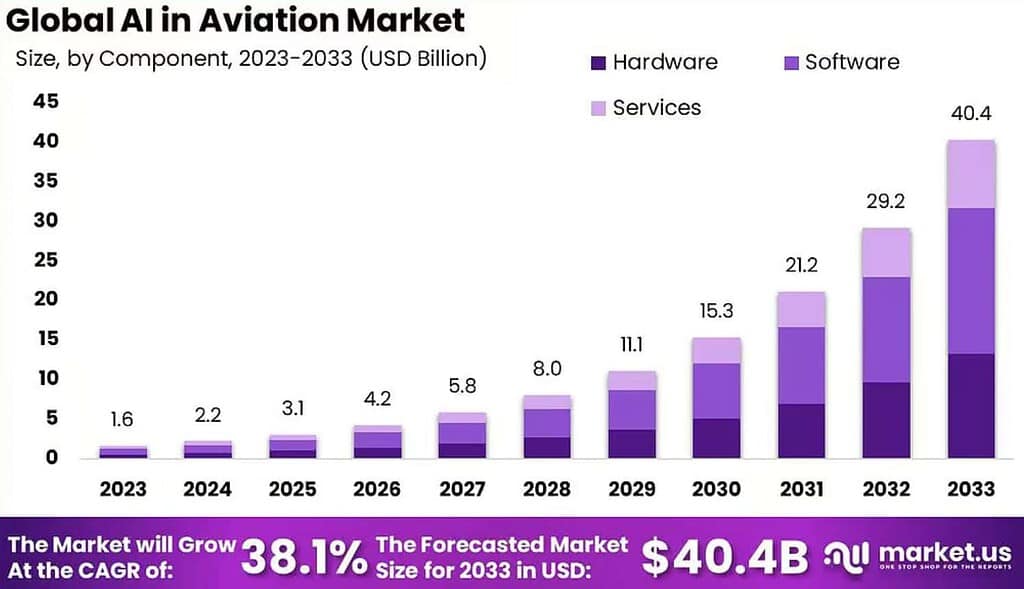
- The global AI in aviation market was valued at USD 3.1 billion in 2025, and it is expected to reach USD 4.2 billion in 2026.
- By 2033, the market is forecast to reach USD 40.4 billion.
- Overall, the market is projected to grow at a strong CAGR of 38.1% from 2023 to 2033.
Market Segment Analysis
| Segment | Leading Category in 2025 | 2025 Market Share | Fastest Growing Category | Projected CAGR, 2026-2035 |
| Application | Predictive maintenance | 28.45% | Passenger experience enhancement | 52.14% |
| Technology | Machine learning | 34.12% | Computer vision | 54.06% |
| Component | Software | 41.25% | Services | 51.27% |
| End user | Airlines | 38.91% | Airports | 53.45% |
AI and Airport Technology Trends: North America
- The AirportNEXT 2026 Futures Study surveyed 320 airport executives in the U.S. and Canada about 55 trends over the next 3-5 years.
- Respondents included 81% from the U.S. and 19% from Canada.
- AI for automating airport operations ranked 11th with a 3.57/5 score, while biometrics ranked 10th with 3.60/5. AI and digital upskilling ranked 25th at 3.30/5.
- The study also identified 120 strategies and 72 case studies across 61 airports, of which 87% were commercial and 13% general/business aviation.
- The FAA’s SMART platform initially covered 3 Washington-area airports through a 90-day test.
- It forms part of a USD 875 million software upgrade within a USD 12.5 billion modernization program.
- SMART centralizes 200 data feeds for scheduling and routing recommendations.
- DOT linked SMART to USD 10 billion modernization funding.
Europe
- EASA held its 4th AI Days conference on 9-10 September 2026.
- EASA aims to address Issue 3 of its AI Concept Paper by the end of 2026.
- The agency plans to implement AI Roadmap 3.0 by the end of 2028.
- EASA’s approved project covers 3 aviation AI use cases, including drone collision avoidance and vision-based maintenance inspection.
- EUROCONTROL forecasts 11.4 million flights in Europe in 2026, representing 3.2% growth.
- Forecast growth ranges from 1.3% in the low scenario to 5.1% in the high scenario.
- AI is a top investment priority for 82% of European airlines and 84% of airports.
- Data platforms are used by 90% of airlines and 71% of airports, while 34% share data with partners.
- 61% cite data sharing, and 46% cite privacy and GDPR as major challenges.
Asia-Pacific
- According to TTW Weekly, 98% of Asia-Pacific airlines used AI in 2026, compared with 63% globally for operations control.
- Only 21% of regional airlines shared operational data with partners, highlighting a coordination gap.
- Travelers who had never used biometrics fell from 41% in 2024 to 31% in 2025.
- 62% of travelers preferred biometric gates over traditional border counters.
- Air India’s AI.g assistant handled over 26 million queries by July 2026, with a 97% containment rate.
- Air India reported around 100 AI initiatives and more than 30 agent-led workflows in progress.
- Another 2026 update recorded 17 million queries and 18,000 daily sessions.
- The 97% containment rate remained unchanged across both reporting periods.
AI Adoption in the Aviation Industry
- SITA’s 2025 Air Transport IT Insights reported that 63% of airlines use AI for operational control, disruption management, aircraft assignment, and crew availability.
- Meanwhile, 37% have not yet deployed AI in these areas.
- AI adoption is also strong in airline services, with 75% using AI for customer service, followed by 40% (in-flight optimization), 39% (predictive alerts), and 38% (simulation).
- 64% of airports use AI for cybersecurity, while 60% apply it to manage passenger flows.
- AI supports customer service at 57% of airports and aircraft turnaround at 53%.
- 79% of airlines rank generative AI and large language models among their top 3 technology investment priorities for the next 12 months.
- Over the next 2 years, 73% of airports and 90% of airlines plan to increase AI investment.
- According to Oliver Wyman’s 2026 MRO Survey, 58% of organizations remained in the experimental stage in 2025 and 2026.
- Data integration remains a key barrier to AI scaling for 49% of airlines.
- Meanwhile, 33% of airports report data consistency challenges.
Key AI Aviation Companies and Recent Markers
(Source: airsidelabs.com)
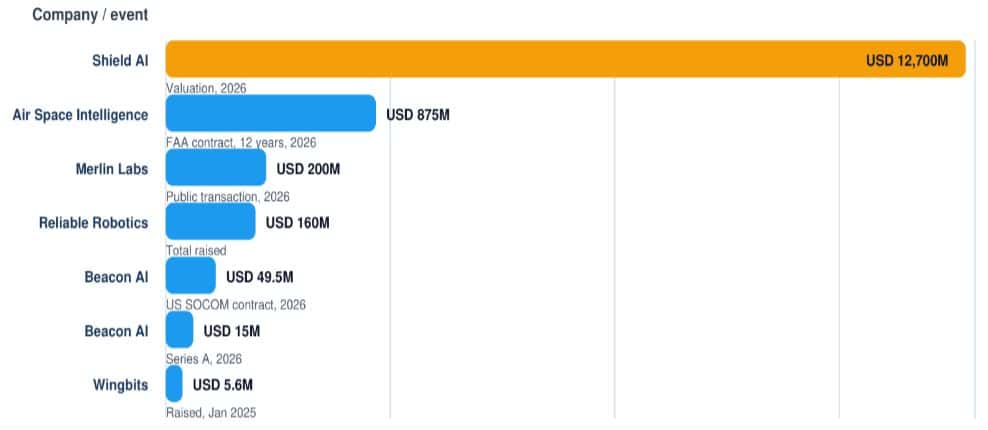
- Air Space Intelligence develops machine-learning tools that optimize flight routes and air-traffic operations through its Flyways platform. It won the FAA’s approximately USD 875 million, 12-year SMART air-traffic-management program in 2026.
- Beacon AI provides the Murdock AI cockpit copilot and the Lighthouse aviation data platform. The company raised USD 15 million in Series A funding and secured a USD 49.5 million U.S. SOCOM contract in 2026.
- Shield AI develops Hivemind, an autonomous AI pilot for defense aircraft. Its valuation reached approximately USD 12.7 billion after a funding round in 2026.
- Merlin Labs builds AI autopilot software for existing aircraft and went public in a transaction valued at approximately USD 200 million in 2026.
- Reliable Robotics develops automated flight-control systems and has raised approximately USD 160 million.
- Overwatch AI raised USD 1.5 million in pre-seed funding in 2026 and supports more than 30,000 flights per month.
- Wingbits operates a decentralized ADS-B receiver network and raised USD 5.6 million in January 2025.
AI and Digital Transformation in Aerospace Design
- Airbus’ SimulON solution has cut simulation and analysis time by 70%.
- More than 272,000 users have deployed Airbus’ Gemini AI app, involving nearly 66,000 employees.
- Airbus’ Skywise platform connects more than 12,000 aircraft and supports over 50,000 users worldwide.
- Airbus uses additive manufacturing to produce 32 door-latch shafts per A350, with redesigned parts that are 45% lighter than their forged counterparts.
- Airbus delivered 793 aircraft in 2025, compared with 766 in 2024, and had a backlog of 8,754 aircraft at year-end.
- Airbus forecasts 4.9% passenger-traffic growth in 2026.
AI Applications Improving Aviation Operations
- According to a report shared by Wifitalents, AI-driven predictive maintenance can reduce aircraft downtime by up to 20% and help avoid 30% of unplanned maintenance events.
- AI-based flight planning can reduce fuel use by 3%-5%.
- Meanwhile, optimized taxiing can lower ground fuel burn by 15%.
- AI can analyze 10,000 aircraft parameters in real time and predict hydraulic failures with 95% accuracy up to 50 hours ahead.
- AI-enabled ground handling can improve turnaround times by 12%.
- Moreover, cargo optimization can increase space use by 10%.
- Predictive analytics may extend component life by 15%, as per published aviation research.
- AI weather forecasting can reduce weather-related delays by 20%.
- 48% of airlines have deployed AI for flight operations management.
- AI drones can cut inspection time by 50%, while maintenance bots can handle 75% of routine technical queries.
- AI engine-washing schedules can save USD 20,000 per aircraft annually, while spare-parts optimization can reduce carrying costs by 20%.
- Thread in Motion reported that computer vision can achieve 99.9% accuracy in tool tracking.
- AI cabin monitoring can reduce false alarms by 40%.
- AI scheduling can reduce fatigue-related disruptions by 18%, and AI de-icing can cut glycol waste by 25%.
AI in Passenger Experience and Airport Services
- SITA reports that biometric processing can reduce boarding times by around 30%, and 55% of passengers are willing to share their biometric data.
- 65% of passengers prefer AI chatbots for booking changes, and personalized recommendations can increase conversions by 20%.
- AI baggage tracking can improve handling accuracy by 25%, while facial recognition can reach 99.5% accuracy.
- 80% of major airports plan to use AI robot assistants by 2030, while 40% of airlines use AI for lost-and-found matching.
- AI social media analysis can resolve complaints 40% faster, while AI queue management can cut peak security wait times by 10 minutes.
- Dynamic AI pricing can change fares up to 200 times a day, while AI duty-free recommendations can add USD 5 per passenger.
- AI re-accommodation tools can rebook 1,000 passengers in under 5 minutes.
- Translation tools support more than 25 languages.
- AI entertainment can increase satisfaction by 12%, while AI lounge management can reduce food-service wait times by 15%.
AI for Aviation Safety, Security and Ethics
- AI security scanners can improve prohibited-item detection by 30%, and AI X-ray systems can cut false positives by 50%.
- AI threat detection could mitigate 92% of aviation cyberattacks.
- Meanwhile, 60% of aviation IT teams prioritize AI cybersecurity investments over the next 3 years.
- Machine learning can predict pilot micro-sleep with 90% accuracy and identify safety trends 3 times faster.
- AI-based FOD detection can reduce inspection time by 80%, while AI bird-strike systems can cut incidents by 15%.
- 75% of aviation leaders support ethical AI guidelines for autonomous flight.
- AI border systems could reduce identity fraud by 20%, and facial recognition is used at 1 in 5 airports.
- AI weight-and-balance systems can reduce manual errors by 99%, while black-box analysis can be up to 10 times faster.
- ACAS X could reduce the risk of mid-air collisions by 40%, while AI refueling sensors can achieve 99.99% reliability.
AI’s Impact on Predictive Aircraft Maintenance
(Source: gitnux.org)
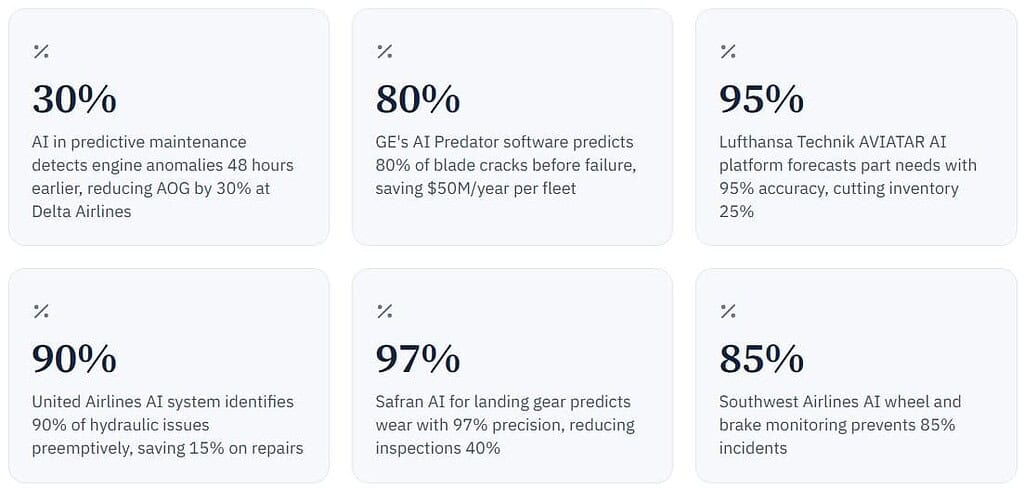
- AI-driven predictive maintenance can detect engine anomalies 48 hours earlier, reportedly reducing aircraft-on-ground events by 30% at Delta Air Lines.
- GE’s AI system reportedly predicts 80% of blade cracks before failure, with potential fleet savings of USD 50 million annually.
- Lufthansa Technik’s AVIATAR platform forecasts parts needs with 95% accuracy and can reduce inventory by 25%.
- United Airlines’ AI system reportedly identifies 90% of hydraulic issues early, reducing repair costs by 15%.
- Safran’s AI landing-gear system predicts wear with 97% accuracy and can reduce inspection frequency by 40%.
- Southwest Airlines’ AI wheel and brake monitoring reportedly prevents 85% of related incidents.
Summary
AI is becoming a key part of modern aviation. Airlines and airports are using it to spot maintenance problems early, manage flights, reduce delays, and improve passenger services. At the same time, AI can help aviation companies save time and make better use of their resources.
Its growth also brings challenges around data security, safety, and workforce skills. With the right safeguards and human oversight, AI can support smoother operations and improve the overall air travel experience.
FAQ
AI improves flight safety by predicting equipment failures, detecting risks, optimizing routes, and supporting pilots during critical situations.
AI predicts equipment failures, detects faults early, and helps technicians plan timely aircraft maintenance.
AI improves passenger experience through personalized services, faster support, smoother check-ins, and real-time travel updates.