









Brief Introduction
Embodied AI Statistics: Embodied AI is technology that lets machines see, think, and act in the real world, from robots to self-driving vehicles. You might ask why it’s important; well, because AI is no longer limited to screens.
It now works in factories, warehouses, and hospitals, where it speeds up work, lowers risks, and helps cover labor shortages, while pushing companies to update their workflows, skills, and safety rules. Continue reading for more insightful stats.
Editor’s Key Choices
- Embodied AI could hit USD 25.07 billion by 2032.
- China closed 322 embodied AI deals in the first half of 2026, raising USD 14.01 billion.
- Just two companies, AGIBOT and Unitree, took 75% of about 19,100 humanoid robot shipments.
- In 2025, 84% of humanoid robots were used for research, education, entertainment, or data collection.
- 79% of surveyed organizations engage with physical AI, but only 4% run it at large scale.
- One humanoid robot costs about USD 43,000 to build, with an estimated selling price of USD 55,000.
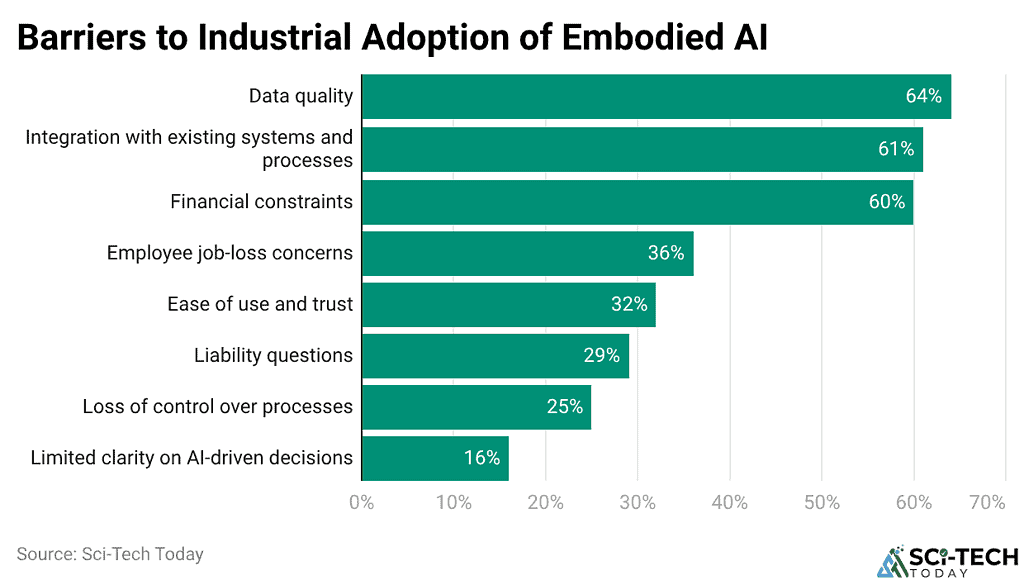
- Data quality is the top roadblock: 64% of industrial respondents say it slows embodied AI adoption.
- Consumers are not sold yet: 40% are negative, 33% are positive, and the Net Promoter Score is −68.
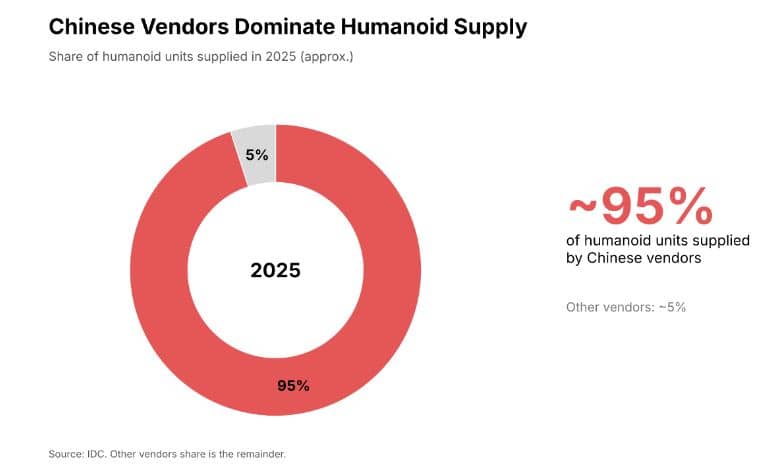
- Chinese vendors supplied about 95% of all humanoid robot units in 2025, according to IDC.
- Businesses expect big gains: 72% want higher efficiency, and 70% want lower operating costs.
Country-wise Embodied AI Funding
Europe
- The EU AI Act applies fully from August 2026, while Machinery Regulation 2023/1230 takes effect in January 2027.
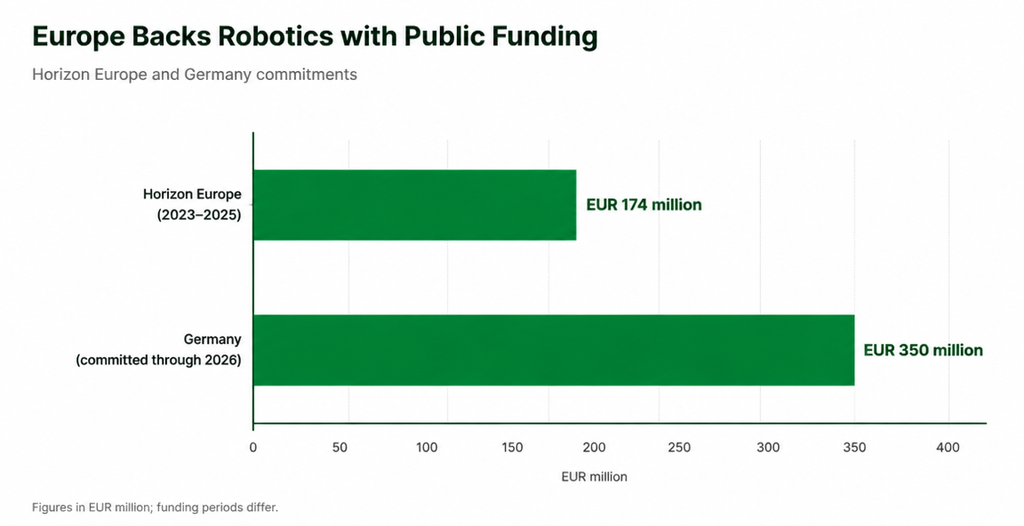
- Horizon Europe allocated EUR 174 million for robotics during 2023–2025, while Germany committed another EUR 350 million through 2026.
Japan
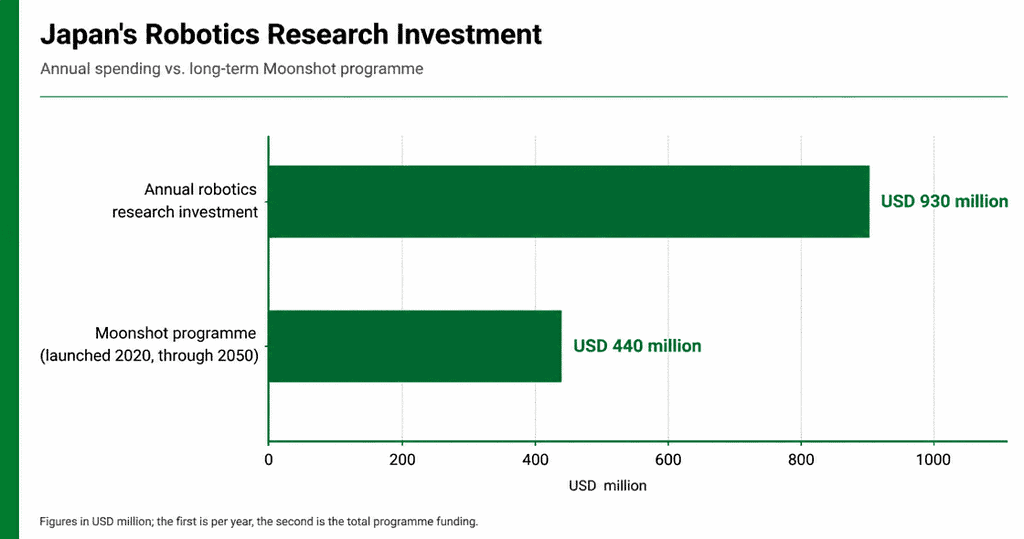
- Japan invests around USD 930 million annually in robotics research.
- Launched in 2020, Japan’s Moonshot programme provides USD 440 million through 2050 for AI and autonomous robots.
- FANUC’s ROS 2 driver and Yaskawa’s MOTOMAN NEXT-NHC 10DE show how manufacturers are advancing robot capabilities.
South Korea
- Building on its 2008 robotics law, South Korea’s 4th Basic Plan commits approximately USD 2.2 billion during 2024–2028.
- Hyundai’s 2021 acquisition of Boston Dynamics helped drive further robotics investment and research.
Global Humanoid Robot Shipments Insights
| Category | Company or metric | Share or details |
| Shipment share | AGIBOT | 44% |
| Shipment share | Unitree | 31% |
| Shipment share | Galbot | 5% |
| Shipment share | UBTECH | 4% |
| Shipment share | Leju | 3% |
| Shipment share | Others | 13% |
| Shipment share | Total | 100% |
| Shipment volume | Total reported shipments | Approximately 19,100 units |
| Shipment volume | Sum of listed vendor volumes | Approximately 19,000 units |
| Measurement | Basis of comparison | Shipment units, not revenue, installed robots or the wider embodied AI market |
What Are the Key Trends Driving Robot Orders Across Industries?
- Food and consumer goods took the lead in robot orders with a 105% jump, well ahead of automotive manufacturers at 68%.
- Metals grew 11%, and all other industries together grew 8%.
- Semiconductors, electronics and photonics barely moved, up just 1%.
- Life sciences, pharma and biomedical orders fell 14%.
- Automotive components dropped 25%, while plastics and rubber took the biggest hit at 35%.
- A3’s data shows demand is far from even. Food and consumer goods are racing ahead of the auto sector.
| Industry | Year-on-year change in robot orders, Q3 2025 |
| Food and consumer goods | +105% |
| Automotive manufacturers | +68% |
| Metals | +11% |
| All other industries | +8% |
| Semiconductors, electronics and photonics | +1% |
| Life sciences, pharmaceuticals and biomedical | −14% |
| Automotive components | −25% |
| Plastics and rubber | −35% |
Global Adoption of Physical AI
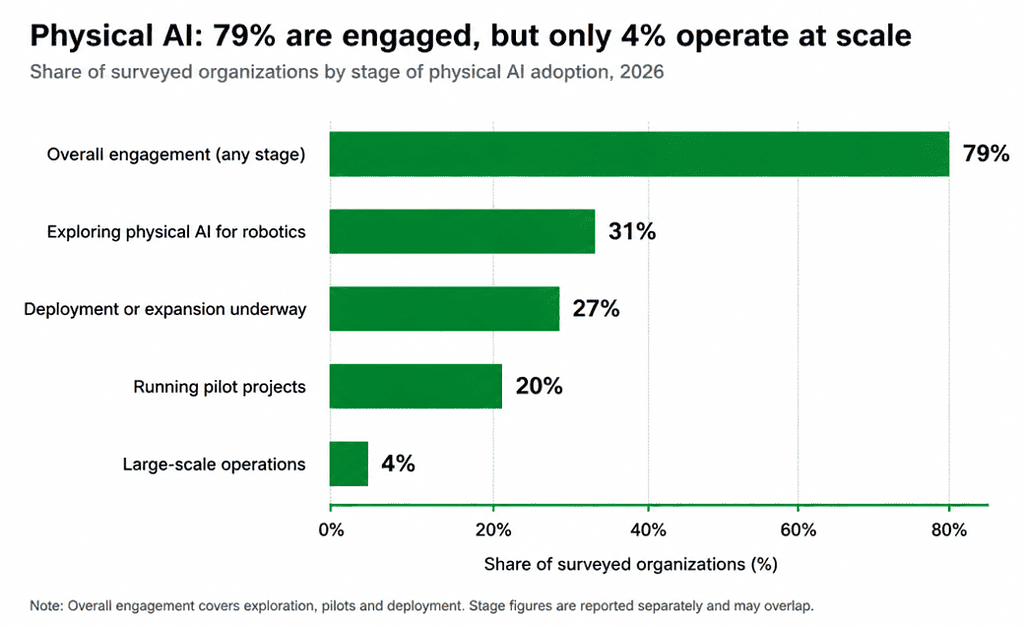
- Physical AI engagement reached 79% of surveyed organizations in 2026, covering exploration, pilots, and deployment rather than production use alone.
- Early-stage activity remained common, with 31% of surveyed organizations exploring physical AI for robotics and 20% running pilot projects.
- Physical AI deployment or expansion was underway at 27% of surveyed organizations, marking progress beyond exploration and pilots.
- Large-scale physical AI operations remained limited, with only 4% of surveyed organizations reaching this stage.
- Broader physical AI use reached 58% of surveyed companies, including limited use, making it different from the 27% robotics deployment figure.
- Moderate or greater physical AI use was reported by 18% of surveyed companies, showing that deeper adoption remained limited.
Global Embodied AI Industry Growth Insights
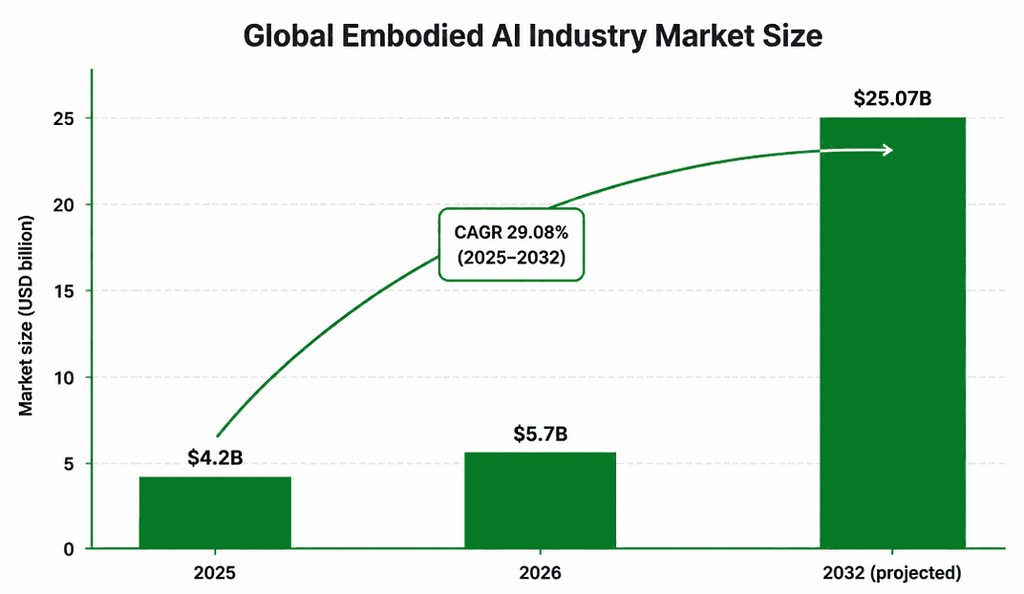
- According to Sci Tech Today, the global embodied AI industry grew from USD 4.2 billion in 2025 to USD 5.7 billion in 2026.
- However, by 2032, the industry is set to reach USD 25.07 billion, representing a 29.08% CAGR from 2025 to 2032.
Global Embodied AI Market by Segmentation
| Segmentation basis | Segment | Scope and role |
| Component | Hardware | This segment includes robots, sensors, cameras, processors, and motion-control systems that enable machines to interact with their surroundings. |
| Component | Software | This segment includes AI models and programs that support perception, task planning, decision-making, and movement control. |
| Component | Services | This segment includes integration, customization, deployment, training, and maintenance that support practical implementation. |
| Application | Perception | These applications help machines recognize objects, people, and physical surroundings using sensors, cameras, and computer vision. |
| Application | Planning and control | These applications help machines select actions, plan tasks, and control physical movements. |
| Application | Human interaction | These applications help robots respond to people and operate in shared environments. |
| Application | Training and simulation | These applications support the development and testing of machine behavior before real-world deployment. |
| End-use industry | Manufacturing | Applications include robotic guidance, automated material handling, and quality inspection. |
| End-use industry | Logistics | Applications include the robotic movement, sorting, and handling of goods. |
| End-use industry | Security and inspection | Applications include monitoring environments, identifying problems, and conducting physical inspections. |
Growth Rate of Embodied AI Industry in the US
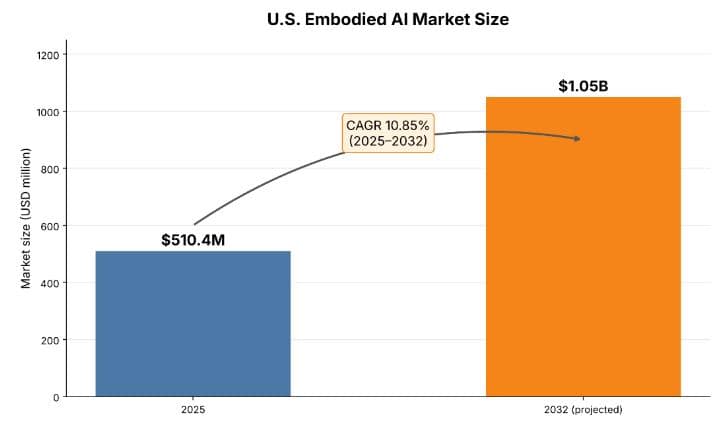
- The U.S. Embodied AI market grows from USD 510.4 million in 2025 to USD 1.05 billion by 2032, achieving 10.85% CAGR.
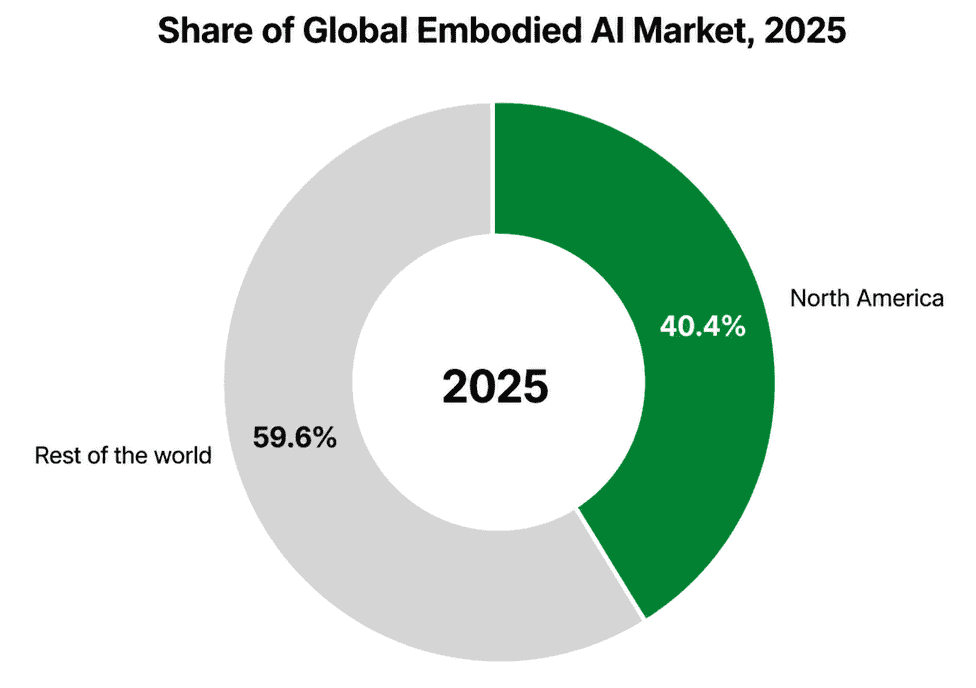
- North America accounts for 40.4% of the global Embodied AI market in 2025.
Embodied AI Funding Deals in 2026
| Company | Timing | Funding amount | Funding round | Main purpose |
| Skild AI | January 2026 | USD 1.4 billion | Series C | Develop Skild Brain to work across different robots and tasks. |
| NEURA Robotics, Germany | June | Up to USD 1.4 billion | Series C | Support NEURAverse, NEURA Gyms, large-scale robot production, and global deployment. |
China Leading the Embodied AI Funding Race

- According to IT Juzi, China recorded 322 embodied AI funding deals in the first half of 2026, raising USD 14.01 billion.
- Funding reached about 5 times the first-half 2025 total, while the number of funding rounds rose 137% year on year.
- Seed, angel, and pre-Series A rounds made up 58.94% of all deals, highlighting strong early-stage activity.
- Growth-stage rounds, from Series A to Series B+, attracted more than 40% of total funding.
- The top 20 companies secured about USD 14.01 billion, capturing 59% of total funding.
- Humanoid robot companies raised about USD 4.72 billion, while embodied AI “brain” developers attracted about USD 2.17 billion.
- Core-component companies secured a further USD 2.17 billion.
How High Costs are Slowing Down Robot Adoption?
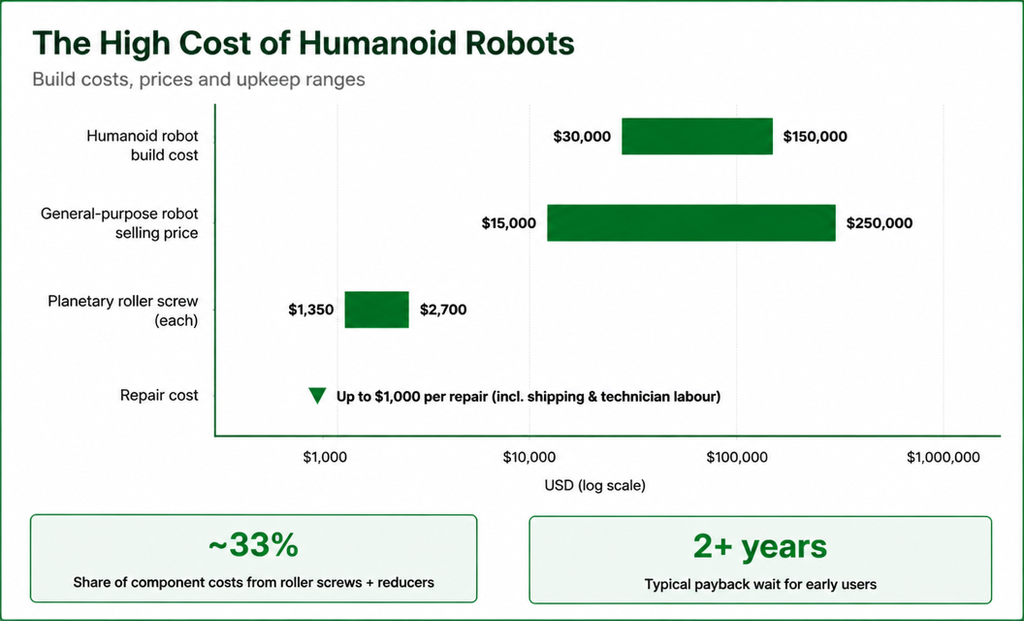
- Building a humanoid robot costs USD 30,000–USD 150,000, depending on its design and materials.
- At USD 1,350–USD 2,700 each, planetary roller screws are expensive; combined with reducers, they represent around 33% of component costs.
- General-purpose robots sell for roughly USD 15,000–USD 250,000, while early users often wait more than 2 years to recover their investment.
- Repairs can cost up to USD 1,000 each, including shipping and technician labour, with downtime adding further costs.
Difference Between Physical Labour Automation and Humanoid Robots
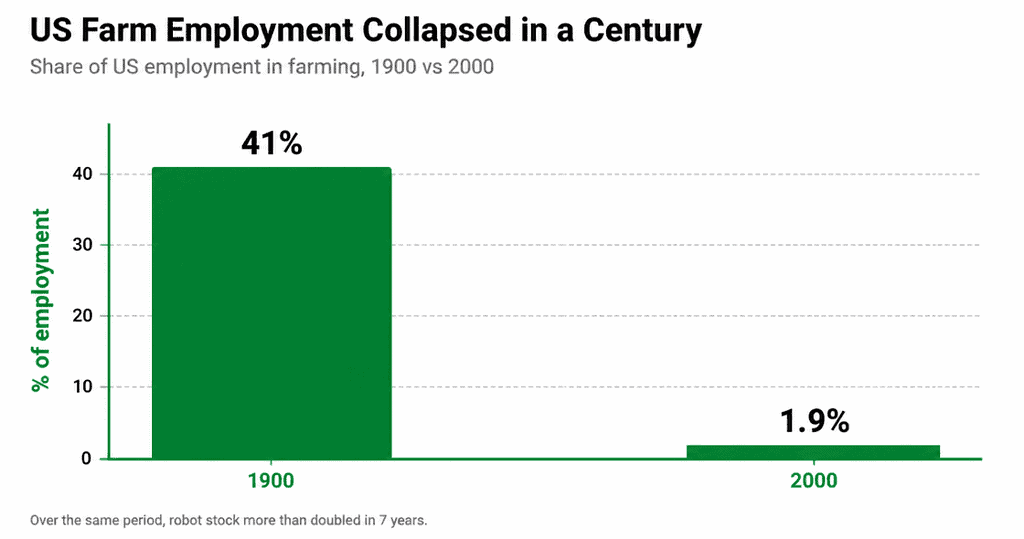
- US farm employment dropped from 41% to 1.9% during 1900–2000, while robot stock more than doubled in 7 years.
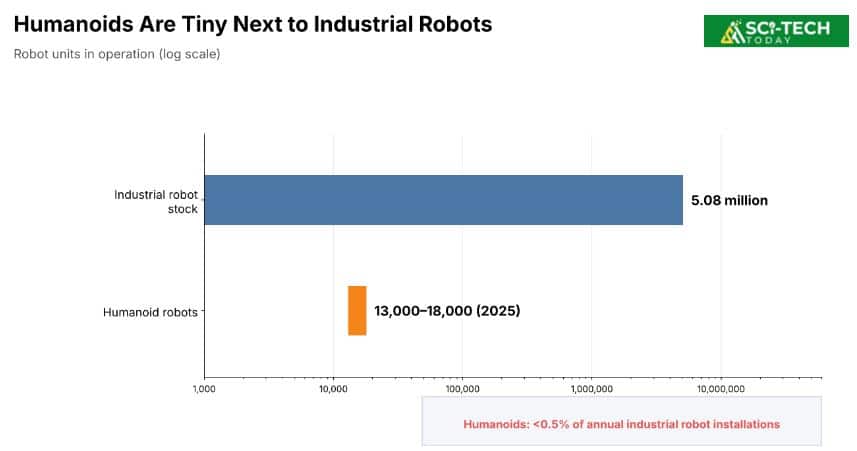
- Humanoid robots numbered 13,000–18,000 units in 2025, mostly serving non-productive purposes rather than demonstrating lasting economic change.
- Physical labour automation has evolved for over a century, while humanoid robots have roughly 3 years of commercial activity.
- Industrial robot stock reached 5.08 million units, while humanoid robots represented less than 0.5% of annual industrial robot installations.
- Automation already influences the economy, labour, trade, and energy, while humanoid robots’ impact across these areas remains largely prospective.
- Automation’s global impact is concentrated in Asia, while Chinese vendors supplied approximately 95% of humanoid units in 2025, according to IDC.
Share of Humanoid Robot Use by Applications
- Research, education, entertainment, and data collection accounted for 84% of humanoid robot units in 2025, while other uses represented 16%.
- Research-related applications represented 69% of humanoid robot units in the first half of 2026, while other uses accounted for 31%.
- A separate first-half 2026 estimate placed research-related uses at 63%, service and guidance at 19%, and manufacturing at 13%.
- Warehousing and logistics accounted for the remaining 5% in that breakdown, calculated by subtracting the other application shares from 100%.
- The 63% research-related share was calculated as the remainder, while the original estimate described this category as above 60%.
How Are Industrial Organizations Planning to Adopt Embodied AI?
- Plans to introduce embodied AI were reported by 73% of surveyed industrial organizations, highlighting strong interest in future adoption.
- Embodied AI testing was underway at 12% of surveyed organizations, marking a move from planning to practical trials.
- No plans to introduce embodied AI were reported by 15% of surveyed organizations.
- Planning or testing activities involved 85% of surveyed organizations, showing broad interest without confirming full-scale deployment.
| Adoption stage | Share of surveyed organizations |
| Implementation planned | 73% |
| Technology testing underway | 12% |
| No implementation planned | 15% |
| Combined planning or testing | 85% |
What Benefits Do Businesses Expect from Embodied AI?
- Higher efficiency ranked as the leading expected benefit of embodied AI, cited by 72% of respondents.
- Lower operating costs followed closely, with 70% of respondents expecting embodied AI to help reduce expenses.
- Better quality emerged as an expected benefit for 49% of respondents.
- Greater operational flexibility was anticipated by 29% of respondents.
- Stronger knowledge management was identified as a potential benefit by 22% of respondents.
- Improved workplace safety was expected by 21% of respondents, ranking last among the listed benefits.
Barriers to Industrial Adoption of Embodied AI
- Readiness remained uneven despite strong interest, with many organizations only moderately prepared to adapt systems and processes for humanoid robots.
- Data quality emerged as the leading reported barrier to embodied AI adoption, cited by 64% of respondents.
- Connecting embodied AI with existing systems and processes presented a challenge for 61% of respondents.
- Financial constraints stood out as a major adoption barrier, highlighted by 60% of organizations.
- Employee concerns about job losses were anticipated by 36% of respondents, making workforce acceptance an important issue.
- Concerns about ease of use and trust were expected by 32% of respondents.
- Questions about liability created another adoption barrier, identified by 29% of respondents.
- Losing control over processes concerned 25% of respondents as machines gained greater autonomy.
- Limited clarity around AI-driven decisions was flagged by 16% of respondents.
Cost of Industrial Humanoid Robots
- Standardized designs and larger production volumes could lower future costs toward USD 55,000 per robot, supporting wider industrial adoption.
- Control and AI learning software carries an estimated cost of USD 3,900 per robot.
- IT hardware and chips add an estimated USD 2,700 to each robot’s cost.
- Sensors account for an estimated USD 7,400 per robot.
- Body parts contribute an estimated USD 1,000 to the overall cost.
- Navigation equipment, including cameras, LiDAR, and radar, costs an estimated USD 2,700 per robot.
- Precision servomotors for joint movement add an estimated USD 5,500 per robot.
- Batteries and self-charging systems represent an estimated USD 900 per robot.
- Motors and transmission systems lead component spending, with an estimated cost of USD 18,900 per robot.
- Combined hardware and software costs total approximately USD 43,000 per robot.
- Research and development costs and profit margins bring the estimated selling price to approximately USD 55,000 per robot.
| Component | Estimated cost per robot |
| Control and AI learning software | USD 3,900 |
| IT hardware and chips | USD 2,700 |
| Sensors | USD 7,400 |
| Body parts | USD 1,000 |
| Navigation equipment, including cameras, LiDAR, and radar | USD 2,700 |
| Precision servomotors for joint movement | USD 5,500 |
| Battery and self-charging system | USD 900 |
| Motors and transmission systems | USD 18,900 |
| Approximate hardware and software subtotal | USD 43,000 |
| Approximate selling price, including research and development costs and profit margins | USD 55,000 |
Consumer Views on Embodied AI
- Positive views were reported by 33% of consumers, while 40% were negative and 27% were neutral towards embodied AI.
- Only 10% were promoters, compared with 78% who were detractors, resulting in a Net Promoter Score of −68.
- Regular interaction with humanoid robots was reported by 7% of respondents, showing that direct experience remained uncommon.
- Among regular users, 88% reported positive experiences. However, this does not prove that interaction alone improved their opinions.
- Average purchase intent was reported at 36%, compared with 28% among respondents who had never used a robot.
- Purchase intent among respondents with personal experience was described as almost 3 times higher, although an exact figure was not provided.
Recent Embodied AI Developments
- China’s November 2026 prohibition affected the Chinese portion of SoftBank’s proposed USD 5.375 billion ABB robotics acquisition, announced in October 2025.
- Figure and Nscale’s 2026 compute commitments reached USD 3.5 billion, potentially exceeding USD 6 billion, targeting 100,000 GPUs from late 2027.
- NVIDIA’s July 2026 Cosmos 3 Edge launch introduced a 4-billion-parameter model for on-device visual reasoning and robot-action generation.
- SoftBank led Skild AI’s January 2026 funding round of nearly USD 1.4 billion, pushing its valuation above USD 14 billion.
- NVIDIA’s January 2026 Hugging Face collaboration connected its 2 million robotics developers with Hugging Face’s 13 million AI builders.
- October 2025 saw 1X launch USD 20,000 NEO preorders, targeting 2026 deliveries; a USD 499/month subscription was planned.
- Figure’s September 2025 Brookfield partnership targeted humanoid deployment across a portfolio exceeding USD 1 trillion, including 100,000 managed residences.
- With September 2025 Series C commitments exceeding USD 1 billion, Figure secured a USD 39 billion valuation to scale commercialization.
Summary
Embodied AI is moving from experimentation toward commercial scale, with the global industry projected to expand rapidly through the forecast period. China leads funding, and Chinese vendors supply most humanoid units.
Adoption remains early: most humanoids serve research purposes, costs stay high, and data quality, integration, and budgets block industrial rollout. Consumer sentiment is weak, so wider growth depends on lower costs and proven practical use.
FAQ
Embodied AI gives machines the ability to sense their surroundings, make decisions, and act in the physical world. Examples include robots that handle objects and autonomous vehicles that navigate roads.
Generative AI typically produces digital content, such as text or images. Embodied AI connects intelligence with sensors and physical controls, enabling machines to move, manipulate objects, and respond to their surroundings. The technologies can work together.
Embodied AI combines sensor data, AI models, and mechanical controls in a continuous feedback loop. A machine observes its environment, selects an action, carries it out, and uses the resulting feedback to guide its next action.
Applications include warehouse robots transporting goods, industrial robots handling materials, and autonomous vehicles navigating traffic. Businesses use these capabilities to automate physical tasks and improve operational flexibility, although deployment requirements vary by environment.
Key challenges include operating safely around people, handling unfamiliar situations, integrating hardware with AI, and transferring simulated training into real environments. Reliable deployment requires rigorous testing because physical errors can damage equipment or cause injury.


