








Opening Statement
Drone Chips Statistics: Drone chips are small electronic parts that help a drone fly, see, and make decisions. They include flight controllers, main processors, AI chips, camera processors, communication chips, and power management chips. Each one must be light, use little energy, and stay cool. Without these chips, a drone cannot fly steadily or work on its own.
Drone chips are used in consumer products, military systems, and industrial work. Demand is growing because drones now need to avoid obstacles, build maps, and study video directly on the device, without waiting for a human pilot. Chip makers compete on speed, low power use, and how many functions they can fit on one chip. Buyers look at price, reliability, and steady supply. This report examines the drone chip industry through these factors.
What Caught the Editor’s Eye
- Ukraine recorded 270 STMicroelectronics component entries across recovered Russian drones, missiles, and electronic-warfare systems by May 2026.
- The Geran-5 K5-K teardown identified 23 Texas Instruments components, including two digital signal processors.
- India imported an estimated 80 to 90% of drone flight controllers, per November 2026 reporting.
- The drone chips market is projected to reach USD 9.3 billion by 2033 at a 7.4% CAGR.
- Qualcomm’s Dragonwing Q-8750 offers 77 TOPS, 12-camera support, and triple 48MP image signal processors for drones.
- Ambarella’s 4nm CV7 delivers 20% lower power consumption and over 2.5 times the AI performance of CV5.
- TDK ICM-42688-P price falls from USD 4.67 individually to USD 2.94960 per chip at 5,000 units.
- NeutronRC lists its AT32F435 flight controller at USD 32.49, versus USD 99.00 for ZEXFPV’s STM32H743 model.
- STMicroelectronics’ VL53L9 delivers 2.3K zones at 100 frames per second across a 5 centimeter to 9 meter range.
Drone Chips and Components
- November 2026 reporting estimated India imported 80–90% of drone flight controllers; these measures import dependence, not chip shipments.
- The same 2026 report estimated 90–95% import dependence for drone GNSS modules, not individual navigation-chip shipments.
- By May 2026, Ukraine recorded 270 STMicroelectronics component entries across recovered Russian drones, missiles, and electronic-warfare systems.
- More than half those 270 entries involved STM32 microcontrollers; the 2026 investigation did not establish shipment volumes.
- A November 9, 2026 Geran-5 K5-K teardown identified 23 Texas Instruments components, including regulators, transceivers, and two signal processors.
Drone Chips by Drone Type
- Multirotors: A September 2026 guide lists Cube Orange+ supporting 3–8 motors, using STM32H757 and 1 MB RAM.
- Fixed-wing drones: The same 2026 guide lists Cube Orange+ compatibility, retaining its STM32H757 processor and 1 MB RAM.
- VTOL drones: Cube Orange+ also supports this category; its 2026-listed configuration includes an STM32H757 and triple-redundant inertial sensors.
- Gerbera-2 strike drones: November 2026 reporting identifies STM32F407 microcontrollers and u-blox M8030-KT receivers among 22 foreign-component entries.
- Original Geran-5 jet attack drones: A January 2026 teardown identified six Texas Instruments chips and 2024–2025-manufactured CTS oscillators.
- Geran-4 jet attack drones: September 2026 reporting identifies TI LM5176, LM5117, LM258 chips, plus Micron memory and Infineon transistors.
- Geran-5 K5-K jet attack drones: November 2026 reporting counts 23 Texas Instruments components, including two digital signal processors.
- Geran-5 K5-K: The November 2026 teardown additionally identifies seven STMicroelectronics microcontrollers, one voltage regulator, and two u-blox navigation modules.
- Geran-5 K5-K: Three CTS oscillators carry date codes 2517, 2539, and 2603, indicating production through January 2026.
Consumer Drone Chips Statistics
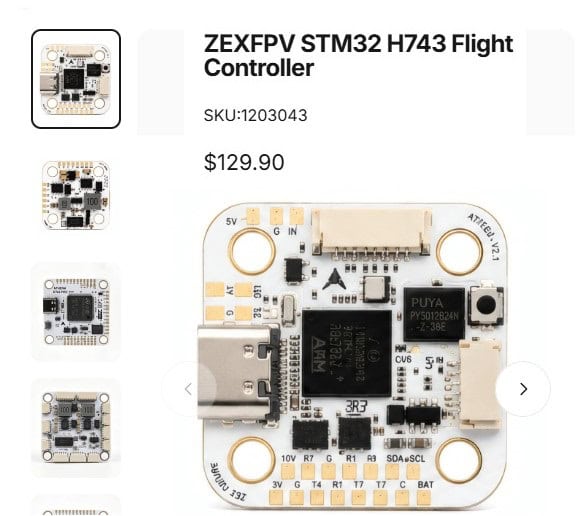
- ZEXFPV’s 2026-listed H743 controllers use STM32H743 processors running at 480 MHz for racing, freestyle, and cinematic drones.
- ZEXFPV’s H743 MINI incorporates two ICM42688-P inertial sensors and 16 MB Winbond flash for flight-data logging.
- ZEXFPV lists complete H743 controllers at USD 99.00, MINI at USD 129.90, and PRO at USD 119.00.
- NewBeeDrone’s 2026-listed Hummingbird 255 uses an AT32F435CGU7 microcontroller operating at 288 MHz for consumer FPV builds.
- Hummingbird 255 targets 2.5–4-inch FPV drones, integrating its AT32F435 controller with 50 A continuous-current motor-control electronics.
- Hummingbird 255 supports 60 A burst current and 3–6S batteries; these describe integrated-controller capabilities, not standalone-chip ratings.
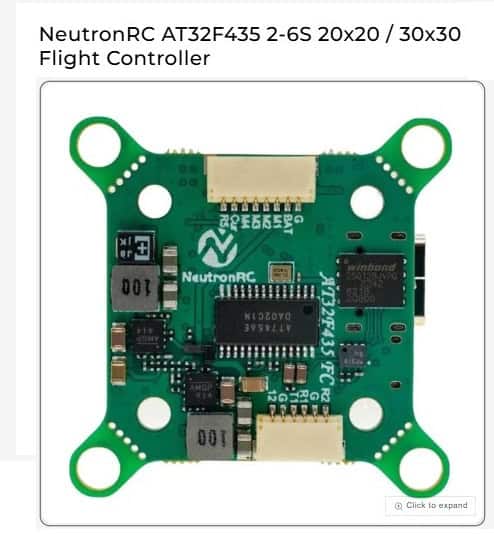
- NeutronRC’s November 2026-listed AT32F435 flight controller specifies a 288 MHz processor and 1 MB flash memory.
- NeutronRC lists its complete AT32F435 flight controller at USD 32.49, supporting 2–6S batteries and Betaflight firmware.
Drone Chips Market Growth
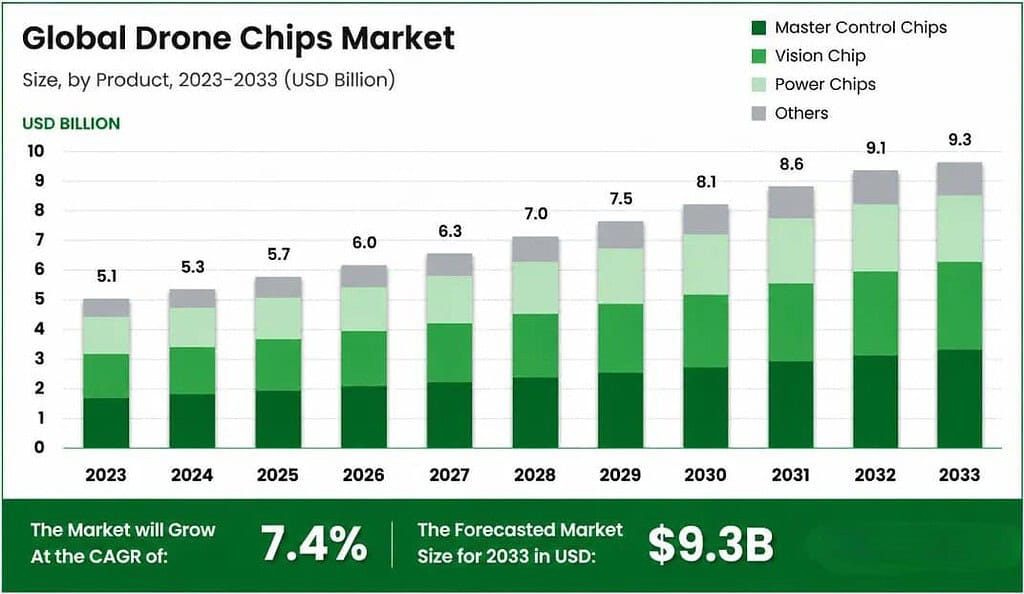
- The global drone chips market covers master control chips, vision chips, power chips, and other products, with a reported compound annual growth rate (CAGR) of 7.4%.
- The market was valued at USD 5.7 billion in 2025 and USD 6.0 billion in 2026, with its value projected to reach USD 6.3 billion in 2027.
- The market is projected to increase to USD 9.3 billion by 2033, with master control chips remaining the largest product category.
Military and Defense Drone Chips Statistics
- November 2026 reporting identified 93 foreign electronic components in Russia’s Geran-5 K5-K; these are teardown counts, not shipments.
- Texas Instruments’ Geran-5 K5-K components included two digital signal processors, alongside voltage regulators and CAN-bus transceivers.
- The November 2026 Geran-5 K5-K teardown identified seven STMicroelectronics microcontrollers and one STMicroelectronics voltage regulator.
- Geran-5 K5-K contained two u-blox satellite-navigation modules, according to the November 2026 component assessment.
- Three CTS oscillators carried codes 2517, 2539, and 2603, indicating manufacturing dates spanning April 2025–January 2026.
- The original Geran-5’s January 2026 teardown identified six Texas Instruments chips, versus 23 components in November’s K5-K assessment.
- Ukraine’s November 2, 2026 Gerbera-2 database entry identified an STMicroelectronics STM32F407 microcontroller in the drone’s flight controller.
- Gerbera-2’s November 2026 assessment listed 22 foreign components; origins remained unidentified for two, including an AIME1 memory chip.
Sensor and Camera Chip Statistics for Drones
| Drone sensor or camera | Numeric information |
| BETAFPV Matrix 1S sensor change | BMI270-equipped 3IN1 flight controllers began shipping January 5, 2026. |
| Matrix 1S gyroscope sampling | ICM42688P configurations support 8 kHz maximum sampling; the BMI270 configuration supports 3.2 kHz. |
| Matrix 1S sensor firmware | BMI270-specific firmware documentation identifies Betaflight version 2026.6.1. |
| Bosch BMI270 sensing architecture | Six-axis IMU combines a three-axis accelerometer and three-axis gyroscope, both with 16-bit resolution. |
| Bosch BMI270 measurement ranges | Acceleration ranges: ±2, ±4, ±8, and ±16 g; gyroscope ranges extend from ±125 to ±2,000 degrees/second. |
| Bosch BMI270 electrical and package specifications | Typical current: 685 µA; package dimensions: 2.5 × 3.0 × 0.83 mm, with 14 contacts. |
| TDK ICM-42688-P gyroscope | Maximum gyroscope output rate: 8 kHz; noise density: 2.8 millidegrees/second/√Hz. |
| BETAFPV C03 drone camera sensor | 1/3-inch CMOS sensor; camera output rated at 1,200 TVL, with a 4:3 image ratio. |
| Sony ILX-LR1 imaging sensor | Full-frame, back-illuminated Exmor R CMOS sensor provides approximately 61.0 million effective pixels. |
Drone Chips Pricing and Cost Insights
- STM32H743VIT6 pricing falls to USD 14.084 each for 10 units and USD 11.37293 each for 450 units.
- TDK ICM-42688-P inertial sensors cost USD 4.67 individually, USD 4.014 each at 10, and USD 3.52060 at 100.
- At 5,000 units, ICM-42688-P pricing reaches USD 2.94960 per chip, totaling USD 14,748 per reel.
- Digi-Reel packaging adds USD 7.00 per order for ICM-42688-P purchases, separate from listed sensor prices.
- The EV_ICM-42688-P evaluation board costs USD 32.45 individually; this is development hardware, not a standalone sensor chip.
- The DK-42688-P development kit costs USD 122.32 individually, falling to USD 104.32260 each for 50 kits.
Recent Drone Chips Statistics
- On November 9, 2026, NXP launched its unified robotics platform, combining drone reference designs and software to enable initial functionality within 30 minutes.
- On October 12, 2026, ModalAI released VOXL SDK 1.8.0, providing software builds for VOXL 2, VOXL 2 Mini, VRX, and QCS6490 platforms.
- On June 22, 2026, STMicroelectronics introduced VL53L9 sensing technology, delivering 2.3K zones, 100 frames/second, a 5-centimeter–9-meter range, and up to 1% accuracy.
- On January 5, 2026, Qualcomm introduced drone-targeted Dragonwing Q-8750, offering 77 TOPS, 12-camera support, triple 48MP ISPs, and models up to 11-billion parameters.
- On January 5, 2026, Ambarella launched drone-capable 4nm CV7, delivering 20% lower power consumption, over 2.5× AI performance, and 2× encoding performance versus CV5.
- On December 22, 2025, Ambarella announced Antigravity A1’s deployment of its CV5 chip, combining 8K, 360-degree imaging with onboard AI inference.
- On October 7, 2025, NXP announced that its Trimension SR150 ultra-wideband chip enabled precise positioning for Jedsy X medical-delivery drones.
- On February 25, 2025, Qualcomm introduced Dragonwing, consolidating industrial computing, AI, and connectivity offerings for applications including drones under 1 brand portfolio.
Closing Statement
Drone chips now power flight, vision, and autonomy across consumer, industrial, and military use. The market is projected to grow steadily, and master control chips remain the largest category.
Consumer flight controllers are available at accessible prices, while new AI chips from Qualcomm and Ambarella raise onboard processing power. Teardowns of Russian drones and heavy import dependence in India keep supply chain risk a central concern for buyers and manufacturers.
FAQ
Drones use several chips working together: a microcontroller or processor for flight control, an inertial measurement unit with gyroscope and accelerometer for orientation, a GNSS module for positioning, a radio chip for communication, and electronic speed controller chips for the motors. Camera-equipped models add image signal processors and sometimes AI accelerators.
Major suppliers include Qualcomm, which offers the Flight RB5 platform; NVIDIA, whose Jetson modules handle onboard AI; and STMicroelectronics, whose STM32 microcontrollers are common in-flight controllers. NXP and Ambarella also supply processors and vision chips for drone and robotics applications.
Basic flying does not require an AI chip, since standard flight controllers handle stabilization. AI chips become useful for obstacle avoidance, object tracking, autonomous navigation and real-time image analysis, where the drone must process camera data onboard instead of relying on a remote operator or cloud connection.
Key factors include processing power, power consumption, weight, size, and supported sensors and interfaces. Power efficiency is especially important because lower draw extends flight time. Developers also check software support, such as compatibility with PX4 or ArduPilot, along with reliability under vibration and temperature extremes.
Every chip draws power from the same battery that spins the motors. Efficient processors reduce electrical load and heat, leaving more energy for flight, while heavier AI modules add both power draw and weight. Motors, propellers, and battery capacity usually account for the largest share of consumption

Sources


