








Opening
Social Anxiety Disorder Statistics: Do social situations make you feel scared, nervous, or worried about being judged? If these feelings are strong and happen often, you may be dealing with Social Anxiety Disorder (SAD). It is more than simple shyness. People with SAD may avoid talking to others, speaking in public, attending social events, or even making eye contact because they fear embarrassment or rejection. This condition can affect school, work, relationships, and everyday life.
The good news is that Social Anxiety Disorder is treatable. With the right support, therapy, and healthy coping skills, people can manage their anxiety, build confidence, and enjoy a happier, more connected life.
Featured Choice
- 7.1% of U.S. adults experienced social anxiety disorder (SAD) in the past year, while 12.1% will develop it at some point in their lifetime.
- Social anxiety disorder affects an estimated 203 million people worldwide and about 15 million people in the United States.
- Nearly 1 in 10 U.S. teenagers and adults experience social anxiety, with adolescents showing a prevalence of 9.1%.
- Women are more likely to experience SAD than men, with 8.0% of adult females affected compared to 6.1% of adult males.
- Around 60% of people with SAD report significant daily impairment, and 50% miss work or school because of their symptoms.
- Major depressive disorder is the most common co-occurring condition, affecting 30%-40% of people with social anxiety disorder.
- Only 10%-15% of people with SAD receive treatment, despite CBT showing a 60%-70% success rate.
- Depression and anxiety contribute to the loss of 12 billion working days globally each year, resulting in nearly USD 1 trillion in annual productivity losses.
- Workplace social anxiety costs the U.S. economy more than USD 238 billion annually through reduced productivity and higher health care expenses.
- The global anxiety disorders treatment market is projected to exceed USD 12.77 billion by 2026.
Key Social Anxiety Disorder Statistics
- Around 7.1% of U.S. adults experienced social anxiety disorder during the past year, while 12.1% are expected to develop the condition at some point in their lifetime.
- National Library of Medicine estimates that SAD affects 8.3% of adolescents and up to 17% of young adults in some study groups.
- According to psychiatry.org, in the U.S., nearly 1 in 10 teenagers and adults experience social anxiety.
- Among adolescents aged 13-17 years, the condition affects about 11% of females and 6% of males.
- Overall, anxiety disorders affect an estimated 4.4% of the global population, with SAD being one of the most common types, as per the World Health Organization.
- A report published by Towards Healthcare estimated that the global anxiety disorders treatment market is projected to exceed USD 12.77 billion by 2026.
Anxiety Disorder Type
- The Institute of Applied Psychophysiology shows generalized anxiety disorder (GAD) affects 272 million people globally and 6.8 million in the U.S.
- Social anxiety disorder affects 203 million people worldwide and 15 million in the U.S.
- Panic disorder affects 58 million globally and 6 million in the U.S.
- PTSD affects 70 million people worldwide and 7.7 million in the U.S.
- OCD affects 55 million globally and 2.2 million in the U.S.
- Specific phobias affect 190 million people worldwide and 19 million in the U.S.
Social Anxiety Disorder Prevalence Statistics by Adults in the U.S.
- Data from the National Comorbidity Survey Replication (2001-2003) shows that 7.1% of U.S. adults aged 18 years or older experienced social anxiety disorder during the past year.
- The condition was more common in females (8.0%) than in males (6.1%).
- Researchers also found that 12.1% of U.S. adults experience social anxiety disorder at some point during their lifetime.
Impact on Daily Life
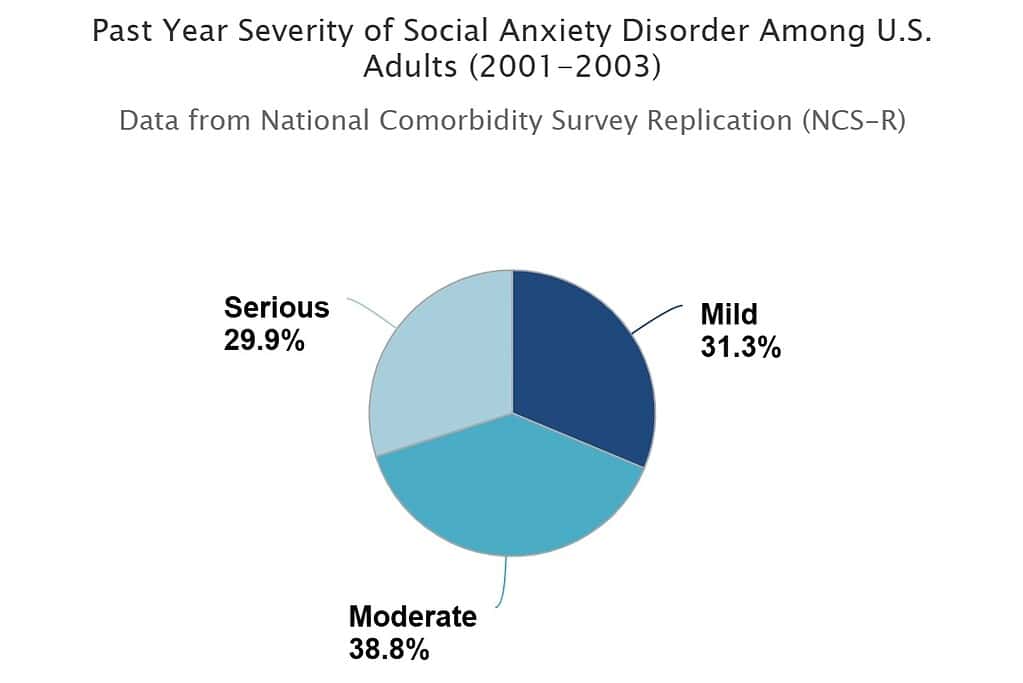
(Source: nimh.nih.gov)
- Among adults with social anxiety disorder, 29.9% had serious impairment in daily activities.
- Around 38.8% experienced moderate impairment.
- Another 31.3% had mild impairment, based on the Sheehan Disability Scale.
Adolescents in the U.S.
- The National Comorbidity Survey Adolescent Supplement reported that the overall prevalence of the condition among adolescents is 9.1%.
- Around 1.3% of adolescents experience severe impairment.
- Female adolescents show a higher rate at 11.2%, compared to 7.0% in males.
- By age group, prevalence increases with age: 7.7% (13-14 years), 9.7% (15-16 years), and 10.1% (17-18 years).
Social Anxiety Disorder (SAD) Statistics by Comorbidity
- Major depressive disorder is the most common co-occurring condition, affecting 30%-40% of people with SAD.
- Around 20% also have panic disorder, while 15% have generalized anxiety disorder (GAD).
- About 10%-15% have a substance use disorder (SUD), and 18% have obsessive-compulsive disorder (OCD).
- Borderline personality disorder affects 12%, eating disorders affect 14%, and somatic symptom disorder affects 9% of people with SAD.
- According to Worldmetrics, around 30% of adolescents with SAD also have ADHD, while 10% of children have conduct disorder.
- Adults with MDD report suicidal thoughts in 25% of cases.
- People with both SAD and GAD have a 2x higher risk of treatment resistance.
- SAD with MDD increases recurrence risk by 50%, while SAD with SUD is linked to an earlier onset (8 years vs. 12 years).
- Anxiety disorder NOS affects 22%, and narcissistic personality disorder is uncommon at 1% compared with 12% for other personality disorders.
- Females with SAD are 3x more likely to have PTSD, while males are 3x more likely to have SUD.
By Demographic Statistics
- Women are 1.5x more likely than men to experience SAD.
- Symptoms usually begin between 13-14 years, although onset is 12-13 years in females and 16-18 years in males.
- During adolescence, SAD affects 5.6% of females and 3.2% of males.
- Prevalence is 9.2% in Hispanic/Latino individuals, 7.1% in Caucasians, and 5.9% in African Americans.
- Asian populations have a 23% higher prevalence than Caucasians.
- First-generation immigrants have lower rates (2.1%) than second-generation immigrants (5.8%).
- People with lower socioeconomic status have higher rates (6.8%) than those with higher status (3.4%).
- Strong personal support is linked to lower prevalence (2.3% vs. 6.5%).
- Rates are 4.1% for people under 25, 4.9% for ages 25-44, 4.2% for 45-64, and 3.5% for 65+.
- Additional findings include 21% higher risk in left-handed people, 5.8% in only children vs. 4.2% with siblings, 6.3% in LGBTQ+ individuals vs. 5.1% in heterosexual individuals, 10.4% in adolescents from single-parent households vs. 7.8% in two-parent households, 8.2% among people with an abuse history vs. 4.9% without, 3.1% in religious individuals vs. 5.9% in non-religious individuals, 19% lower risk in first-born children, and 5.5% of people with SAD identify as disabled.
Impairment Statistics
- About 60% of people with SAD report significant daily impairment.
- Around 50% miss work or school, while 45% avoid social events.
- Relationship difficulties affect 65%, loneliness affects 70%, and poor academic performance affects 55% of adolescents.
- Other challenges include avoiding medical care (30%), avoiding eating in public (35%), difficulty making phone calls (20%), difficulty using public transportation (25%), difficulty starting conversations (40%), and reduced leisure activities (50%).
- SAD is linked to 3x higher unemployment risk, 2x greater social isolation, 2x higher self-harm risk, 2x greater work-related stress, 3x higher quality-of-life impairment, and 4x greater likelihood of delaying major life events.
- It is also the 7th leading cause of disability worldwide, and people with both SAD and MDD have a 5x higher risk of severe functional impairment.
Prevalence Statistics
- Lifetime global prevalence is 7.4%, while the global 12-month prevalence is 3.7% and the 30-day prevalence is 2.8%.
- In the U.S., 6.8% of adults experience SAD within a year, and 13.3% experience it during their lifetime.
- Lifetime prevalence is 9.0% among adolescents, 6.1% among children aged 6-12 years, 3.5% among adults aged 65+, and 7.2% among college students.
- Lifetime prevalence is 8.1% in Europe and 9.5% in Australia.
- High-income countries report 10.2% lifetime prevalence among adolescents, while adults in low-income countries report 5.7%.
- Additional findings include 12.3% prevalence in primary care settings, 3.2% severe SAD in adolescents, 4.3% developing SAD before age 10, 8.9% reporting severe impairment, 2x higher future panic disorder risk among affected adolescents, 4.9% prevalence in urban areas vs. 2.8% in rural areas, and 5.4% remaining untreated for more than 10 years.
Treatment Statistics
- Cognitive Behavioral Therapy (CBT) is 60%-70% effective, while long-term CBT maintains 60% effectiveness after 12 months.
- Combining CBT with medication produces a 75% response rate compared with 50% for CBT alone.
- Mindfulness-based therapy is 45%-50% effective, group therapy is 50% effective, virtual reality exposure therapy is 55% effective, and behavioral activation therapy is 40% effective. Transcranial magnetic stimulation (TMS) is 30% effective in treatment-resistant cases.
- SSRIs remain the first-line medication, but 30% of patients do not respond, 15% stop treatment because of side effects, and 40% do not achieve full remission.
- Only 10%-15% of people with SAD receive treatment. Cost limits care for 35%, 12% seek help from primary care providers, 22% of those with both SAD and SUD receive integrated treatment, 20% use complementary therapies, 18% prefer self-help resources, 25% use alcohol to reduce anxiety, and pharmacogenetic testing may improve medication response in 20% of patients.
Global Anxiety Disorder Statistics by Country
| Country / Region | People Affected | % of Population |
|---|---|---|
| United States | 40 million | 19.1% |
| United Kingdom | 8.2 million | 12.7% |
| Australia | 5.5 million | 21.3% |
| Canada | 4.5 million | 11.6% |
| European Union | 84 million | 18.9% |
| Global South | 171 million | 4.6–7% |
(Source: charleslinden.institute)
In the Global South, an estimated 171 million people (4.6%-7%) live with anxiety disorders, although many cases remain untreated.
Anxiety disorders affect about 40 million people (19.1%) in the United States, 8.2 million (12.7%) in the United Kingdom, 5.5 million (21.3%) in Australia, and 4.5 million (11.6%) in Canada.
What are the Symptoms of Social Anxiety Disorder?
Mental symptoms
- Increased self-consciousness
- The feeling of the world getting smaller or that the world is a failure
- Lack of confidence
- Feeling isolated, trapped, or alone
- Always being misunderstood
Cognitive Symptoms
- Although there are positive aspects, continuously looking for flaws in social interaction
- Assuming people’s responses are always negative
- Assuming someone else’s problem or behavior is caused by you, believing you are the center of the universe
- Even though people have some weaknesses, believing that these people are always strong
- Always thinking negatively and believing that the situation is true
- Focusing only on embarrassing social situations
Physical Symptoms
- Muscle spasms or twitches
- Increased blushing
- excessive sweating
- increased dizziness
- The feeling of my mind going blank
- Increased feeling of nausea and an upset stomach
- Difficulty in swallowing
- Dry mouth
- Tremors or body shaking
Behavioral Symptoms
- Avoiding public interactions
- Avoiding eye contact
- Always asking for reassurances
- Apologizing excessively without reason
- Acting passively
- Avoiding uncomfortable social gatherings
What Causes Social Anxiety Disorder?
- Family history
- Learned behavior gained through personal experiences
- Personality
- Childhood trauma
- Traumatic experiences
- Any other mental health conditions
- Brain chemistry
Case Study – Understanding and Overcoming Social Anxiety Disorder
Patient: Sarah Jones, 23
Presenting Issue: Sarah experiences intense anxiety in social situations, fearing judgment and scrutiny from others. This fear significantly impacts her daily life, affecting her work, relationships, and overall well-being.
Understanding Social Anxiety Disorder
Social anxiety disorder (SAD), also known as social phobia, is a common mental health condition characterized by an intense and persistent fear of social situations. People with SAD worry excessively about being scrutinized, judged, or negatively evaluated by others. This fear can manifest in various ways, including:
- Physical symptoms: Blushing, sweating, trembling, heart palpitations, nausea, and shortness of breath.
- Cognitive symptoms: Negative self-talk, intrusive thoughts of embarrassment, and fear of making mistakes.
- Behavioral symptoms: Avoiding social situations, public speaking anxiety, difficulty making eye contact, and social isolation.
SAD is distinct from shyness. Shyness is a milder discomfort in social settings, while SAD is a debilitating fear that significantly disrupts daily life.
Causes of Social Anxiety Disorder
The exact cause of SAD is unknown, but several factors likely contribute to its development:
- Genetics: A family history of anxiety disorders increases the risk of developing SAD.
- Brain chemistry: Imbalances in brain chemicals like serotonin and norepinephrine may play a role.
- Life experiences: Negative social experiences like bullying or public humiliation during childhood can trigger SAD.
- Medical conditions: Certain medical conditions, like thyroid problems, can worsen anxiety symptoms.
Treatment Options in 2024
The good news is that SAD is highly treatable with a combination of therapy and medication. Here’s a look at some of the most effective treatment approaches available in 2024:
- Cognitive-behavioral therapy (CBT): CBT is the first-line treatment for SAD. It helps individuals identify and challenge negative thought patterns that contribute to their anxiety. In CBT, therapists teach coping skills to manage anxiety in social situations.
- Exposure therapy: This therapy gradually exposes individuals to feared social situations in a safe and controlled environment. Through repeated exposure, patients learn to manage their anxiety and develop confidence.
- Social skills training: This therapy helps individuals develop skills for navigating social interactions more effectively.
- Medication: Antidepressants and anti-anxiety medications can help manage symptoms of SAD, especially when combined with therapy.
Importance of Open Communication
Talking freely about your struggles with SAD is crucial for recovery. Here’s why:
- Validation: Sharing your experiences allows trusted individuals – friends, family, or a therapist – to validate your feelings and offer support. This can go a long way in reducing isolation and boosting self-esteem.
- Understanding: Open communication helps loved ones understand your triggers and how they can best support you. This can lead to a more positive and supportive social environment.
- Reduced Stigma: Talking openly about SAD helps to normalize mental health struggles and reduce the stigma associated with seeking help.
Early Treatment – The Key to Long-Term Relief
Early intervention is crucial for managing SAD effectively. Here’s why:
- Reduced severity: Getting treatment early can prevent the symptoms of SAD from worsening and interfering significantly with life.
- Improved response: Studies show that individuals who receive early treatment tend to respond better to therapy and medication.
- Prevention of complications: Left untreated, SAD can lead to other mental health conditions like depression and substance abuse. Early intervention can help prevent these complications.
Facts about Social Anxiety Disorder
- SAD is one of the most common mental health disorders in the United States, affecting an estimated 12.1% of adults at some point in their lifetime.
- SAD can affect people of all ages, genders, and socioeconomic backgrounds.
- While there’s no complete cure, SAD is highly treatable with therapy and medication. Most people with SAD can learn to manage their anxiety and live fulfilling lives.
- According to Social Anxiety Disorder Statistics, the average cost of treating SAD in the United States is estimated to be around $4,600 per year. Early intervention can significantly reduce these costs by preventing complications.
Economic Impact of Social Anxiety Disorder Statistics
- Axismh report further stated that in the United States, workplace social anxiety costs exceed USD 238 billion each year, while broader mental health disorders generated USD 107.3 billion in economic losses in 2023. Costs will also vary depending on the specific medication and dosage prescribed.
- Social anxiety disorder and other anxiety conditions create a major economic burden through higher health care costs and lower workplace productivity.
- WHO estimates show depression and anxiety cause the loss of 12 billion working days each year worldwide, leading to nearly USD 1 trillion in annual productivity losses.
- According to sciencedirect.com, earlier depression and anxiety account for about USD 925 billion in yearly productivity losses, a benchmark still referenced in 2026.
- Anxiety disorders make up around 2.08% of total health care spending.
- Direct costs equal about 0.22% of GDP, while indirect costs add 0.23%, bringing the total economic burden close to 0.45% of GDP.
- In Europe, social anxiety disorder costs about EUR 11,952 per patient annually, with estimates as low as EUR 6,100.
- Total costs reach around EUR 136 million per 1 million people, including medical care and productivity losses.
- People with social anxiety disorder have 1.60 times higher direct medical costs than those without anxiety.
Importance of Self-Care
In addition to therapy and medication, Sarah can actively manage her SAD by incorporating self-care practices into her daily routine:
- Regular exercise: Physical activity releases endorphins, which have mood-boosting effects and can help reduce anxiety symptoms.
- Healthy sleep: Getting enough sleep is crucial for mental and emotional well-being. Aim for 7-8 hours of sleep each night.
- Balanced diet: Eating nutritious foods provides the body with the nutrients it needs to function optimally, which can improve overall mental health.
- Mindfulness practices: Activities like meditation and yoga can help Sarah develop greater awareness of her thoughts and feelings and learn to manage them effectively.
The Road to Recovery
With dedication to her treatment plan and incorporating self-care practices, Sarah can manage her social anxiety and experience a significant improvement in her quality of life. Here are some encouraging facts:
- Social Anxiety Disorder Statistics show that CBT is highly effective in treating SAD, with success rates of up to 75%.
- Early intervention leads to better treatment outcomes and reduces the risk of developing other mental health problems.
The Power of Support
Throughout her treatment journey, Sarah’s support system will play a crucial role. Here’s how loved ones can help:
- Educate themselves about SAD: Understanding the disorder will help friends and family be more supportive and encouraging.
- Provide a safe space for communication: Creating a judgment-free environment allows Sarah to discuss her struggles and anxieties openly.
- Offer practical support: This could include accompanying Sarah to therapy appointments or helping her practice social skills in low-pressure situations. Be patient and understanding as Sarah navigates her challenges.
By working together, Sarah and her support system can overcome SAD and build a fulfilling and rewarding life.
Final Thoughts
Social Anxiety Disorder is more than just being shy. It is a common mental health condition that can affect daily life, work, school, and relationships. The good news is that it can be treated with the right support, therapy, and, if needed, medication.
Getting help early can make a big difference. With proper care and practice, people with Social Anxiety Disorder can build confidence, manage their fears, and enjoy a happier and more active life.
FAQ
Common symptoms include fear of social situations, sweating, blushing, trembling, avoiding people, and difficulty speaking confidently.
Genetics, brain chemistry, stressful experiences, and personality traits may increase the risk together.
Yes, therapy, medication, and healthy coping skills help most people manage symptoms and improve daily life.

Sources


