








Opening
AI Infrastructure Statistics: AI infrastructure refers to the hardware, software, and computing resources needed to build, train, and run AI systems. This includes powerful chips like GPUs, data storage systems, networking equipment, and cloud-based services that work together to support AI applications across industries. As AI adoption grows rapidly worldwide, the demand for strong infrastructure is increasing at an unprecedented pace, driven by factors like the rising use of generative AI, growing enterprise adoption, and the need for faster data processing capabilities.
Major technology companies, known as hyperscalers, are leading this expansion by building massive data centers worldwide, while newer players called neo-clouds are emerging quickly to meet growing demand for GPU access. Venture capital funding in this space has grown substantially, with investors backing companies working on chips, storage, and networking solutions, while industries like telecom explore AI infrastructure as a new growth opportunity and regions like India emerge as important future markets.
Now let’s explore the statistical facts of AI infrastructure today, including market size, spending insights, and growth projections as demand continues to accelerate.
Curated by Our Editors
- Global AI infrastructure market is set to hit USD 460.5 billion by 2033.
- Global AI infrastructure spending is projected to nearly triple, reaching USD 902 billion by 2029.
- US AI data center power demand could grow thirtyfold, from 4 to 123 gigawatts by 2035.
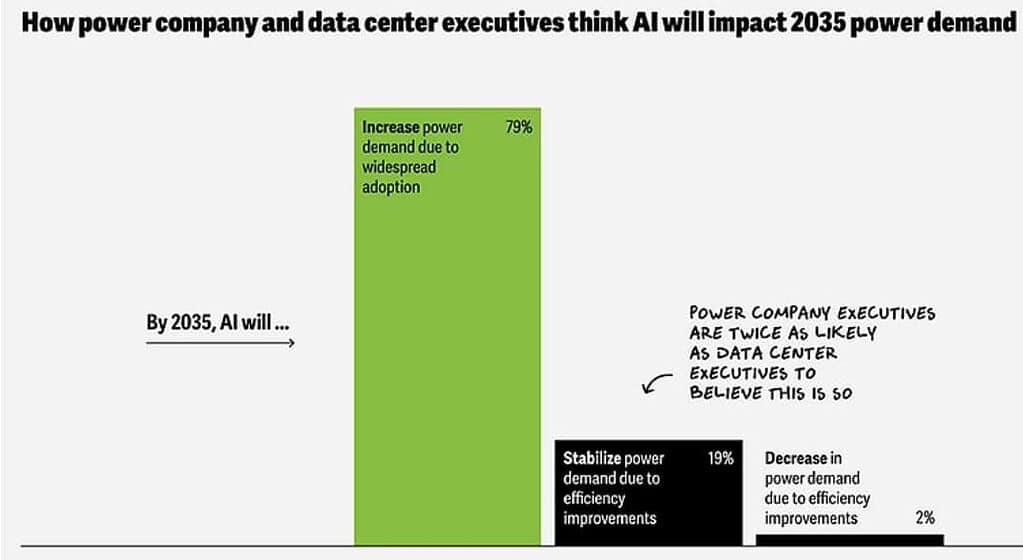
- 79% of executives believe AI will keep increasing power demand through 2035.
- ACaaS is AI infrastructure’s fastest-growing segment, set to grow 48% yearly through 2030.
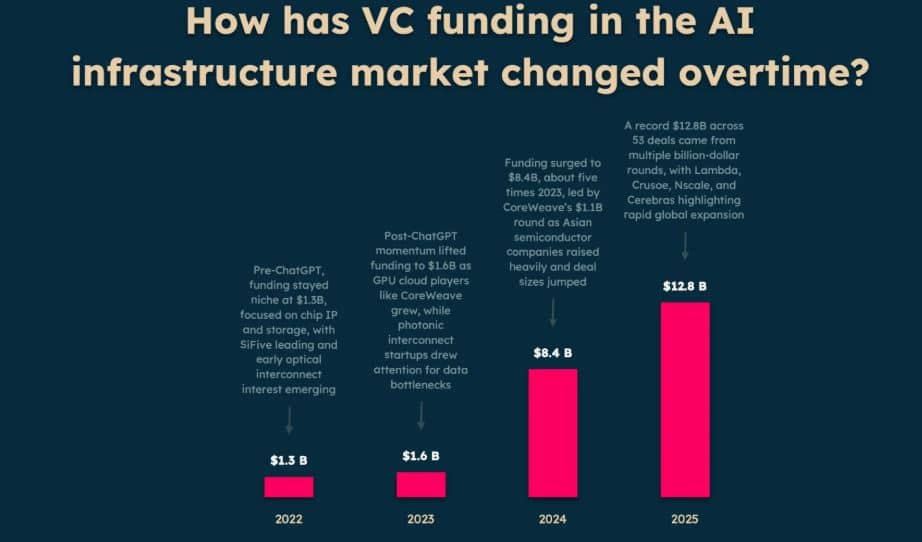
- AI infrastructure VC funding hit a record USD 12.8 billion in 2025.
- Neo-cloud providers’ spending share jumped from 3% to 18% between 2020 and 2026.
- NVIDIA and partners plan to mobilize over USD 500 billion for AI compute.
Global AI Infrastructure Market Statistics
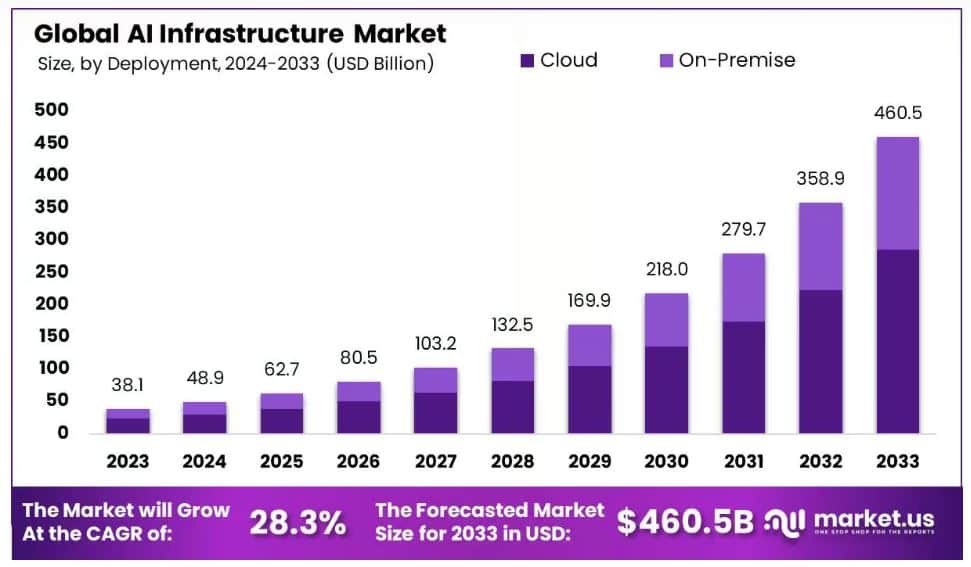
- By 2025, the market reached USD 62.7 billion, followed by USD 80.5 billion in 2026 and USD 103.2 billion in 2027.
- The market is projected to reach USD 358.9 billion by 2032, and it is expected to hit USD 460.5 billion by 2033.
- This growth reflects a strong yearly rate of 28.3%, known as CAGR, driven mainly by cloud deployment.
(Source: market.us)
Global AI Infrastructure Spending Stats
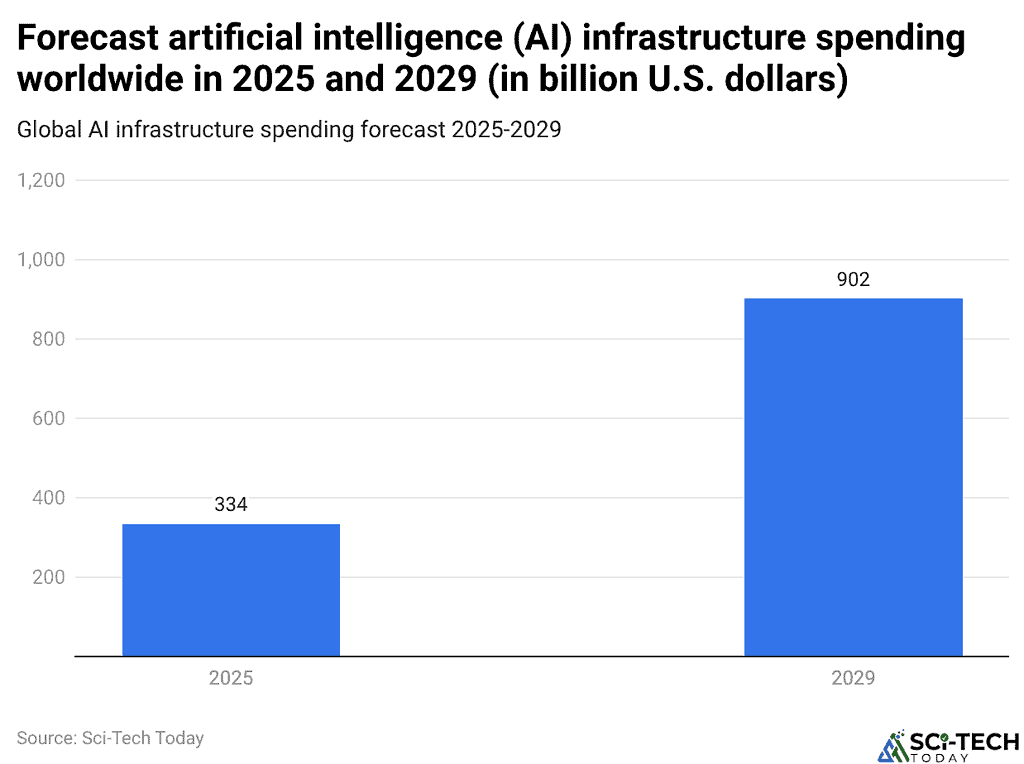
- Global spending on AI infrastructure is expected to reach USD 334 billion in 2025, according to the Statista Research Department.
- By 2029, this spending is projected to grow significantly, reaching USD 902 billion worldwide.
- This data covers the forecast period from January 1, 2025, to December 31, 2029, across all categories worldwide.
(Reference: statista.com)
AI Data Centers Insights
- The size of AI data centers and their power needs are growing at a very fast pace.
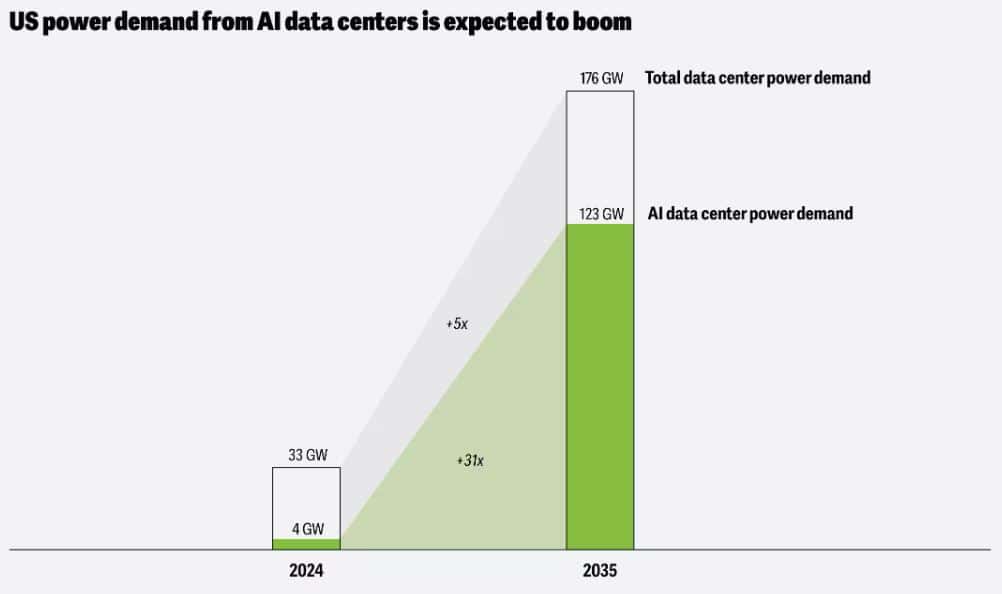
- According to Deloitte, power demand from AI data centers in the United States could grow more than thirtyfold by 2035, reaching 123 gigawatts, up from just 4 gigawatts in 2024.
- AI data centers use much more energy per square foot compared to traditional data centers.
- For example, a five-acre data center using advanced graphics processing units could see its energy use jump from 5 megawatts to 50 megawatts.
- The total US data center power demand is expected to reach 178 gigawatts by 2035, with AI data centers making up the majority at 123 gigawatts.
- Leading AI infrastructure companies, known as hyperscalers, currently use less than 500 megawatts of power for their largest data centers.
- However, the data centers these hyperscalers are planning could require up to 2,000 megawatts, equal to 2 gigawatts, showing massive future growth in power needs.
(Source: deloitte.com)
AI’s Impact on Power Demand
- In April 2025, Deloitte surveyed 120 US-based power company and data center executives to understand key challenges in data center infrastructure development.
- The survey found that grid stress was the leading challenge faced by these executives.
- A large majority, 79% of respondents, believe that AI will increase power demand through 2035 due to its widespread use.
- Meanwhile, 19% think power demand will stay stable because of efficiency improvements, and only 2% believe demand will actually decrease.
- Interestingly, power company executives are twice as likely as data center executives to believe efficiency improvements will help stabilize power demand.
(Source: deloitte.com)
AI Infrastructure Revenue by Component
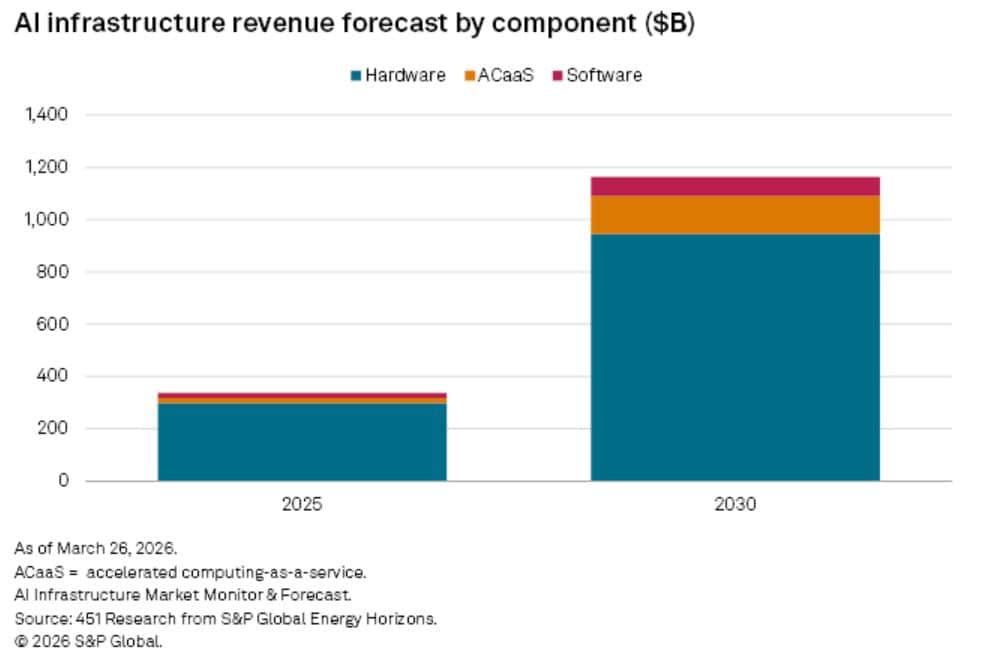
- AI infrastructure is built on three main parts: hardware, software, and ACaaS, which together form the foundation of the entire AI system.
- Hardware is expected to remain the largest contributor to AI infrastructure revenue, growing from USD 298 billion in 2025 to USD 946 billion in 2030, at a strong yearly rate of 26%.
- Software is expected to grow faster, increasing from USD 19 billion to USD 72 billion during the same period, at a yearly rate of 31%.
- ACaaS is expected to be the fastest-growing segment, expanding from USD 20 billion in 2025 to USD 145 billion in 2030, at an impressive yearly rate of 48%.
(Source: spglobal.com)
AI Infrastructure Demand Drives Hardware Revenue
- A study analyzed five leading AI infrastructure hardware manufacturers, including Cisco, Dell, HPE, Lenovo, and Supermicro, to understand their revenue growth.
- In the early-2025 reporting period, these companies saw a weighted average year-over-year revenue growth of 11%.
- This growth increased significantly in the early-2026 reporting period, reaching 53%.
- The revenue growth was calculated by comparing each company’s most recent reported quarter to the same quarter from the previous year.
- This sharp rise from 11% to 53% shows how strong AI infrastructure demand is driving faster revenue growth for major hardware companies.
AI Infrastructure MMF Revenue Forecast
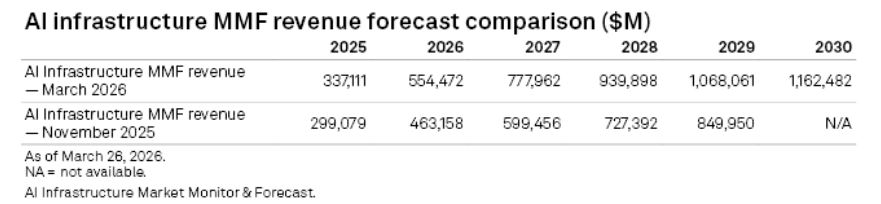
- According to the AI Infrastructure Market Monitor and Forecast, revenue projections were updated between two reporting periods, November 2025 and March 2026.
- In the March 2026 forecast, AI infrastructure revenue is expected to reach USD 337,111 million in 2025 and grow to USD 554,472 million in 2026.
- This growth continues strongly, reaching USD 777,962 million in 2027 and USD 939,898 million in 2028.
- By 2029, revenue is projected to hit USD 1,068,061 million, followed by USD 1,162,482 million in 2030.
- In comparison, the earlier November 2025 forecast estimated lower figures, starting at USD 299,079 million in 2025 and rising to USD 849,950 million by 2029.
- Data for 2030 was not available in the November 2025 forecast, showing how projections have been updated and increased over time as of March 26, 2026.
(Source: spglobal.com)
How VC Funding in AI Infrastructure Has Changed
- Before ChatGPT became popular, venture capital funding in AI infrastructure remained small at USD 1.3 billion in 2022, mainly focused on chip technology and storage, led by companies like SiFive.
- After ChatGPT’s launch, funding grew to USD 1.6 billion in 2023, driven by GPU cloud companies like CoreWeave and growing interest in optical interconnect startups solving data bottlenecks.
- In 2024, funding surged sharply to USD 8.4 billion, about five times higher than 2023, largely led by CoreWeave’s USD 1.1 billion funding round and rising investment in Asian semiconductor companies.
- By 2025, funding reached a record USD 12.8 billion across 53 deals, including multiple billion-dollar rounds from companies like Lambda, Crusoe, and Cerebras, highlighting fast global expansion in AI infrastructure investment.
(Source: newmarketpitch.com)
AI Spending on Hyperscalers vs. Neo-Clouds
- Hyperscaler cloud providers have consistently captured the largest share of AI infrastructure spending, growing from 53% in 2020 to 62% in 2026.
- Neo-cloud and colocation providers have grown the fastest during this period, increasing from just 3% in 2020 to 18% in 2026, as buyers need GPUs immediately rather than waiting.
- Enterprise and public sector spending share has declined steadily, dropping from 38% in 2020 to 17% in 2026.
- Edge inference spending has remained small and fairly stable, ranging between 2% and 4% throughout the years from 2020 to 2026.
- This data clearly shows that while hyperscalers still dominate AI infrastructure spending, neo-clouds are rapidly gaining ground due to faster GPU access for buyers.
Global Data Center Demand Expected to Triple by 2030
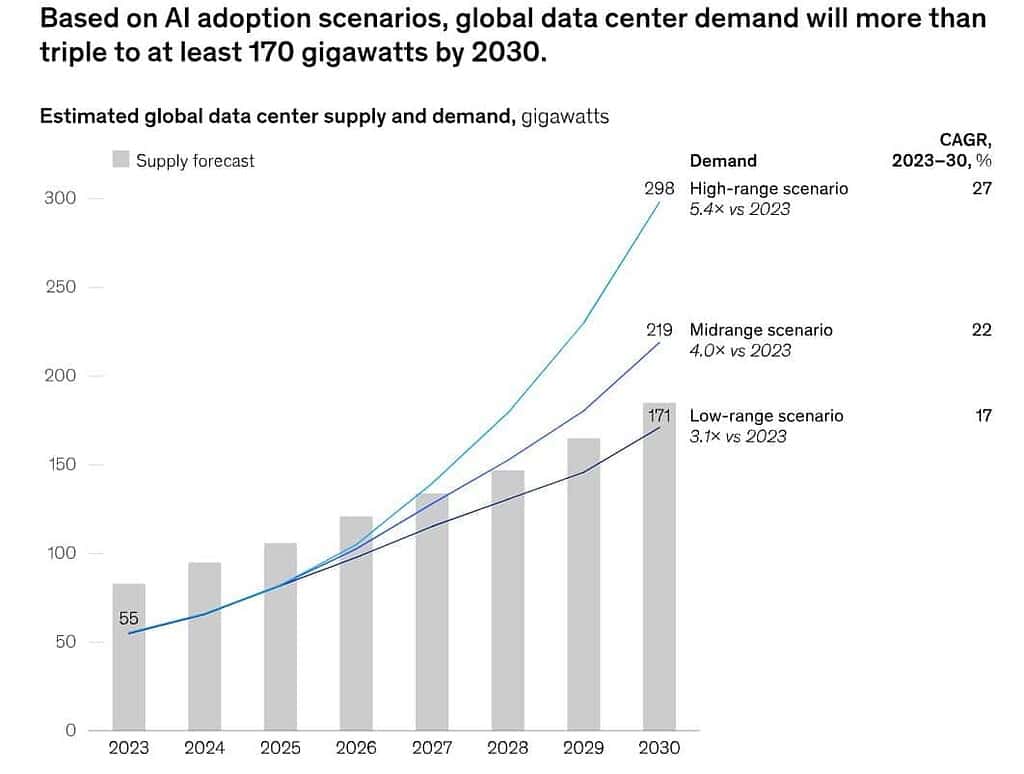
- Based on AI adoption trends, global data center demand is expected to more than triple, reaching at least 170 gigawatts by 2030.
- In the low-range scenario, demand is projected to grow to 171 gigawatts by 2030, which is 3.1 times higher than 2023, growing at a yearly rate of 17%.
- In the midrange scenario, demand could reach 219 gigawatts by 2030, which is 4.0 times higher than 2023, growing at a yearly rate of 22%.
- In the high-range scenario, demand may climb as high as 298 gigawatts by 2030, which is 5.4 times higher than 2023, growing at a strong yearly rate of 27%.
- Data center supply, which stood at 55 gigawatts in 2023, is also expected to grow steadily to help meet this rising demand by 2030.
(Source: mckinsey.com)
New Data Centers in New Markets
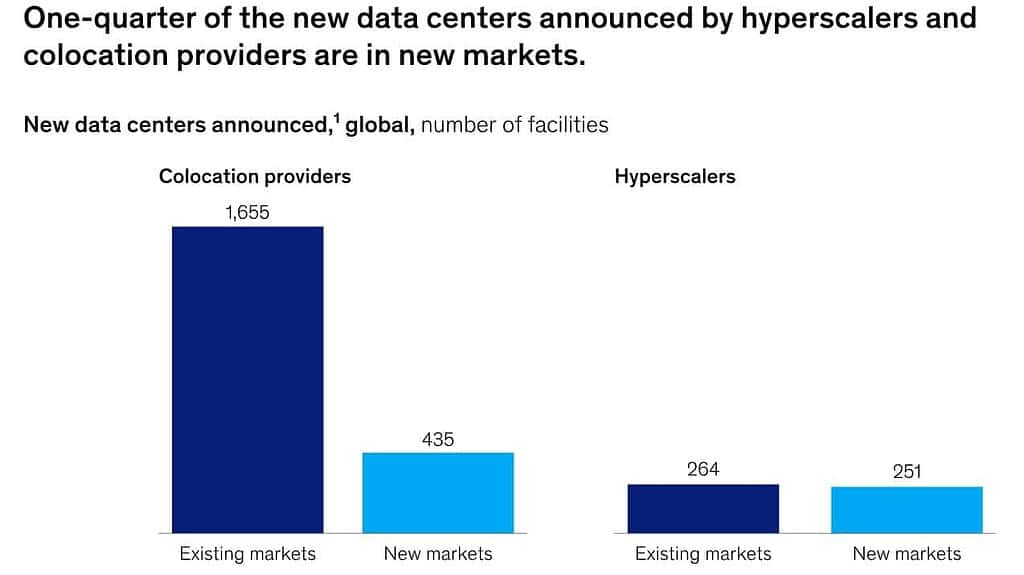
- According to McKinsey, about one-quarter of new data centers announced by hyperscalers and colocation providers are being built in new markets.
- Colocation providers announced 1,655 new data center facilities in existing markets, while 435 facilities were announced in new markets.
- Hyperscalers announced 264 new data centers in existing markets, compared to 251 facilities in new markets.
- This shows that colocation providers still favor existing markets more, while hyperscalers are expanding almost equally between existing and new locations.
- The data excludes 84 announced facilities where city location information was not available, based on research from 451 Research, part of S&P Global Market Intelligence, as of December 2024.
(Source: mckinsey.com)
Recent AI Infrastructure Developments
- On September 9, 2026, NVIDIA partnered with eight Australian data center and cloud companies to develop up to 2 gigawatts of AI infrastructure by 2027.
- On August 10, 2026, NVIDIA partnered with Apollo, BlackRock, Blackstone, Brookfield, Goldman Sachs and KKR to mobilize more than USD 500 billion for AI compute infrastructure.
- On July 22, 2026, OpenAI announced Project Camellia, an AI data center in Georgia supported by 3.2 gigawatts of power delivered in phases between 2028 and 2032.
- On July 21, 2026, an AI Infrastructure Partnership consortium completed its USD 40 billion acquisition of Aligned Data Centers, which controls more than 6.4 gigawatts of operational and planned capacity.
- On June 22, 2026, Microsoft announced a multibillion-dollar AI data center campus in Pecos, Texas, adding approximately 2 gigawatts of capacity and supporting over 6,000 construction jobs.
- On May 7, 2026, NVIDIA and IREN formed a partnership to deploy up to 5 gigawatts of AI infrastructure, with NVIDIA receiving rights to invest up to USD 2.1 billion in IREN.
- On April 20, 2026, Anthropic committed more than USD 100 billion to AWS over 10 years for up to 5 gigawatts of compute capacity, while Amazon invested another USD 5 billion in Anthropic.
- On April 6, 2026, Anthropic expanded its partnership with Google and Broadcom for multiple gigawatts of next-generation TPU capacity, with deployment expected to begin in 2027.
- On January 9, 2026, OpenAI and SoftBank invested USD 1 billion in SB Energy, while OpenAI signed a lease for a 1.2-gigawatt Stargate data center in Texas.
Final Thoughts
The scale of recent AI infrastructure deals, from major hyperscaler cloud commitments to massive private-equity-backed compute consortiums, signals that AI buildout has become a macroeconomic force reshaping capital market, not just a technology trend. Yet this growth is running into hard limits: power availability, grid stress, cooling capacity, and chip supply are already the top constraints cited by industry executives, with US AI data center demand set to climb sharply in the years ahead.
Going forward, the priority is balancing this demand across faster-deploying neo-clouds and traditional hyperscalers, expanding into new geographic markets to ease pressure on existing grids, and scaling renewable power fast enough to meaningfully offset rising electricity demand.
FAQ
AI infrastructure includes specialized processors, servers, storage, networking, cloud platforms, data centers, cooling systems, and power supplies used to train and operate AI models.
Global spending on AI-optimized servers, storage, and networking is forecast to reach USD 497 billion in 2026, up 56% from 2025.
Amazon, Microsoft, Alphabet, Meta, and Oracle are expected to remain the largest AI infrastructure investors, with combined 2026 capital expenditure estimated at up to USD 725 billion.
Compute hardware accounts for an estimated 51.7% of AI infrastructure spending, while cloud deployment holds a 44.2% revenue share.
Data centers consumed around 415 terawatt-hours of electricity in 2024, equal to about 1.5% of global electricity use.
Global data center electricity consumption could reach approximately 945 terawatt-hours by 2030, more than double the 2024 level.
Renewable generation for data centers is forecast to grow by 22% annually between 2024 and 2030, supplying nearly 50% of additional electricity demand.
Power availability, cooling requirements, chip supply, construction costs, and grid connections can delay AI infrastructure expansion. AI workloads also require substantially denser computing capacity than traditional cloud systems.