









At a Glance
AI In Modern Warfare Statistics: War is no longer fought with weapons and soldiers alone. Artificial intelligence is bringing a new dimension to modern warfare, changing how countries plan military operations, monitor threats, and respond to attacks. From autonomous drones and intelligent surveillance to advanced cyber defense systems, AI is giving armed forces new ways to operate on the battlefield. It can process large amounts of data, identify potential threats, and support faster military decisions. As a result, major powers are racing to develop AI-driven defense technologies.
However, this shift also brings serious questions about human control, security risks, and the use of autonomous weapons. AI is now shaping the future of military power.
Featured Selection
- The global AI in modern warfare market is projected to reach USD 12 billion in 2025 and USD 17 billion in 2026.
- In 2026, UAVs and UGVs support surveillance, target tracking, logistics, and bomb disposal, accounting for nearly 30% and 22% of AI-integrated defense equipment, respectively.
- Defensive AI accounts for 48%, strengthening surveillance, cybersecurity, and early threat detection.
- North America and Europe lead the market with 38% and 22% shares, respectively, in 2026.
- More than 55% of defense innovation projects involve AI to improve military readiness and decision-making.
- For military threat detection, 41% expected improvements, 21% anticipated mixed effects, 14% expected reduced effectiveness, and 23% were unsure.
- In 2026, the pre-AI benchmark was 100 targets per day and 4.2 decisions per hour.
- 2,000 drone launches or attacks and 500 ballistic missile launches in the first week of May 2026.
- For THAAD, interceptor costs are 6.4 times the high ballistic missile estimate and 12.7 times the low estimate.
- The Army projected USD 507 million, the Navy USD 308 million, and the Air Force USD 415 million for AI-related IT spending in 2026.
AI’s Growing Role in Modern Warfare
- According to the Arms Control Today report, United States forces struck more than 13,000 targets in Iran during the first 38 days of the 2026 conflict, averaging approximately 342 targets daily.
- The Maven Smart System combines intelligence analysis, target identification, and strike planning. Its Pentagon contract value reached nearly USD 1.3 billion, according to Inside Defense.
- The VICE video claims AI can reduce target-selection time from days or weeks to milliseconds.
- A Bloomberg investigation linked outdated intelligence and excessive reliance on AI-supported systems to the Minab school strike, which killed more than 150 people, including at least 123 children.
- In 2021, Google and Amazon secured Israel’s USD 1.2 billion Project Nimbus cloud contract, reported by Reuters.
- Separately, the Associated Press reported a three-year Microsoft-Israeli Ministry of Defense contract worth USD 133 million.
- As reported by David Kirichenko in the U.S. Army War College’s War Room, the Ukraine-Russia drone race shows that drones account for approximately 70%-80% of battlefield casualties.
- AI-based targeting technology can be added to drones for as little as USD 25.
- Ukraine has tested more than 70 domestically developed unmanned ground vehicles.
- Ukraine’s OCHI system has collected 2 million hours of drone footage from more than 15,000 frontline crews since 2022.
- AI integration has increased Ukraine’s FPV drone strike accuracy from 30%-50% to approximately 80%.
AI in Modern Warfare Market Size
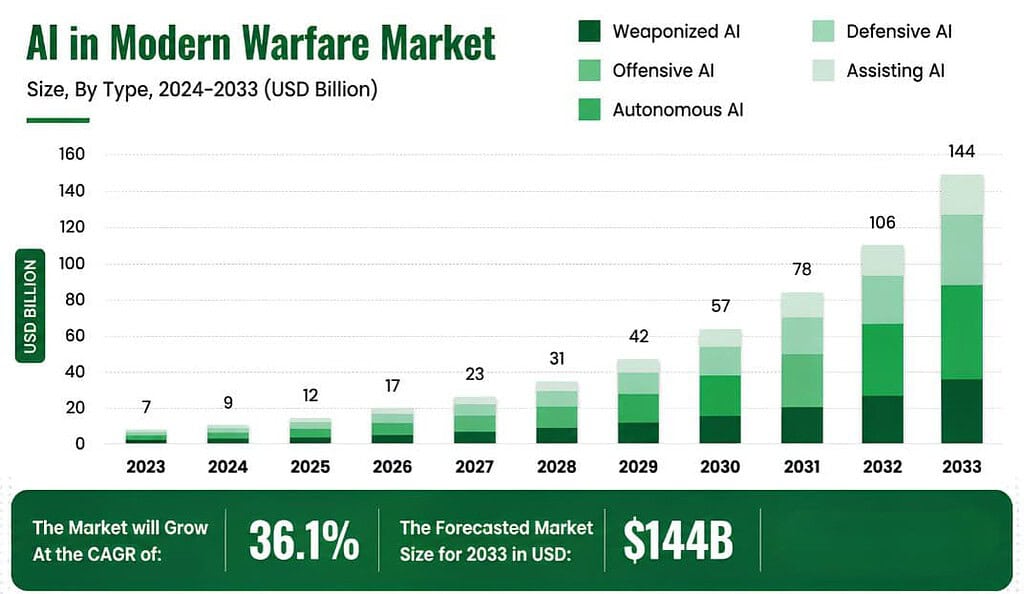
- The global AI in modern warfare market is projected to reach USD 12 billion in 2025 and USD 17 billion in 2026.
- By 2033, the market is forecast to reach USD 144 billion, with a compound annual growth rate of 36.1%.
Segmental Analysis by Type
- According to Reanin, weaponized AI attracts over 35% of investment, while offensive AI accounts for nearly 22% of deployments.
- Defensive and assisting AI improve cybersecurity, surveillance, logistics, and military decisions, accounting for around 28% and 18% of military AI adoption, respectively.
- Autonomous AI drives independent drones, underwater vehicles, and robots across nearly 25% of defense projects.
By Type of Equipment
- UAVs and UGVs support surveillance, target tracking, logistics, and bomb disposal, accounting for nearly 30% and 22% of AI-integrated defense equipment, respectively.
- AI combat systems receive approximately 27% of global smart military spending.
- Recovery and maintenance vehicles account for nearly 12% of ground support infrastructure.
- Reconnaissance and Medical Vehicles account for 18% and 9%, respectively.
By Application
- Defensive AI accounts for 48%, strengthening surveillance, cybersecurity, and early threat detection.
- AI supports target identification, autonomous weapons, and mission planning, representing approximately 52% of defense operations.
By Geography
- North America and Europe lead the market with 38% and 22% shares in 2026
- Asia Pacific holds 26%, supported by military AI investments in China, India, and South Korea.
- Middle East, Africa, and Latin America account for 8% and 6%, respectively.
Key Drivers of AI Adoption in Modern Warfare
- More than 55% of defense innovation projects involve AI to improve military readiness and decision-making.
- Around 42% of new tactical systems use AI-powered autonomy for faster battlefield responses.
- AI supports over 48% of defense imaging platforms, strengthening surveillance and threat detection.
- Approximately 38% of defense AI budgets are allocated to cybersecurity to detect breaches and protect military networks.
Global Military AI Market Outlook
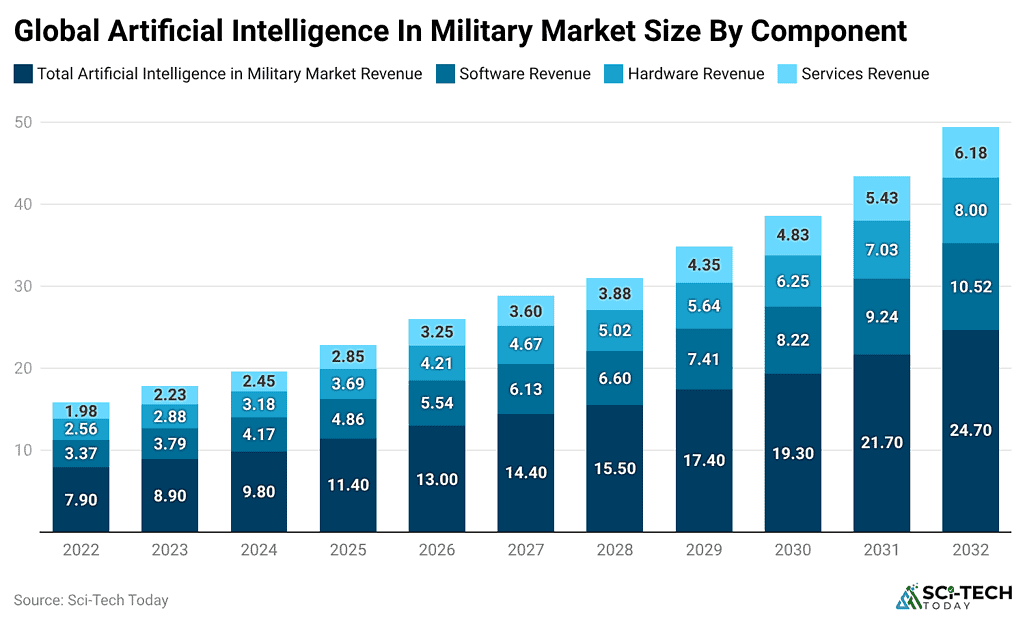
- The global artificial intelligence in the military market is projected to generate total revenue of USD 13 billion in 2026.
- Software revenue is forecast at USD 5.54 billion, making it the largest component.
- Hardware revenue is expected to reach USD 4.21 billion, while services revenue is projected at USD 3.25 billion.
- Space platforms lead with 33%, followed by land at 29%, airborne at 21%, and naval platforms at 17%.
United States Public Opinion on AI in Military Operations
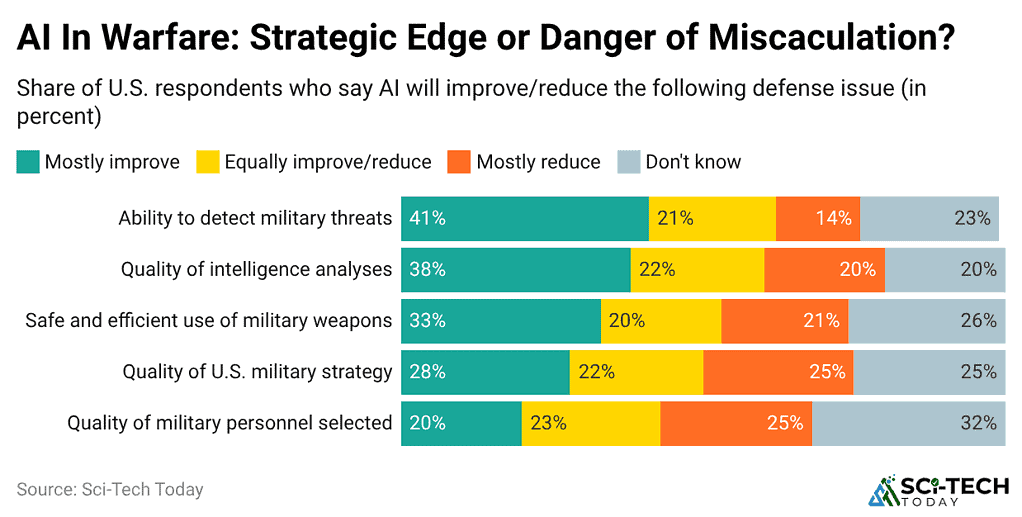
- For military threat detection, 41% expected improvements, 21% anticipated mixed effects, 14% expected reduced effectiveness, and 23% were unsure.
- Regarding intelligence analysis, 38% expected improvements, 22% predicted mixed results, 20% anticipated declines, and 20% expressed uncertainty.
- For safer weapons use, 33% expected improvements, 20% foresaw mixed effects, 21% anticipated reductions, and 26% were undecided.
- On military strategy, responses were 28%, 22%, 25%, and 25%, respectively.
- For personnel selection, the figures were 20%, 23%, 25%, and 32%, highlighting greater public uncertainty.
AI Adoption Across the Department of War
- According to Torch.AI, federal AI use cases increased from 571 in 2023 to 1,110 in 2024, nearly doubling in one year. However, the Department of War is excluded from the public inventory.
- The Pentagon’s generative AI platform attracted 1.7 million active users, representing more than 42% of the defense workforce.
- It also supported 100,000 AI agents and processed over 11 million documents.
- Of 685 identified AI projects, 88% remained in the research and development stage.
- Only 17 of 88 major weapon systems had clearly identified AI projects.
- The Pentagon requested USD 13.4 billion for autonomous and remotely operated systems in 2026.
Measurable Improvements in Military Decision-Making Through AI
- AI-powered decision tools reduced the sensor-to-shooter timeline in a West Point simulation from 11.0 to 7.7 minutes, delivering a nearly 30% improvement.
- During a 2026 JRTC exercise, an AI-supported brigade team completed detailed military operation orders in approximately 23 hours.
- A Naval Postgraduate School experiment demonstrated 1.00 recall and 0.98 precision in satellite-based ship detection with only 200 training images.
- Another NPS study achieved 94% accuracy when predicting vessels’ future positions using historical tracking data.
AI Targeting Capacity
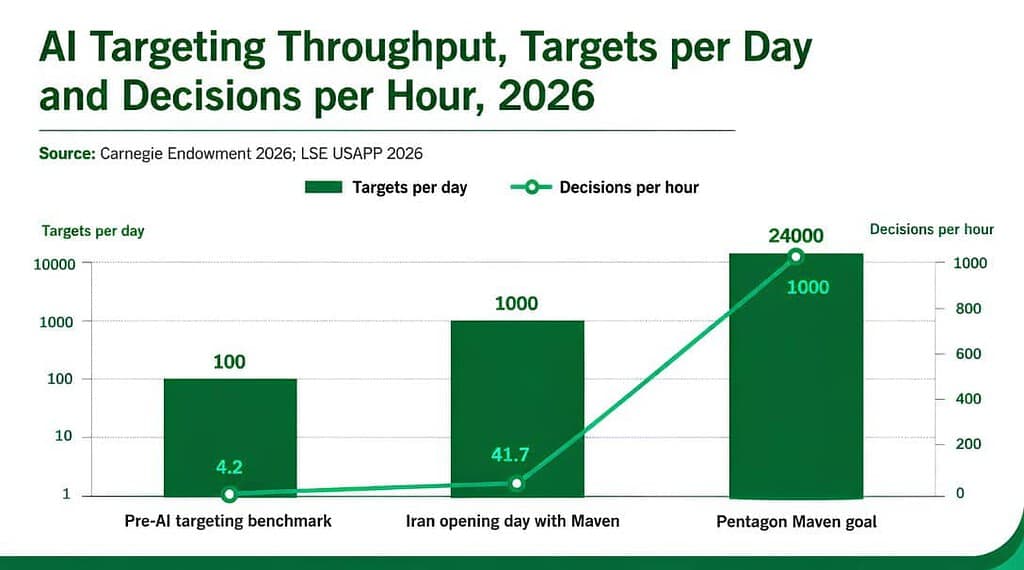
- In 2026, the pre-AI benchmark was 100 targets per day and 4.2 decisions per hour.
- On its opening day, Iran’s Maven recorded 1,000 targets per day and 41.7 decisions per hour.
- The Pentagon’s Maven goal is 24,000 targets per day and 1,000 decisions per hour.
Iran’s Drone and Missile Activity, 2026
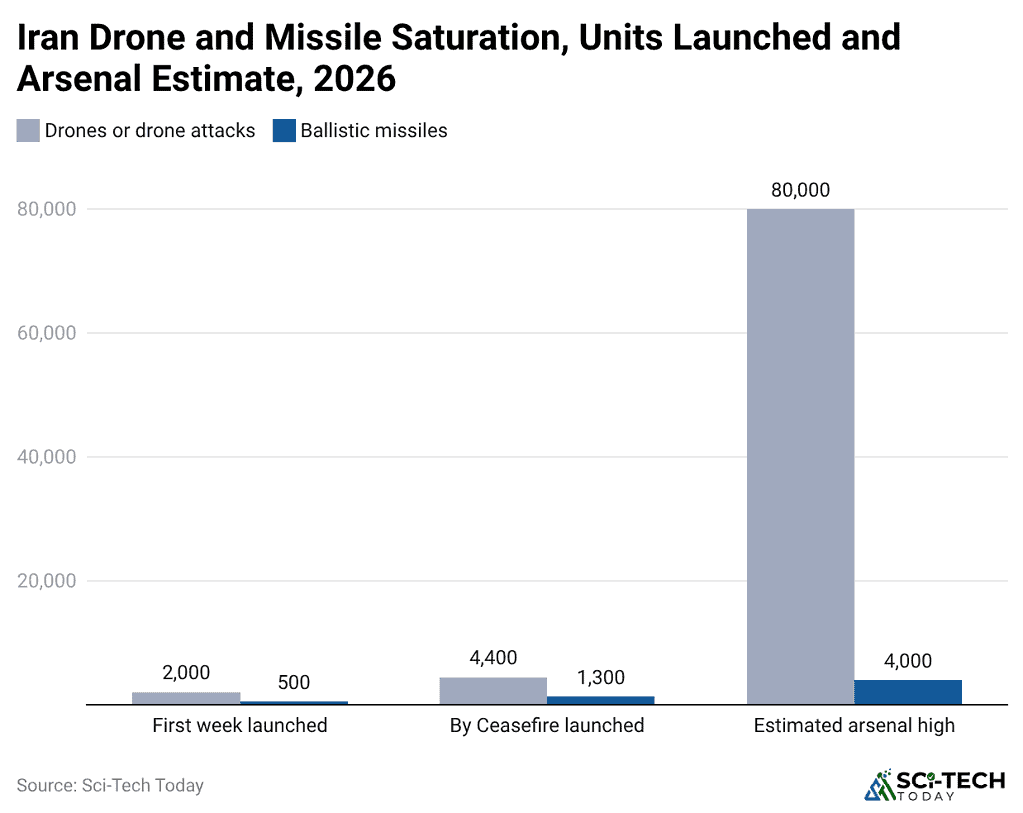
- The chart reports 2,000 drone launches or attacks and 500 ballistic missile launches in the first week.
- By the ceasefire, cumulative launches reached 4,400 drones or drone attacks and 1,300 ballistic missiles.
- High-end arsenal estimates stood at 80,000 drones and 4,000 ballistic missiles.
Defense System Cost Estimates
- A May 2026 report by The Economy Research examines that Nero’s “Archer” FPV drones are listed at USD 2,000 each.
- Shahed/Karrar drones range from USD 20,000 to USD 50,000 each.
- LUCAS drones cost USD 35,000 each.
- AIM-120 AMRAAM missiles cost between USD 400,000 and USD 1,000,000 each.
- Standard Missiles cost USD 2,100,000 each.
- Patriot PAC-3 missiles cost USD 3,000,000 each.
- Block-III UAV/MQ-9 units have the highest listed cost at USD 30,000,000 each.
Drone Defense Cost Ratios, 2026
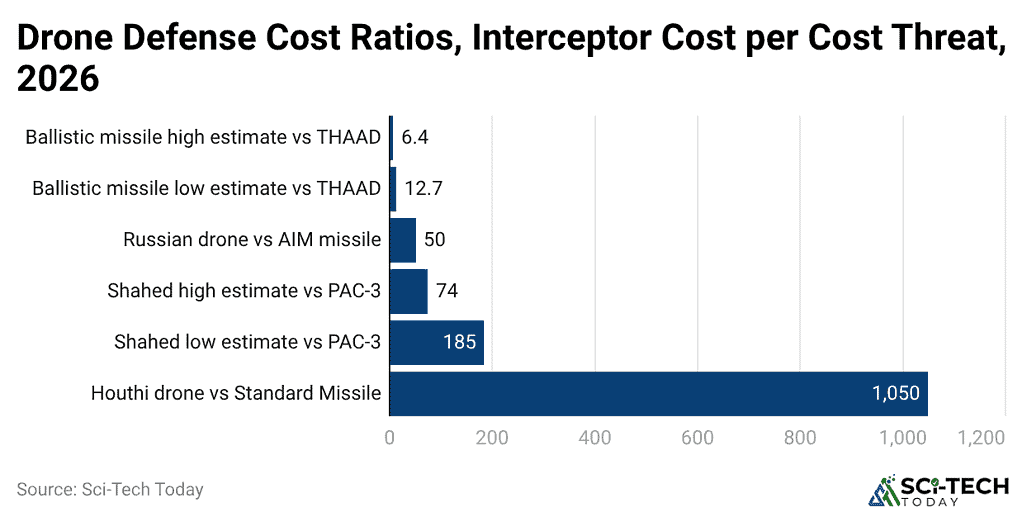
- For THAAD, interceptor costs are 6.4 times the high ballistic missile estimate and 12.7 times the low estimate.
- Against the Russian drones shown, AIM missiles carry a price tag 50 times higher.
- The PAC-3 comparison shows a gap of 74 times the high Shahed drone estimate, rising to 185 times the low estimate.
- The widest gap involves Standard Missiles, priced at 1,050 times the cost of Houthi drones.
Major Department of War AI Investments
- ImmixGroup reported that the Army projected USD 507 million, the Navy USD 308 million, and the Air Force USD 415 million for AI-related IT spending in 2026
- Broader AI-related reconciliation funding is estimated at USD 2.5 billion.
- According to the U.S. Department of War’s 2026 Mandatory Funding Allocation Plan, generative and agentic AI received USD 250 million, while Cyber Command AI initiatives received another USD 250 million.
- AI testing received USD 124 million, while AI-enabled unmanned systems received USD 145 million.
- Autonomous systems received a USD 13.4 billion budget request.
- Potential DoD AI contract values reached USD 90.7 billion in 2026.
U.S. Defense Spending and the Economic Impact of AI
- The 2023 President’s Budget proposed USD 773 billion for the Department of Defense, a 4% increase over the previous fiscal year’s funding, within USD 1.7 trillion in required spending.
- According to NSTXL, the Pentagon planned to allocate USD 874 million for AI and machine learning development.
- The global AI market is projected to reach USD 3,527.8 billion by 2033.
- AI could increase productivity by up to 40% and contribute USD 15.7 trillion to global GDP by 2030.
Ukraine and Russia’s Autonomous Weapons Race
- A report published by the National Security and Defense Council of Ukraine stated that Ukraine’s annual FPV drone production capacity is expected to exceed 8 million units in 2026. It produced 100,000 interceptor drones in 2025.
- Ukraine recorded 819,737 video-confirmed drone strikes in 2025, highlighting the growing role of unmanned weapons.
- Ukraine ordered 240,000 drones through Brave1 Market in 2026. Long-range drone usage increased 6 times year over year, with ranges exceeding 2,000 km.
- Ukraine has more than 2,000 defense technology companies and manufacturers, and land drones completed over 20,000 missions in the first three months of 2026.
- Russia planned to produce 79,000 Shahed-type drones in 2025 and more than 7 million FPV drones in 2026.
- Reuters reported that Russia produced 404 Shahed-type drones daily in January 2026, against a target of 1,000 per day.
- Russia plans to expand its unmanned systems force to 101,000 personnel in 2026 and increase annual unmanned aviation production to 130,000 units by 2030 and 350,000 by 2035.
AI Warfare: U.S. Software Advantage vs. China’s Manufacturing Scale
- According to Michael Parekh’s October 12, 2026, analysis, the U.S. 2027 defense budget request is USD 1.5 trillion, including a USD 1.15 trillion base budget. China allocated 1.91 trillion yuan (approximately USD 277 billion) in 2026, up 7%.
- The U.S. produces around 100,000 combat drones annually and aims to exceed 1 million within 2–3 years. China has the capacity to manufacture millions annually.
- DJI controls approximately 70% of the global commercial drone market. China’s Jiu Tian drone carrier can carry 100-150 drones.
- The US plans to invest approximately USD 1 billion in Collaborative Combat Aircraft in 2027 and deliver 340,000 small drones by 2028.
- China produces around 23 million gross tons, compared with less than 100,000 gross tons in U.S. capacity, a roughly 232-fold difference.
Why AI Is Changing Warfare
- According to an analysis published by IAS GYAN, AI speeds up military decisions from days to seconds, with some strike approvals requiring only 20 seconds of human review.
- India’s ECAS reportedly identified enemy radar positions with 95% accuracy.
- Autonomous drone swarms navigate without GPS or human input.
- AI-guided drones reportedly achieve 70%-80% accuracy, versus 10%-20% manually.
- AI strengthens cyber defense, counters jamming, and combines battlefield information across domains.
Outlook
AI is becoming an important part of modern warfare, helping military forces detect threats, analyze information, and respond faster. From drones to advanced surveillance systems, these technologies are changing how wars are fought.
However, greater use of AI also brings risks related to security, human control, and accountability. As military technology continues to advance, countries must manage innovation with responsibility and ensure that humans remain in control of critical military decisions
FAQ
International Humanitarian Law regulates AI warfare by ensuring distinction, proportionality, precaution, and protection of civilians during armed conflicts.
AI supports military surveillance, intelligence analysis, autonomous systems, cybersecurity, logistics, targeting, and battlefield decision-making.
AI strengthens cyber warfare through automated attacks, threat detection, espionage, and sophisticated cyber defense strategies.

Sources