









Introduction
Wearable AI Statistics: Wearable AI is changing quickly. It is moving beyond basic fitness tracking to offer real-time health monitoring, personal advice, hands-free help, and injury prevention. In the first quarter of 2026, global wearable device shipments reached 145.7 million units.
This is a 4.3% increase compared to the same time last year. Smart glasses are expected to grow even faster, with a predicted growth rate of 41.4% in 2026. Healthcare is one of the biggest opportunities for wearable AI. These devices use smart sensors to continuously monitor heart activity, blood sugar levels, and other health markers.
However, there are still some concerns to address, such as privacy, bias, device compatibility, and medical accuracy testing. Wearable AI is also becoming popular in sports. Athletes and coaches are using it to predict injuries and improve overall performance.
Must Reads by the Editor
- The global AI wearable market is projected to grow from USD 47.7 billion in 2025 to USD 664.5 billion by 2034, a 34% CAGR.
- On-device AI now drives 62.6% of the market, reflecting a shift toward faster, privacy-first, offline-capable devices.
- North America leads with a 33.4% market share, backed by strong consumer spending and early adoption.
- Shipments from 534.6 million units in 2024 (+5.4% YoY)
- Q1 2026 shipments reached 145.7 million units, up 4.3% year over year
- Momentum cooled in Q2 2026, with wrist-worn shipments down 4.3% to 48.01 million units.
- Bioelectronics performance has improved 100-fold since 2010, cutting edge AI processing delay from 500 ms to under 20 ms.
- Clinical trials are validating injury-prediction use cases, with Shah et al.’s RCT on 218 soccer players hitting an AUC of 0.87.
- US health wearable adoption hit 25.2% in January 2026, though it skews younger and higher-income, with only 18.6% adoption among baby boomers.
- Oura’s September 2026 IPO filing, backed by 74% revenue growth, and parallel moves from Meta, Google, Samsung, and Amazon confirm strong capital-market confidence in the sector.
Interesting Facts about Wearable AI
| Facts | Numeric Data |
| Global AI Wearable Market Value (2025) | USD 47.7 Bn |
| Global AI Wearable Forecast Revenue (2034) | USD 664.5 Bn |
| Global AI Wearable CAGR (2025-2034) | 34% |
| Global AI Wearable Dominant Region | North America |
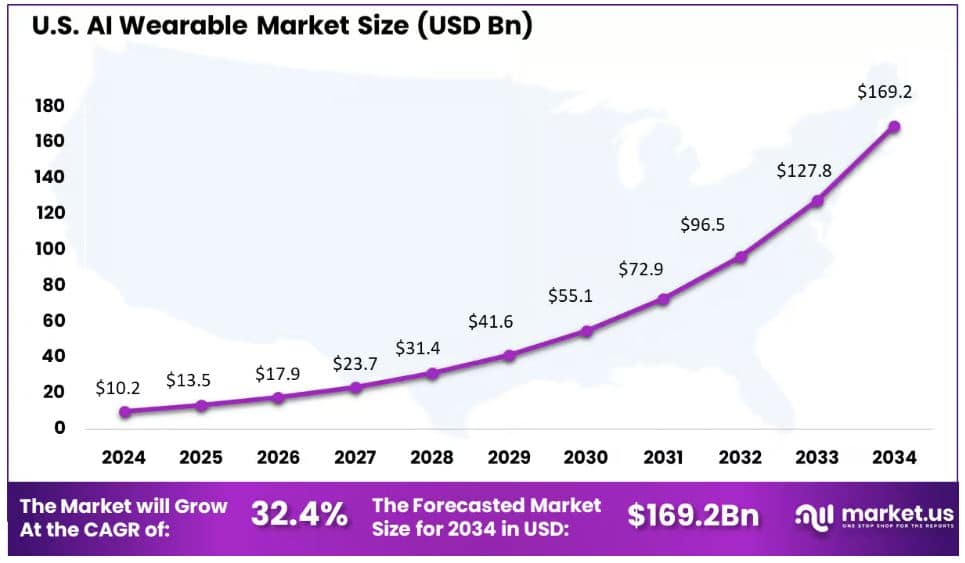
| U.S. AI Wearable Market Value (2025) | USD 13.5 Bn |
| U.S. AI Wearable Market Value (2034) | USD 169.2 Bn |
Global Wearable AI Market Statistics
(Source: market.us)
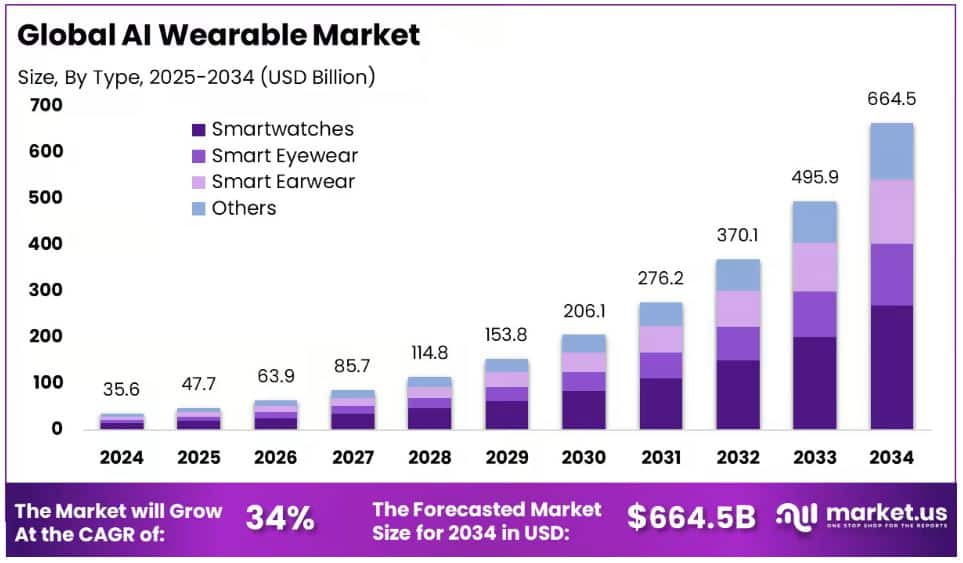
- The global AI wearable market was worth USD 35.6 billion in 2024. It is expected to grow from USD 47.7 billion in 2025 to around USD 664.5 billion by 2034, at an average annual growth rate of 34%.
- Consumer electronics hold about 34.8% of the market, as more people use AI wearables for daily activities, personal tracking, and convenience.
- On-device AI accounts for approximately 62.6% of the market. It allows wearable devices to work faster, protect user data, and provide some features without an internet connection.
- Processors represent nearly 54.7% of the market, due to the need for powerful chips that can quickly handle AI tasks in wearable devices.
- North America holds around 33.4% of the global market, supported by high consumer spending and the early adoption of new technologies.
(Source: market.us)
Wearable Device Shipment Market Insights
- Global wearable device shipments reached 534.6 million units in 2024, representing 5.4% year-over-year growth.
- The wrist-worn device market grew 10.5% year-over-year in Q1 2025, with Huawei, Xiaomi, and Apple ranking as the leading vendors.
- Hearables are expected to lead product growth in 2025, while smartwatches are likely to record a modest recovery during the year.
| Market Insights | Data |
| Total Shipments (2024) | 534.6 million units |
| Year-over-Year Growth (2024) | 5.4% |
| Wrist-Worn Market Growth (Q1 2025) | 10.5% year-over-year |
| Leading Wrist-Worn Vendors (Q1 2025) | Huawei, Xiaomi, and Apple |
| Top Product Growth (2025) | Hearables are expected to lead growth |
| Product Recovery (2025) | Smartwatches are anticipated to have a modest recovery |
Wearable AI Bioelectronics Performance Stats
- Wearable bioelectronics connect the human body with digital healthcare systems. These devices continuously and non-invasively measure biological and chemical signals for health checks, disease management, and personalized treatment.
- A complete system has 3 main parts: a bioreceptor, a transducer, and an AI processor. Bioreceptors have advanced from enzyme sensors with Km values of 10–30 mM to molecularly imprinted polymers with Kd below 1 nM and 90% specificity.
- Electrochemical transducers have improved their sensitivity from the μA/mM range to the nA/pM range. Laser-scribed graphene can achieve more than 95% charge-transfer efficiency, while plasmonic optical sensors can provide enhancement factors above 108.
- Edge AI has reduced processing delays from 500 ms to below 20 ms and lowered energy use from 100 mW to under 5 mW per analysis cycle.
- Modern systems can deliver 99% signal accuracy, compared with 70% in 2010. Interface resistance has fallen from 105 to 102 Ω.
- Flexible devices record less than 5% performance loss after 10,000 bending cycles, compared with complete failure after 100 cycles in early designs.
- Overall efficiency has improved 100-fold since 2010. Current systems support continuous monitoring below 1 mW, detect biomarkers below 1 pg/mL, and maintain variation below 3% CV.
AI Wearables for Sports Injury Prediction
- Shah et al. studied 218 elite soccer players using GPS, HRV, and accelerometers. Random forest and RNN models achieved an AUC of 0.87 in an RCT.
- Chidambaram et al. tested 142 multisport athletes using HRV, EMG, and IMU sensors. LSTM and decision-tree models reached 84% accuracy in a cohort study.
- Chen and Dai examined 67 collegiate runners using foot pods and gyroscopes. CNN and logistic-regression models recorded an AUC of 0.76 through narrative synthesis.
- Musat et al. tracked 88 basketball players using GPS, heart-rate sensors, and force plates. SVM and ANN models delivered 81% accuracy in an observational study.
- Kovoor et al. assessed 95 amateur cyclists with IMU, HRV, and cadence data. A CNN-KNN hybrid produced an AUC of 0.82 in cross-sectional research.
- McDevitt et al. analyzed 45 subjects using EMG and motion capture. An XGBoost ensemble achieved an AUC of 0.79, supported by narrative review and expert opinion.
- Seshadri et al. studied 203 rugby and team-sport athletes using GPS, accelerometers, and gyroscopes. A deep neural network reached an AUC of 0.85 in an RCT.
- Yadav et al. evaluated 61 track-and-field athletes using HRV and muscle-oxygenation data. Logistic regression achieved 78% accuracy in a cohort study.
| AI + wearables for injury prediction | ||||||
| Study | Sport/Task | Sensor Stack | Model Type | Sample Size (n) | Accuracy/AUC | Validation Level |
| Shah et al. | Soccer (elite) | GPS, HRV, accelerometer | Random forest, RNN | 218 players | AUC = 0.87 | RCT |
| Chidambaram et al. | Multisport (training load) | HRV, EMG, IMU | LSTM, decision trees | 142 athletes | Accuracy = 84% | Cohort |
| Chen and Dai | Running (collegiate) | Foot pod, gyroscope | CNN, logistic regression | 67 runners | AUC = 0.76 | Narrative synthesis |
| Musat et al. | Basketball (injury tracking) | GPS, HR, force plate | SVM, ANN | 88 athletes | Accuracy = 81% | Observational study |
| Kovoor et al. | Cycling (pro-amateur) | IMU, HRV, cadence | CNN + KNN hybrid | 95 cyclists | AUC = 0.82 | Cross-sectional |
| McDevitt et al. | General biomechanics | EMG, motion capture | Ensemble (XGBoost) | 45 subjects | AUC = 0.79 | Narrative + |
| Expert opinion | – | – | – | – | – | – |
| Seshadri et al. | Rugby/team sports | GPS, accelerometer, gyroscope | Deep neural network | 203 athletes | AUC = 0.85 | RCT |
| Yadav et al. | Track and field (rehab phase) | HRV, muscle oxygenation | Logistic regression | 61 athletes | Accuracy = 78% | Cohort |
(Source: Premierscience)
Health Wearable Adoption in the U.S.
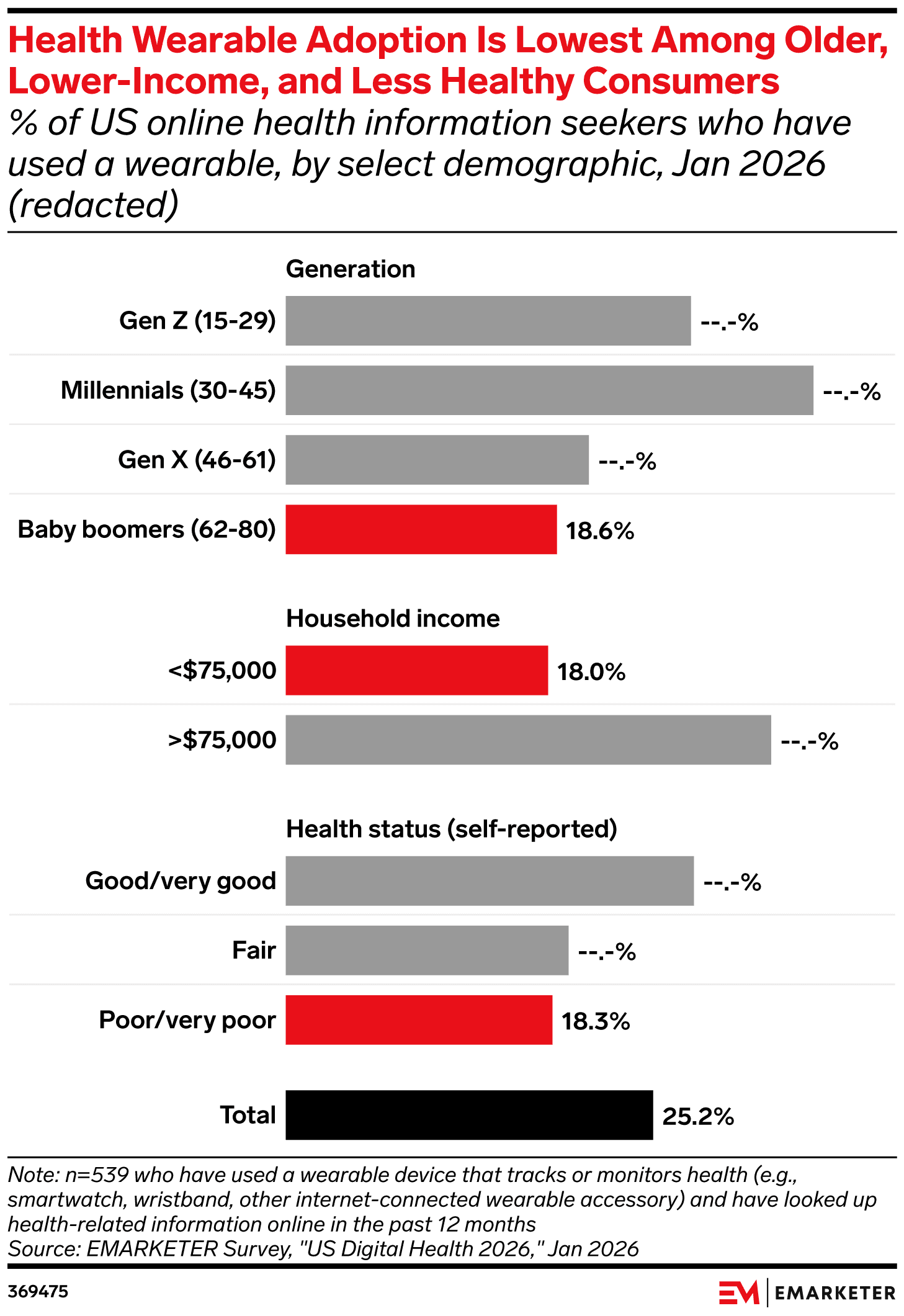
- In January 2026, 25.2% of U.S. online health-information users reported using a wearable device to track or monitor their health.
- Adoption among baby boomers aged 62–80 was 18.6%, lower than the levels shown for Gen X aged 46–61, millennials aged 30–45, and Gen Z aged 15–29.
- Among consumers with a household income below USD 75,000, 18.0% used a health wearable. Usage was higher among those earning more than USD 75,000.
- Consumers who rated their health as poor or very poor recorded an adoption rate of 18.3%. Those reporting fair, good, or very good health used wearables more often.
- The findings were based on 539 respondents who had used a wearable health device, visited health-related websites, or interacted with health information during the previous 12 months.
(Source: emarketer.com)
Global Wearable Shipment Stats
- In Q1 2025, worldwide wrist-worn shipments reached 45.6 million units, up 10.5% year over year.
- In Q2 2025, global wearable shipments reached 136.5 million units, up 9.6%, while wrist-worn shipments rose 12.3% to 49.22 million units.
- By Q3 2025, global smartwatch shipments for the first 3 quarters totalled 120 million units, increasing 7.3% year over year.
- In Q4 2025, worldwide wearable shipments grew 14%, supported by stronger demand for smart glasses, rings, and watches.
- In Q1 2026, total wearable shipments reached 145.7 million units, representing 4.3% annual growth.
- In Q2 2026, wrist-worn shipments declined 4.3% to 48.01 million units. Smartwatches fell 4.2% to 37.08 million units, while fitness bands dropped 4.7% to 10.92 million units.
Recent Wearable AI Statistics
- On September 3, 2026, Oura filed for a U.S. IPO after nine-month revenue increased 74% to approximately USD 1.21 billion; its previous funding round exceeded USD 900 million at an estimated USD 11 billion valuation.
- In July 2026, Meta awarded nearly USD 2 million in AI Glasses Impact Grants to 30 U.S. organizations selected from almost 500 applications.
- On June 22, 2026, Meta announced Meta Glasses with EssilorLuxottica; availability began June 23 for Glasses with the Muse Spark-powered Meta AI assistant in the United States and Canada, followed by availability in additional markets.
- On May 19, 2026, Google and Samsung presented two Gemini-powered intelligent-eyewear designs developed with Gentle Monster and Warby Parker, with the first audio-glasses collections scheduled for fall 2026.
- On April 10, 2026, Snap’s Specs subsidiary and Qualcomm signed a multiyear agreement to use Snapdragon XR processors in future Specs generations, including support for on-device AI and advanced graphics.
- On January 5, 2026, XREAL and ASUS Republic of Gamers formed a strategic partnership and unveiled the ROG XREAL R1 AR glasses, scheduled for global shipment during the first half of 2026.
- On December 5, 2025, Meta acquired Limitless, the developer of an AI pendant that records and transcribes conversations; financial terms were not disclosed.
- On July 22, 2025, Amazon agreed to acquire Bee, whose USD 50 AI bracelet converts recorded conversations into summaries, reminders, and task lists.
The Bottom Line
The wearable AI market shows clear structural momentum, with strong long-term growth projections now being validated by real capital flows. Oura’s IPO filing on the back of sharp revenue growth, alongside major hardware and acquisition moves from Meta, Google, Samsung, and Amazon, signals that big players see this as a durable category rather than a passing trend.
At the same time, a recent dip in wrist-worn shipments points to near-term saturation in that segment, even as smart glasses and bioelectronics continue to accelerate. Ultimately, the sector’s next phase of growth depends on resolving privacy, accuracy, and interoperability concerns before adoption can meaningfully broaden beyond its current base.
FAQ
The wearable AI market is expected to grow at 34% rate over the next several years. This steady growth is driven by rising demand for health tracking and smart connectivity features.
Smartwatches and fitness trackers are the leading devices in the wearable AI market today. These devices are popular because they offer real-time health monitoring and personalized insights.
North America currently leads the global wearable AI market. Strong technology adoption and high consumer spending power drive this regional dominance.
Wearable AI devices are widely used in healthcare to monitor heart rate, sleep patterns, and physical activity. These insights help users and doctors track health conditions more effectively.
Wearable AI plays a major role in fitness tracking by providing personalized workout recommendations and progress reports. This technology motivates users to stay active and reach their fitness goals.
Wearable AI faces challenges such as data privacy concerns and battery life limitations. Many companies are working to improve security features and device efficiency to address these issues.

Sources