









Introduction
Cloud Statistics: Cloud computing is now a big part of everyday life—from the apps we use on our phones to how businesses store files and run services. Whether you’re a business owner, work in tech, or use online tools, knowing the latest cloud stats is super helpful. Why? The Cloud isn’t just a passing trend; it’s changing how people work, share, and grow in today’s digital world.
In this overview, you’ll learn about key cloud trends like market value in USD, how fast it’s growing, how much money it saves, and the main problems companies deal with. These Cloud Statistics can help you make smarter choices in a cloud-based world.
Editor’s Choice
- Global spending on cloud computing is projected to reach USD 679 billion by 2024.
- By 2025, there will be 200 zettabytes (a trillion gigabytes) of data in the world.
- According to Spacelift.io, nearly 96% of companies utilize the public Cloud.
- By 2026, the cloud computing market is projected to be worth USD 947.3 billion.
- Amazon Web Services remains the largest public cloud provider, with a 32% market share.
- Around 84% of the companies use a private cloud.
- The main challenge facing cloud decision-making is managing cloud spend at 82%.
- Nearly 94% of businesses noted improvement in their security after moving to the Cloud.
- Forbes Global has created an EBITDA value of nearly USD 3 trillion.
- Market drivers for public cloud computing have grown to 23.8%.
- AWS dominated the industry with a nearly 32% share of the cloud market.
- By 2026, it is estimated that 85% of companies will adopt a cloud-first principle.
- According to Statista’s report, “Cloud Statistics,” nearly 73% of the insurance sector utilizes a flexible architecture.
Worldwide Public Cloud Services End User Spending Forecast, 2024-2025(Millions of U.S Dollars)
| 2024 Spending | 2024 Growth (%) | 2025 Spending | 2025 Growth (%) | |
|
Cloud System Infrastructure Services (IaaS) |
169,818 | 21.3 | 211,856 | 24.8 |
| Cloud Desktop-as-a-Service (DaaS) | 3,466 | 7.7 | 3,849 |
11.1 |
|
Cloud Application Services (SaaS) |
250,804 | 18.1 | 299,071 | 19.2 |
| Cloud Application Infrastructure Services (PaaS) | 171,565 | 19.1 | 208,644 |
21.6 |
|
Total Market |
595,652 | 19.2 | 723,421 |
21.5 |
Cloud Computing Market Statistics
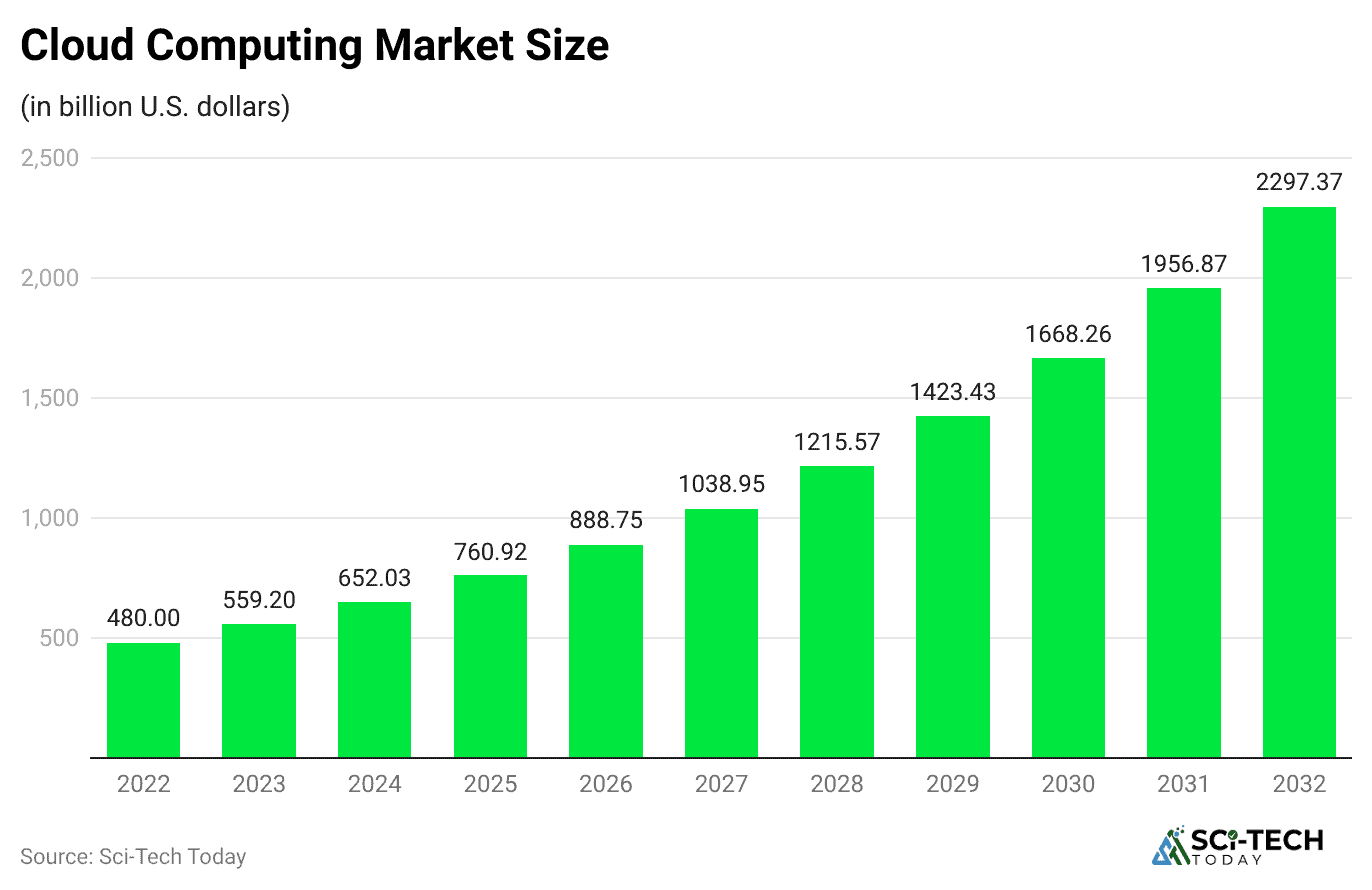
- The global cloud computing market has experienced significant growth in recent years. It was worth USD 446.51 billion in 2022 and is projected to increase to USD 500 billion in 2023.
- Experts predict that it will surpass USD 1 trillion by 2028 and could reach USD 1.6 trillion by 2030.
- New reports also indicate that the market is expected to grow at a compound annual growth rate (CAGR) of approximately 43% through 2032.
 (Reference: edgedelta.com)
- Cloud computing is now a basic need for many companies. About 94% of large businesses around the world are using the Cloud in their operations.
- By 2030, the use of cloud services is expected to help Forbes Global 2000 companies generate more than USD 3 trillion in EBITDA (Earnings Before Interest, Taxes, Depreciation, and Amortisation). For Fortune 500 firms alone, the expected value exceeds USD 1 trillion.
- Businesses are shifting toward the Cloud because it’s easy to grow, secure, and dependable. In 2020, cloud spending went up by 35% (about USD29 billion)
- In 2023, demand for public cloud services grew to 23.8%.
- During the COVID-19 pandemic, cloud spending increased by 9%, while overall IT budgets decreased by 8%.
Cloud Spending Statistics
- By 2025, small and mid-sized businesses (SMBs) are expected to use over 50% of their technology budget on cloud services.
- In 2025, people and companies worldwide are expected to spend approximately USD 723.4 billion on public cloud services. That’s a big jump from USD 595.7 billion in 2024, mostly due to the fast growth of AI tools and mixed cloud setups.
- About 1 out of 3 organizations will invest more than USD12 million a year on public cloud services in 2025—up from 29% in 2024. This increase is closely tied to the growing use of generative AI, which 72% of businesses now utilize.
- More than half (54%) of small and medium businesses now spend over USD 1.2 million every year on cloud services. That’s a big rise from 38% just two years ago.
- According to IDC, SMBs are expected to raise their cloud budgets by 31% to support more cloud usage.
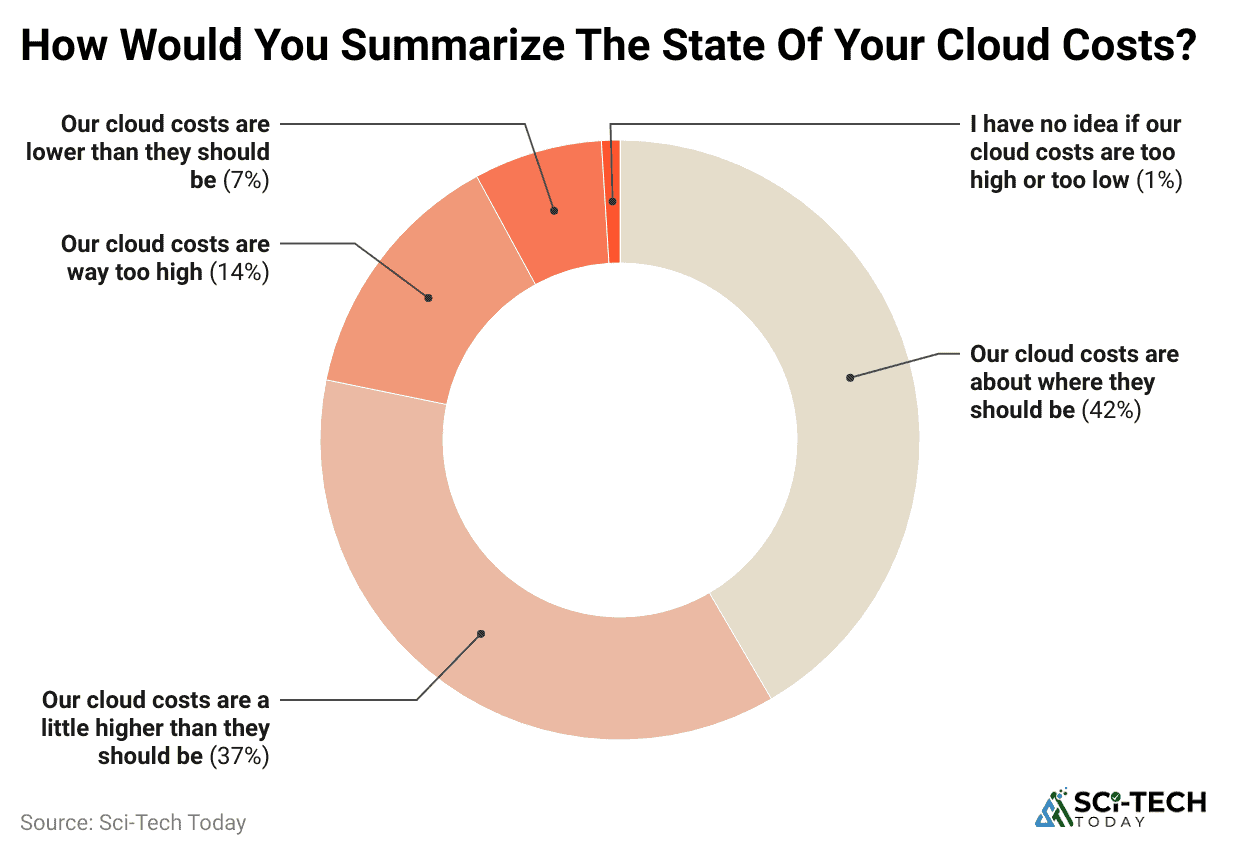
- Around 6 in 10 organizations say they’re paying more for cloud services than they planned. Out of 1,000 people asked, 490 said their costs were a bit higher than expected, while 110 said the costs were much too high.
 (Reference: cloudzero.com)
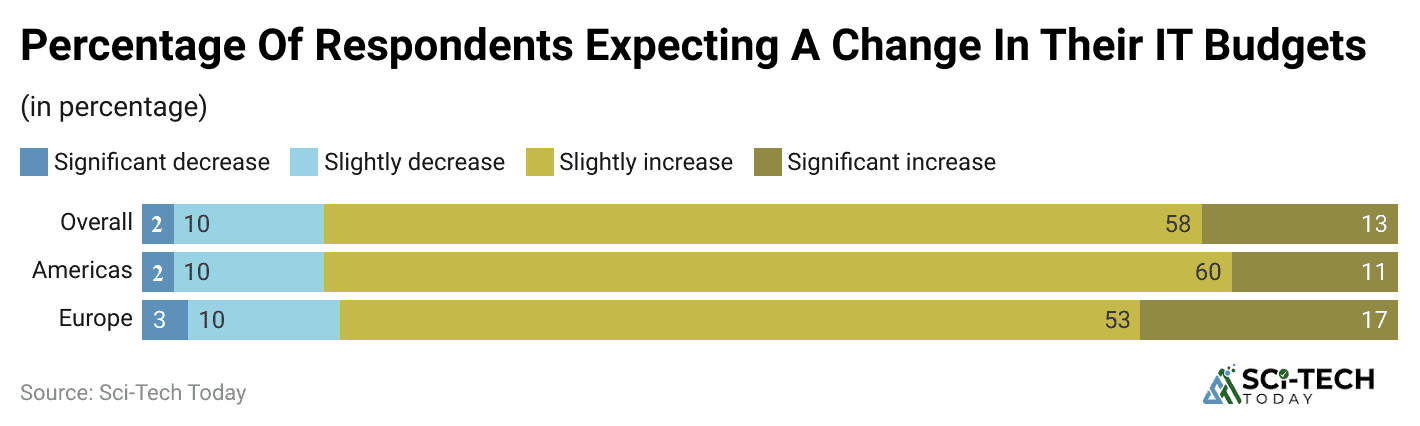
Around 71% of businesses believe their cloud spending will rise soon. In a global survey of 501 IT leaders:
#1. 58% expect a small rise in cloud costs
#2. 13% expect a big increase in what they spend
#3. Only 2% think their cloud bills will drop a lot
#4. 10% expect a slight decrease in spending
 (Reference: cloudzero.com)
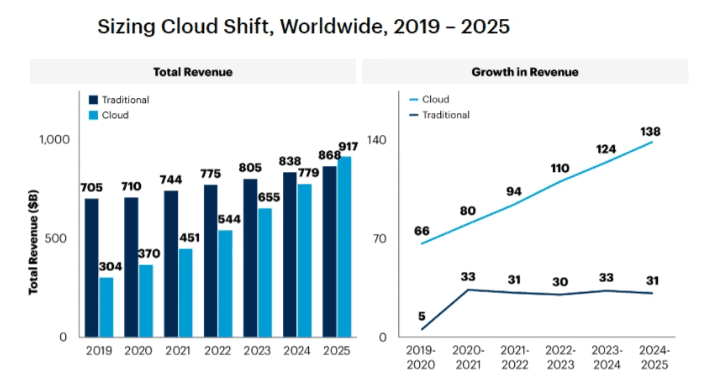
- According to cloud statistics, Forbes reported that 58.7% of IT budgets are still allocated to traditional tech systems. But that’s about to change.
- According to Gartner’s 2019–2025 forecast, cloud spending is going up each year, while spending on older IT setups is slowly dropping.
- By 2025, businesses are expected to allocate a greater portion of their budget to cloud services than to traditional IT.
 (Source: cloudzero.com)
Cloud Computing Key Players
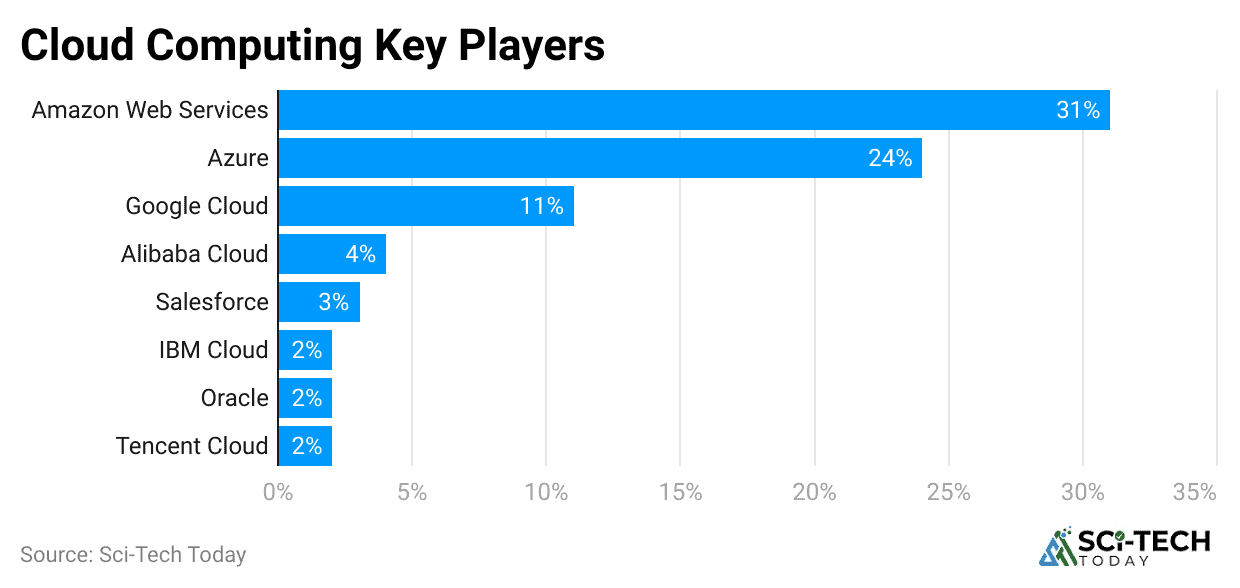 (Reference: edgedelta.com)
| Key players | % |
|
Amazon Web Services |
31% |
| Azure |
24% |
|
Google Cloud |
11% |
| Alibaba Cloud |
4% |
|
Salesforce |
3% |
| IBM Cloud |
2% |
|
Oracle |
2% |
| Tencent Cloud |
2% |
Cloud Migration Statistics
- Almost one-third of the money businesses spend on cloud services is wasted because of poor planning and wrong decisions.
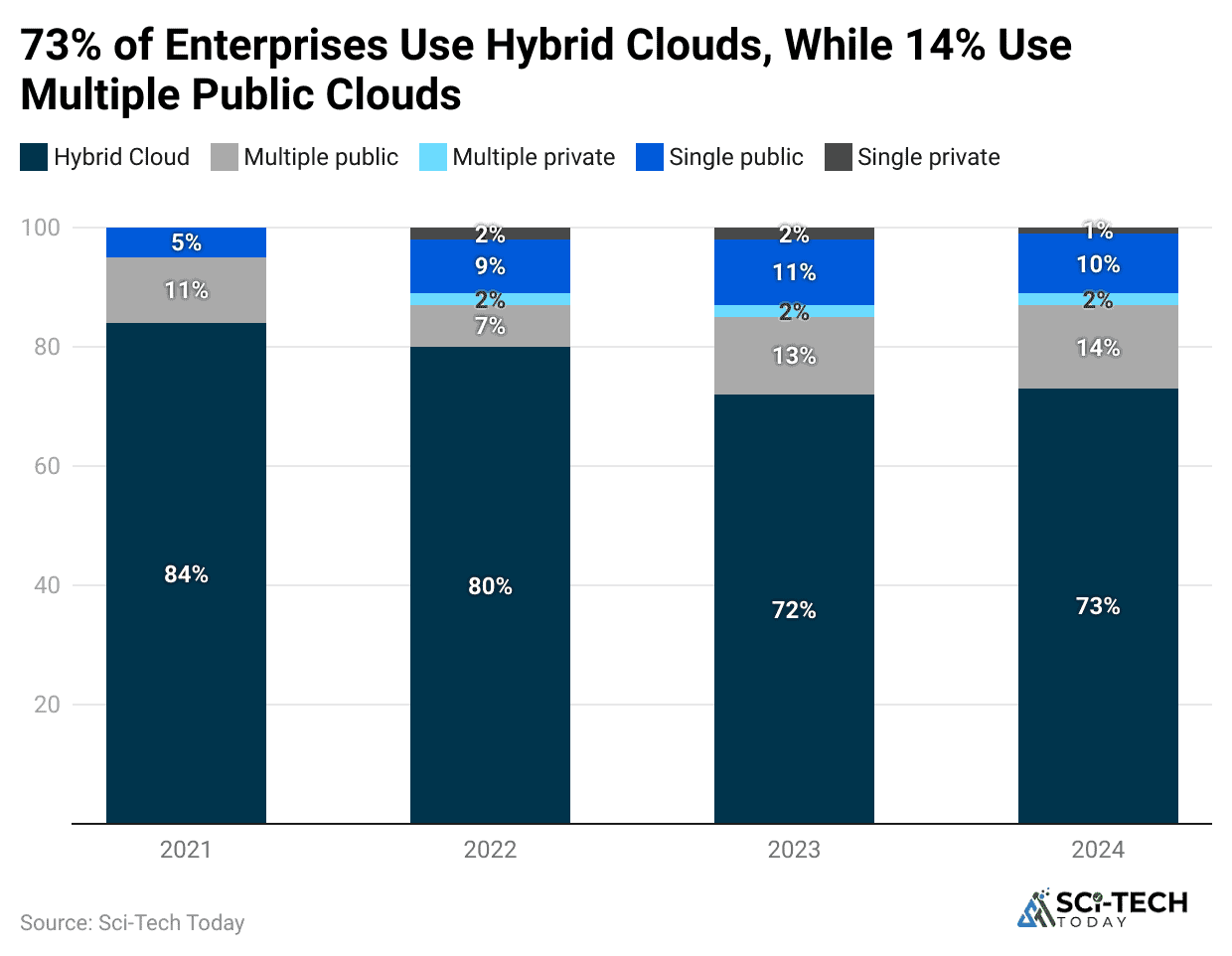 (Reference: auvik.com)
| Year | Hybrid Cloud | Multiple public | Multiple private | Single public | Single private |
|
2021 |
84% | 11% | – | 5% | – |
| 2022 | 80% | 7% | 2% | 9% |
2% |
|
2023 |
72% | 13% | 2% | 11% | 2% |
| 2024 | 73% | 14% | 2% | 10% |
1% |
Here’s how much companies are expected to spend this year and how much that’s up from last year:
#1. PaaS: USD176.5B (+21.5%)
#2. SaaS: USD244B (+18.9%)
#3. DaaS: USD3.1B (+10.7%)
#4. BPaaS: USD72.9B (+10%)
- 60% of Businesses Saw Their Revenue Stay Strong or Improve Thanks to the Cloud
The public cloud market was worth:
#1. 3B in 2021
#2. 5B in 2022
#3. USD561B in 2023
- It’s expected to grow by 2.5% in 2024 and reach USD 675.4 billion, then USD 825 billion by 2025, with a 21.3% yearly growth rate.
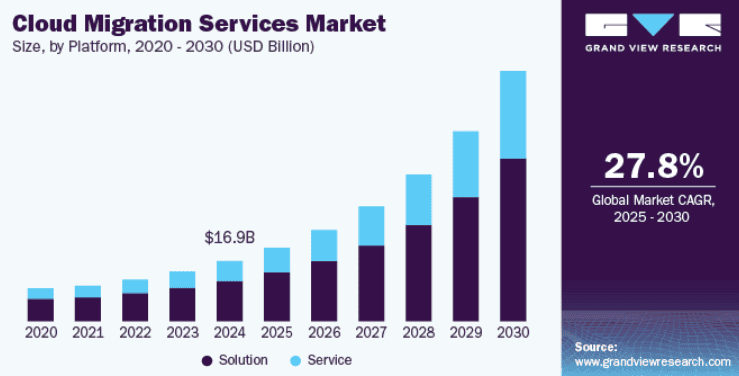 (Source: grandviewresearch.com)
Estimated 2024 numbers for different cloud types:
#1. SaaS: USD247.2 billion
#2. IaaS: USD180 billion
#3. PaaS: USD172.4 billion
#4. BPaaS: USD76.7 billion
#5. DaaS: USD3 billion
- By fully leveraging cloud technology, companies could gain a portion of an estimated USD 3 T in profits before taxes and interest (EBITDA) by reducing costs, increasing revenue, and investing in advanced technology.
Plans for using multiple cloud providers:
#1. Researching or exploring: 36%
#2. In progress: 24%
#3. Already using: 13%
#4. No plans: 27%
- On average, businesses spend 31% of their tech budget on cloud services. Around 66% of IT leaders believe that number will increase in the next 12 months.
AWS is the biggest provider with a 31% share, followed by:
#1. Microsoft Azure: 25%
#2. Google Cloud: 10%
- In most companies, IT departments make 72% of cloud-related spending choices. Other departments manage the remaining 28%.
- In 2023, fewer than 15% of large businesses utilized cloud platforms to support new projects. That number is expected to increase to 70% by 2027, primarily due to the rise of AI tools.
- Forbes cited Cloud Statistics, showing that nearly 60% of firms already use the Cloud for sensitive financial info.
- Only 25% say they don’t plan to, which shows the growing need for strong cloud security.
What companies look for most when picking a cloud vendor:
- Help with cost control: 37%
- Strong security skills: 34%
- Better tools to manage cloud services: 28%
- Advice on cloud strategy: 26%
- Support and training: 25%
- Discounts or bulk licenses: 25%
- Tools for rules and governance: 23%
- New techs like AI and ML: 21%
- Services for specific industries: 19%
- Sticking to industry standards: 17%
What businesses are most likely to adopt in the next year:
- AI/ML: 53%
- Security: 46%
- Backup and disaster recovery: 46%
- SaaS: 40%
- Big data: 38%
- Analytics: 33%
- Serverless computing: 31%
- IaaS: 31%
- Compliance tools: 30%
- PaaS: 29%
- Automating tasks: 29%
- Managing multiple clouds: 26%
- Edge computing: 26%
- Private Cloud: 25%
- Data center IaaS: 23%
- Security as a service: 23%
Types of Cloud Computing Statistics (SaaS, PaaS, IaaS, and Serverless)
- Worldwide spending on cloud infrastructure could grow to USD 1.35 trillion by 2027. This expansion is expected to happen at a compound annual growth rate (CAGR) of 19.9% between 2023 and 2027.
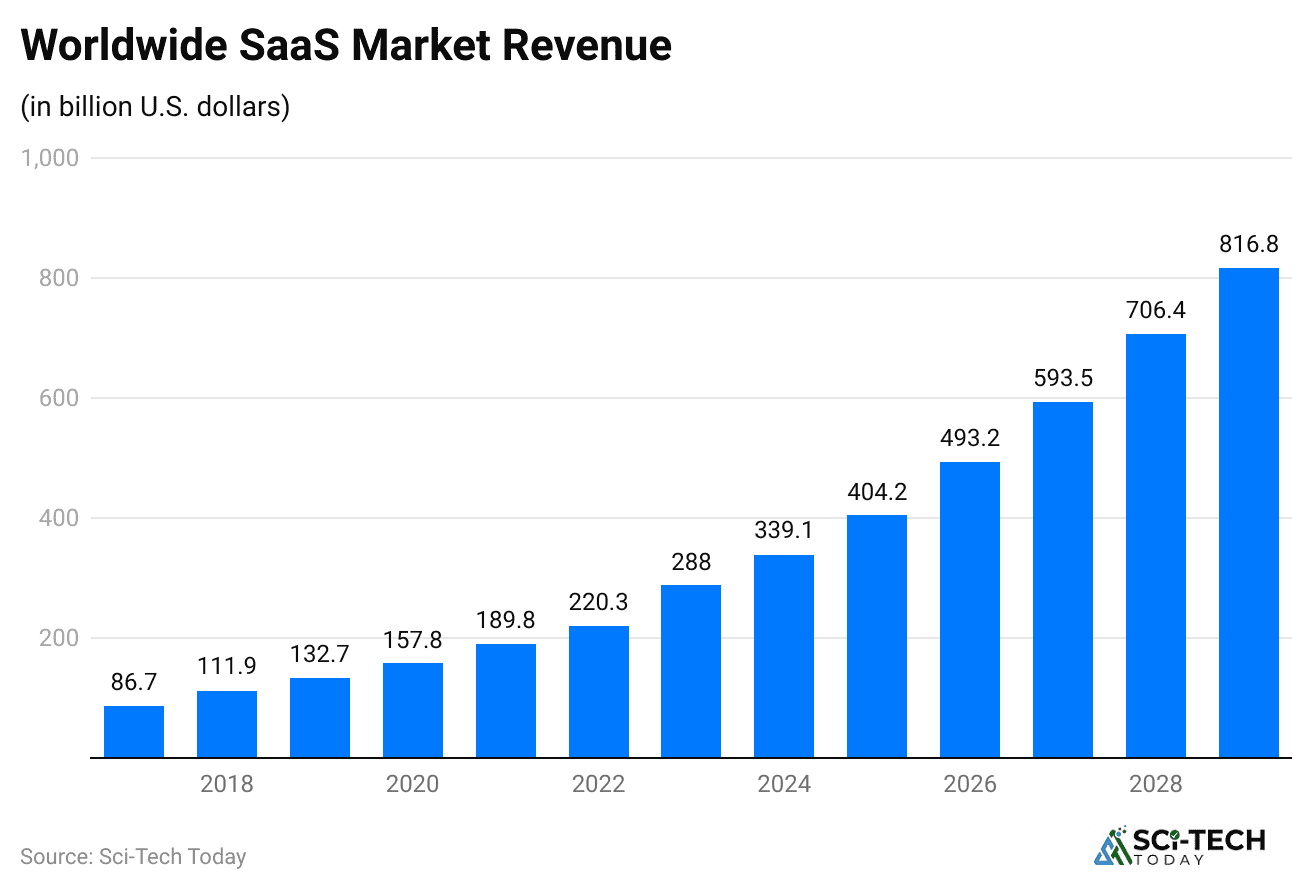 (Reference: semrush.com)
- In the above chart, we can see the worldwide SaaS market revenue from 2017 to 2029.
Specific industries are likely to see even faster growth:
#1. Software and information services are expected to grow at a compound annual growth rate (CAGR) of 24%.
#2. Capital markets are projected to increase by 21.9% each year.
#3. The telecommunications sector is projected to grow at an annual rate of 21.8%.
#4. Countries like Canada, as well as regions such as Asia-Pacific and Central and Eastern
#5. Europe is seeing a rising demand for cloud infrastructure services.
- In 2023, Software as a Service (SaaS) took the lead in the public cloud market, making up about 62% and bringing in around USD 412.5 billion in total revenue.
- Approximately 45% of this market originated from SaaS applications, which generated USD 298.5 billion.
- Another 17% came from system infrastructure software under SaaS, contributing USD 144 billion.
Other public cloud segments included:
#1. Infrastructure as a Service (IaaS) accounted for 19.9% of the market, with USD 133.4 billion in revenue.
#2. Platform as a Service (PaaS), which made up 18.4% and generated USD 123.3 billion.
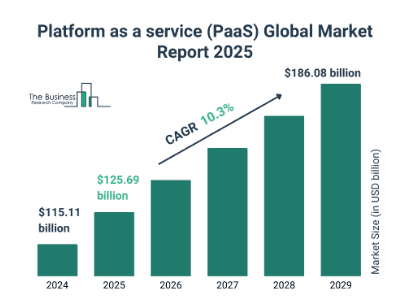 (Reference: thebusinessresearchcompany.com)
- The chart above shows the Platform as a Service (PaaS) Global Market Report 2025.
- Over 75% of cloud specialists say they run their apps using ‘as-a-service’ solutions offered by Amazon Web Services (AWS).
- Worldwide spending by users on Software as a Service (SaaS) is expected to reach close to USD300 billion by 2025.
- Over 70% of AWS users, 60% of Google Cloud users, and 49% of Azure users are now using serverless services.
- In the past year, more companies have started using serverless features—Google Cloud saw a 7% jump, Azure grew by 6%, and AWS increased by 3%.
- Among organizations running serverless tasks on big cloud platforms, 7% are using CDNs to do it. Of these, 62% prefer frontend platforms like Vercel or Netlify, and 39% use edge computing tools from Cloudflare or Fastly.
Private Cloud Statistics
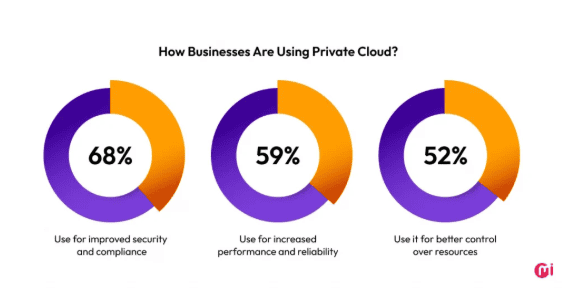 (Source: mindinventory.com)
- About 84% of companies are now using private cloud services as part of their IT systems.
- Revenue from private cloud solutions is expected to grow to nearly USD685.2 billion by 2030, with an average yearly growth rate (CAGR) of 29.7% from 2024 to 2030.
- Currently, 63% of small and medium-sized businesses (SMBs) have most of their workloads running in private cloud environments.
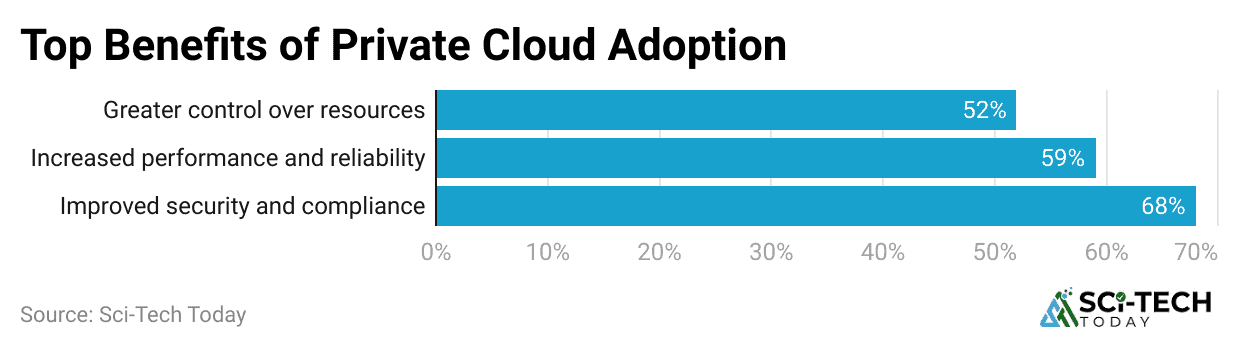 (Reference: scoop.market.us)
Companies report several key advantages of using private Cloud:
- 68% say it offers stronger data protection and helps meet regulatory standards
- 59% mention better speed and system reliability
- 52% say it gives them greater control over their computing resources
Still, many face some difficulties when using private cloud solutions:
- 45% find it hard to set up due to complexity
- 40% lack trained staff with the right skills
- 37% say the initial costs are too high
Public Cloud Statistics
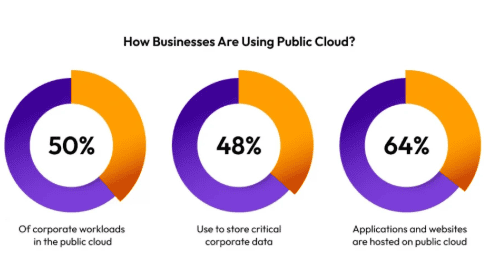 (Source: mindinventory.com)
- The global public cloud market is expected to reach USD 2.2 trillion by 2031, with an average annual growth rate of 17.41% from 2024 to 2031.
- Right now, about 96% of businesses worldwide are using public cloud services. On average, companies run over half of their workloads using public cloud platforms.
- Approximately 48% of companies utilize public cloud systems to store their most critical business data. In addition, about 66% of applications and 62% of websites are hosted on public cloud platforms.
- A survey by O’Reilly found that 67% of respondents reported using public cloud solutions in their organizations.
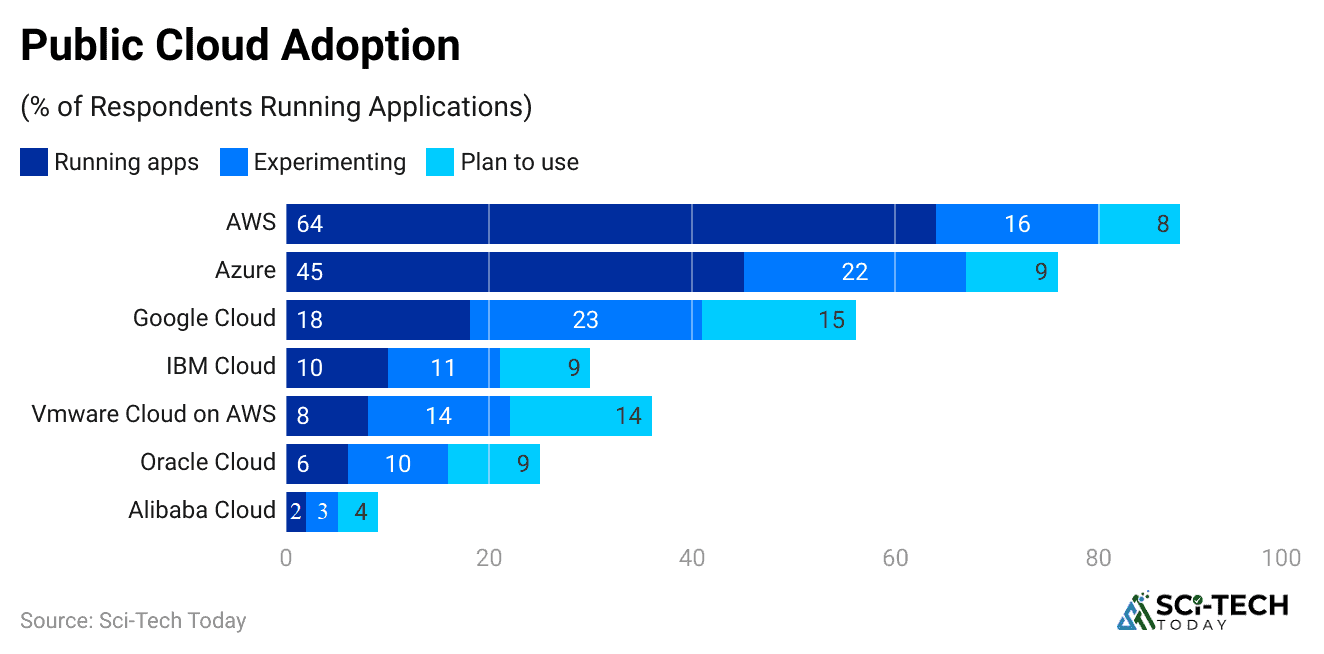 (Reference: cloudworldwideservices.com)
- The chart above shows the public cloud adoption rate among respondents running applications.
- Companies are spending more than USD 326 billion on public cloud services to support industries such as banking, technology, and telecommunications.
- A report by Flexera indicates that approximately 31% of large companies allocate over USD 12 million annually for public cloud tools and services.
- Top providers like Amazon Web Services (AWS), Google Cloud, and Microsoft Azure control a combined 66% of the public cloud market. AWS leads with a 31% market share as of early 2024.
- Many companies use containers to run Software in the Cloud — 83% of businesses use containers, and 77% also use tools like Docker and Kubernetes to manage them.
- Techdogs cited Cloud Statistics, showing that approximately 68% of businesses choose public cloud services because they help reduce expenses.
- Companies moving to the public Cloud can save anywhere from 15% to 50% in the long term.
Hybrid Cloud Statistics
- The hybrid cloud industry is expected to reach USD 262 billion by 2027, with the Asia-Pacific region accounting for the largest portion of this market.
- As of 2024, approximately 73% of companies have adopted a hybrid cloud strategy. A report from Flexera indicates that nearly 80% of large businesses utilize a combination of public and private cloud services.
- Around 56% of companies making over USD500 million annually have already added a hybrid Cloud to their IT operations.
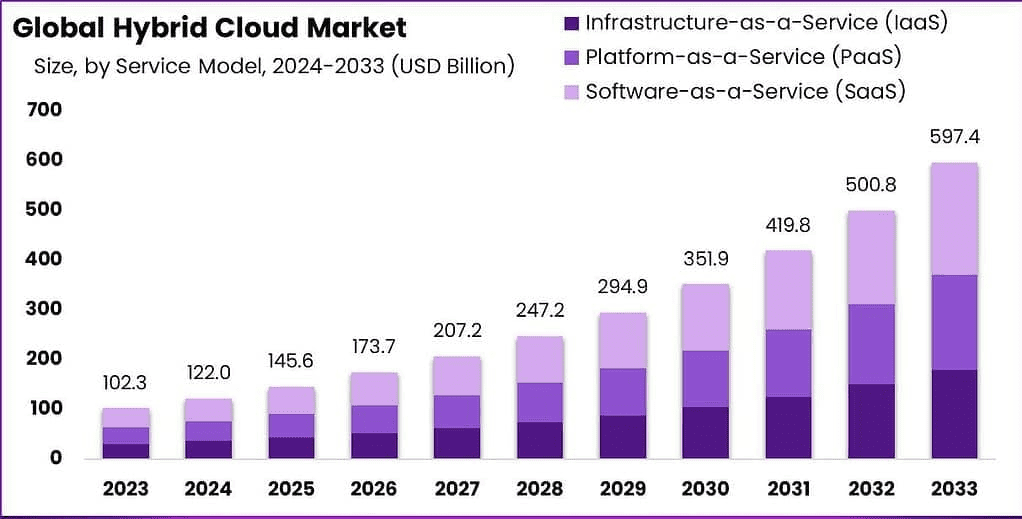 (Source: market.us)
- The above charts show the global hybrid cloud market for the years 2024-2033.
- Based on Cloud Statistics, Tech Dogs revealed that Firms using hybrid setups report that it works 2.5 times better than sticking to just one cloud platform.
-
Businesses also see major benefits:
#1. 42% improvement in flexible development environments.
#2. 40% boost in how fast and creatively they can respond to change.
#3. 94% say hybrid Cloud strengthens their data security.
#4. 77% believe it helps deliver apps and services quicker.
-
Firms rely on a hybrid cloud for different tasks:
#1. 65% use it for safe data backup and recovery.
#2. 48% use it for big data analysis.
#3. 45% apply it in app development and testing.
-
Even with its advantages, the hybrid Cloud comes with some difficulties:
#1. Sixty-two per cent of businesses deal with security and compliance concerns.
#2. 47% lack sufficiently skilled staff to manage cloud tools.
#3. Another 47% struggle to integrate cloud systems with their existing in-house infrastructure.
Multi-cloud Statistics
- The multi-cloud market is expected to reach USD 50.04 billion by 2030, growing at a rapid pace with a 28.6% CAGR.
- A study by Oracle found that 98% of businesses already using public cloud services have switched to a multi-cloud setup to save money and gain better control over their data.
- Approximately 90% of companies are transitioning to multi-cloud platforms to leverage their diverse range of benefits.
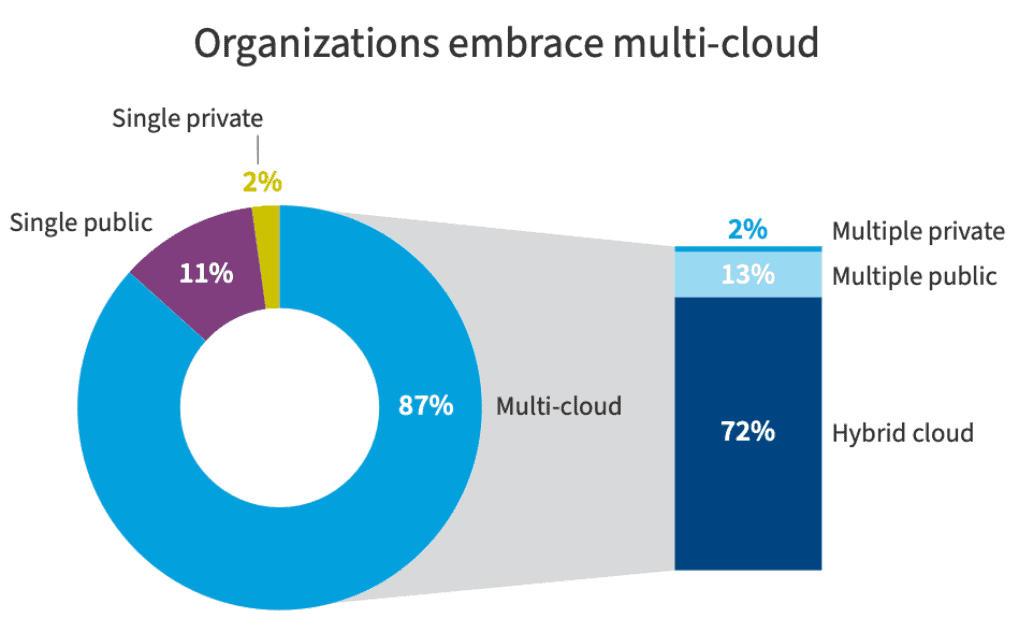 (Source: flexera.com)
-
Firms prefer multi-cloud environments for many reasons:
#1. 46% trust its strong performance and reliability
#2. 43% like its ability to adjust to new technologies
#3. 42% find it offers more freedom and flexibility
#4. 41% say it provides stronger control and oversight
They also use multi-cloud strategies to:
#1. Improve system dependability (46%)
#2. Support digital transformation efforts (43%)
#3. Scale services more easily (42%)
#4. Strengthen security and governance (41%)
- According to HashiCorp, 53% of organizations reported that their multi-cloud strategy enabled them to achieve their business goals.
- Looking ahead, 47% of companies plan to integrate multi-cloud systems into their existing setups.
- Meanwhile, 89% of businesses believe that automation is crucial for simplifying and improving multi-cloud operations.
-
Even though multi-cloud is popular, companies still face challenges:
#1. 51% struggle with implementation
#2. 47% deal with security issues
#3. 41% lack experienced cloud professionals
#4. 35% find the setup too complicated
#5. 33% run into compliance and regulation problems
Conclusion
Now that we have studied the issues and impacts of cloud security in detail security, companies have a pressing need to adopt an advanced approach to cybersecurity. Those days are gone when we could afford to use security measures months and weeks after deployment. Businesses shall focus on automated and continuous approaches. There shall be a security framework across the checks and controls in place that is properly governed by your organization’s risk management and adjusted as necessary to monitor the evolving threat landscape.

Sources
- Cloudzero
- Spacelift
- Statista
- Edgedelta
- Nextwork
- Gartner
- Auvik
- Statista
- Statista
- Statista
- Idc
- Europa
- Mindinventory
- Bluehost
- Sprinto
- Cloudkeeper
- G2
- Explodingtopics
- Market
- Cloudwards
- Radixweb
- Cloudzero
- Lemon
- Flexera
- Socradar
- Softext
- Forbes
- Canalys
- Cloudsecurityalliance
- Impossiblecloud
- Cloudinstitute
- Hashicorp
- Hava
- Saasworthy
- Pwc
- Techmagic
- Factmr
- Optiq
- Sentinelone
- Pump
- Techtarget
- Techjury
- Enterpriseappstoday
- Socradar
- Esparkinfo
- Holori
- Srgresearch
- Research
- Mordorintelligence
- Adivi
- Lambertconsulting
- Fortunebusinessinsights
- Market
- Secureframe
- Parachute
- Hostingadvice
- Hginsights
- Hotframeworks
- Hellohaar
- Precisely
- Stationx
- Whatsthebigdata
- Getastra
- Grandviewresearch
- Resfeberinfosolutions
- Expertinsights
- Brightlio
- Precedenceresearch
- Cloudwards
- Techdogs
- Founderjar


