








Beginning
Color Psychology Statistics: Colors do more than make things look beautiful, as they influence how we feel, think, and act. A bright yellow room can feel cheerful, while a blue space often feels calm and relaxing. This hidden effect of colors is called Color psychology. From brand logos and websites to home décor and fashion, colors play a powerful role in shaping emotions and decisions.
Businesses use the right colors to attract customers, while designers use them to create better experiences. Although color meanings can differ across cultures and personal preferences, they still have a strong impact on everyday life. Understanding color psychology helps you choose colors that communicate the right message and create the desired impression.
Must-Read
- 85% of consumers say color is the main reason they choose a product.
- Color can improve brand recognition by up to 80%, making consistent branding a key competitive advantage.
- 62%-90% of first impressions are based on color, and consumers often form these judgments within 90 seconds.
- 95% of the top 100 brands use only 1-2 logo colors to build a clear and memorable brand identity.
- Consistent brand colors across platforms can increase revenue by up to 23%.
- Red CTA buttons can increase conversions by 21% compared with green buttons in A/B tests.
- 42% of consumers view green packaging as a symbol of health and sustainability, while 54% associate red packaging with increased appetite.
- 76% of websites use white backgrounds, making white the most common website design color.
- Warm colors such as red, orange, and yellow increase attention and urgency, while blue enhances creativity and green supports memory and creative thinking.
- Google tested 41 shades of blue, and the winning shade generated an estimated USD 200 million in additional advertising revenue, demonstrating the business value of color optimization.
What is Meant By Color Psychology?
Color psychology is connected to colors, behavior, and emotions. It shows how colors play an important role in your moods and can also be part of a person’s wellness routine. For the market and industry, color psychology influences decisions like the packaging of the product or the logo of the brand. From ancient times, people have had a long fascination with colors and their power to change a person’s views and thoughts. Color was used in ancient China, Egypt, and Greece to induce emotions, assist in spiritual practices, and also treat many conditions.
Beyond color therapy, color psychology is also used in marketing and advertising a product or service. Product design and branding are also based on how people respond to a particular color.
Global 2026 Color Psychology Insights
- Web FX report further stated that color plays a major role in consumer decisions, with 85% of consumers saying color is the main reason they choose to buy a product.
- Research shows that 62%-90% of first impressions about products or environments are influenced by color alone.
- Around 60% of consumers accept or reject new products based on their color, and people typically form product judgments within 90 seconds, with color driving 62%-90% of that impression.
- A WebFX study found that 84.7% of people considered color the primary factor behind a purchase decision.
- Color advertising performs better, with color ads receiving 42% more views than black-and-white ads.
- Color can improve brand recognition by up to 80%.
- Globally, around 300 million people experience some form of color vision deficiency, while only 29% of websites meet WCAG AA color-contrast standards.
Key Insights on Brand Color Impact in 2026
- Colorlib Report shows that 95% of the top 100 brands use only one or two colors in their logos to maintain simple and consistent branding.
- Consistent use of brand colors across platforms can increase revenue by up to 23%, while colors can improve brand recognition by up to 80%.
- Around 76% of marketers consider color an important factor in building brand recognition.
(Source: pinterest.com)
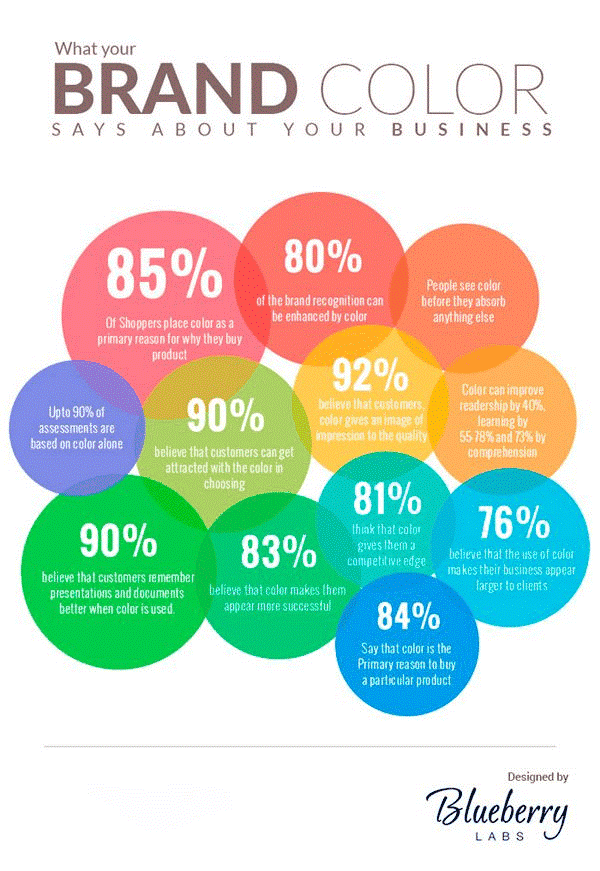
- 85% of shoppers say color is the main reason they choose a product.
- 80% of brand recognition can be improved through the right use of color.
- Up to 90% of first assessments are driven by color alone.
- 90% of people feel customers are attracted when strong colors are used.
- 92% believe color gives a clear image of product quality.
- Color can lift readership by 40% and support learning by 55%, 78%, and 73% for key messages.
- 90% say they remember presentations better when color is added.
- 83% think color makes a business appear more successful.
- 81% feel color delivers a competitive edge.
- 84% say color is the main reason they buy a specific product.
Color Psychology Associations in Marketing
- Blue is mainly linked with trust and security; 34% of people choose blue for trust and 28% for security, making it a strong choice for reliable brands.
- Red is strongly associated with speed and action; 76% of people pick red for speed, and 28% connect it with courage and bravery.
- Yellow is tied to fun and happiness, with 26% saying it represents joy, although muted yellow can also suggest nausea or sickness.
- Black signals high‑quality products and high technology; 26% associate it with high tech and 43% with high quality, but 38% also connect it with fear.
- Purple is associated with bravery by 29% of people and with fun and happiness by 17%.
- Green is linked to good luck, money, security, and trust in many responses.
- Silver and grey are associated with high technology by around 23% of people and often with good quality.
- Gold is viewed as a luxury, high‑quality color, strongly connected to expensive goods.
Color Psychology Statistics That Reveal How Colors Influence Brands
- Amra and Elma’s report also shows that consistent brand colors can increase recognition by up to 80%. Brands using 7+ consistent touchpoints achieved 87% recognition in 2026.
- Around 62%-90% of first impressions are shaped by color, and visual colors influence 88% of brand judgments at 90ms.
- Nearly 85% of consumers say color affects their purchase decisions, with this number reaching 93% among 18-34 shoppers.
- Brand colors are remembered by 81% of consumers, while only 43% recall brand names, showing the power of visual memory.
- About 92% of consumers consider visuals a major purchase factor, and 39% of website users are strongly influenced by site colors.
- Color advertisements receive 42% more impressions than black-and-white ads, improving advertising impact.
- Red CTA buttons can increase conversions by 34%, while blue appears in around 40% of Fortune 500 company logos.
- Around 95% of top brands use only 1-2 logo colors to create stronger recognition and consistency.
- Red, orange, black, and royal blue encourage impulse purchases, while navy and teal help build trust among budget-focused customers.
- Blue and black are often linked with premium quality, and consistent color branding can support up to 23% revenue growth.
- Around 55% of brand first impressions are visual, while strong color choices influence 48%-85% of buying decisions.
- Blue is the most preferred color in the United States at 35%, followed by green (16%) and purple (10%).
- Warm colors create energy and urgency, while cool colors promote trust and calmness. In 2026, 85% of marketers consider AI-powered color tools important for improving branding strategies.
Most Popular Brand Colors
(Source: colorlib.com)
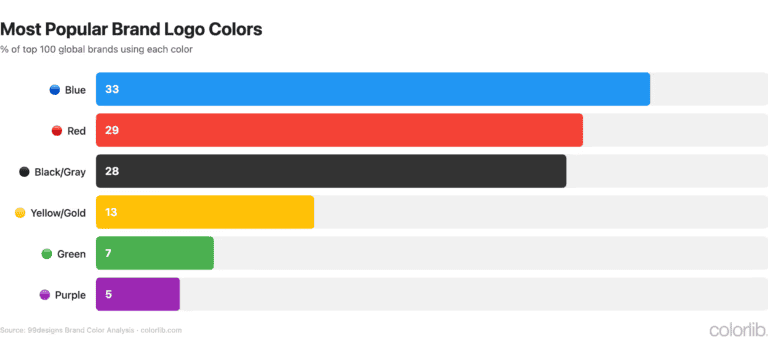
- Blue (33%) is the most used color among top brands, especially in finance, technology, and healthcare, with 75%+ of major banks using blue branding.
- Red (29%) is common in food, retail, and entertainment because it attracts attention and can stimulate appetite.
- Black/Gray (28%) is linked with luxury, fashion, and automotive brands, with black logos perceived as 50% more luxurious.
- Other colors include Yellow/Gold (13%), Green (7%), and Purple (5%).
Color Strongly Influences Buying Decisions and Attention
- 85% of consumers say color is the main reason they choose a product, according to Colorcom.
- The CCICOLOR Institute found that people make 62%-90% of their first impression based on color alone.
- Research from the Seoul International Color Expo shows that 93% of consumers focus on a product’s visual appearance before buying.
- Kissmetrics reports that 52% of shoppers have left a store because of poor visual design.
- Shopify UX found that accurate color display can reduce product returns by 39%.
- Xerox reports that color advertisements are read 42% more often, increase willingness to read by 80%, and improve learning and comprehension by 55%-78%.
- A University of Winnipeg study found that color advertisements are 26% more recognizable than black-and-white ads.
Color Impact on Conversion Rates
- Color changes can significantly affect customer actions, but there is no single color that works best for every brand. Businesses should test colors based on page design, audience behavior, and brand identity.
- A/B testing showed that red CTA buttons increased conversions by 21% compared with green buttons.
- Colored email buttons improved click-through rates (CTR) by 28% compared with plain text links.
- Green “free shipping” badges increased conversions by 14% compared with red or blue badges.
- Black packaging improved perceived product value by 10%-15%, while white space around products increased perceived value by 20%.
- Instagram posts with blue tones received 24% more likes than posts using red tones.
Color Trends in Web Design
- 76% of websites use white backgrounds, making it the most common web design choice.
- Google tested 41 shades of blue, with the best-performing shade generating USD 200 million in additional ad revenue.
- 46% of consumers consider website design a key factor in judging company credibility.
- 39% of users leave websites with unattractive color layouts, while high-contrast designs improve readability by up to 40%. Dark mode adoption has reached 82% among users with access.
Gender‑Based Favorite Colors
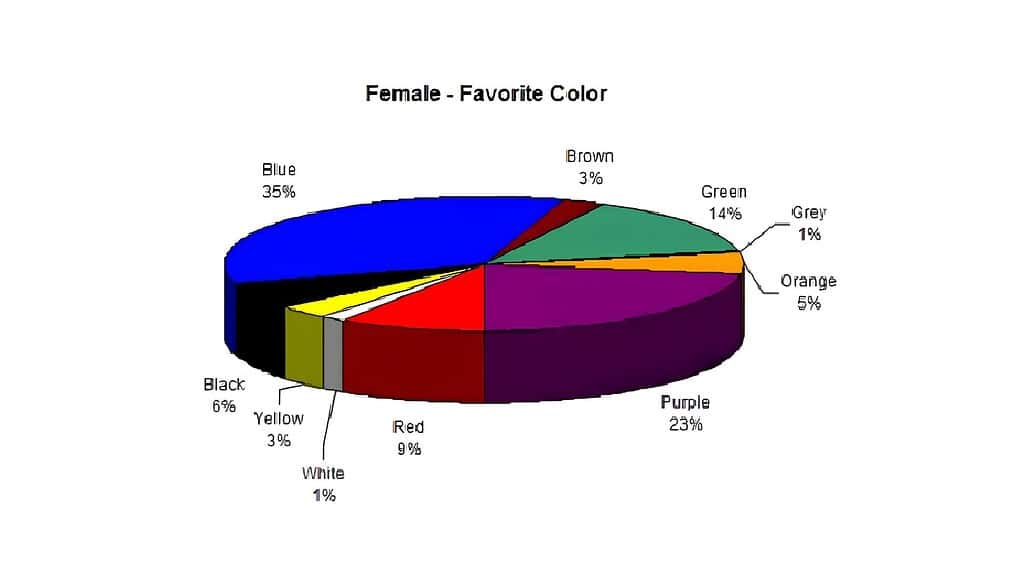
(Source: scribd.com)
Men
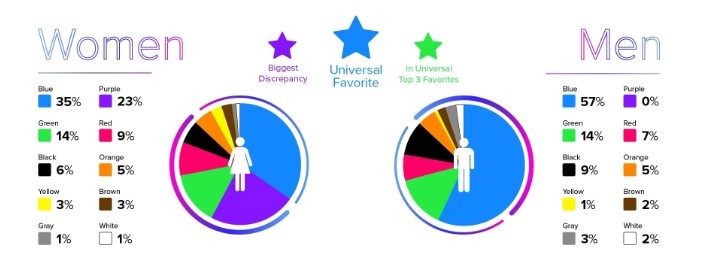
- Blue is the clear favorite for men, chosen by 57% of respondents.
- Green is the second favorite, selected by 14% of men.
- Black is preferred by 9% of male respondents.
- Red appeals to 7% of men, while orange is chosen by 5%.
- Grey is favored by 3% of men, brown by 2%, white by 2%, and yellow by 1%.
Women
- Blue is also the top favorite for women, chosen by 35% of respondents.
- Purple ranks second, with 23% of women selecting it as their favorite color.
- Green is preferred by 14% of women, and red by 9%.
- Black is chosen by 6%, orange by 5%, yellow by 3%, brown by 3%, while grey and white each stand at 1%.
Least Favorite Colors Statistics
(Source: vmgstudios.com)
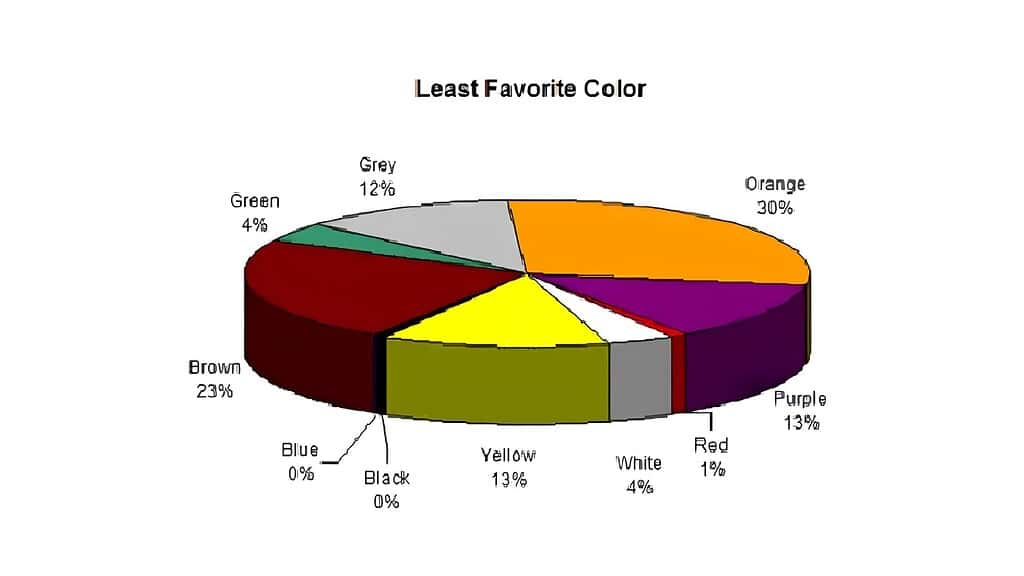
- Among women, brown is the most disliked color at 33%, followed by white at 3% and gray at 17%.
- Yellow is disliked by 13% of women, while black and green are least disliked at 0% and 6%, respectively, and purple is disliked by 8%.
- Among men, brown is again the top disliked color at 27%, with orange close behind at 22%.
- Purple and red are disliked by 22% and 13% of men, respectively, while white and gray each stand at 5%.
- Yellow is disliked by 13% of men, and green and blue rank lowest at 2% and 1%.
- The biggest gender gap appears in purple, marked as the color with the greatest discrepancy in dislike between men and women.
How Colors Influence Human Behavior and Memory
- Warm colors such as red, orange, and yellow can increase heart rate, stimulate appetite, and create a sense of urgency.
- Research shows that red improves performance on detail-focused tasks, while blue enhances creative thinking.
- Using color can improve memory by 55%-78% compared with black-and-white materials.
- Brief exposure to green before a creative task can increase creativity and idea generation.
- Baker-Miller Pink has been linked to reduced aggressive behavior in controlled settings.
- Blue lighting can improve alertness and cognitive performance.
- The Von Restorff Effect shows that items highlighted with distinct colors are easier to remember.
- Consumers are 15% more likely to revisit a blue-themed store than an orange-themed store.
How Product Colors Influence Consumer Buying Decisions
- Product and packaging colors strongly affect consumer choices by creating feelings linked to health, luxury, trust, and sustainability.
- A study by LIFOCOLOR found that 62% of consumers associate green packaging with health and sustainability, while 54% find red packaging more appetite-stimulating.
- Around 48% view black packaging as a sign of luxury.
- 50% of consumers selected a brand because of its color scheme.
- It also found that 42% of impulse purchases are influenced by shelf colors, while 56% of consumers associate blue with trust and 23% connect green with freshness.
- Around 68% of consumers believe packaging colors affect buying decisions, increasing to 82% in beverages.
- Coordinated point-of-sale color designs can increase purchase intent by 38%, and 71% of shoppers consider store design important for a positive shopping experience.
Ending Note
Color psychology helps us understand how different colors can affect our feelings, thoughts, and choices. It is widely used in marketing, branding, design, fashion, and daily life to create the right mood and message.
However, people do not always react to colors in the same way because culture, age, and personal experiences also matter. Using colors wisely can improve communication, attract attention, and create a better experience for everyone.
FAQ
No, color meanings vary with culture, personal experiences, age, and individual preferences.
Red usually attracts the most attention because it appears bold, bright, and eye-catching.
The best branding colors depend on your brand. Blue builds trust, red creates excitement, green shows growth, and black represents luxury.

Sources