









Introduction
Fractional Executive Hiring Statistics: Fractional executive hiring has turned into one of the fastest-growing talent approaches in 2026, because companies want seasoned C-suite guidance without paying the high full-time price or locking themselves into a long commitment. More and more startups, mid-sized SMEs, private equity-backed teams, and even large enterprise orgs are bringing in fractional CEOs, CFOs, CMOs, CTOs, CHROs, and COOs to speed up expansion, oversee change efforts, and handle AI-powered disruption as it shows up.
At the same time, higher executive pay, ongoing leadership gaps, and economic doubt are all pushing the trend faster. Findings cited by Heidrick & Struggles, MBO Partners, Gartner, Newsweek, and various workforce reports suggest that fractional leadership is moving out of a weird niche staffing lane and into something pretty mainstream for executive hiring. The global market is expected to keep growing at double-digit rates across the decade.
This article explores the latest fractional executive hiring statistics, market growth, adoption trends, pricing models, cost comparisons, AI-driven demand, and the measurable business benefits shaping executive leadership in 2026.
Editor’s Choice
- Globally, the fractional executive market hit USD 5.7 billion in 2025, and it’s still rising at a 14% CAGR, which basically points to steady demand for flexible leadership.
- The fractional talent pool now sits above 120,000 professionals. Meanwhile, LinkedIn fractional executive profiles jumped from 2,000 to 110,000 between 2022 and 2024.
- 72.8% of fractional executives bring more than 15 years of experience, so businesses can tap leadership that’s already been through the real cycles.
- Teams that hire fractional marketing leaders report around 40%–70% cost savings versus bringing on full-time execs with comparable skills.
- Fractional leaders tend to start showing measurable business results within 30–45 days, where traditional executive hiring often takes about 6–9 months.
- Organizations also report an 84% client renewal rate.
- Gartner thinks that by 2027, over 30% of midsize businesses will have at least one fractional executive on board.
- Fractional marketing executives usually run about USD 60,000–USD 240,000 per year, which is way under the USD 275,000–USD 500,000+ you’d pay for a full-time CMO.
- 77% of business leaders say AI is boosting the need for specialized fractional executives, and the demand for AI freelancer skills jumped 109% year over year.
- By the end of 2026, more than 40% of U.S. SMEs are expected to use fractional leadership.
What is A Fractional Marketing Executive?
A fractional marketing executive, often a CMO, VP of Marketing, or Marketing Director, works with your company on a part-time basis. They still hold the same kind of authority and accountability you’d expect from a full-time leader. They join your senior leadership group, report to the CEO, and take real responsibility for measurable results like pipeline contribution, CAC efficiency, and revenue growth. The key difference is ownership at the leadership level, not just sideline advisory.
A fractional CMO actually makes decisions, manages budgets, keeps vendors in line, and is genuinely accountable for outcomes, unlike a marketing consultant who mainly recommends. According to Carter Murray February 2025, the fractional model is now pretty well established in the United States, and it’s getting more common across the United Kingdom and EMEA too. Most fractional arrangements land around 8 to 30 hours per month, usually set up as a monthly retainer with a clear scope and termination terms in the 30- to 660-dayrange.
Fractional Executive Market
(Source: over50pros.com)
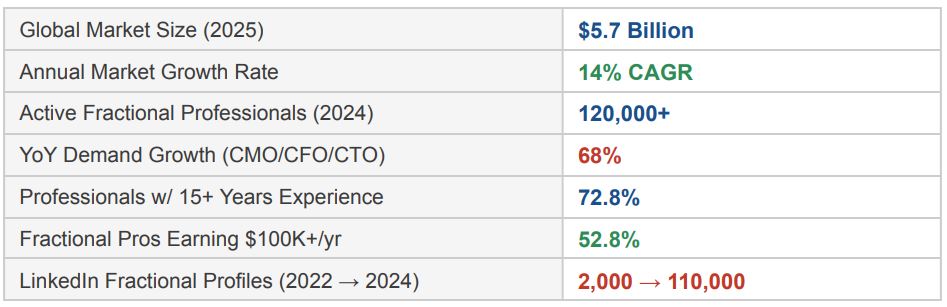
- The fractional executive market has matured into a big piece of the global workforce, really pointing to a longer-lasting change in how companies pull in senior leadership.
- According to Over 50 Pros, the market hit USD 5.7 billion in 2025, and it’s still climbing at about a 14% compound annual growth rate (CAGR), which basically shows ongoing interest in flexible executive know-how, not so much in the old full-time leadership setup.
- The talent pool keeps getting wider, with active fractional professionals going beyond 120,000 in 2024, which suggests experienced executives are starting to see fractional work as a real long-term career lane, instead of some quick fallback.
- Over 50 Pros says 72.8% of fractional executives have more than 15 years of work experience, and 52.8% bring home over USD 100,000 a year.
- You can also see the model getting more visible, with LinkedIn fractional executive profiles going from around 2,000 in 2022 to about 110,000 in 2024 (Over 50 Pros).
- At the same time, demand for fractional CMOs, CFOs, and CTOs jumped 68% year over year, so clearly organizations want specialist leadership, and not just generic leadership coverage.
- Looking forward, Gartner projects that by 2027 more than 30% of mid-sized enterprises will keep at least one fractional executive on the roster, kind of confirming that this approach is moving into mainstream corporate planning.
Leading Fractional Executive Roles By Market Share In 2026
(Source: over50pros.com)
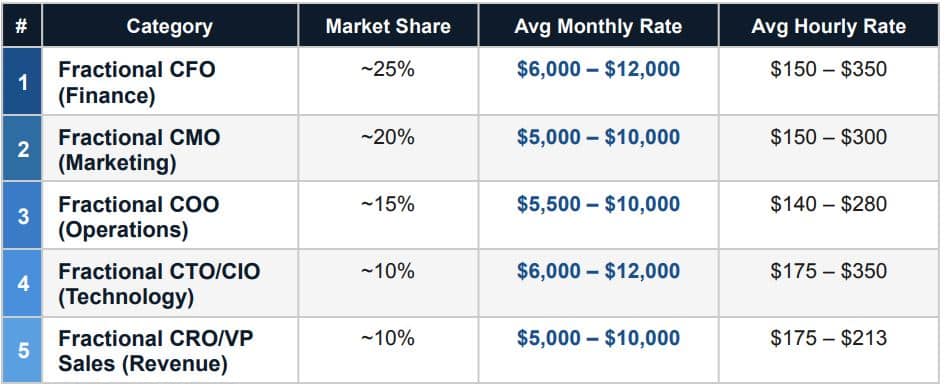
- The fractional executive space is getting more specialized, and the need is mainly piling up in those leadership roles that really steer financial results, business expansion, and day-to-day operational efficiency.
- The market data indicates that Fractional CFOs are still the biggest part, so roughly 25% of the overall pie, and honestly, it makes sense.
- In most cases, their pay sits at about USD 6,000 to USD 12,000 per month, or USD 150 to USD 350 per hour, which points to the strong demand for financial strategy, fundraising support, and cash flow governance.
- Next in line, Fractional CMOs are sitting at around 20, and you’ll typically see monthly retainers from USD 5,000 up to USD 10,000, while hourly pricing lands between USD 150 and USD 300. This sort of spread really underscores how more companies want seasoned marketing direction, not just basic campaign work.
- There is operational leadership, with Fractional COOs taking about 15% of the market. Their engagements are often priced from USD 5,500 to USD 10,000 per month, and hourly from USD 140 to USD 280, depending on scope and how fast things need to move.
- Technology leadership is also climbing, especially now that digital transformation is speeding up, so Fractional CTOs and CIOs together make up roughly 10% of the market. They usually command around USD 6,000 to USD 12,000 monthly, or USD 175 to USD 350 per hour.
- Meanwhile, Fractional CROs and VP Sales are both near 10% of demand, and the compensation is generally USD 5,000 to USD 10,000 per month, plus USD 175 to USD 213 per hour.
- Organizations are putting the most weight behind finance, marketing, operations, technology, and revenue leadership.
- In these areas, experienced leaders can produce tangible business outcomes while still giving more flexibility than a traditional full-time hire.
Fractional Marketing Executive Hiring Trends In 2026
- The growing adoption of fractional marketing executives shows this longer-term shift in how businesses sort out leadership teams.
- Instead of just adding more permanent exec headcount, a lot of orgs are pulling in seasoned marketing leaders on a flexible, almost tactical basis to push efficiency and speed up growth.
- According to Spencer Stuart’s 2025 CMO Tenure Study, only 66% of Fortune 500 companies had a C-suite marketing leader in 2024, which is about an 8-point drop from 2023.
- Fractionus (2026) estimates that companies can see roughly 40% to 70% savings versus bringing on a full-time executive at a comparable experience level. But it’s not only about the budget.
- Businesses also get senior marketing knowledge in a much quicker timeframe.
- With conventional executive hiring, the process drags through recruitment, references, and onboarding.
- Fractional leaders, though, can start adding strategic value within days, not weeks. Plus, they’ve typically worked across around 15 to 20 B2B companies, so they can adapt tested growth tactics while helping avoid the usual marketing traps, and then they let decisions move faster too.
- MarkCMO’s 2026 Pricing Guide says monthly retainers commonly sit between USD 5,000 and USD 20,000, and most ongoing arrangements land between USD 8,000 and USD 15,000 per month.
- Businesses needing shorter, or more specialized, support usually end up paying around USD 200 to USD 500 per hour, while assignments that are truly project-based tend to land in the USD 8,000 to USD 40,000 band depending on how complex things get and what’s actually being delivered.
- In practice, pricing is more tied to executive seniority, industry specialization, and the breadth of responsibilities than it is to geographic location, because remote work has made seasoned leadership easier to access almost everywhere.
- These kinds of pricing structures help organizations secure executive-level marketing know-how and still keep capital for product innovation, customer acquisition, and expansion moves, so fractional marketing leadership is still one of the most workable and scalable talent plays in 2026.
Fractional Executive Hiring Growth and Workforce Trends
- Fractional execs are showing that speed is becoming one of the most valuable competitive edges in modern business.
- According to fractional-csuite.com (February 2026), companies onboarding fractional leaders often see real measurable business impact in about 30 to 45 days, while traditional full-time executive hiring can take roughly 6 to 9 months before productivity looks comparable.
- The shorter time-to-value helps firms react faster to shifting market conditions, new technology adoption, and business transformation.
- The study also notes an 84% client renewal rate, which suggests most organizations keep working with fractional executives after the first engagement since the results are tangible.
- Statista, as it is cited by fractional-csuite.com (2026), says the gig economy will reach 50% of the U.S. workforce by 2027, which is roughly 86.5 million people.
- If you look even further, the OECD projects that by 2030, about 50% of professionals worldwide will be in portfolio careers, a move away from the old one-employer pattern. And yes, you can already spot this change in the executive arena.
- For example, The Frak Conference notes that fractional professionals went from 60,000 in 2022 to 120,000 in 2024, so a pretty clear doubling there.
- At the same time, LinkedIn profiles that mention fractional roles reportedly jumped from 2,000 to 110,000 during the same window, which is an impressive 5,400% rise.
- Fractional leadership is no longer just a side option; it’s becoming a more established career route, reshaping how organizations tap into executive talent.
Pricing Model Comparison Table
| Pricing Model | Typical Range (2026) | Best For | Risk |
| Monthly retainer | USD 5,000 to USD 20,000 per month | Ongoing strategic leadership, embedded executive role, scaling | Underutilization in slow months |
| Hourly | USD 200 to USD 500 per hour | Advisory engagements, audits, short-term diagnostics, founder coaching | Misaligned incentives, fragmented work |
| Project | USD 8,000 to USD 40,000 per project | Defined deliverables: GTM strategy, repositioning, marketing audit, brand launch | Hand-off without ongoing accountability |
| Performance/hybrid | Base retainer plus 10 to 20% variable | PE portfolio companies, revenue-tied engagements | Outcomes depend on factors outside marketer’s control |
Fractional Vs. Full-Time: A Cost and Impact Comparison
| Dimension | Fractional Marketing Executive | Full-Time CMO | Marketing Agency |
| Annual cost (typical) | USD 60,000 to USD 240,000 | USD 275,000 to USD 500,000+ | USD 120,000 to USD 360,000 |
| Time to value | 14 to 30 days | 6 to 9 months | 30 to 60 days |
| Strategic ownership | Yes, embedded in leadership | Yes, embedded in leadership | No, vendor relationship |
| Team leadership / hiring authority | Yes | Yes | No |
| Recruiting cost | None | USD 50,000 to USD 150,000+ | None |
| Severance/equity exposure | None | Yes | None |
| Cross-industry pattern recognition | High (15-plus companies) | Medium (1 to 3 companies) | High but tactical |
| Scope flexibility | High, scales monthly | Low, fixed at hire | Medium, scope-of-work-bound |
| Accountability for revenue | Yes | Yes | Sometimes |
| Best for revenue range | USD 1M to USD 30M | USD 25M-plus | Tactical execution at any size |
AI Is Accelerating The Growth Of Fractional Executive Hiring
- Artificial intelligence is turning into one of the most powerful reasons for the fast growth in the fractional executive space.
- According to Jobbers Research (2026), 77% of business leaders believe AI is boosting demand for specialized fractional talent; companies want seasoned leaders who can steer AI adoption, digital transformation, and data-driven decisions.
- Upwork reported that demand for AI-related freelance skills jumped by 109% year over year in 2025, which really shows how much firms need specialised know-how.
- At the same time, Gallup’s February 2026 survey, involving 23,717 U.S. employees, found that organizations deploying AI were much more likely to carry out workforce restructuring and staffing changes.
- The AI contribution is pushing businesses to bring in experienced executives for specific initiatives, rather than locking in full-time leadership commitments.
- Looking ahead, long-term projections suggest fractional leadership is becoming normal business practice.
- On the supply side, Heidrick & Struggles 2026 Talent Lens Survey noted that 85% of interim leaders had been working independently for over one year, while the portion of newer professionals entering the fractional market rose from 6% in 2020 to 15% in 2025.
- Further reinforcing this momentum, Vendux (2026) estimates that over 40% of U.S. small and medium-sized businesses will be using fractional leadership by the end of 2026, with finance, manufacturing, and healthcare emerging as the fastest-growing adopters beyond the traditional technology sector.
Key Benefits Of Hiring A Fractional Executive
- Fractional executive hiring is getting attention as a sort of strategic fix for organizations that want seasoned leadership but not the big bill, nor the usual waiting that comes with traditional executive recruitment.
- As Gartner puts it, companies using fractional executives can show measurable business results in about 30–45 days, while full-time executive recruiting and onboarding often takes around 6–9 months.
- McKinsey & Company also says that when organizations adopt fractional leadership, they tend to cut executive compensation costs by roughly 40%–70%, but they still keep that high-level strategic visibility.
- A recent comprehensive study by Forrester emphasizes the immense value of targeted expertise, demonstrating that companies actively benefit from professionals who seamlessly apply more than 15 years of cross-industry pattern recognition to immediately diagnose complex bottlenecks without the extended learning curve typical of new, permanent hires.
- Market adoption keeps speeding up too. In Dataintelo’s 2026 Fractional Executive Market Report, the global fractional executive market is estimated to have hit USD 9.4 billion in 2025, which signals more enterprises actually asking for flexible leadership options.
- Statista notes that portfolio-based careers are expanding, so experienced C-suite professionals can back multiple organizations at once. That, in practice, helps businesses work around executive talent shortages, while boosting leadership flexibility and using capital more efficiently.
Conclusion
Fractional executive hiring has kind of moved into the mainstream leadership playbook, so companies can tap seasoned C-suite people with more flexibility, lower costs, and quicker real-world impact. Lately, more and more firms are moving away from the older executive hiring routine, mainly because specialized know-how matters a lot now, AI rollouts are speeding up, and the whole workforce is transforming in different directions. Research keeps showing that fractional executives can deliver measurable outcomes within weeks, and at the same time bring meaningful savings plus clear strategic accountability.
Since more midsize enterprises, startups, and private equity-backed groups are adopting it, fractional leadership is starting to look like a lasting competitive edge. It helps teams push growth faster, handle change without too much chaos, and stay steady in a business world that’s never really static.
FAQ
A fractional executive is a part-time C-suite leader who gives strategic direction without paying the full-time executive price tag.
The market hit USD 5.7 billion in 2025, and it’s projected to grow at about a 14% CAGR.
Most businesses typically save around 40%–70%, compared with bringing in a full-time executive with a similar background.
In many cases, measurable impact shows up within 30–45 days, where traditional executive hires can take 6–9 months.
AI adoption keeps climbing, leadership talent is tighter than before, organizations want cost efficiency, and there’s an ongoing need for niche, specialized expertise.