








Introduction
AI-Native Advertising Statistics: AI-native advertising kinda feels like one of the quickest ramping parts of digital marketing, especially in 2026. And yeah, unlike the more old-school digital ads, AI-native advertising leans hard on generative AI, large language models (LLMs), agentic AI, predictive analytics, and autonomous optimization, so teams can create, personalize, deliver, and track campaigns with less manual effort.
Big names Google, Meta, Amazon, Microsoft, and OpenAI are now folding AI right into ad workflows, which means marketers can automate creative drafting, audience selection, bidding strategies, and ongoing campaign refinement. As companies keep pumping more money into AI, and as ad platforms become more and more AI-driven, many brands are moving budget toward AI-powered campaigns that supposedly boost ROI, lower production spend, and speed up execution.
The article below basically maps the newest market size, consumer trust, adoption, and business directions that are shaping AI-native advertising through 2026.
Editor’s Choice
- The global native advertising market hit USD 112.4 billion in 2026, and it’s expected to expand toward USD 847.6 billion by 2035, so there’s a clear long-term growth story.
- AI-personalized native advertising brought in USD 43.1 billion, about 38.4% of the total native advertising market in 2026.
- Native ads also got the strongest consumer trust score at 81%, which is way above display banners at 32% and pop-up ads at 14%.
- AR Native ads delivered the top mobile CTR, at 1.24%, while Native Carousel posted roughly 7.4× higher CTR compared with traditional banner ads.
- Native advertising showed a 6.2% click-to-purchase rate, almost 3× over retail banner ads (2.1%), which is kinda notable.
- Finally, a review of 1,840 campaigns across 31 markets found native advertising lifted purchase intent by 26% and brand affinity by 14%.
- AI-powered native advertising has basically taken 38% of total ad spending.
- Amazon and Walmart controlled more than 84% of the U.S. retail media advertising budgets, and Amazon by itself sits at 77.3% of digital retail media spending.
- Amazon Fire TV native campaigns delivered a 58% new-to-brand customer rate, and they hit a 2.97× ROAS too, showing that AI-driven retail media actually works.
What is Native Advertising?
- Native advertising is paid content that’s built to blend with the look, feel, and overall function of the media format where it shows up.
- Unlike banner or pop-up ads, native ads kind of merge with the surrounding editorial flow, which means less user disruption while staying relevant to the platform’s audience.
- It typically creates an ad unit that follows the site’s editorial tone and visual style, so instead of barging in with unrelated messages, it ties into themes the audience already likes, like wellness or nutrition.
- For example, according to IPG Media Lab and Sharethrough, consumers view native ads 53% more often than banner ads, and exposure to native content leads to an 18% increase in purchase intent versus standard display.
Native Advertising Market Growth and Consumer Trust Analysis
(Source: amraandelma.com)
- Native advertising is still, kind of uh, getting stronger and stronger as one of the most trusted digital ad formats, and it’s not just hype. Fast market growth keeps pushing it forward, and now AI adoption is making it feel even more necessary.
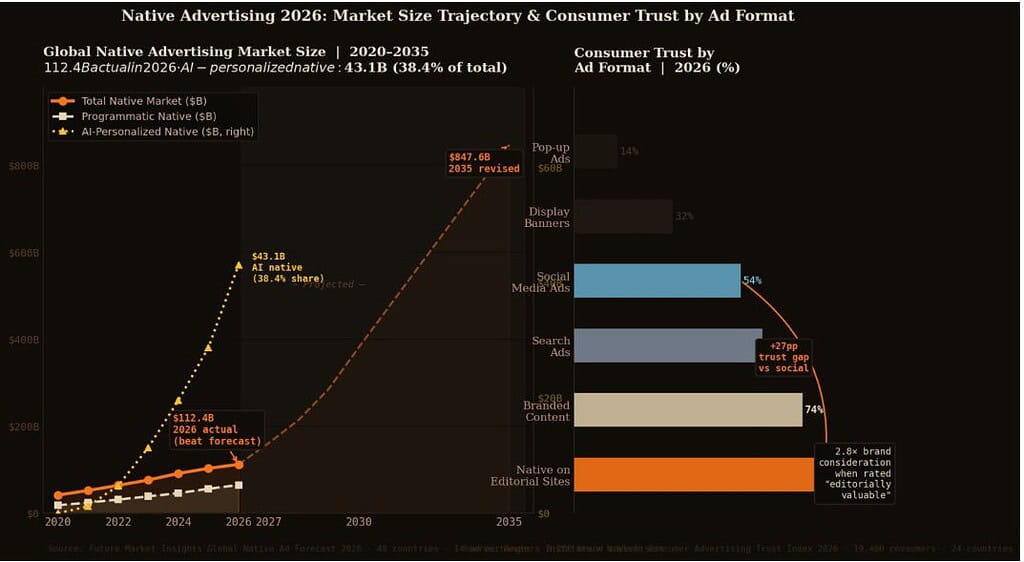
- In the Future Market Insights “Global Native Ad Forecast 2026” report, they say the global native advertising market hit $112.4 billion in 2026, and that number beats the older projections.
- Out of that, AI-personalized native advertising sits at $43.1 billion, or 38.4% of the whole native market, which basically points to artificial intelligence turning into a real growth engine.
- The same study also predicts the market could climb to $847.6 billion by 2035, based on a revised forecast, so yeah, long-term expansion looks pretty substantial.
- On the trust side, the 2026 Nielsen “Consumer Advertising Trust Index” shows people leaning toward ads that don’t feel too in-your-face.
- Native ads placed on editorial websites got the highest trust level at 81%, so those are the most believable option.
- Branded content comes next, at 74% consumer trust.
- Search ads land at 57%, which leaves a 27% trust gap versus social media advertising, sitting at 54%.
- The more traditional formats drop a lot; display banners are trusted by 32% of consumers, while pop-up ads only reach 14%.
- Nielsen also adds that native advertising that’s actually editorially valuable can drive 2.8 times higher brand consideration, and that pretty strongly reinforces that trust has become one of the hardest competitive advantages in digital advertising.
Native Advertising CTR Performance, Brand Impact, and Spending Analysis
(Source: amraandelma.com)
- Native advertising seems to be delivering stronger engagement and actual business outcomes than regular display ads, so it’s being treated as a go-to spend plan for marketers in 2026.
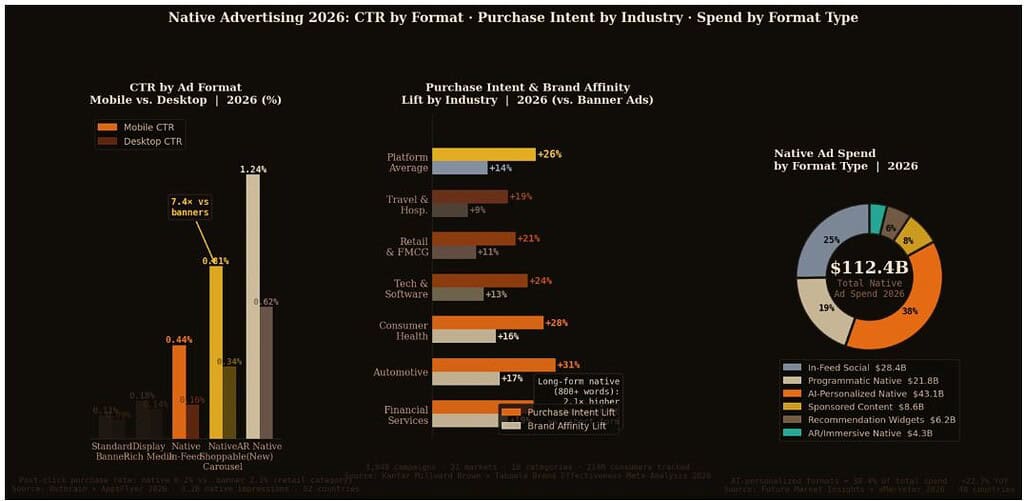
- The 2026 performance benchmarks for AR Native (new) show the top mobile click -through rate, at 1.24%.
- On desktop, it hits 0.62%, which is still higher than any other format.
- Then Native Carousel comes in next, with 0.81% on mobile and 0.34% on desktop, and the write-up basically says this format produces 7.4 times the CTR of banner ads.
- Standard Native Rich Media sits at 0.44% on mobile and 0.16% on desktop, while Display Rich Media is lower at 0.18% and 0.14% respectively.
- The traditional Standard Banner ads look weakest in comparison, only 0.11% on mobile and 0.09% on desktop.
- The report also points out native ads average a click-to-purchase rate of 6.2%, versus just 2.1% for retail banner ads, so the conversion story is clearer.
- According to the Nielsen & Brand Metrics Native Effectiveness Benchmark 2026, using 1,840 campaigns across 31 markets, 18 categories, and 214 million consumers tracked, the platform average lands a 26% increase in purchase intent and a 14% lift in brand affinity.
- Between industries, Financial Services managed to land the biggest bump in purchase intent, with 31%, and then 20% brand affinity, sort of followed by Consumer Health at 28% and 16%.
- After that, Technology & Software shows 24% and 13%, Retail & FMCG lands at 21% and 11%, and Travel & Hospitality trails with 19% and 9%, respectively.
- Long-form native advertising, especially anything above 800 words, ends up driving 2.1x higher engagement, which, honestly, really underlines how strong the high-value content angle can be.
- According to Future Market Insights Global Native Ad Forecast 2026, total native advertising spending is projected to hit $112.4 billion in 2026.
- AI-personalized native advertising takes the lead at $43.1 billion, which is 38%.
- In-Feed Social follows with $28.4 billion (25%), Programmatic Native at $21.8 billion (19%), Sponsored Content at $8.6 billion (8%), Recommendation Widgets at $6.2 billion (6%), and AR/Immersive Native at $4.3 billion (4%).
- Advertisers are leaning more and more toward AI-powered, high-engagement native experiences that keep producing stronger engagement, more purchase intent, and better brand results.
How Exactly is AI changing Native Advertising in 2026?
- Artificial intelligence is reshaping native advertising, so campaigns become more “smart”, more operationally efficient, and also more privacy-minded.
- A key breakthrough here is Dynamic Creative Optimization (DCO), where AI can automatically generate and test thousands of ad variations in real time.
- Instead of waiting on manual tweaks, the system keeps tuning things like headlines, visuals, and even promotional offers based on user behaviour plus what’s happening in the content context.
- According to Meta’s official performance data, Advantage+ drives a 7% lower median cost per conversion (CPA), not a 7% increase in total conversions, so it is more like an efficiency improvement than sheer volume.
- The machine learning models look at historical and real-time signals to estimate what happens next, then they help steer ad placements before the advertising budgets are used up, which gives marketers a way to improve efficiency and also the return on investment.
- At the same time, AI is supporting a privacy-first advertising ecosystem by using contextual targeting based on what’s on the webpage, instead of leaning on third-party user tracking.
- This helps brands show relevant advertisements while still fitting evolving privacy expectations, yeah.
- New York became the first U.S. state to pass legislation that requires advertisers to disclose when advertisements feature AI-generated “synthetic performers”.
- The law, enacted in December 2025, took effect in June 2026. It also includes monetary penalties for non-compliance, which suggests transparency and responsible AI use are turning into essential ingredients for the next chapter of native advertising.
U.S. Retail Media Networks 2026: Native Advertising Performance and Market Analysis
- The U.S. retail media landscape is getting more and more run by four major Retail Media Networks (RMNs): Amazon, Walmart Connect, Instacart, and Target Roundel, and together they grab most of the native advertising demand.
- Skai (2025) says that Amazon and Walmart alone account for over 84% of U.S. retail media advertising budgets, and that Amazon by itself is sitting at 77.3% of digital retail media ad spending in 2025.
- The rest, 15.8%, is basically split across Walmart, Instacart, Target Roundel, and also 200+ other RMNs, which kind of shows how concentrated the market is.
- Amazon is still out front, mostly because of Sponsored Display, DSP native ads, plus newer placements like Fire TV and Alexa.
- In the Amazon Ads Nutrafol case study, Fire TV campaigns apparently hit a 58% new-to-brand customer rate, which is 163% higher than the benchmark. Those same efforts also produced a $2.97 return on ad spend (ROAS), or 337% better than the baseline.
- In Q2 2025, Amazon’s ad business reportedly made $15.6 billion, which keeps it positioned as the biggest native advertising platform in retail.
- Instacart meanwhile keeps showing up as a solid player, especially across grocery retail media.
- Pacvue, via RMIQ, reports an average ROAS of $5.25 in H1 2025, and for branded keyword campaigns it was 5x–8x+ ROAS.
- Sponsored product campaigns tend to run with a $0.50–$1.50 cost per click (CPC), and there’s a minimum bid of $0.15.
- On the shoppable display side, inventory starts at a $15 CPM, and the Schnucks Carrot Ads pilot logged a 2.6% click-through rate (CTR), which makes that format one of the stronger, higher-performing native retail media options out there.
- According to Skai’s 2025 State of Incrementality in Retail Media, off-site retail media spend is set to grow about two to three times faster than on-site ads over the next few years, while in-store retail media advertising spend is projected to triple from 2024 to 2028.
AI-Native Advertising: The Future Of Privacy-First Digital Marketing
- Native advertising is getting really popular because it tends to perform well as brands move toward privacy-first mindsets and AI-driven contextual targeting. It differs from old-school display ads in a few key ways.
- Native placements are commonly served through the publisher’s content management system (CMS) or via server-side integrations, so the experience feels like first-party content.
- Since native ads generally use the same HTML layout, design patterns, and rendering steps as editorial material, they’re also less likely to get stopped by ad blockers or ignored through banner blindness.
- A lot of industry guidance now points out that native advertising can be evaluated with first-party instruments, which lets publishers keep tighter control over how data is gathered and how consent is handled; still, it also helps with compliance when it comes to rules like the GDPR and the ePrivacy Directive.
- As third-party cookies keep fading out, contextual targeting is showing up as a more welcome alternative because the ads are aligned with what’s on a page, rather than being tied to an individual’s browsing record.
- Piwik PRO also says that modern AI-driven contextual targeting works by scanning keywords, themes, the language used, page structure, and even sentiment, so the system can infer what the webpage really means, then it delivers ads that fit, without leaning on personal identifiers or third-party cookies.
- Edge226 mentions something similar: contextual advertising depends only on page context, not cross-site user data, which cuts down privacy exposure while the relevance of ads stays intact.
- Pairing AI-powered contextual targeting with native advertising gives a scalable method that’s privacy-compliant, and yet still supports a level of personalization, all while meeting the constantly shifting regulatory expectations across different regions.
Conclusion
AI-native advertising is kinda reshaping digital marketing, in a way that mixes artificial intelligence with those native ad formats that actually feel more engaging, like, less “ad-y” and more natural. The idea is that you get better personalization, more consumer trust, and business results you can track. Investments in AI-driven creative tuning, contextual targeting, retail media networks, and privacy-first promotion are pushing the market to expand faster, pretty much everywhere.
Compared with the older banner approach, AI-native campaigns tend to keep showing higher engagement, stronger purchase intent, improved click-through rates, and a better return on investment. And honestly, as rules keep nudging brands toward transparent AI use, and third-party cookies keep fading out, AI-powered native advertising is turning into the “go-to” method for companies looking for scalable, privacy-compliant, performance-first digital marketing in the next few years.
FAQ
AI-native advertising uses artificial intelligence to automatically create, personalize, optimize, and measure native campaigns with minimal human involvement.
The global native advertising market hit USD 112.4 billion in 2026, and it’s expected to climb to USD 847.6 billion by 2035.
Native ads sit alongside editorial content, so they feel more believable. That leads to higher trust, stronger interaction, and a 6.2% click-to-purchase rate, while banner ads are at 2.1%.
AI helps by automating creative optimisation, audience matching, contextual pairing, bidding, and ongoing campaign refinement. So the ROI goes up while advertising costs tend to drop too.
AI-powered contextual advertising delivers relevant ads based on webpage content instead of third-party cookies, helping brands maintain personalization while supporting privacy regulations such as GDPR.