









Introduction
Short-Form Video ROI Statistics: In 2026, short-form video kind of became the top digital content thing, you know, the one that keeps outperforming everything else for brand awareness, engagement, leads, and even sales. On TikTok, Instagram Reels, YouTube Shorts, Snapchat Spotlight, and also LinkedIn video, people are spending attention spans on clips that are usually under 90 seconds, and that shift is pretty noticeable.
At the same time, AI editing tools plus recommendation systems that feel personal, creator collaborations, and social commerce too have pushed ROI higher for marketers across a bunch of industries. So businesses are gradually moving ad money away from still visuals and toward quick video, mainly because it delivers more interaction, better conversion outcomes, and lower customer-acquisition costs. Reports and research from HubSpot, Wyzowl, Statista, eMarketer, and TikTok basically agree that short-form video is still the most profitable content marketing approach in 2026.
Editor’s Choice
- The global short-form video market is expected to climb from USD 59.09 billion (2026) to USD 640.9 billion (2035) at a 30.33% CAGR, which is honestly pretty wild.
- 49% of marketers say Short-form video is the highest-ROI content format in 2026.
- 93% of marketers say video is a must-have marketing instrument, and 37% plan to boost their video spending in 2026.
- 73% of consumers prefer learning about products via short-form videos.
- YouTube Shorts grabs engagement with a 5.91% engagement rate, while TikTok holds 78% of viewers.
- 82% of marketers report positive ROI, and 83% say they’ve seen higher sales.
- Websites that add video see a 4.8% conversion rate compared to 2.9% when there’s no video, so the uplift comes out around 65%.
- 51% of companies say 30–60 second videos are the best performing format for both engagement and campaign effectiveness.
- Video production costs drop roughly 40–70%, localization costs can fall by as much as 80%, and production timelines shrink by about 60–90% too.
- Industry forecasts suggest the short-form video advertising space could hit USD 132 billion by 2030.
Short-Form Video Market Growth
(Source: businessresearchinsights.com)
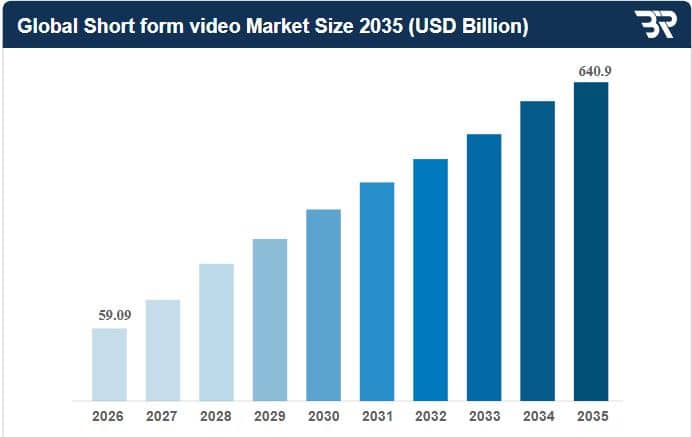
- The global short-form video market is estimated at roughly USD 59.09 billion in 2026, and it may climb to USD 640.9 billion by 2035.
- The growth path implies a CAGR of 30.33% from 2026 to 2035.
- The global short video platforms market is expected to experience steady growth over the next several years.
- According to Coherent Market Insights, the market is estimated to be worth USD 59.10 billion in 2026 and is projected to reach USD 118.87 billion by 2033, growing at a compound annual growth rate (CAGR) of 10.5% during the forecast period.
Short-Form Video Continues To Deliver The Highest Marketing ROI
(Reference: hubspot.com)
- Short-form video honestly has kinda locked itself in as the most powerful content thing for marketing results in 2026.
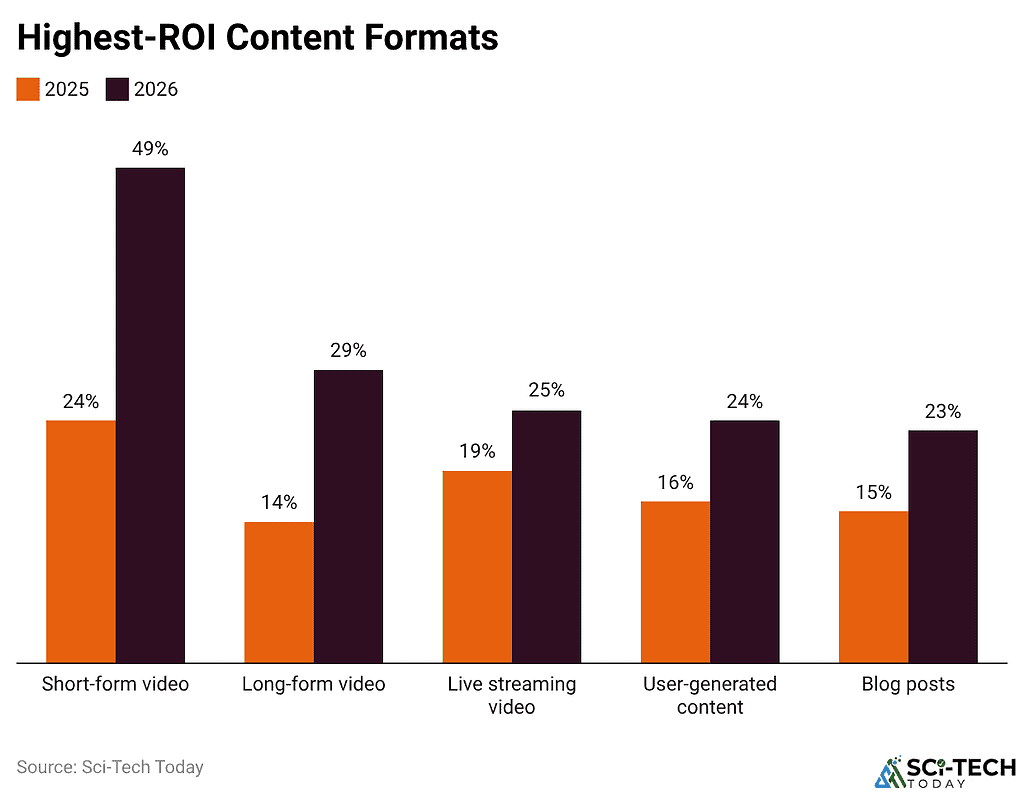
- According to the HubSpot State of Marketing Report 2026, 49% of marketers see short-form video as the top ROI driver, and it beats long-form video 29%, plus live-streaming video at 25%.
- 93% say video is basically a must-have in their marketing strategy, and 37% plan to pump more money into video marketing during 2026.
- 73% of consumers prefer to pick up information about products or services via short-form videos instead of other types of content (The Leap, 2023).
- Platform signals look pretty strong too, like Statista (2024) notes YouTube Shorts pulled the highest engagement rate at 5.91% in Q1 2024, with TikTok not far behind at 5.75%, while Facebook Reels sits way lower around 2%. LinkedIn even reports a 36% rise in video views.
- For example, Statista (2024) says the average TikTok video in 2024 runs about 42.7 seconds, which is higher than the 39 seconds in 2023.
- Meanwhile, INFLOW Network (2023) found that most YouTube Shorts land in the 30–40 second window, but clips stretching 50–60 seconds tend to pull the best viewership.
- Short-form video is turning into the main format for grabbing attention, broadening reach, and producing marketing outcomes that actually measure.
Short-Form Video Platforms Compete On Reach, Engagement, and Audience Retention
| Metric | Metric | TikTok | YouTube Shorts | Instagram Reels |
| Monthly Active Users | Monthly Active Users | 1.6B+ | 2B+ | 1.8B+ |
| Avg Engagement Rate | Avg Engagement Rate | 2.80% | 5.91% | 0.65% |
| Viewer Retention | Viewer Retention | 78% | 73% | 65% |
| Market Share (short-form) | Market Share (short-form) | 40% | 20.00% | 20.00% |
| Best Video Length | Best Video Length | 21–34 seconds | 20–25 seconds | 60–90 seconds |
| Daily Views | Daily Views | N/A | 70B+ | 200B+ |
(Source: shortsintel.com)
- The short-form video space is getting more competitive, like, fast, as every platform shows off its own little advantages in audience reach, engagement, and how the content actually lands.
- YouTube Shorts still looks like the big gorilla, because it has over 2 billion monthly active users, so it ends up being the largest of the three.
- The top average engagement rate is 5.91%, and that basically means people don’t just scroll; they actively interact with the short-form stuff more than they do on the other platforms.
- Meanwhile, TikTok holds a really strong position with 1.6 billion monthly active users and the highest viewer retention rate at 78%, which hints that its recommendation engine keeps people around longer.
- TikTok also seems to dominate the short-form video ecosystem with a 40% market share, and that reinforces its creator-led momentum.
- Instagram Reels, on the other hand, reaches more than 1.8 billion monthly active users, but it posts an average engagement rate of 0.65% and a viewer retention rate of 65%.
- Even with those numbers, it still “wins” on consumption, delivering more than 200 billion daily views, and that level is reported as notably higher than YouTube Shorts’ 200 billion daily views.
- TikTok tends to do best with videos around 21–34 seconds, YouTube Shorts works better for 20–25 seconds, while Instagram Reels tends to perform stronger with longer clips in the 60–90 second range.
- If a brand wants maximum engagement, it might lean into YouTube Shorts.
- If the priority is audience staying power, plus market dominance, TikTok is the obvious bet.
- If advertisers are hunting massive daily exposure with broad consumer reach, Instagram Reels can be the move.
- The above figures demonstrate that no single platform dominates every metric, making a multi-platform short-form video strategy increasingly valuable.
Video ROI and Business Impact
(Reference: shortsintel.com)
- Video marketing still feels like one of the best digital marketing investments, and it keeps bringing measurable outcomes across customer engagement, brand building, lead generation, and even sales.
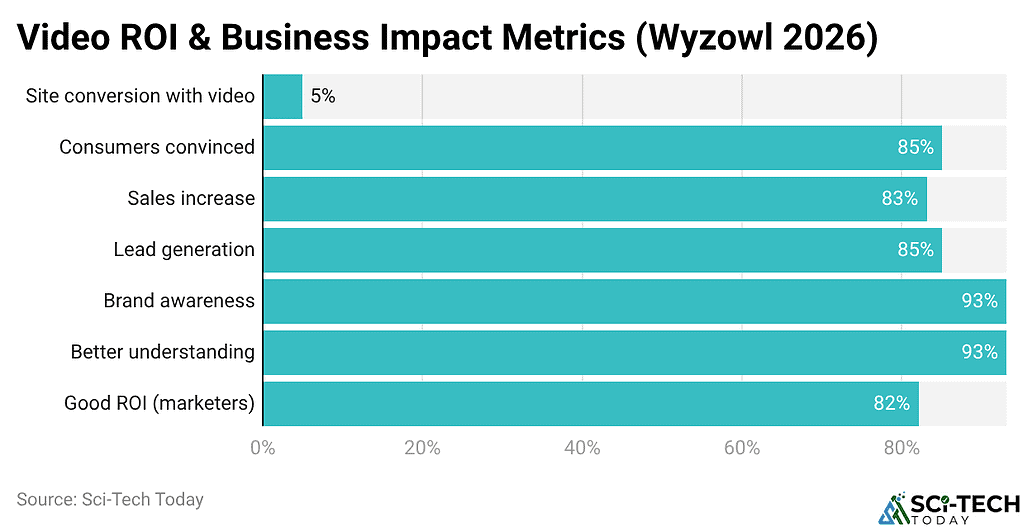
- According to Wyzowl 2026, 82% of marketers say video marketing brings a positive return on investment ROI. Sure, that’s an 11.8% dip from 2025, but honestly, the performance is still exceptionally strong.
- Also, video isn’t only about promotion; it’s kind of a learning mechanism too, because 93% of video marketers say it helps customers understand their products or services better.
- The same 93% report that video boosts brand awareness, so it’s not subtle in expanding market visibility.
- With 85% of marketers saying it generates qualified leads and 83% confirming that it directly increases sales. Consumer behavior basically echoes the same story.
- According to SundaySky 2025, websites with videos show a 4.8% conversion rate, while sites without video sit at 2.9%, which is about a 65% lift in conversions.
- 85% of consumers say they got nudged into buying after watching a video, so the impact on purchasing choices is pretty clear.
- The above numbers make it feel like video is no longer only a branding tool; it’s become a powerful performance marketing asset that improves customer understanding, strengthens recognition, helps conversion rates, and supports revenue growth you can actually measure.
Short-Form Video Global Usage and Reach
- Short-form video kinda became, at this point, one of the most dominant types of digital content, pushed by people across generations actually adopting it, and also by platforms getting more engaged over time.
- Like, more than 90% of Gen Z and Millennials regularly watch short-form stuff on TikTok, Instagram, and Facebook, and Gen X is still really into it too; over half of Baby Boomers do engage with this format.
- Overall, video has made up over 82% of global internet traffic by 2025, and short-form content is taking a pretty big chunk of that watching.
- The platform rivalry is still intense, with TikTok sitting around 40% of the short video market, while Instagram Reels and YouTube Shorts hover near 20% market share in many regions.
- Facebook Reels reached roughly 800 million users by the end of 2023, Instagram Reels logged about 2.8 billion users in 2023, and YouTube Shorts reportedly passed 5 trillion cumulative views by 2024.
- For example, YouTube expanded the max length for Shorts up to 3 minutes, meaning 180 seconds, so creators can basically make more short-form content, and that kind of stuff usually pulls higher view numbers and stronger like rates compared to older, more traditional videos.
- On top of that, research is moving along, including a behavioral study using 153,561 short-form videos, plus the VQualA 2025 challenge, which looked at how people engage via audio, visual, and metadata cues.
- The findings suggest short-form video isn’t just getting a bigger crowd. It is also changing how content gets made, how platforms compete, and how digital engagement works worldwide.
Short-form Video Length
(Reference: wyzowl.com)
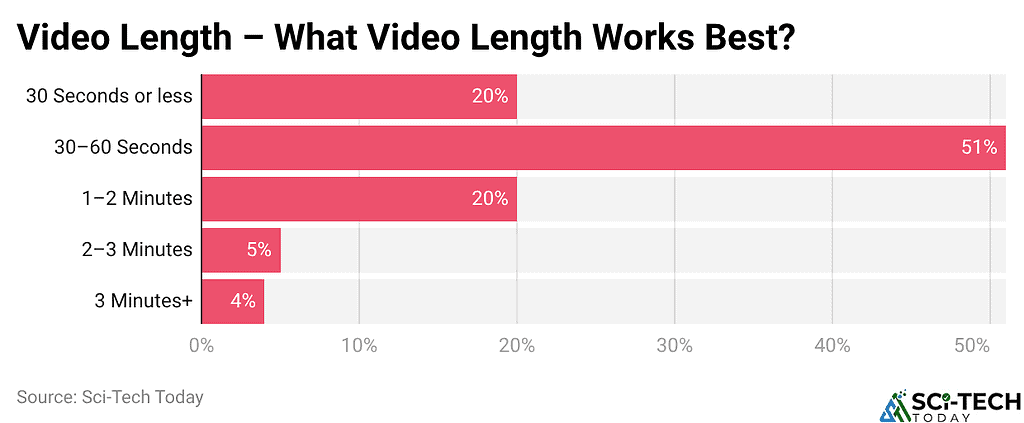
- The data sort of makes it clear that 30-60 seconds has become the most effective short-form video length, and 51% of companies say it’s the best-performing duration.
- Then there’s the shorter end, where 20% of companies seem to prefer videos that are 30 seconds or less, showing that quick, compact content is still useful for grabbing instant attention.
- Also, videos in the 1–2 minute window make up another 20%, so there’s still some space for slightly longer pieces if you need extra context or more product details.
- But once you go past that, performance tends to dip hard, with only 5% of companies choosing 2–3 minute videos and just 4% going for anything longer than 3 minutes.
- The findings basically point to keeping videos under one minute as the best way to drive engagement and marketing impact, while longer formats become weaker and less effective for holding viewer interest.
- Businesses that want to maximize reach, retention, and campaign performance should really focus on concise, high-value content that communicates the message quickly.
Generative AI’s Impact On Production Costs
| Lever dimension | Pre-generative AI baseline | With generative AI and AI testing | ROI implication |
| Video production cost | Traditional shoots, editing, and localization can easily run to tens of thousands per campaign. | AI tools reduce costs by about 40%–70% and localization by up to 80%, while cutting time by 60%–90%. | Lower cost per asset and faster cycle times improve net ROI even if revenue stays constant. |
| Marketing productivity | Manual content design and targeting limit the number of campaigns and variants that can be tested. | Generative AI lifts marketing productivity by 5%–15% of total spend, enabling many more experiments. | More testing and personalization increase conversion rates and revenue per dollar spent. |
| A/B testing speed and depth | Human-run A/B tests focus on a few variants and require weeks of data collection. | AI-powered platforms run continuous, multivariate tests, reallocating spend in real time to winning variants. | Faster optimization reduces wasted spend and drives CAC down as budgets concentrate on high-ROAS assets. |
Future ROI Outlook For Short-Form Video Marketing
- Short-form video is expected to keep being the highest-performing digital content format, as brands keep prioritizing cost-effective campaigns with measurable business results.
- HubSpot and Rocketium project that short-form video will keep delivering the strongest ROI, mostly because it has low production costs, high engagement, and it’s really easy to share, so it becomes the preferred pick for marketers.
- ShortsIntel says the global short-form video advertising market could reach about USD 132 billion by 2030, with a sustained double-digit CAGR, which basically signals more trust in long-term profitability.
- According to Clouted (2026), the short-form video market is valued at USD 59.09 billion in 2026, and it could grow to USD 640.9 billion by 2035, so there is serious investment potential there.
- The current 82% positive ROI rate for video marketing is, in large part, shaped by tighter attribution models, not weaker campaign performance or anything.
- Conbersa, along with Rocketium, adds that future ROI will rely more and more on advanced measurement practices like multi-touch attribution, UTM tracking, view-through attribution, and incrementality testing.
- Meanwhile, Prabisha and OneDay think brands will use short-form video mainly for awareness and audience acquisition, then pair it with long-form content to build credibility and lift conversions. That combo, effectively, turns into a stronger full-funnel marketing strategy.
Conclusion
Short-form video kinda got super popular, and honestly it became the most effective digital marketing format, delivering great engagement, stronger conversions, and results you can actually measure for the business. With AI-powered content creation, tailored suggestions, and this increasing consumer preference, brands can reach bigger audiences while at the same time dialing down production costs and improving overall campaign efficiency.
TikTok, YouTube Shorts, and Instagram Reels keep pushing each other, mostly by audience size, retention, and how much interaction they get, so marketers are encouraged to run multi-platform strategies instead of betting on one thing. And as investment keeps climbing in video marketing, while AI keeps accelerating production, short-form video is expected to stay the highest ROI marketing channel and keep driving sustainable growth for businesses throughout the decade.
FAQ
Short-form videos often earn higher engagement, deliver better conversions, cost less to produce, and keep audiences watching longer than most other content formats.
Most teams land on 30–60 seconds as the sweet spot, and 51% of companies say this timing helps maximize engagement.
YouTube Shorts shows the highest engagement rate at 5.91%, while TikTok tends to win on viewer retention.
AI can reduce production costs by 40–70%, cut creation time by 60–90%, and help teams test, iterate, and personalize content faster.
The global market is valued at USD 59.09 billion in 2026 and is projected to jump to USD 640.9 billion by 2035.