








Lead-in
Raven Industries Statistics: Raven Industries is known for turning smart ideas into practical technology. The company has built a strong presence in agriculture, aerospace, and specialty manufacturing, serving industries where precision and performance matter. Its technology helps farmers work more efficiently, while its aerospace and defense solutions support demanding missions and advanced applications.
Over the years, Raven has grown by focusing on innovation, quality, and real-world solutions. From precision farming systems to high-tech aerospace products, the company continues to explore new opportunities across different markets.
In this article, we examine Raven Industries’ key statistics, history, products, financial performance, market position, and other important facts that illustrate how the company has grown and where it stands today.
Top Recommendation
- Raven Industries, founded in Sioux Falls, South Dakota, on February 11, 1956, began by producing high-altitude research balloons for government agencies.
- By the early 1960s, it had become a leader in polyethylene stratospheric balloons, capable of reaching 100,000-150,000 feet.
- Raven helped revive modern hot-air ballooning and supported record-setting civilian and unmanned research missions.
- Its Aerostar business built deep capabilities in aerospace engineering, manufacturing, and government contracting for NASA, the U.S. Navy, and defense customers.
- CNH Industrial acquired Raven in late 2021 for approximately USD 2.1 billion, paying USD 58 per share.
- Raven is now a wholly owned CNH brand and no longer trades independently under the RAVN ticker.
- The acquisition expanded CNH’s autonomous, digital, and precision-agriculture technology across Case IH and New Holland.
- Raven brought 71 precision-agriculture patents into CNH’s technology portfolio.
- CNH is targeting a near doubling of Precision Technology sales as a share of Agriculture Net Sales by 2030.
- Technologies associated with Raven, including Sense-and-Act systems, can reduce herbicide use by up to 60%.
Raven Industries Origins and Early Years
(Source: media.cnh.com)
- Raven Industries was founded on February 11, 1956, by four people in Sioux Falls, South Dakota, starting with high‑altitude research balloons for government agencies.
- By the early 1960s, Raven became market leaders in polyethylene stratospheric balloons reaching between 100,000 and 150,000 feet in altitude.
- The company revived modern hot‑air ballooning, supporting record‑setting flights and early unmanned research balloon missions.
- In the 1960s and early 1970s, Raven’s annual balloon production exceeded 200 units, with a manufacturing footprint of around 30,000 sq ft.
- The Aerostar division grew rapidly, serving NASA, the U.S. Navy, the Office of Naval Research, and defense clients for high‑altitude systems.
- Plastic film production and sewn products were added later, but the primary focus remained on aerospace and balloons.
- Revenue in this era wasn’t publicly disclosed regularly, but Raven remained a modest organization, employing in the low hundreds.
- Strategic investment in R&D during those years positioned Raven at the intersection of aerospace and agricultural technology.
- Balloon altitude records and civilian hot‑air balloon innovation cemented its niche reputation.
- By 1977, Raven had established capabilities in engineering, manufacturing, and government contracting that shaped future diversification.
Raven Industries Financial Outlook
(Reference: eulerpool.com)
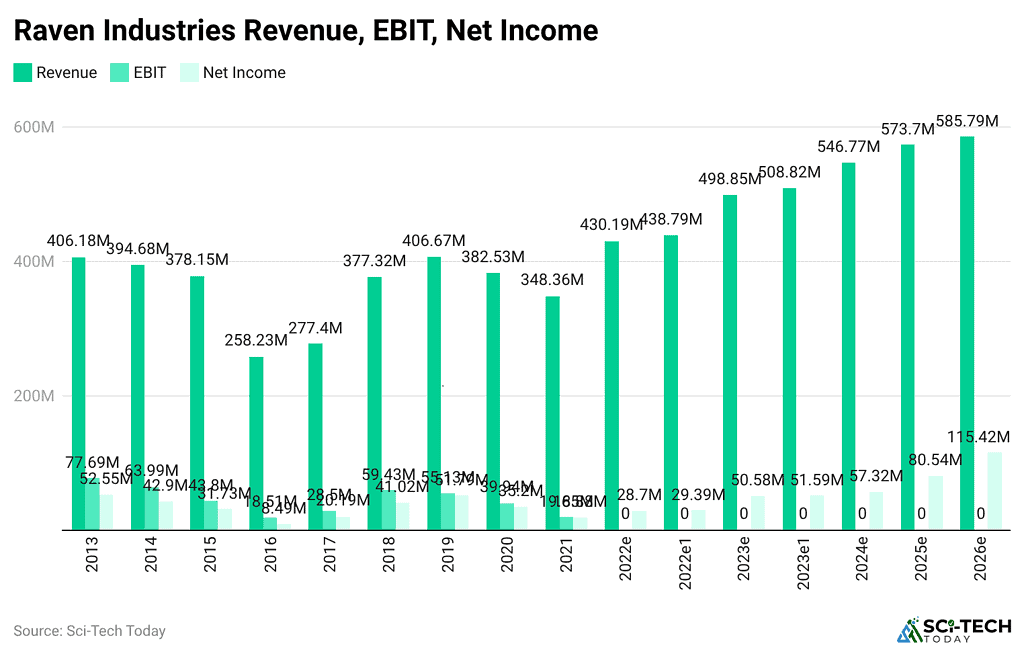
- Raven Industries is estimated to generate USD 585.79 million in revenue in 2026, reflecting 2.09% growth.
- Gross income is projected at USD 196.68 million, with a gross margin of 33.62%.
- Net income is expected to reach USD 115.42 million, representing a 43.75% increase.
- The company is expected to have 36.00 million shares outstanding.
- Operating expenses rose 17.11% year over year to USD 98.15 million.
- Raven Industries reported USD 77.14 million in current liabilities on Aug 20, 2026, up 36.72% from USD 56.42 million the previous year.
Estimated Legacy-Segment Revenue, 2026
- Applied Technology (ATD) is estimated to generate USD 247.73 million, implying a 10.9% CAGR from 2021 to 2026.
- Engineered Films (EFD) is projected at USD 248.94 million, representing an 11.0% CAGR.
- Aerostar is expected to reach USD 89.64 million, with a 10.9% CAGR.
- Intersegment eliminations are estimated at USD 0.17 million.
- Overall, the legacy Raven segments are projected to generate USD 585.79 million in 2026, reflecting a 10.9% CAGR.
Raven Industries (RAVN) Market Cap Snapshot
(Source: companiesmarketcap.com)
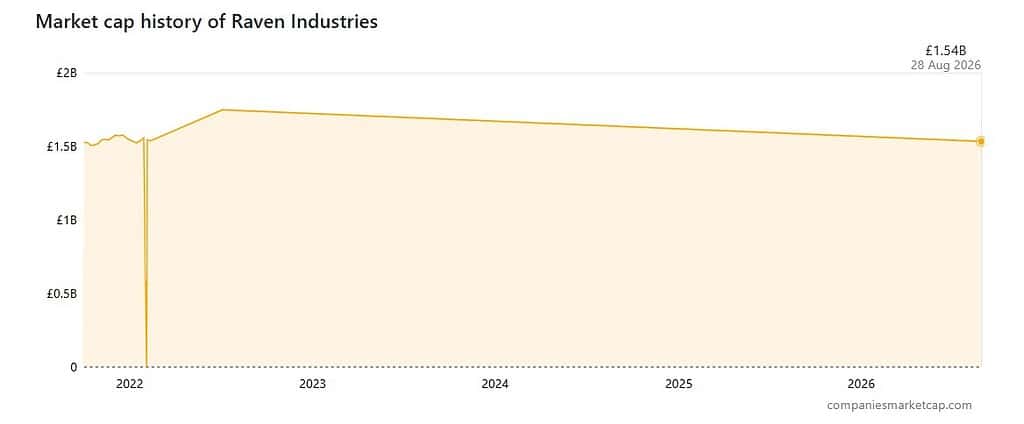
- Raven Industries holds a market cap of £1.52 billion (about USD 1.93 billion), ranking #4970 among global companies.
- Its share price stands at £42.56, with 0.00% change in the last 1 day and a massive 17,810.96% jump over 1 year.
- The firm falls under the Agriculture sector, reflecting its focus on equipment and ag-tech.
Acquisition by CNH Industrial
(Source: nasdaq.com)
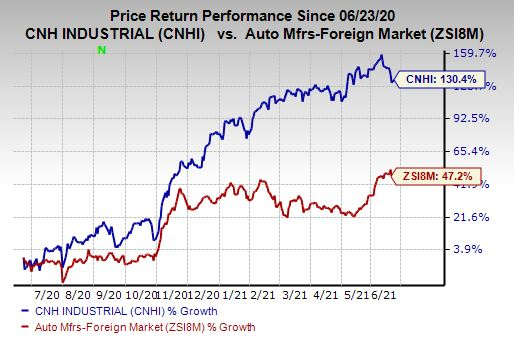
- CNH offered US $58 per share in June 2021, valuing Raven at approximately US $2.1 billion (33.6% premium).
- The transaction closed in Q4 2021, and Raven ceased being publicly traded, becoming a full CNH subsidiary.
- Raven’s trailing-12-month revenue to Jan 2021 was US $348.4 million; CNH had annual revenue of approximately US $26 billion for context.
- At acquisition, ATD contributed US $160 million in revenue (46%), Engineered Films US $163 million (47%), and Aerostar US $51 million (15%).
- CNH expected synergies of US $400 million in incremental revenue and US $150 million in EBITDA by 2025.
- CNH had already been Raven’s largest ATD customer, accounting for 30% of Applied Technology’s income.
- The deal aligned Raven’s autonomy tech to the OEM pipeline of Case IH and New Holland equipment.
- Raven’s patents (71 in precision ag) became fully integrated into CNH’s R&D.
- Post‑deal plan included accelerating global expansion, especially in Latin America and Europe.
- CNH retained ATD and divested the lower-margin divisions to sharpen focus on precision agriculture.
Raven’s Strategic Role in CNH’s Technology Strategy
- Raven remains a key platform for autonomous systems, digital agriculture, and precision technology within CNH.
- CNH aims to nearly double Precision Technology sales as a share of Agriculture Net Sales by 2030, according to investors.cnh.com.
- CNH received 3 AE50 awards in 2026, out of 50 products selected annually, highlighting its innovation across seeding, planting, and crop protection.
- SenseApply can operate at up to 25 mph, while Seedbed Sense supports speeds of up to 10 mph.
- Planter Automation places more than 95% of seeds within 0-5 cm of the intended path.
- Sense-and-Act technology can reduce herbicide use by up to 60%.
- CNH’s Green-on-Green solution is planned for North America in 2027, with potential herbicide savings of up to 80%.
- The R4 autonomous robot offers potential for up to 100% CO2 reduction.
Raven Industries Statistics by Headquarters and Corporate Structure
- Raven Industries was founded in 1956 and is headquartered at 205 E 6th Street, Sioux Falls, South Dakota 57104, United States, according to Agri-Pulse.
- The company previously traded under the RAVN ticker but is no longer a standalone public company.
- CNH Industrial acquired Raven Industries in a USD 2.1 billion deal, making Raven a brand within CNH’s precision agriculture portfolio.
- LinkedIn lists Raven in the 501-1,000 employee range and reports 34,919 followers as of 2026.
Global Employee Footprint
(Reference: reveliolabs.com)
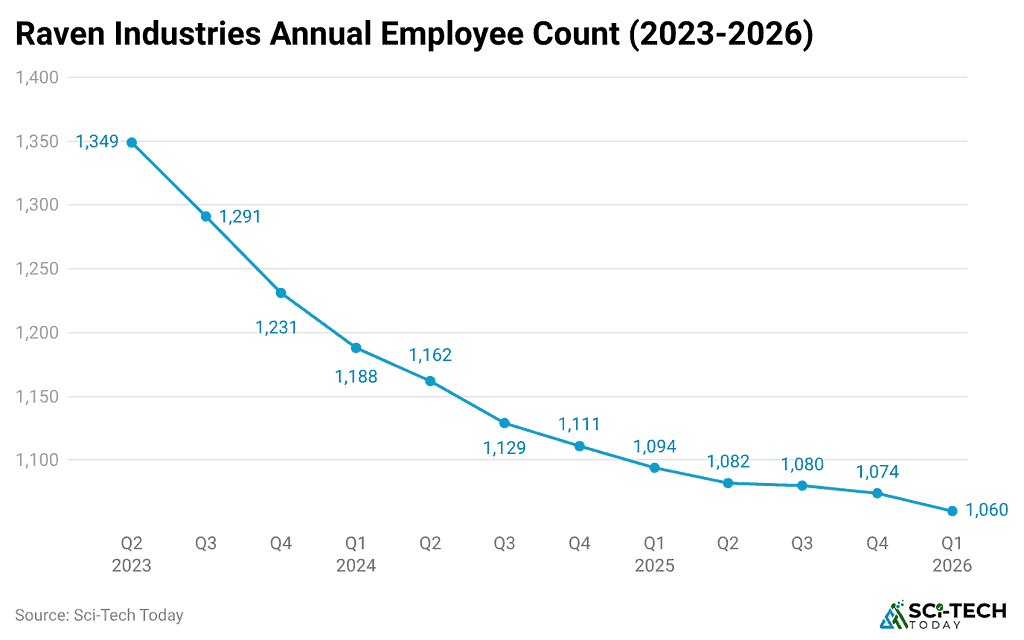
- Raven employed approximately 1,060 people worldwide in Q1 2026, down 21.4% from 1,349 in 2023.
- The workforce also declined by 0.8%, or 34 employees, from 1,094 in Q1 2025.
- North America remained the largest employee base with 658 employees, representing 62.6% of the workforce.
- South Asia ranked second with 204 employees (19.4%).
- Western Europe accounted for 51 employees (4.9%), while Southeast Asia had 27 (2.6%).
- Other regions included South America with 24 (2.3%), Northern Europe with 16 (1.5%), Sub-Saharan Africa with 14 (1.4%), Pacific Islands with 12 (1.1%), North Africa with 9 (0.8%), and Arab States with 8 (0.8%).
Functional and Salary Breakdown
(Reference: reveliolabs.com)
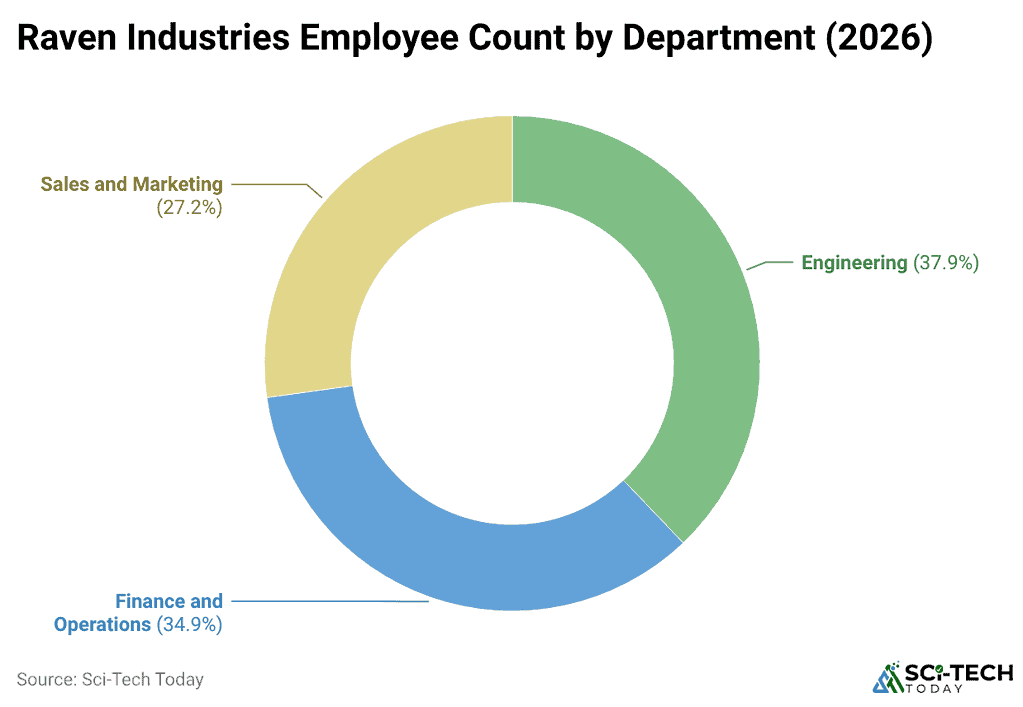
- Engineering represented 37.9% of employees, or 377, making it Raven’s largest functional group.
- Finance and Operations accounted for 34.9%, or 347 employees, while Sales and Marketing represented 27.2%, or 271 employees.
- Average global employee salary was USD 55,778 in 2026, down 0.6% year over year.
- Median salaries ranged from USD 70,000 in the Pacific Islands to USD 7,000 in South Asia.
Headcount and Hiring Trends
- Raven’s headcount declined from 1,111 employees in Q4 2024 to 1,060 in Q1 2026, showing a continued reduction in workforce size.
- Quarterly headcount stood at 1,094 in Q1 2025, 1,082 in Q2, 1,080 in Q3, 1,074 in Q4, and 1,060 in Q1 2026.
- Hiring activity weakened significantly in 2026, with 0 active job openings, compared with 92 new postings in 2025.
CNH Industrial Operational Targets
- CNH Industrial has set several 2030 sustainability targets that apply across the group, including Raven Industries as a CNH brand.
- CNH aims to cut Scope 1 and Scope 2 CO2 emissions by 50% from the 2018 baseline.
- The company plans to source 100% of its electricity from renewable sources by 2030.
- CNH targets 100% waste recovery at its plants and a 50% reduction in water withdrawal per production hour compared with 2018.
- The company also targets 90% product recyclability and wants 15% of spare-parts net sales to come from remanufactured components by 2030.
- Employee safety is another priority, with a target to reduce the injury-frequency rate by 71% from 2018 levels.
- CNH plans to involve 100% of Tier 1 suppliers in sustainability assessments and link 20% of leadership variable compensation to sustainability goals.
Latest Reported Performance
- CNH’s 2025 Sustainability Report, published in May 2026, provides detailed and verifiable operating results mainly for 2024.
- Scope 1 and 2 emissions fell by more than 25% year over year in 2024, while renewable electricity accounted for more than 70% of total electricity consumption.
- CNH invested in decarbonization across 34 global sites, and 30 plants were ISO 50001-certified, covering 100% of CNH operations’ energy consumption by the end of 2024.
- Environmental protection spending reached USD 25.4 million, with an additional USD 3.81 million invested in environmental impact reduction initiatives.
- CNH involved 740 stakeholders in its materiality assessment and identified 20 sustainability sub-topics.
- Its enterprise risk framework covers 44 enterprise risks and 155 risk drivers.
- Customers saved an average of 30% when purchasing CNH Reman components compared with equivalent new parts.
- CNH’s long-term goal is to achieve net zero emissions by 2050.
Final Thoughts
Overall, Raven Industries stands out for its work in agriculture, aerospace, and advanced technology. Its focus on innovation and practical solutions has helped the company build a strong position in these markets.
As farming becomes more technology-driven and demand for aerospace solutions grows, Raven Industries has good opportunities for future growth. With its diverse business areas and focus on new technologies, the company is well placed to adapt to changing market needs and maintain steady progress.
FAQ
CNH Industrial acquired Raven for USD 58 per share, representing an enterprise value of approximately USD 2.1 billion.
Raven’s agricultural technology portfolio includes solutions for application controls, guidance and steering, field computers, boom controls, cloud services, logistics, and injection systems.
Historically, Raven operated across several areas, including precision agriculture, engineered films, aerospace and defense, and high-altitude balloon systems.