








Introduction
Automated Lead Generation Statistics: Automated lead generation in 2026 is mostly software that helps find prospects, clean up contact data, group audiences, run campaigns, and handle conversational qualification, predictive scoring, routing, nurturing, appointment scheduling, CRM updates, and performance analysis. Salesforce notes that 87% of sales teams use AI for tasks like prospecting, forecasting, lead scoring, or drafting emails. HubSpot also says 47% of marketers use automation to make marketing processes run faster.
Taken together, these numbers point to a shift away from rigid rules and timed email blasts. Outcomes depend on things like data accuracy, buyer trust, human decisions, attribution, and how well the CRM ties in whether greater activity produces qualified pipeline or merely more noise.
This article will present the trending automated lead generation statistics and its market growth in 2026.
Featured Selection
- 87% of sales organizations use AI for tasks like prospecting, forecasting, lead scoring, or email drafting.
- 54% of sellers have used AI agents, and nearly 90% plan to use them by 2027.
- Strong sales teams are 1.7 times more likely than weaker teams to use prospecting agents.
- 80% of businesses that use automation say they generate more leads, and 77% say conversions rise.
- Email automation grew from 63% in 2024 to 68% in 2026, and it stays the top automated marketing channel.
- Automated lead nurturing can produce 50% more sales-ready leads and cut costs by 33%.
- Intent-based routing can raise lead-to-opportunity conversion by 4 times, and qualified leads convert at 30% to 40%.
- About 26% of a company’s data is thought to be unreliable.
- The median New CAC Ratio hit 2.00, showing $2.00 was spent for each $1.00 of new-customer ARR, which rose by 14% during 2024.
- 25% of AI projects end up meeting the ROI they promised, while only 16% manage to grow across the whole enterprise, highlighting the importance of execution and integration.
Automated Lead Generation Metrics
| Area | Statistic |
| AI use in sales organizations | 87% of sales organizations use AI for activities including prospecting, forecasting, lead scoring, or email drafting |
| AI-agent usage by sellers | 54% of sellers say they have used AI agents |
| Future AI-agent adoption | Nearly 9 in 10 sellers plan to use AI agents by 2027 |
| Prospecting-agent use | High-performing sales teams are 1.7 times more likely than underperforming teams to use prospecting agents |
| Automation-driven lead growth | 80% of businesses using automation report generating more leads |
| Automation-driven conversion growth | 77% of automation users report higher conversions |
| Lead-generation challenge | 61% of marketers say generating quality leads is their top challenge |
| Nurturing performance | Organizations that excel at lead nurturing generate 50% more sales-ready leads at 33% lower cost |
| Marketing automation priority | 39% of marketers identify marketing automation as a demand-generation strategy |
| LinkedIn as a B2B lead source | 64% of B2B marketers generate leads through LinkedIn |
| Average cold-email reply rate | 5.10% |
| Average B2B cold-email open rate | 27.70% |
| Lead-generation budget allocation | 37% of marketing budgets are allocated to lead generation |
| Lead-quality evaluation | 53% of B2B marketers rate their average lead quality as high |
AI is reshaping the automated funnel
- AI is widening what automation can do and moving past fixed “if this then that” rules, which can assist with research for prospects, campaign materials, ranking accounts, summarizing interactions, recommending next steps, and drafting personalized communications.
- Salesforce says 87% of sales teams use AI in at least one part of sales, including prospecting, lead scoring, forecasting, and writing first drafts of outreach.
- The same report also notes that 54% of sellers have already used AI agents, while nearly 90% say they plan to use them by 2027.
- Most strong setups still keep people in control; AI supports people rather than replacing commercial judgment. Human review remains important for:
- Setting the ideal customer profile and the target account list
- Checking that the data is solid and that consent is in place
- Reading outbound messages for correctness, tone, and rules
- Dealing with tricky technical or enterprise deal talk
- Understanding account context that does not show up in CRM data
- Making the last call on price, lead qualification, and relationship choices
- Sales teams that perform best seem to use AI for prospecting more often.
- Salesforce found that top teams are 1.7 times more likely than weaker teams to use prospecting agents.
- The bigger point is not just owning AI tools, but whether those tools connect to good data, follow clear steps, and tie to revenue results that you can measure.
Automation Adoption by Marketing Channel
(Reference: amraandelma.com)
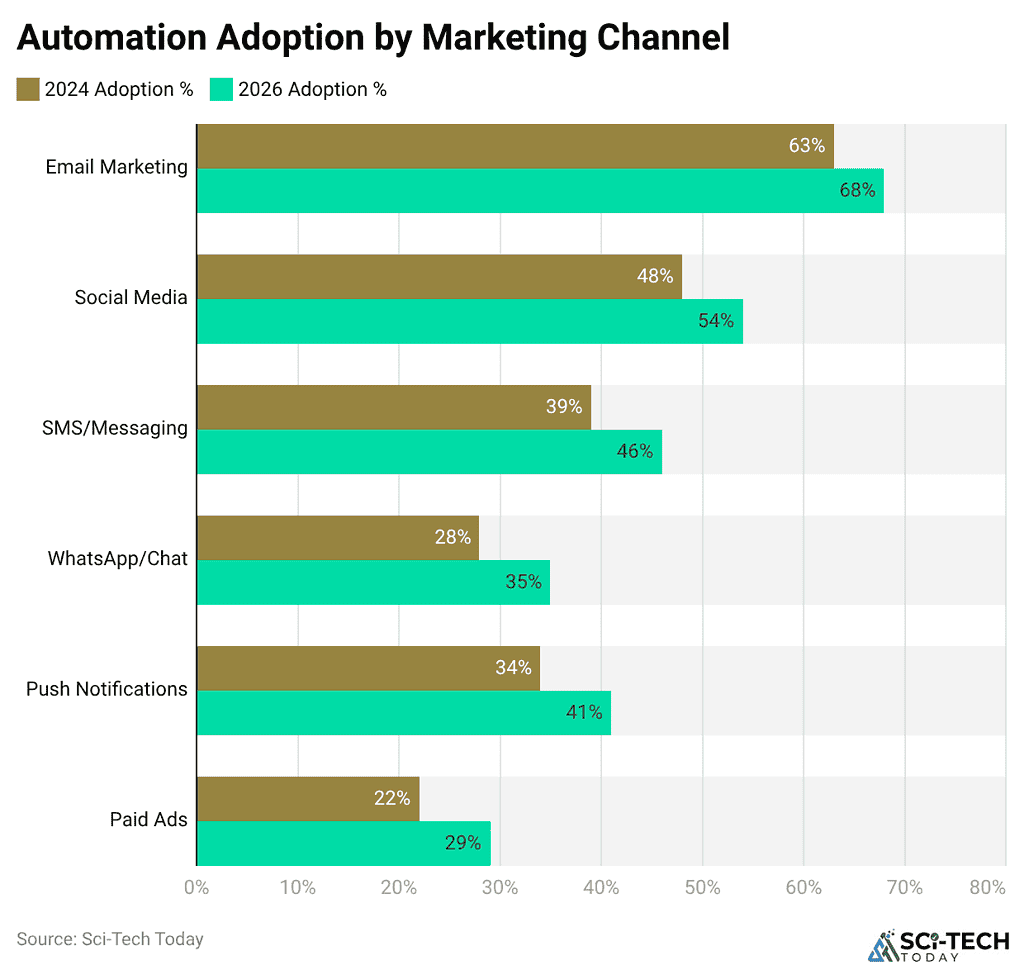
- The chart presents automation implementation in marketing across each of the channels from 2024 to 2026. Email remains at the top, increasing from 63% to 68% (a 5-point rise), thus proving that it is still the primary source of automated messages.
- At the same time, the social media-related channels gain popularity as well, changing from 48% to 54%. There is also an increase in the SMS and messaging channels, changing from 39% to 46%. All of these changes seem to indicate that automation is reaching customers faster and through two-way channels as well, not only via e-mail.
- WhatsApp or chat channels vary from 28% to 35%, and push notifications include a rise from 34% to 41%. Each channel gained 7%, acting as one of the biggest changes in the chart.
- Paid advertising rises from 22% to 29% but remains the lowest share among those channels covered by the chart, although the trend suggests that automation is already applied in advertising activities.
- In fact, research done by HubSpot in 2026 proves that automation and AI play a wider role in marketing activities.
- The above results show the increase in share in each channel ranging from 5 to 7%, thus confirming the growing implementation of automation processes in marketing.
B2B Lead Nurturing Automation Statistics
- More companies in the B2B sector are utilizing lead nurturing automation to aid in advancing leads down the sales funnel, where it is important for the leads to take additional steps accordingly.
- A study by Forrester mentions that nurtured leads have a chance of converting into sales leads 50% more often while simultaneously reducing the cost by 33%.
- Moreover, the same research performed in 2025 points out that nurturing emails have a CTR 4-10 times higher than normal emails, with average open rates of around 36.7%-42.35%, while having around 8% CTR in contrast to about 3% for standard emails.
- Furthermore, Forrester states that lead routing received a positive impact from intent-based routing, as the conversion rate from lead to opportunity rises to 4 times higher, where at least 30% of qualified leads manage to convert compared to about 10% of leads in the old days using other lead routing methods.
- In B2B deals that include more complex processes, Landbase research reports that the nurturing process can involve at least 10 emails laying down for several months, while the welcome series is shorter, consisting of around 3-5 emails.
- According to a case study from Mailmodo, the welcome series resulted in an increase in qualified leads by 278% when the sequence was segmented on the basis of industry and function.
- This is further corroborated by data from the Content Marketing Institute, featured by SalesSOSO, which states that as many as 71% of B2B marketers utilize email newsletters for disseminating information and facilitating prospects’ movement, while also indicating email as being 32% effective in generating B2B leads, which makes email the second position in the listed measure.
- The success of B2B automation depends on maintaining consistent follow-up, providing relevant information, tracking behavioral patterns, creating audience segments and making enough transitions to sales at the right time, rather than relying merely on massive email campaigns.
Data Hygiene: The Hidden Bottleneck in AI Automation
- AI prospecting is only as strong as its data. When a machine searches and scores leads, it depends on contact, company, and activity details. If those inputs are wrong or stale, the output will also miss the mark.
- Salesforce says data leaders believe about 26% of their company data cannot be trusted. It also says 84% feel their data plan has to be redone to back AI work.
- HubSpot, using MarketingSherpa, reports B2B records drop by 2.1% each month. That works out to 22.5% in a year.
- ZoomInfo puts overall annual decay in the 22.5% to 70% range. It also notes email addresses fall by around 43%, Job titles drop by about 25% to 35%, and Phone numbers decline by roughly 20% to 25%.
- Gartner estimates bad data quality costs firms at least $12.9 million per year on average.
- IBM adds that more than 25% of groups expect annual losses over $5 million, and 7% report losses of $25 million or more.
- Also, 43% of chief operating officers rank data quality as their top data focus.
- Automation can make data issues spread faster, as marketers still need enrichment that is checked, duplicate removal, validation, consent rules, and ongoing checks.
- Tools like Clearbit and ZoomInfo can help with enrichment and cleanup, but organizations should confirm the results match their own records before rolling out automated prospecting at scale.
The ROI of Automation: Customer Acquisition Cost (CAC) Trends
- CAC, which is the cost to acquire customers, is gaining importance in the assessment of efficiency as companies strive to keep the costs of sales and marketing down.
- According to Benchmarkit, the Cue New CAC Ratio for 2024 had risen by 14%, meaning that $2 was spent for every $1 earned from new customers in terms of annual recurring revenue.
- The OptiFi 2025-2026 dataset covering 939 B2B companies suggests that the average outbound CAC is $400, compared to $200 for inbound.
- However, it should be noted that this is more of a directional benchmark rather than proof that the use of AI automatically reduces CAC by 50%.
- According to McKinsey, generative AI can increase sales productivity by 3-5% of the global sales spending currently incurred in enterprises.
- The utilization of sales automation solutions has already allowed businesses to achieve 10-15% efficiency.
- Salesforce found in a study involving over 4,000 salespeople that 87% of organizations have adopted the use of artificial intelligence in sales processes, with 55% of companies using it for finding prospective customers.
- Gartner found that 61% of leads would rather adopt an approach that does not involve sales representatives.
- Yet according to IBM, only 25% of existing AI projects have yielded positive ROI, while only 16% of projects have been utilized at large.
- Automation should be evaluated with reference to customer acquisition metrics, conversion, revenues, payback, costs of implementation, etc.
Conclusion
Automated lead generation in 2026 will evolve from basic automation into AI-assisted research and generation of leads, nurturing, qualification, and completion of sales. There is a significant adoption rate, with 87% of sales organizations applying AI and 54% of salespeople using automated assistants. According to salespeople, the usage of automated solutions leads to higher volumes of leads and conversions and allows them to spend 50% less money to produce leads that are ready to buy.
However, there are problems with data quality since 26% of all organizational data is considered to be unreliable. There is also an increase in costs, which makes it even more pressing to conduct proper measurement and analysis. Effective automation of lead generation is based on clean data, relevant information, integration with CRM, human supervision, and measurable results.
FAQ
A total of 87% of sales organizations utilize AI in their business practices, which include activities such as prospecting, forecasting, lead scoring, and email drafting.
Companies that leverage lead nurturing processes can expect to receive up to 50% more sales-ready leads at a cost 33% lower.
Email automation accounted for 68% of lead automation in 2026.
Intent-based routing can enhance conversion from lead to opportunity 4 times.
According to the estimates, approximately 26% of the company’s data can be regarded as unreliable.