








Introduction
Predictive Lead Scoring Statistics: Predictive lead scoring is now a key part of B2B revenue work. Teams used to assign points by hand for things like a form fill, a job title, or an email click; predictive systems use machine learning to look at past results and then score leads and accounts based on behavioral activity, firmographic fit, buying-group engagement, and other inputs to rank the people and accounts most likely to convert.
The 2026 predictive lead scoring statistics below suggest faster adoption, but data quality, clear business goals, human oversight, and explainable recommendations remain essential.
Key highlights
- Predictive scoring plus generative AI personalization to 201% average ROI, and for SaaS firms, they cite 224%.
- Lead scoring at 138% lead generation ROI versus 78% without scoring, a 60-percentage-point difference.
- Real-time AI qualification engines are said to cut qualification time by 79%.
- AI-native tools are reported to raise conversion rates by 93% when compared with rule-based scoring.
- A Forrester study noted sales-qualified opportunity rates moving from 4% up to 18%, while newer AI models reached 27%.
- Engagement frequency is listed as 75% of the criteria used, making it the top signal in the mix shown.
- More than 483,940 companies are said to use predictive lead scoring tools, with Salesforce listed at 30.09% of the market.
- Predictive scoring plus AI automation is reported to drive 112% more conversions than methods without scoring.
- Mature predictive scoring frameworks are said to lower customer acquisition costs by 39%, with median annual savings cited at $620,000 for mid-market firms.
- Gartner reports that 59% of organizations do not measure data quality, indicating a major limitation for predictive scoring accuracy.
What Is Predictive Lead Scoring?
- Predictive lead scoring uses machine learning to forecast conversion likelihood.
- The model trains on your closed-won and closed-lost history, learns the patterns that distinguish the two, and applies that learning to new leads.
- In rules-based scoring, you pick the points yourself. For example, you might give +10 for a demo request and +5 for a pricing page visit.
- Predictive scoring finds the patterns automatically, including signals you wouldn’t have weighted on your own. For the basics on rules-based scoring, see our lead scoring guide.
- Most predictive scoring setups use a few kinds of signals.
- First, there is fit by company details. This includes things like company size, industry, and what tech they use.
- Next, there are behavior and engagement signals. Think of page visits, email opens, content downloads, product use, and meeting history.
- After that, there are intent and outside signals. These can include third-party research, funding activity, hiring changes, and exec moves that often show readiness to buy.
- Models also update as new deal outcomes come in, which helps the ranking stay up to date without extra manual work.
- The accuracy ceiling is the data underneath, and stale records produce confident but wrong scores.
Predictive Lead Scoring ROI, Speed, and Conversion Statistics 2026
(Reference: amraandelma.com)
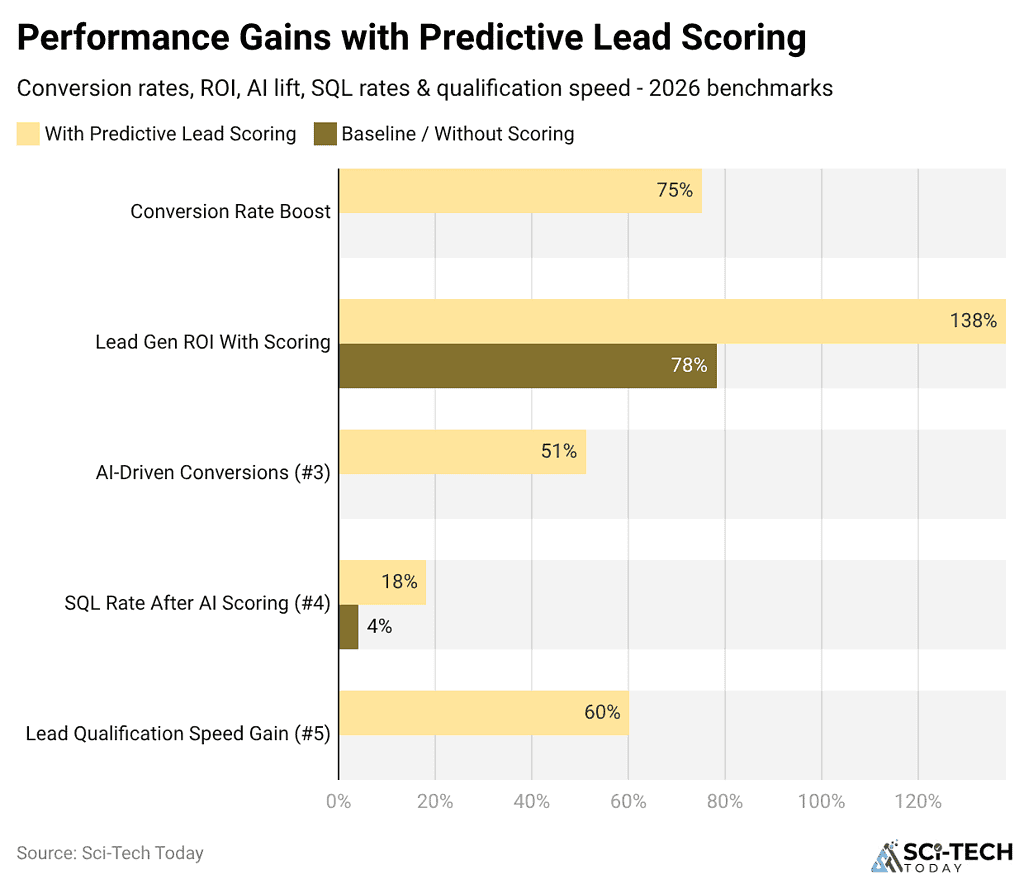
- The 2026 data in this section suggests real gains from predictive methods and AI-based lead scoring. The areas mentioned are return on investment, faster qualification, and better sales conversion.
- Marketing Analytics Institute report found that firms that pair predictive scoring with generative AI personalization saw an average ROI of 201%, compared with a prior benchmark of 138%.
- The same source also says SaaS businesses reported the top average, at 224% ROI.
- Another comparison is about lead-generation ROI: it is reported at 138% with lead scoring, while without lead scoring, it is reported at 78%, and the gap shown is 60 percentage points.
- McKinsey and Company, using research that covers 890 sales groups in 14 countries, reports that real-time AI qualification engines cut lead qualification time by 79%.
- Some financial services platforms score inbound leads in under 11 seconds and also claim a 60% cut in qualification time from AI tools and chatbots.
- Forrester, looking at 1,200 B2B firms in North America and Europe, reports an extra 18 percentage points over a 75% baseline.
- It also states that AI-native tools show a reported 93% conversion lift versus rule-based scoring, and another reported figure places AI-driven conversion improvement at 51 to 52%.
- In the last set of findings, Forrester studies 640 B2B sales organizations over 18 months and reports sales-qualified opportunity rates rising from 4% to 18%. It also says newer third-generation AI models reach 27%.
- Predictive scoring can help teams spot and rank commercially relevant opportunities faster, with outcomes depending on how it is set up, the data quality, and the business context.
Predictive Lead Scoring Retention, Adoption, and Scoring Behavior in 2026
(Source: amraandelma.com)
- Most of the time, engagement is still the key input for lead scoring, while companies keep adding new ways to use scores and track results.
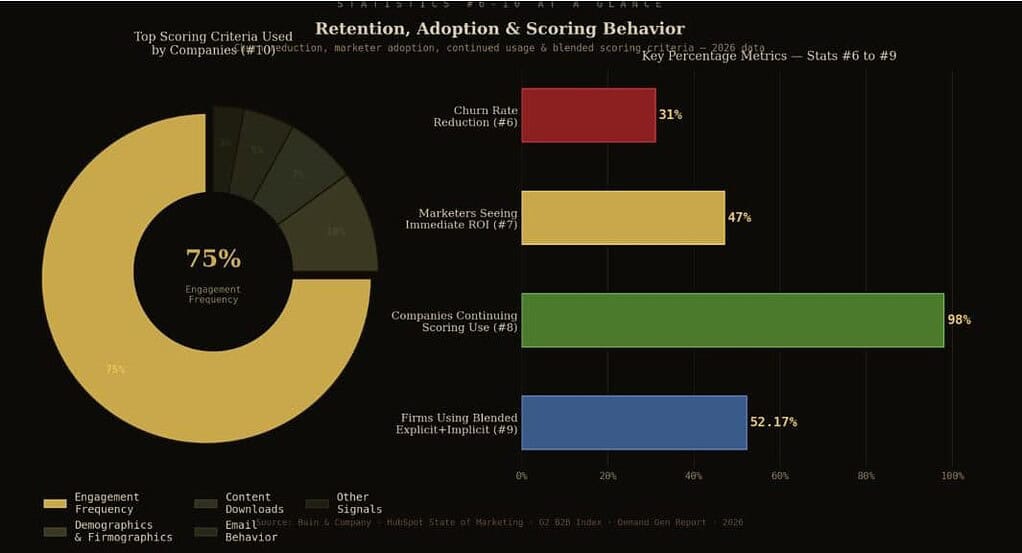
- In the chart, engagement frequency is listed at 75%, which is the top criterion shown. Other criteria include demographics and firmographics at 10%, Content downloads at 7%, Email-source behavior at 5%, and other signals at 3%.
- On performance, 31% say churn dropped, pointing to scoring helping groups decide where to focus next.
- Also, 47% of marketers report ROI right away; close to half are seeing monetary benefits soon after using scoring.
- The chart says 98% of companies keep using it, which suggests that after a firm starts scoring, most do not stop. Instead, they bring it into marketing or sales routines.
- The chart also shows 52.17% of firms using blended scoring and implicit scoring criteria, combining information provided directly by prospects with observed behaviors, showing a wider picture of lead quality than using only one kind of data.
- The above results fit the broader move in 2026 toward behavioral and buyer-intent signals in addition to older lead details.
Top 5 Predictive Lead Scoring Technologies in 2026
(Source: 6sense.com)
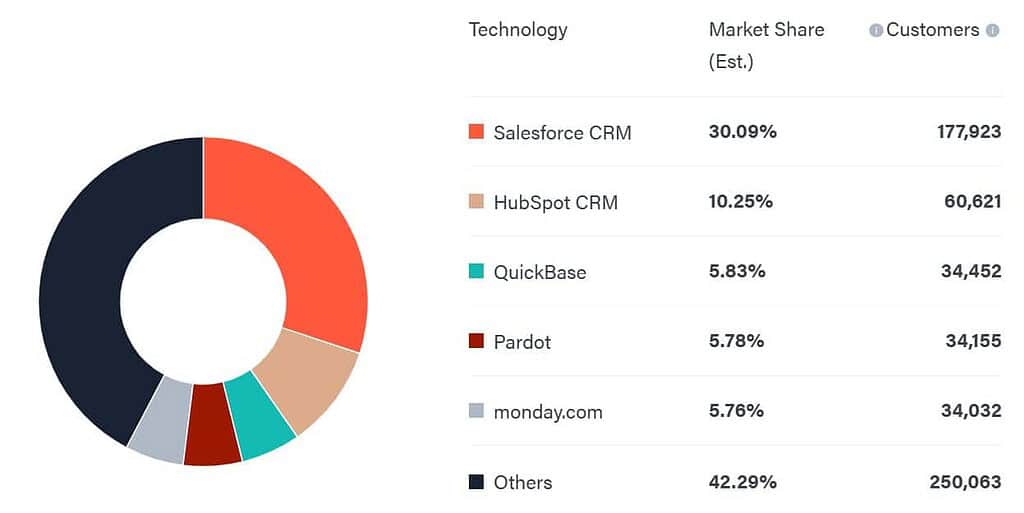
- The above data, in 2026, indicate that approximately 483,940 companies are making use of the technologies of predictive lead scoring in order to decide which leads should be prioritized and qualified.
- In this regard, the best-selling product is Salesforce CRM, which accounts for 30.09 % of the market share, meaning that the company has 177,923 customers worldwide.
- The company coming second is HubSpot CRM with 10.25% of the market share and a total of 60,621 customers, while the company ranked third is QuickBase with its 5.83% share, amounting to the number of 34,452 customers.
- The data around Salesforce demonstrate a strong concentration of market share, as almost one third of the share is taken by the leading provider alone.
- Meanwhile, the market is known to have a fragmented structure, as the remaining providers together account for 42.29% or 250,063 customers.
- Predictive lead scoring is not limited to a narrow circle of providers but demonstrates the wide range of companies using the technology while performing tasks related to sales.
Predictive Lead Scoring Impact on Content, Conversions, and Acquisition Costs in 2026
(Source: amraandelma.com)
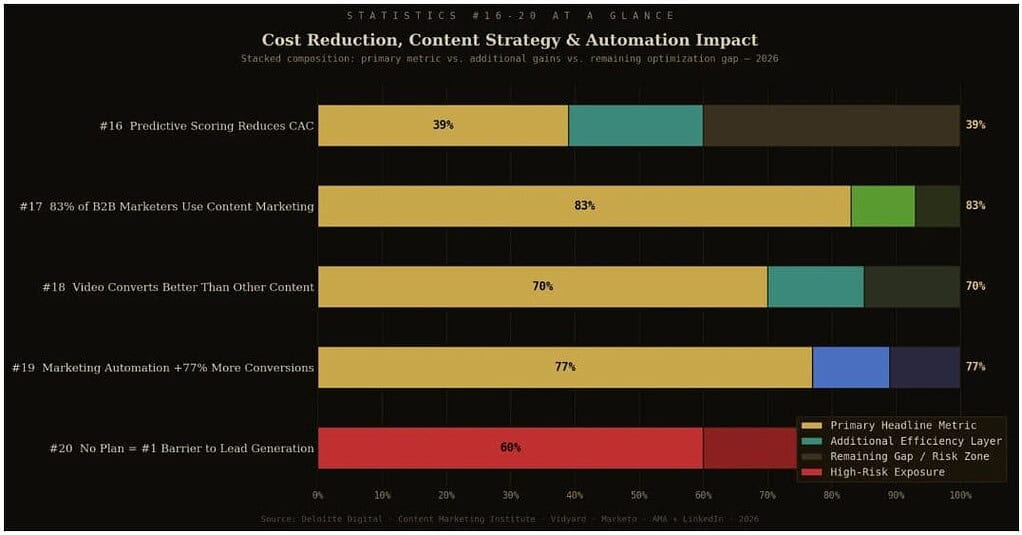
- In 2026, predictive lead scoring is getting tied more tightly to content planning, marketing automation, and how well teams bring in new customers.
- Content Marketing Institute says 91% of B2B marketers use content marketing as a main way to generate leads, up from 83%.
- It also says 69% use predictive scoring to spot which pieces of content connect to pipeline growth within 90 days after the first touch.
- Marketers want to tell the difference between content that just gets clicks and content that actually helps someone move toward a purchase.
- Vidyard reports that around 70% of B2B marketers see video as the best format for driving conversions.
- Leads who watch product demo videos for more than 4 minutes convert at 43%, while the number is 11% for text-only content.
- The Platforms weigh video watch time more heavily; pipeline conversion efficiency rises by 58%.
- Marketo says that firms using predictive scoring along with AI automation saw 112% more conversions than groups without scoring.
- Marketo also reports that enterprise SaaS teams using intent data and behavioral scoring noted gains as high as 141%. The earlier benchmark mentioned is 77% more conversions.
- Deloitte Digital looked at 1,300 companies in the United States, the United Kingdom, and Australia. It found that mature predictive scoring frameworks cut customer acquisition costs by 39%.
- Median annual savings were reported at $620,000 for mid-market companies. Enterprises were listed at more than $4.2 million.
- Taken together, these figures suggest that scoring links what people do with content to what happens next in conversion and acquisition performance.
Predictive Lead Scoring Customers by Geography
(Reference: 6sense.com)
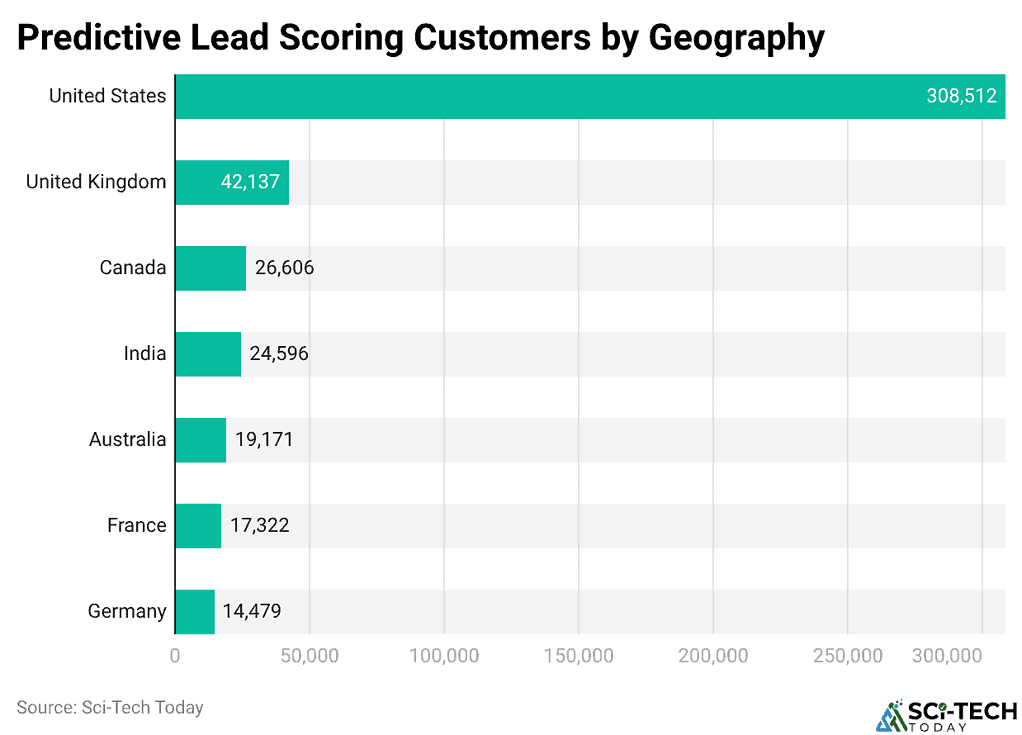
- A review of 6sense market share figures for predictive lead scoring shows the United States leads the list. There are 308,512 companies in the U.S., which is 63.75% of the customers found in the data.
- In other words, the U.S. makes up almost two-thirds of the tracked geographic customer pool.
- The United Kingdom comes in next and has 42,137 customers, or 8.71%, while Canada has 26,606 customers and a 5.50% share.
- Looking at it as a whole, most adoption sits in the U.S. The UK and Canada are the next two main spots.
- Combined, these three countries total 377,255 customers, or 77.96% of the reported base, and the rest, 22.04%, is spread across other countries, indicating places each holds smaller shares, but they still show wider use outside the top markets.
The 4 Key Data Signals Used in Predictive Models
| Signal category | What it describes | Representative inputs |
| Firmographics | The organisation’s ideal customer profile. | Company size, employee count, revenue, industry, geography, technology stack, and growth stage. |
| Demographics | The individual’s relevance and important role in the decision. | Job title, seniority, department, function, location, authority, and account relationship. |
| Behavioral data | Direct engagement across the company’s owned channels. | Website visits, page sequences, content downloads, email clicks, webinars, forms, meetings, trials, and product usage. |
| Intent data | Research activity beyond the seller’s owned properties. | Third-party topic consumption, research surges, review-site activity, community engagement, and social signals |
Predictive Scoring Challenges and Data Limitations
- Predictive lead scoring can help teams rank prospects. It usually performs well only when the inputs are solid. It also needs enough past conversions and a clear way to handle revenue.
- Adobe says to use about two years of recent training data when you can, with at least six months of history plus the time you will score leads, and add a baseline of 10 good conversion events for each goal. These are practical requirements, not guarantees of statistical reliability.
- Startups and low-volume companies often hit harder limits because their lead history is shorter, long sales cycles, and limited closed opportunities reduce the data available for training.
- Gartner notes that 59% of groups do not check data quality, and estimates that bad data costs about $12.9 million each year, on average.
- Gartner further expects that 60% of AI efforts that lack AI-ready data will be dropped by 2026.
- Accuracy can slip for several reasons: missing or repeated records can skew results, sampling bias, data leakage, and models can drift over time.
- NIST points out that AI bias can come from different places: systemic bias, computational or statistical bias, and human thought bias. The ICO adds that uneven past data can lead to unfair outcomes.
- Companies should monitor precision, recall, calibration, score-band conversion, drift, and segment results.
- For early-stage companies, a clear rules-based system or a mixed method may be a better first step before adopting more complex predictive models.
Conclusion
Predictive lead scoring is turning into a key revenue-ops tool, with better results in ROI, faster lead checks, higher conversion, and improved cost to acquire new customers. The strongest figures include 201% average ROI when predictive scoring is paired with generative AI personalization, a 79% drop in qualification time, and a 39% cut in customer acquisition costs when using mature frameworks.
Usage is wide, with more than 483,940 companies said to use predictive scoring tools. Even with that, the model depends on solid inputs, clean data, enough conversion history, and regular checks over time. Gartner also notes that 59% of organizations do not measure data quality the need for strong data governance before scaling predictive scoring.
FAQ
It is a method that uses machine learning to estimate how likely a lead is to convert. It draws from past results, lead behavior, firmographic details, and intent signals.
Reports say predictive scoring plus generative AI personalization can reach a 201% average ROI.
Some real-time AI engines are reported to cut qualification time by 79%.
More than 483,940 companies are reported to use predictive lead scoring technologies in 2026.
A common issue is data quality. Gartner reports that 59% of organizations do not measure data quality.