








Introduction
Multimodal AI Statistics: Multimodal AI combines different types of data, such as text, images, audio, video, and genetic information, into one unified system. This approach often performs better than AI models that only use a single type of data. This technology works by connecting and combining different data types using techniques like shared embeddings and cross-attention mechanisms, supported by large amounts of training data. Its core building blocks include data pre-processing pipelines, modality encoders, fusion layers, alignment and reasoning modules, and interfaces for specific tasks.
This design helps AI make more accurate predictions, faster decisions, and better understand context across different situations. It is used in many fields, including healthcare diagnostics, drug discovery, robotics, self-driving cars, fraud detection, and systems that understand both language and images together. However, there are still challenges to solve, such as standardizing data, managing high computing costs, making AI decisions easier to understand, and properly handling sensitive information.
In this article, we will look at key statistics, real-world uses, and trends shaping the growth of multimodal AI.
What Caught the Editor’s Eye
- The global multimodal AI market is set to grow from USD 2.5 billion in 2025 to USD 26.5 billion by 2033.
- AI voice cloning revenue could surpass USD 1.1 billion by 2028, fueled by media and gaming.
- Vision-based multimodal AI led all deployments in 2025, accounting for 35% of the market.
- Large enterprises hold 65% of the multimodal AI market, dwarfing the 20% share held by SMBs.
- North America invested about USD 1.7 billion in multimodal AI in 2025, nearly double Asia-Pacific’s USD 900 million.
- Global investment in multimodal AI startups reached USD 4.1 billion in 2025, with 68% of it from venture capital.
- NVIDIA released Nemotron 3 Nano Omni on April 28, 2026, reaching over 25 partner platforms.
- US private AI investment hit USD 285.9 billion in 2025, more than 23 times China’s USD 12.4 billion.
Global Multimodal AI Market Growth
(Source: market.us)
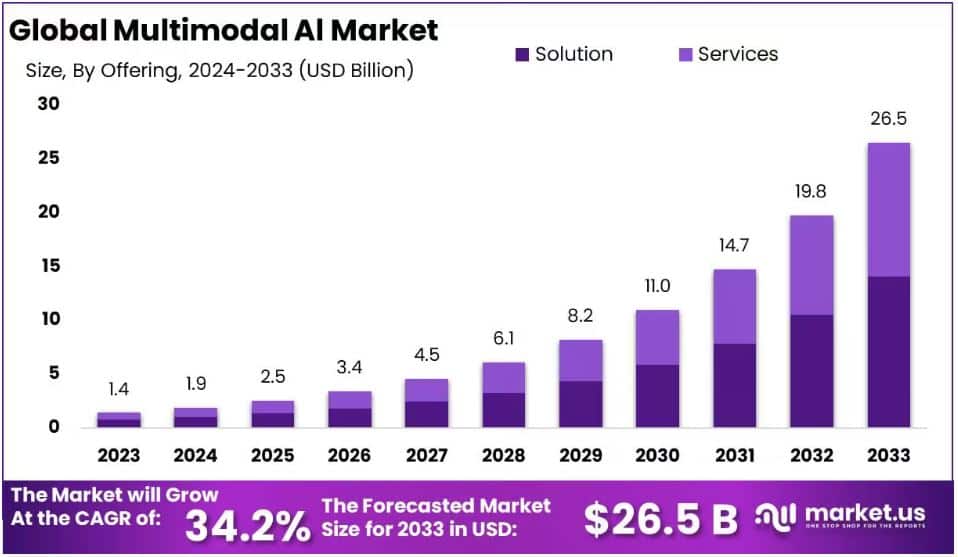
- The market grew to USD 1.4 billion in 2023 and is expected to reach USD 2.5 billion in 2025.
- The market is forecast to grow further to USD 19.8 billion in 2032 and USD 26.5 billion by 2033.
- Overall, the global multimodal AI market is expected to grow at a compound annual growth rate of 34.2% from 2024 to 2033.
Multimodal AI for Video Creation and Content Automation
- By 2026, more than 42% of online learning platforms are expected to start using AI avatar generators, cutting how much it costs to produce content by almost 60%.
- AI voice cloning revenue could go past USD 1.1 billion by 2028, driven mainly by media, gaming, and personalized marketing use.
- Around 58% of universities worldwide are expected to add AI-powered educational video generators to their online learning tools by 2027.
- Demand for AI scene generation tools is expected to grow by 320% between 2024 and 2029, driven by the rise of short-form video platforms like Reels and TikTok.
- By 2026, more than 70% of small businesses are likely to use automated video editing tools to make social media and ad content faster.
- Creators say auto subtitle generators have made videos more accessible and increased viewer retention by an average of 22% across major platforms.
- By 2027, AI script generators are expected to power 40% of corporate video production, helping companies cut their pre-production time in half.
Examples of Multimodal AI Tools
- GPT-4V (Vision) is OpenAI’s multimodal AI model. It can understand both text and images, allowing users to ask questions about visual content and receive detailed answers.
- Inworld AI helps developers create realistic non-player characters for video games. It combines voice, text, and animation so characters can hold natural conversations, understand player behaviour, and respond with suitable facial expressions and body language.
- Runway Gen-2 can create short videos from written prompts or still images. For example, a user can describe a drone flying over a sunset city, and the tool can generate a video from that idea.
- DALL-E 3 creates images from written descriptions. Its connection with ChatGPT allows users to improve their ideas through conversation before generating the final image.
- Meta Llama 3 is mainly a language model, but its open design allows developers to build tools that combine text with images and other types of data.
Multimodal AI Adoption Across Industries
- Healthcare organizations use multimodal AI in 22% of cases, mainly for medical diagnosis and patient monitoring.
- Retail companies account for 16% of multimodal AI use, focusing on better customer experiences and personalized services.
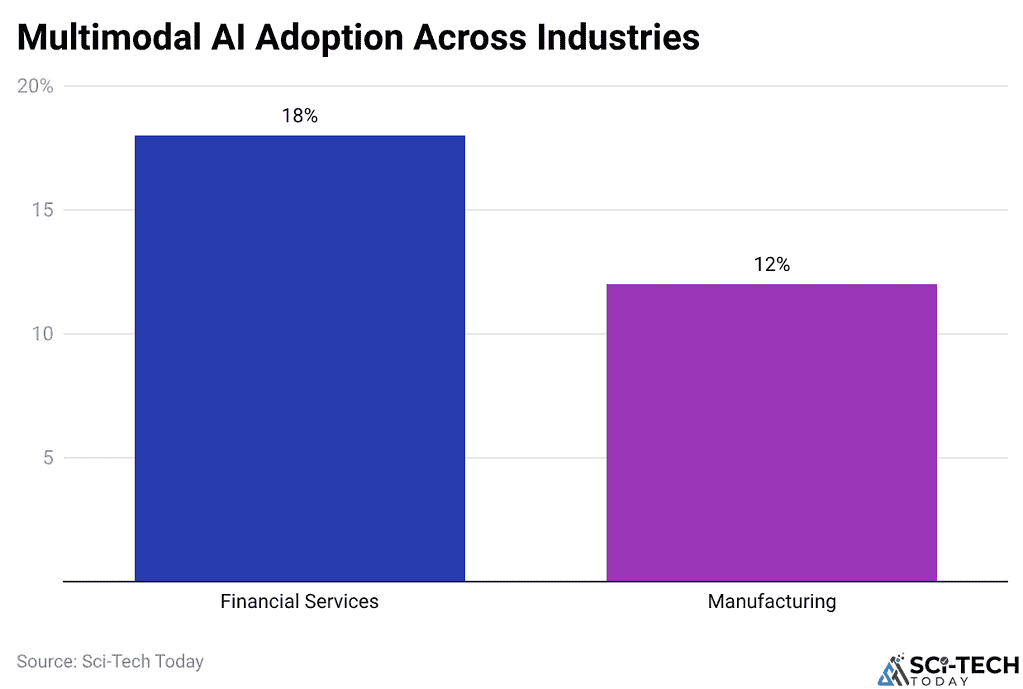
- Financial services use multimodal AI in 18% of digital projects, compared with 12% in manufacturing.
- The automotive industry represents 14% of multimodal AI applications, supporting self-driving vehicles and safety systems.
- Educational institutions use multimodal AI at a rate of 9%, mainly to improve remote and online learning.
- Logistics and supply chain companies account for 11% of multimodal AI use, slightly higher than media and entertainment at 10%.
- Energy and utility companies represent 7% of multimodal AI applications, mainly for infrastructure monitoring and improving operational efficiency.
- Combining natural language processing with image analysis accounts for 25% of multimodal AI applications.
- The public sector uses multimodal AI in 12% of cases, as government agencies increasingly explore AI-based services.
- Small and medium-sized businesses make up around 20% of the multimodal AI market, while large enterprises hold a much larger 65% share.
(Reference: zebracat.ai)
Regional Growth of the Multimodal AI Market
- North America held the largest share of the global multimodal AI market in 2025, accounting for 38% of the total market.
- North America’s multimodal AI market was valued at approximately USD 3.5 billion in 2025.
- Asia-Pacific’s multimodal AI market reached around USD 2.8 billion in 2025.
- Asia-Pacific had the fastest market growth, increasing by 27% in 2025. This was higher than Europe’s growth rate of 15%.
- Europe accounted for 22% of the global multimodal AI market in 2025, with strong use in healthcare and manufacturing.
- Europe’s use of cloud-based multimodal AI reached 54% in 2025, slightly below North America’s 57%.
- Latin America represented 8% of the global market and grew by 21% in 2025 as digital infrastructure expanded.
- The Middle East and Africa accounted for 5% of the market, supported by government smart-city programs.
- Multimodal AI adoption in the Middle East and Africa grew by 16%, higher than the global average growth rate of 13%.
- North America invested about USD 1.7 billion in multimodal AI in 2025, nearly twice Asia-Pacific’s investment of USD 900 million.
Multimodal AI Technology and Use Cases
- Vision-based multimodal AI accounted for 35% of all deployments in 2025, making it the most widely used technology type.
- Multimodal AI that combines natural language processing with visual data represented 28% of applications, especially in customer service.
- Audio-visual AI made up 18% of the market and was mainly used for security and surveillance.
- Gesture-recognition technology accounted for 7% of multimodal AI deployments, mainly in gaming and virtual reality.
- Sensor-fusion applications represented 12% of use cases. These systems combine data from multiple sources to support industrial automation.
- Vision-based AI was used nearly 2 times more than audio-based AI solutions in 2025.
- Platforms that combine natural language processing and computer vision achieved 25% higher engagement rates than tools using only 1 type of data.
- Robotics applications accounted for 14% of multimodal AI use cases, mainly supporting manufacturing and healthcare assistance.
- Retail applications represented 15% of deployments, including inventory management and personalized marketing.
- Security and surveillance used multimodal AI in 10% of cases, mainly through audio-visual tools.
Multimodal AI vs. Unimodal AI Stats
| Multimodal AI | Unimodal AI |
| It combines different types of data, including text, images, video, audio, sensor data, and genomic data. | It is trained using only 1 type of data, such as text or images. |
| It finds connections between different data types, creating deeper context and richer insights. | It works within a single data source, which can limit the insights it provides. |
| It requires stronger data storage, data-alignment methods, and more computing power. | It is usually easier to train and deploy because it needs less data-processing power and computing resources. |
| It is used for disease diagnosis, cross-modal search, autonomous systems, and financial market analysis. | It is used for language translation, object recognition, speech-to-text tools, and grammar or writing assistants. |
Multimodal AI Investment and Funding Insights
(Source: zebracat.ai)
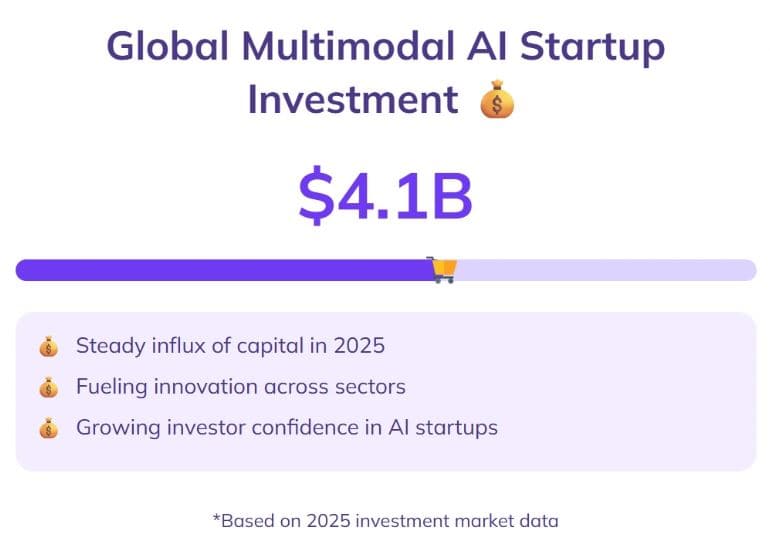
- Global investment in multimodal AI startups reached USD 4.1 billion in 2025.
- Venture capital provided 68% of total multimodal AI funding, while private equity contributed the remaining 32%.
- Multimodal AI companies focused on healthcare received 22% of total funding in 2025, the highest share among industries.
- Financial-services-focused multimodal AI companies received 18% of total investment.
- North American startups raised about USD 2.3 billion in multimodal AI funding, more than double the USD 900 million raised by Asia-Pacific startups.
- Corporate venture-capital groups participated in 25% of multimodal AI funding rounds during 2025.
- The average multimodal AI funding round increased from USD 14 million in 2024 to USD 18 million in 2025.
- Early-stage rounds, including seed funding and Series A, accounted for 42% of multimodal AI investments.
- Later-stage rounds, including Series C and later, represented 35% of funding rounds.
- Startups developing multimodal AI for retail applications received 12% of total sector funding in 2025.
Recent Multimodal AI Developments
- On April 7, 2026, Meta introduced Muse Spark, a model designed for complex reasoning and multimodal tasks that now powers the Meta AI app and Meta.ai.
- On April 28, 2026, NVIDIA released Nemotron 3 Nano Omni, an open multimodal model that processes video, audio, images, and text; it became available through 25+ partner platforms.
- On May 18, 2026, Google announced Gemini Omni at Google I/O, a multimodal model that can generate content from varied inputs, beginning with video.
- On May 18, 2026, Google made Gemini 3.5 Flash the default model in AI Mode globally, allowing users to search using text, images, files, videos, and Chrome tabs.
- On June 22, 2026, Meta and EssilorLuxottica launched Meta Glasses with Meta AI powered by Muse Spark in the United States and Canada.
- On July 21, 2026, Meshy raised nearly USD 400 million in a Series B round at a USD 1.5 billion valuation to expand its AI-powered 3D-generation models.
- On August 31, 2026, NVIDIA expanded the Nemotron model family with multimodal models for agentic reasoning, visual understanding, graduate-level science, and advanced mathematics.
- In 2026, the multimodal AI market was valued at USD 2.83 billion and was forecast to reach USD 8.24 billion by 2030, growing at a 30.6% CAGR.
- In 2025, U.S. private AI investment reached USD 285.9 billion, more than 23 times China’s USD 12.4 billion private AI investment.
Conclusion
Multimodal AI is scaling fast, with the market on track for exponential growth, led by vision-based systems and large enterprises driving most of the adoption. Investment has surged, and recent months brought major model launches from Meta, NVIDIA, and Google. Healthcare and finance lead industry use, though data standardization and computing costs remain hurdles.
With the US significantly outpacing China in private AI investment, multimodal AI is becoming the next competitive battleground.
FAQ
Multimodal AI refers to AI systems that can understand and process more than one type of input at once, such as text, images, audio, and video, rather than being limited to a single format.
It works by combining separate models trained on different data types into a shared representation, allowing the system to connect information across formats and generate one combined response.
A common example is a model that can look at a photo, read a caption, and answer questions about both together, such as describing an image, transcribing audio, or generating a video from a text prompt.
Generative AI refers to creating new content like text or images, while multimodal AI refers to processing multiple types of input or output together; a system can be both generative and multimodal at once.
Several major models now support multimodal inputs, including OpenAI’s GPT, Google’s Gemini, and Anthropic’s Claude, all of which can process combinations of text, images, and in some cases audio or video.
Multimodal AI gives more accurate, context-aware responses since it can cross-reference multiple types of information, making it useful for tasks like medical diagnosis, accessibility tools, and content moderation.
Key challenges include the high computational cost of processing multiple data types together, aligning information accurately across formats, and errors compounding when one input type gets misread.