








Introduction
Prospecting Statistics: In 2026, sales prospecting is changing fast and shifting due to three forces: many buyers want to find answers on their own, buying decisions involve larger stakeholder networks, and AI agents handle research tasks, rank leads, write drafts, and routine messages. Sales teams still matter, but the best work is not just sending more messages; the focus is now on picking the right accounts, making messages fit the situation, building trust, and coordinating across multiple stakeholders.
The most reliable evidence does not support replies, connections, meetings, or conversions. Those outcomes vary sharply by market, sender, the offer, sender reputation, the qualification bar, and metric definition.
The statistics below distinguish authoritative surveys from vendor or platform claims, and treat outbound averages as universal rules.
Top Selection
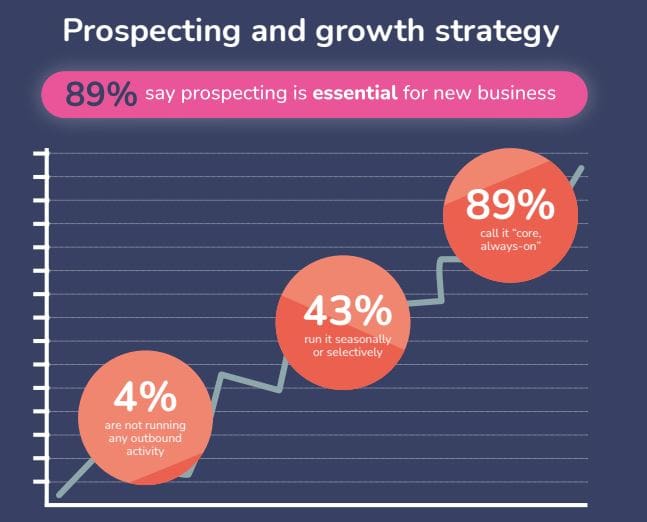
- 89% of B2B leaders say prospecting is key for finding new business and is an ongoing activity for pipeline growth.
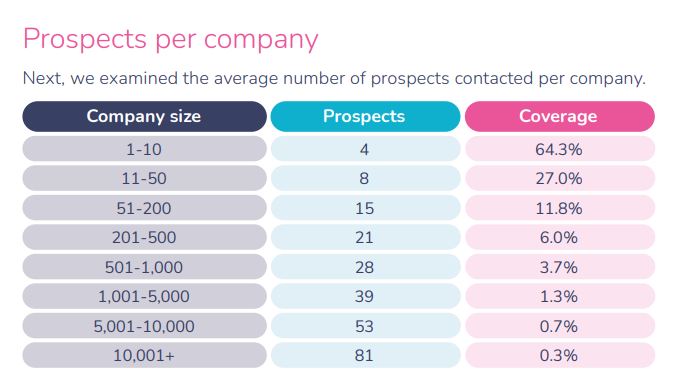
- Prospect coverage drops from 64.3% for firms with 1–10 employees to 0.3% for firms with 10,001+ employees.
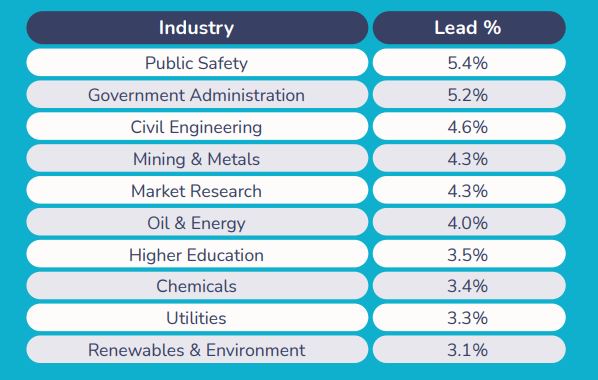
- Public Safety reports the top industry lead rate at 5.4%, compared with Renewables and Environment at 3.1%.
- Signal-qualified leads bring 47% better conversion rates, 43% higher average deal sizes, and 38% more closed deals each quarter.
- Accounts with three or more active buying signals convert at 2.4 times the rate of accounts with just one signal.
- SMARTe gives an average 4.2% cold-email reply rate, and about 1.5% of those replies are considered real positive interest.
- About 62% of responses come from those later steps, which backs the idea of a 4- to 6-email sequence.
- Data loses accuracy at roughly 28% each year, while 67% of people reached have at least one outdated detail.
- 89% of B2B marketers use LinkedIn for lead generation, while Sopro also shows a 13% average conversion rate for LinkedIn Lead Gen Forms.
- Sopro places LinkedIn reply rates by channel near 10%, and for cold email, it reports a 5.1% reply rate in its 2026 outreach data.
Prospecting Remains Essential for New Business Growth
(Source: sopro-2271291.hs-sites.com)
- The graphic is making a simple point. In 2026, prospecting is still a main driver of B2B growth, but teams are not all doing it in the same way or at the same pace.
- In Sopro’s State of Prospecting 2026, 89% of people surveyed said prospecting is needed to bring in new work, suggesting cold or proactive outreach is still fitting alongside inbound, referrals, and other ways to pull demand.
- Another 89% of B2B leaders described prospecting as “core” and “always-on.”, and Sopro built this from answers from 442 senior B2B decision-makers and from large outreach datasets, so the numbers come with some added detail.
- Prospecting matters, but follow-through matters more, and consistency is the key difference in execution.
- Others bring it up only during set windows or around specific pushes, while for sales teams, this supports the view that prospecting should be treated as a steady pipeline job, not only a task for when deals are needed right away.vcb
Prospect Reach Varies Sharply by Company Size
(Source: sopro-2271291.hs-sites.com)
- Sopro’s The State of Prospecting 2026 shows that the number of prospects contacted per company size grows, and the number of prospects reached per company goes up, while total coverage drops.
- In the smallest group, with 1–10 employees, companies contact an average of 4 prospects, which matches 64.3% coverage.
- For 11–50 employees, the average contact count rises to 8 prospects, with coverage falling to 27.0%.
- In the 51–200 range, companies reach 15 prospects on average, with coverage dropping again to 11.8%.
- For 201–500 employees, outreach averages 21 prospects per company, with coverage at 6.0%.
- For 501–1,000 employees, outreach climbs to 28 prospects, with coverage declining to 3.7%.
- The same shift continues for larger companies. With 1,001–5,000 employees, companies contact 39 prospects, and coverage is 1.3%.
- With 5,001–10,000 employees, the figure is 53 prospects, yet coverage is only 0.7%.
- For the largest firms, at 10,001+ employees, outreach averages 81 prospects per company, with coverage at just 0.3%.
- Overall, the numbers show a simple relationship. Prospect volume rises from 4 to 81. Coverage then drops from 64.3% to 0.3%.
Lead Rates Show Clear Industry Differences
(Source: sopro-2271291.hs-sites.com)
- Sopro’s The State of Prospecting 2026 shows that lead rates change a lot from one industry to the next.
- The chart also gives a quick view of where outreach turned into leads more often in the time window being measured.
- Public Safety leads the group with a 5.4% lead rate, Government Administration is close behind at 5.2%, Civil Engineering lands at 4.6%, and Mining & Metals and Market Research both come in at 4.3%.
- Oil & Energy sits in the middle, with 4.0%; Higher Education follows at 3.5%, and Chemicals are at 3.4%.
- Utilities report 3.3%, and Renewables & Environment is the lowest at 3.1%.
- The figures show a gradual spread rather than a dramatic gap, as the top rate and bottom rate differ by 2.3 points, from 5.4% down to 3.1%.
- Six industries are at 4.0% or higher, and four fall below that level.
- The industries with strong day-to-day demands, like public safety, government, and heavy industry, show higher lead rates in the dataset.
AI Prospecting Signals-based selling
- AI prospecting is moving from static contact information to real-time buyer signals.
- Firmographic details can point to companies that match an ideal customer profile, while signals then explain what is happening right now and why a buy could happen soon.
- Triggers may come from leadership changes, new funding, hiring momentum, new tools being rolled out, complaints about competitors, or items mentioned in SEC filings.
- Landbase’s 2025 work highlights what this can mean in practice, as organizations that use signal-qualified leads see conversion improve by 47%, 43% larger on average, and 38% more deals each quarter when compared with older lead-scoring methods.
- However, only 25% of B2B firms use intent or signal-style tools today.
- Autobound says it monitors over 700 signals from more than 25 data sources.
- Autobound reporting shows that accounts with at least 3 active signals convert at 2.4 times the pace of accounts that show only one signal, suggesting that when multiple signals line up, the buying context tends to be stronger.
- Growth List research notes that the first seller who reaches a decision-maker after a trigger event is 5 times more likely to win.
- The same study reports that if a lead is contacted within 5 minutes, conversion is 21 times more likely than if the team waits 30 minutes.
- Signal-based selling is about having good signals, using the right mix, setting priorities, and acting quickly. It is not only about gathering more data.
B2B Prospecting Statistics
- B2B outreach is not really about blasting more messages, but more about having good data, staying consistent, and contacting people when they are ready.
- SMARTe’s 2026 study on B2B prospecting puts cold-email results at a 4.2% reply rate, while only around 1.5% turns into real positive interest.
- Cold calling looks tougher and lands a dial-to-booked-meeting rate of 2.7%, with 8 to 10 dials to reach one decision-maker, once gatekeepers are taken into account.
- About 62% of replies to cold emails happen during follow-up touches, pointing to using a 4- to 6-email run, not just one message and then stopping.
- The data also degrades fast. SMARTe reports 28% annual decay in contact records, with 67% of the people you contact having at least one piece of information that is no longer current.
- Prospects are about 3 times more likely to answer when you have a verified mobile number instead of an office line.
- At the same time, 41% of cold-call attempts do not make it through because they get blocked, filtered, or taken over by gatekeepers.
- SMARTe says 73% of B2B buyers finish most of their research before they talk to a vendor.
- For mid-market deals, the typical number of stakeholders is 9 or more. This means sales teams often join the process after the buyer has already done a fair amount of work on their own.
- Taken together, the data points to a simple lesson: clean contact data, consistent follow-up, accurate phone information, and buyer-aware outreach are central to modern B2B prospecting.
The Evolution of the B2B Sales Data Stack
- B2B sales data used to come from one main place; B2B teams are pulling from several sources, mixing contact details, intent signals, live account activity, and real-time company signals to build a more complete picture of potential buyers.
- FullEnrich’s 2025 waterfall enrichment work points to a single provider often covering only about 50% to 70% of records.
- In contrast, waterfall enrichment checks more than one provider and keeps going until the data is valid can reach roughly 85% to 95% coverage.
- The result is wider prospect coverage and data that can be more dependable, reducing reliance on just one vendor.
- The new setup is usually built in three parts: One part focuses on contact and firm data and answers who is at the company and gives basic company traits.
- Another part brings in intent data, showing what an account may be looking into.
- The last part uses real-time signals, including hiring, new funding, tech changes, or other ongoing business moves.
- Salesforce Research report from 2024 shows that using enriched CRM records with signals can produce 44% more sales-qualified leads. That is compared to firms that only use basic contact data.
- The next step is signal orchestration, in which the platforms gather data from many sources, remove duplicates and clean up formats, rank the signals, and use AI to sort out which signals matter first.
- Autobound brings together data from 25-plus source types, then uses AI to rank what is most relevant, and shares the insights through its outreach tools.
- The competitive advantage is shifting from having more contacts to connecting better-quality data with timely buying signals.
Industries Receiving the Most Prospecting Outreach
(Source: sopro-2271291.hs-sites.com)
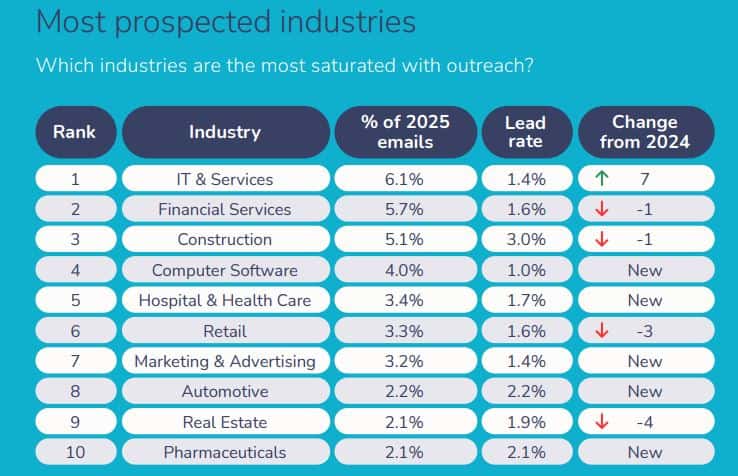
- The State of Prospecting 2026 report by Sopro reveals that IT and services have the highest share. 6.1% of emails are from this sector, and it ranks first among all.
- In this regard, the lead rate is 1.4%, and it has grown by 7% as compared to the year of 2024.
- Financial services is in second place, with a share of five point seven percent of emails, the lead rate was 1.6%, and there was a decline of 1% since the previous year.
- The share of the construction sector was 5.1%, with a lead rate of 3%, but it declined by 1%.
- The computer software sector had 5% with a lead rate of 1%, which is significant compared to the previous year.
- The sector of hospitals and health care was able to get 3.4% of emails, having generated a lead rate of 1.7%; this sector is also new.
- Retail received 3.3% of the emails, had a lead rate of 1.6%, and fell by 3 points in the ranking.
- Marketing & Advertising’s email share was at 3.2%, with a lead rate of 1.4%.
- The share of Automotive stood at 2.2%, with a lead rate also at 2.2%, being New, and the share of Real Estate was at 2.1%, with a lead rate of 1.9%, decreasing by 4 points, while Pharmaceuticals received 2.1% of the share, having a lead rate of 2.1% as well, being New. This proves that the email share and lead rate do not move together uniformly.
Social Selling and LinkedIn Prospecting Effectiveness
- Social selling is now more than a side task for brands and has become a real tool for B2B sales outreach.
- Sopro’s 2025 work says 89% of B2B marketers use LinkedIn to get leads, while 53% use it to find prospects and pull together contact details.
- LinkedIn has over 1 billion members spread across 200 countries and regions, and Sopro adds that four out of five users affect business choices.
- LinkedIn also performs well for lead capture, as 62% of marketers say it brings in leads. That is more than double the share reported for the next social channel.
- Sopro reports an average Lead Gen Form conversion rate of 13%, and the industry landing page average is 2.35%.
- Sopro’s 2026 outreach results put LinkedIn replies near 10%, Cold email sits at 5.1%, and Cold email often lands in the 1% to 5% response range.
- With stronger personalization, results can reach 18%, and for generic outreach, the figure is about 9%.
- Sopro reports that 78% of LinkedIn users read industry updates, 73% use the platform to find new ideas, video posts get 5 times the engagement of static posts, and Live video gets 24 times more. Companies that post every week see about 2 times the engagement, with stronger activity showing up on Tuesday through Thursday, with the time window of 7 a.m. to 4 p.m. also trending higher.
- For enterprise deals, LinkedIn supports outreach across multiple people, and points teams toward mapping stakeholders, adjusting messages, and watching engagement signals.
- The practical sequence is research, connect, engage, personalize, and coordinate follow-up.
- Success should be tracked with reply rates, meetings, stakeholder coverage, opportunities, win rates, and sourced or influenced pipeline. Impressions alone are not the main measure.
Conclusion
B2B prospecting in 2026 depends more on clean data, clear buying intent, tailored outreach, and steady follow-up than on just sending more messages. As firms get larger, it gets harder to keep full prospect coverage, while lead results also shift by industry and by region. Signal-qualified prospects can outperform traditional scoring when multiple relevant signals are combined and acted on quickly. Cold email can still get replies, but follow-up drives a big share of the total responses.
Contact lists also lose accuracy over time, so enrichment matters if you want results you can trust. LinkedIn is now a key place to prospect, and many teams report strong take-up and solid lead generation. Good prospecting comes from accurate records, quick signals, relevant copy, and work that involves more than one person inside the team.
FAQ
89% of B2B leaders surveyed say prospecting is essential for new business.
SMARTe says the average cold-email reply rate is 4.2%.
62% of cold-email replies reportedly come after follow-up.
Sopro reports an average conversion rate of 13% for LinkedIn Lead Gen Forms.
SMARTe estimates about 28% annual contact-data decay.

Sources