








Introduction
Sales Conversion Statistics: Sales conversion rates remain a clear way to judge a business’s commercial performance in 2026. They tell you how effectively visitors turn into leads, leads turn into qualified prospects, and qualified prospects turn into real deals and closed sales; over time, that flow also affects recurring revenue. No single conversion rate works for every case.
B2B SaaS company selling six-figure annual contracts, a professional-services firm selling high-intent consultations, and an e-commerce retailer selling low-cost products operate with fundamentally different buyer journeys. Their conversion rates depend on where they happen in the funnel, the channel, the sales approach, the complexity of the deal, the type of audience, and sales cycle duration.
This article will present the trending sales conversion statistics by industry, calculations, AI, and marketing channels.
Top Picks
- Janitorial and Cleaning Services shows the top industry sales-call conversion rate at 27.15%. Industrial Equipment and Machinery sits at 8.37%.
- For the B2B SaaS funnel, 39% of leads become MQLs, 38% of MQLs become SQLs, and 37% of opportunities close.
- Referral leads convert at 25.56%, while Direct sales and cold calling convert at 9.38%, with a gap of 16.18 percentage points.
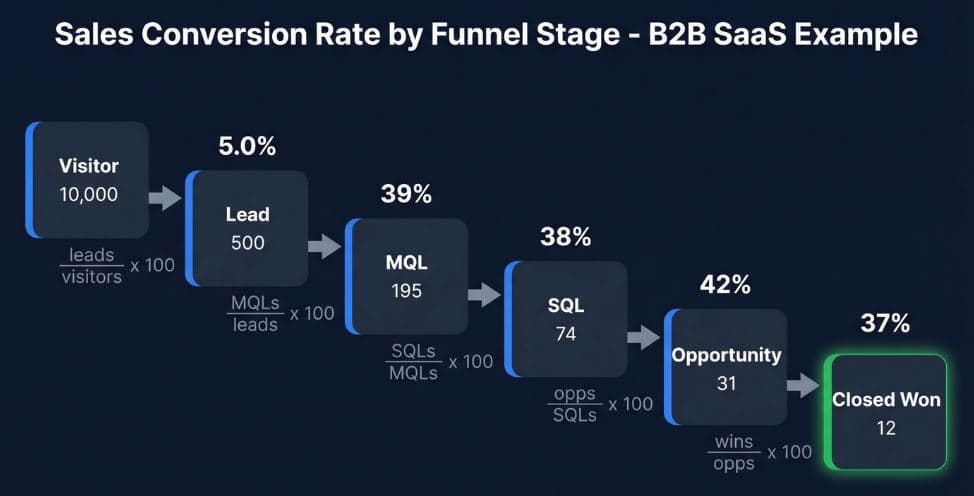
- In a B2B SaaS example, 10,000 visitors create 500 leads, which gives a 5% visitor-to-lead conversion rate.
- 57% of sales professionals report longer sales cycles, making speed and the ability to move stages more important for conversion.
- McKinsey says an AI tool for industrial market research pushed conversion up by 40% and sped up lead follow-through by 30%.
- Another case looks at AI that reads construction permit records; the work led to over $1 billion in fresh opportunities, lifted the pipeline by 10%, and more than doubled click-through performance.
- In many sales teams, forecast accuracy is weak, but only 7% hit 90% or better, and the middle group sits at about 70% to 79%.
- Deals with several contacts close 37% more often, while multiple departments get involved, win rates rise by 56%.
- About 30% of leads, by report, never get touched by a person.
What does sales conversion rate mean?
- Sales conversion rate is a way to judge how well prospects move from one step of the funnel to the next, or how many end up as customers. A common calculation is:
- Conversions ÷ Total Leads × 100. For instance, if you close 50 deals from 200 SQLs, then the SQL-to-close conversion rate is 25%.
- The key issue is what you decide to measure. “Conversion rate” can refer to different jumps in the funnel, like visitor to lead, lead to customer, or opportunity to close, which is the win rate.
- Each metric answers a different question, so they should not be swapped as if they mean the same thing.
- For instance, a website conversion rate of 2% describes how well the website can generate leads, while a closing rate of 2% describes how good the qualified opportunities are at becoming customers.
- Reliable reporting requires clearly defined stages in conversion is important for teams to mark conversion statistics according to the stage they refer to, so that managers can understand where performance is improving or failing.
Sales Conversion Statistics By Industry
| Industry | 2026 Conversion Rate (%) |
| Janitorial and Cleaning Services | 27.15% |
| Printing and Publishing Services | 26.82% |
| Office Supplies and Equipment | 25.32% |
| Business Services (HR, Payroll, Marketing) | 24.47% |
| Food and Beverage Distribution | 24.56% |
| Consulting Services | 23.68% |
| Event Planning and Management Services | 22.76% |
| Training and Development Services | 22.22% |
| Real Estate Services | 20.55% |
| Insurance | 20.52% |
| Facility Management Services | 19.91% |
| Agricultural Equipment and Supplies | 19.35% |
| Security Systems and Services | 18.15% |
| Logistics and Transportation | 17.86% |
| Wholesale Distribution | 15.96% |
| Energy Solutions | 15.17% |
| Financial Services | 14.47% |
| Manufacturing Components | 14.34% |
| Chemical Products | 13.94% |
| Telecommunications | 12.72% |
| Pharmaceuticals | 11.99% |
| Medical Devices and Equipment | 11.66% |
| Construction Materials | 10.37% |
| Technology Solutions and Software | 9.39% |
| Industrial Equipment and Machinery | 8.37% |
(Source: focus-digital.co)
- The statistics for the overall percentage of sales calls converting across industries revealed fluctuations in 2026 based on the industries’ sales cycle length, number of decision-makers, and complexities in the sales process.
- As per the industry benchmark for 2026, Janitorial and Cleaning Services reaches the highest percentage of 27.15%, followed by Printing and Publishing (26.82%), Office Supplies and Equipment (25.32%), and Business Services (24.47%).
- Food and Beverage Distribution achieves 24.56%, while Consulting Services score 23.68%. Event Planning and Management comes next with 22.76%, and it is followed by Training and Development with 22.22%.
- Real Estate sector offers a conversion rate of 20.55%, while Insurance converts slightly less with 20.52%.
- Some mid-tier industries include Facility Management (19.91%), Agricultural Equipment and Supplies (19.35%), Security Systems and Services (18.15%), and Logistics and Transportation (17.86%).
- Wholesale Distribution secures a conversion rate of 15.96%, and Energy Solutions reaches 15.17%.
- Financial Services scores 14.47%, Manufacturing Components 14.34%, and Chemical Products reach 13.94%.
- The sectors with less effective results appeared to be Telecommunications (12.72%), Pharmaceuticals (11.99%), Medical Devices and Equipment (11.66%), Construction Materials (10.37%), Technology Solutions and Software (9.39%), and Industrial Equipment and Machinery (8.37%).
- In industries where the sales-converting rate is low, it is necessary to pay more attention to targeting, timing, follow-up, and the quality of channels instead of simply increasing call volume.
Sales Funnel Conversion Rate Benchmarks by Industry
| Industry | Lead to MQL | MQL to SQL | SQL to Opportunity | Opportunity to Closed |
| Addiction Treatment | 23% | 39% | 45% | 48% |
| Aerospace & Aviation | 18% | 32% | 49% | 61% |
| Automotive | 21% | 42% | 46% | 49% |
| B2B SaaS | 39% | 38% | 42% | 37% |
| Biotech | 36% | 40% | 48% | 55% |
| Business Insurance | 23% | 51% | 49% | 52% |
| Construction | 17% | 37% | 50% | 54% |
| Cybersecurity | 24% | 40% | 43% | 46% |
| eCommerce | 23% | 58% | 66% | 60% |
| Engineering | 27% | 36% | 48% | 52% |
| Entertainment | 19% | 41% | 54% | 61% |
| Environmental Services | 20% | 43% | 58% | 54% |
| Financial Services | 29% | 38% | 49% | 53% |
| Fintech | 21% | 46% | 49% | 58% |
| Healthcare | 24% | 38% | 51% | 51% |
| Heavy Equipment | 29% | 48% | 58% | 56% |
| Higher Education | 45% | 46% | 61% | 66% |
| Hotels & Resorts | 21% | 47% | 58% | 60% |
| HVAC | 42% | 51% | 55% | 49% |
| Industrial IOT | 22% | 39% | 46% | 51% |
| IT & Managed Services | 19% | 38% | 41% | 46% |
| Legal Services | 32% | 35% | 48% | 46% |
| Manufacturing | 26% | 41% | 46% | 51% |
| Oil & Gas | 32% | 38% | 42% | 47% |
| Pharmaceutical | 41% | 56% | 51% | 64% |
| Real Estate | 27% | 33% | 40% | 53% |
| Software Development | 28% | 39% | 60% | 59% |
| Solar | 45% | 36% | 58% | 61% |
| Staffing & Recruiting | 25% | 32% | 45% | 52% |
| Transportation & Logistics | 31% | 44% | 49% | 56% |
(Source: firstpagesage.com)
Average Sales Call Conversion Rate by Marketing Channel
| Acquisition Channel | 2025 Conversion Rate (%) |
| Referral | 25.56% |
| Email Marketing | 22.83% |
| Search Engine Optimization | 21.22% |
| Partner & Channel Programs | 18.01% |
| Pay-Per-Click | 15.73% |
| Industry Events / Trade Shows | 13.59% |
| Social Media Marketing | 11.56% |
| Direct Sales & Cold Calling | 9.38% |
(Source: focus-digital.co)
- Marketing channels have a direct effect on conversion rates because potential customers come with varying degrees of trust, intention, and previous experience with a company.
- Low conversion rates do not mean there is an issue with a sales script, suggesting that the source of a lead and its quality are equally important factors.
- The benchmark illustrates that while the conversion rate for referral leads is 25.56%, the conversion rate for cold-call leads is only 9.38%.
- In other words, those who came through referral opportunities tend to trust the company more, which influences the sales process positively.
- From the point of view of sales teams, this information indicates the necessity to investigate acquisition strategies in addition to analyzing the calls.
- Various referral programs as well as different practices aimed at building customer relationships can help in bringing in leads who already trust the company.
- Instead of approaching all leads in the same way, sales managers can take advantage of channel-level conversion figures to determine which sources produce more successful opportunities and assign funds accordingly.
- While the benchmark does not prove that referrals will always beat cold calls, it indicates that the lead’s source can have a significant impact on sales call results.
Average Sales Call Conversion Rate by Price Point
| Price Range | 2025 Conversion Rate (%) |
| $500 – $10,000 | 25.73% |
| $10,000 – $50,000 | 21.81% |
| $50,000 – $100,000 | 20.24% |
| $100,000 – $500,000 | 16.89% |
| $500,000 – $1,000,000 | 14.92% |
| $1,000,000 – $5,000,000 | 11.27% |
| $5,000,000 – $10,000,000 | 9.09% |
(Source: focus-digital.co)
How to Calculate Sales Conversion Rate at Every Funnel Stage
(Source: prospeo.io)
- Sales conversion should be analyzed at each stage of the funnel since each percentage reflects a different aspect of the pipeline’s success.
- For example, in the B2B SaaS funnel example mentioned above, 500 leads are generated from 10,000 visitors, equating to a 5% conversion rate from visitor to lead. Among those leads, 195 convert into MQLs, which translates to 39% from lead to MQL.
- The next step reveals 74 SQLs, which translates to 38% of MQLs converted to SQLs; then, 31 opportunities emerge, which gives a SQL-to-opportunity conversion of 42%.
- Ultimately, 12 of those opportunities closed, resulting in a 37% opportunity-to-closure conversion rate.
- The visitor-to-lead conversion rate signifies how well the website captures demand, while the lead-to-MQL conversion rate gives information about marketing qualification.
- The MQL-to-SQL transformation shows how well marketing aligns with sales, and SQL-to-opportunity conversion indicates whether qualified prospects enter the buying cycle. Finally, the opportunity-to-close conversion rate measures sales performance.
- The formulas are straightforward: leads ÷ visitors × 100, MQLs ÷ leads × 100, SQLs ÷ MQLs × 100, opportunities ÷ SQLs × 100, and wins ÷ opportunities × 100.
The Impact of AI on Sales Conversion in 2026
- Artificial intelligence is changing how sales teams convert prospects in 2026. It helps reps focus on better leads, reply sooner, and decide based on signals that match real buying behavior.
- The main point is simple. AI is not usually replacing sellers. It is helping them use their time at the right moments and in the right places.
- In 2025, McKinsey’s B2B Pulse Survey looked at how decision-makers were using generative AI.
- The survey reported that 19% were already using AI cases, and also reported that 23% were in the middle of putting those uses into practice, showing that over two-fifths of the market is moving into deployment.
- Teams can combine past conversion results with firm details, add engagement patterns, website behavior, intent signals, and account traits. The goal is to estimate how likely a buyer is to move forward.
- McKinsey described an industrial distributor that used AI to review construction permit data, which led to over $1 billion in new opportunity value and raised pipeline by 10%.
- During the first fiscal year, click-through rates rose to more than twice the prior level.
- AI chat tools can gather details from prospects, answer approved questions, help screen leads, and also set meetings, log information in the CRM, and start follow-ups without someone waiting to do it by hand.
- Gartner notes that AI can lift conversion rates, support better decision-making, resource planning, clearer pipeline views, and higher win rates, but forecast accuracy is not commonly very strong.
- Gartner said only 7% of sales organizations reach 90% accuracy or more, with the middle result sitting around 70% to 79%.
- McKinsey reported that an AI market research tool boosted conversion by 40% in industrial teams.
- It also made lead work 30% faster after they rolled it out. In healthcare, AI cut time spent on competitor checks by about 60% to 80%.
- To track AI with items you can see and test, use things like response time, research time, qualification time, movement across funnel steps, deals that stall, and whether next actions get written down. Do not assume one change will shrink the full sales cycle for every team.
How to lift sales conversions in 2026
- Improving sales conversion is not only about getting more leads. It is about helping each lead move faster and with better fit through each step.
- Measure conversion by stage, not just one overall number. For instance, if your MQL to SQL rate is 20% while others hit 38%, you likely have a qualification problem.
- Also watch landing pages closely for engagement signals such as scroll depth, with targets like 60% or more scroll depth can help, and less than 5 seconds before the first call to action is seen.
- Consider PPC. Even if it shows only a 0.7% visitor-to-lead rate, it can still reach a 35% close rate, close to SEO at about 36%.
- So using only top-of-funnel CPL or early conversion numbers can hide the real value of a channel.
- The other changes include introducing the qualification questions, redefining the terms for sales and marketing, and getting in touch with inactive leads.
- Allegedly, about 30% of leads do not receive any follow-up, which offers significant opportunities for conversion of already existing lead databases.
- By using a precise set of qualification criteria, MQL-to-SQL conversion can be improved by 15-20% without the need to spend any money on additional technology.
Conclusion
In 2026, enhanced movement through every funnel step will be key to sales conversion as opposed to just using one comprehensive percentage. According to different industry standards, there is a major difference in conversion rates; for example, janitorial and cleaning services are at 27.15% and industrial equipment and machinery are at 8.37%. Referral leads have much higher conversion rates of 25.56% in comparison to cold calling, which is at 9.38%, emphasizing the importance of the quality of acquisition.
If we investigate a B2B SaaS example funnel, it has a conversion of 5% from visitor to lead, but it becomes 37% from opportunity to close. One method of increasing conversion with AI is with the help of solutions that improve conversion by 40% and reduce lead time by 30%.
FAQ
It is the share of prospects that move from one agreed funnel step to the next.
Janitorial and Cleaning Services, at 27.15%.
Referral leads, at 25.56%.
The benchmark given is 37%.
AI can help with lead ranking, qualification, quicker replies, research, and moving deals to the next stage by using buying signals.