








Lead-in
Industry 5.0 Statistics: Industry 5.0 is changing the way businesses think about the future of manufacturing. It goes beyond smart machines and automation by giving people a bigger role in the production process. The idea is simple: combine human creativity and skills with advanced technologies such as AI, robotics, IoT, and digital twins. This helps companies build more flexible and efficient operations while reducing waste and using resources more responsibly. Industry 5.0 also focuses on making businesses more resilient to supply chain disruptions and changing customer demands.
As technology continues to advance, this new industrial approach aims to create workplaces where people and machines work together to deliver better results.
Best Pick
- The Global Industry 5.0 market was valued at USD 87.6 billion in 2025 and is projected to reach USD 115.0 billion in 2026.
- Discrete industries are projected to account for 74.65% of the market by 2035.
- The segment includes 1,300 companies, 45,200 employees, and 41 new hires.
- Around 60% of consumers are willing to pay more for sustainable products, encouraging greener manufacturing.
- 542,000 industrial robots were installed worldwide in 2024, with 74% in Asia, 17% in Europe, and 8% in the Americas.
- About 67% of manufacturers plan to invest in Industry 5.0 by 2027.
- Siemens AG uses AI, automation, digital twins, and IoT, with a market capitalization of EUR 178.84 billion.
- Storskogen is the leading Industry 5.0 investor, with total investments of USD 194.3 million, followed by Rockwell Automation at USD 100 million.
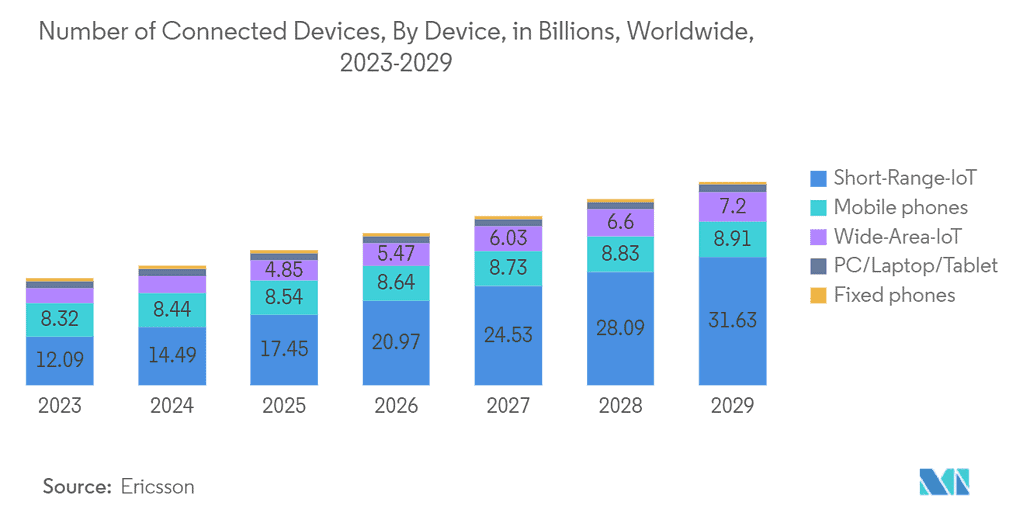
- By 2026, the number of connected devices globally is projected to reach about 35.1 billion units.
- Engineering represents the largest share of Industry 5.0 publications, accounting for 24.2%.
- 72% of manufacturers have adopted AI, while 10% use it at scale.
Key Drivers of the Industry 5.0 Market
- Market Research Future stated that automation could displace 85 million jobs, while 97 million new roles may emerge.
- Around 60% of consumers are willing to pay more for sustainable products, encouraging greener manufacturing.
- AI adoption in manufacturing could raise productivity by up to 30% by 2026.
- About 70% of consumers prefer brands that offer personalized experiences.
- New safety and ethical standards are encouraging companies to adopt advanced technologies responsibly.
Main Characteristics of Industry 5.0
- Industry 5.0 uses AI, robotics, and digital tools to improve worker safety, skills, creativity, and decision-making.
- It supports low-waste production, efficient resource use, recycling, and lower energy consumption.
- Businesses build flexible factories and supply chains that can handle disruptions, cyberattacks, climate events, and shortages.
- Smart technologies work alongside employees to enable safer and more flexible manufacturing.
- Industry 5.0 considers employees, customers, communities, and the environment.
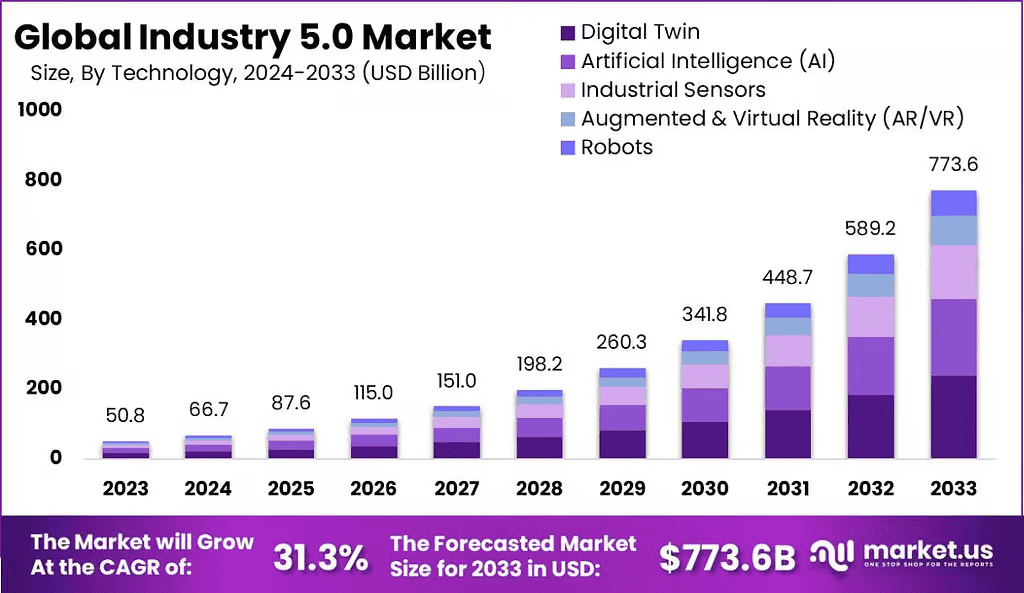
Global Industry 5.0 Market Size
(Source: market.us)
- The Global Industry 5.0 market was valued at USD 87.6 billion in 2025 and is projected to reach USD 115.0 billion in 2026.
- The market is expected to grow at a CAGR of 31.3% from 2024 to 2033.
- By 2033, the market is forecast to reach USD 773.6 billion.
Industry 5.0 Market Share Insights
- According to RootsAnalysis, discrete industries are projected to account for 74.65% of the market by 2035. The process industries are expected to grow at a CAGR of 32.67% from 2026 to 2035.
- The automotive sector could reach a 38.34% market share by 2035. Meanwhile, semiconductors and electronics may record a 32.23% CAGR.
- Large businesses are expected to hold 76.34% of the market, while SMEs may achieve a 34.25% growth rate through 2035.
- North America currently holds 37.69% of the market.
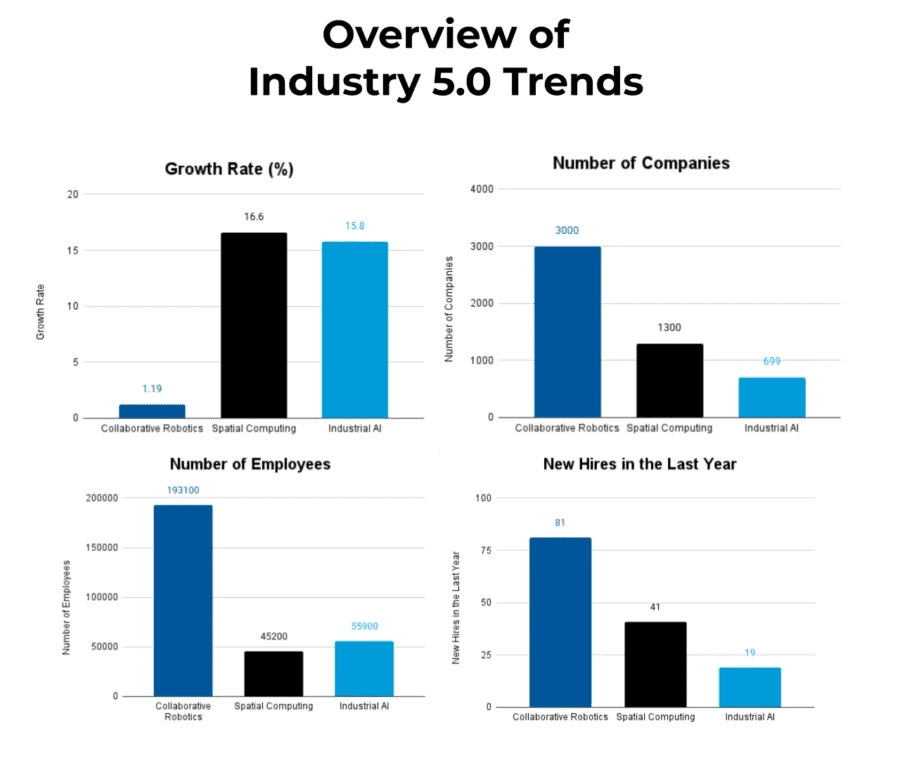
Industry 5.0 Trends Overview
(Source: startus-insights.com)
- Collaborative robotics grew by 1.19%.
- The sector includes 3,000 companies, 193,100 employees, and 81 new hires.
- Spatial computing showed the highest growth rate at 16.6%.
- The segment includes 1,300 companies, 45,200 employees, and 41 new hires.
- Industrial AI grew by 15.8%, with support from 699 companies and 55,900 employees.
- Furthermore, it added 19 new hires during the last year.
Global Industrial Automation Trends
- The IFR reports that 542,000 industrial robots were installed worldwide in 2024, with 74% in Asia, 17% in Europe, and 8% in the Americas.
- Global installations are projected to reach 575,000 in 2025 and exceed 700,000 annually by 2028.
- The stock of operational industrial robots reached 4.66 million units in 2024.
- By January 2026, the World Economic Forum’s Global Lighthouse Network had expanded to 223 sites.
- These facilities covered more than 30 countries and 40 industries.
Industry 5.0 Investment and Performance Insights
- The i40Pilot.app report further stated that about 67% of manufacturers plan to invest in Industry 5.0 by 2027.
- Human-AI collaboration could improve productivity by 35% compared with full automation.
- Cognitive maintenance agents may reduce unplanned downtime by 42%.
- Industry 5.0 transition programs typically reach ROI within 18 months.
Leading Companies in the Industry 5.0 Market
- Siemens AG supports Industry 5.0 through automation, AI, digital twins, IoT, and industrial software. Its market capitalization was EUR 178.84 billion, with a capital stock of EUR 2.346 billion as of March 3, 2026.
- ABB Ltd. provides robotics, cobots, AMRs, AI-enabled automation, and IIoT solutions. Its market capitalization reached USD 156.00 billion in February 2026. It operates in more than 100 countries.
- Schneider Electric’s market capitalization was USD 189.51 billion in September 2026, up 21.7% in 2026.
- IBM had a market capitalization of USD 217.99 billion on September 24, 2026, supporting Industry 5.0 with AI, cloud, data, and cybersecurity.
- Cisco reached USD 420.99 billion on September 25, 2026, providing networking, IoT, edge, and cybersecurity infrastructure.
- Honeywell’s market capitalization was USD 67.14 billion on September 24, 2026.
- Emerson was valued at USD 84.98 billion on September 23, 2026.
- Rockwell Automation’s market capitalization was USD 46.15 billion as of September 21, 2026. In Q2 2026, net income accounted for USD 350 million, or USD 3.10 per share.
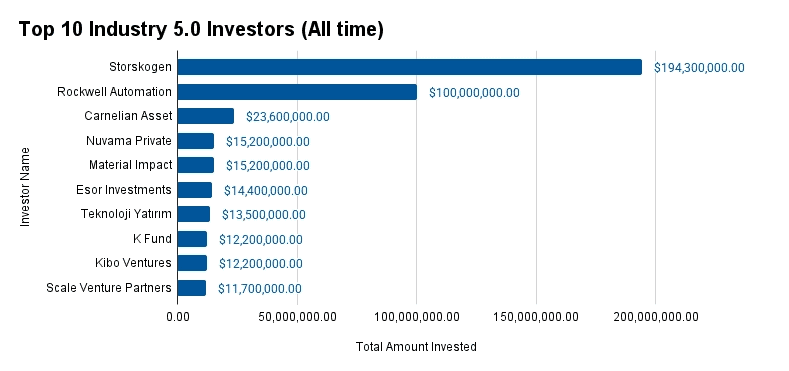
Top Industry 5.0 Investors
(Source: startus-insights.com)
- Storskogen is the leading Industry 5.0 investor, with total investments of USD 194.3 million, followed by Rockwell Automation at USD 100 million.
- Carmelina Asset invested USD 23.6 million, while Nuvama Private and Material Impact each invested USD 15.2 million.
- Other key investors include Esor Investments at USD 14.4 million, followed by Teknoloji Yatırım (USD 13.5 million), K Fund (USD 12.2 million), Scale Venture Partners (USD 11.7 million), and Kibo Ventures (USD 11.2 million).
Industry 5.0 Learning and Assessment Tool
(Source: mordorintelligence.com)
- By 2026, the number of connected devices globally is projected to reach about 35.1 billion units, supporting Industry 5.0 learning tools that connect people, machines, sensors, and digital platforms.
- Short-range IoT devices will lead with 20.97 billion units, followed by mobile phones at 8.64 billion and wide-area IoT devices at 5.47 billion.
Industry 5.0 Research Publications by Subject Area
![Distribution of Industry 5.0 Publications Across Subject Areas [in %]](https://www.sci-tech-today.com/wp-content/uploads/2026/10/Distribution-of-Industry-5.0-Publications-Across-Subject-Areas-in-1024x790-1.png)
(Source: mdpi.com)
- Engineering represents the largest share of Industry 5.0 publications, accounting for 24.2%.
- Computer Science follows with 23%, reflecting the importance of AI, automation, robotics, and digital technologies.
- Other subject areas contribute 17.4%, while Business, Management, and Accounting account for 8.9%.
- Decision Sciences and Mathematics represent 6.8% and 6.3%, respectively, highlighting the multidisciplinary nature of Industry 5.0 research.
Industry 5.0 User and Usage Statistics 2026
- According to parsec-corp.com, 72% of manufacturers have adopted AI, while 10% use it at scale, based on a survey of 1,200 manufacturing leaders.
- 65% use generative AI, compared with 48% in 2024, while 71% report resilient supply chains.
- KPMG found that 49% of 258 industrial leaders across 22 countries have AI use cases that create business value, while 68% expect to scale AI within 12 months.
- PwC surveyed 443 executives across 24 territories, with highly automated processes expected to increase from 18% to 50% by 2030.
- A review of 52 studies found AI in 86%, collaborative robots in 80%, IoT in 71%, digital twins in 63%, and sustainability in 63%.
- Studies in 2026 examined 32 companies, 20 workers and managers, and 14 use cases to assess Industry 5.0 adoption.
- Other research covered 160 firms, 19 interviews, 82 organizations, 398 coded statements, and 378 Indian firms.
Industry 4.0 vs. Industry 5.0 KPI Benchmarks
| KPI Category | Metric | Industry 4.0 Benchmark | Industry 5.0 Target |
| Operational Efficiency | Overall Equipment Effectiveness | 75%-80% | 88%-92% |
| Human-AI Collaboration | Human Override Rate on AI Decisions | – | <8% (high AI trust) |
| Sustainability | Energy Consumption per Unit Produced | Baseline | -25% versus baseline |
| Resilience | Mean Time to Recovery from Disruption | 48-72 hours | <12 hours |
| Workforce Development | AI Literacy Score (workforce average) | – | >70/100 |
| Quality | First Pass Yield with Cognitive QC | 94%-96% | 98.5%+ |
| Supply Chain | Supplier Disruption Response Time | 5-7 days | <24 hours |
Industry 5.0 and Manufacturing Workforce Trends
- Deloitte noted that more than 81% of manufacturing task hours are expected to remain human-driven. Meanwhile, global employment is projected to grow from 494 million in 2023 to nearly 500 million in 2026.
- Women represent 2 in 5 manufacturing workers, with their share in transport equipment rising from 23% in 1991 to 30% in 2023, according to the ILO.
- Rockwell Automation reported that AI-supported operations could rise from 34% in 2026 to 54% by 2030, while 59% already use smart manufacturing and 90% see digital transformation as essential.
- In APAC, 95% consider transformation essential; 71% plan to increase AI use. Moreover, 84% prioritize teamwork, compared with 77% for AI skills and 73% for coding.
- India added 57 lakh manufacturing jobs from 2015-16 to 2024-25, growing at an annual rate of 4%. Technology-intensive activities accounted for 46% of manufacturing value added.
Wrap-up
Industry 5.0 is changing how factories work by combining human skills with smart technologies. AI, robotics, IoT, and data tools help companies improve production and make better decisions. At the same time, the focus is shifting toward sustainability, worker safety, and personalized production.
As adoption grows, businesses will need skilled employees, secure systems, and the right technology strategy. Industry 5.0 can help build smarter, more flexible, and more sustainable manufacturing operations.
FAQ
Industry 4.0 emphasizes automation and connected technologies, while Industry 5.0 focuses on human-machine collaboration, sustainability, resilience, and personalization.
Industry 5.0 uses AI, robotics, IoT, digital twins, automation, cloud computing, and collaborative technologies.
Sustainability in Industry 5.0 means reducing environmental impact while creating efficient, resilient, and human-centered production systems.

Sources