








Overview
AI In Corporate Banking Statistics: Artificial intelligence is becoming a game changer in corporate banking. Banks are now using AI to process loans faster, detect fraud, and make smarter financial decisions. It also helps them analyze business data, reduce manual work, and respond to client needs more quickly. With these tools, banks can improve daily operations and deliver better services to corporate customers. Generative AI is taking this shift further by helping employees handle complex tasks and access useful insights in less time.
However, banks must still address data privacy, cybersecurity, and regulatory challenges. As business needs continue to evolve, AI is helping corporate banks become more efficient, make informed decisions, and build stronger client relationships.
Editor’s Pick
- The global AI in corporate banking market is projected to reach USD 128.4 million in 2025 and USD 139.6 million in 2026.
- According to Corporate Banking Trends 2026, trade finance, payments, and liquidity generate USD 1.3 trillion, nearly 50% of wholesale banking income.
- 81% of financial services firms use AI, and 40% have reached advanced stages of adoption.
- 65% of surveyed U.S. banking leaders see measurable business value from AI.
- In 2025, 65% of financial institutions used AI, with capital markets leading at 68%.
- Around 70% of banks expect AI returns within 1-3 years, while 5% expect 5+ years.
- In Q2 2026, 84% of banks said access to lower-cost large language models influenced their AI strategy for the next 6 months.
- In Q1, 62 AI use cases were recorded across generative, traditional, and agentic applications.
- Generative AI could increase U.S. banking operating profits by USD 340 billion.
- 42% of financial services leaders had assessed AI’s impact on workforce needs.
- AI handled 81% of travel-notice inquiries and 63.5% of lost-or-stolen card reports.
Global AI in Corporate Banking Market Size
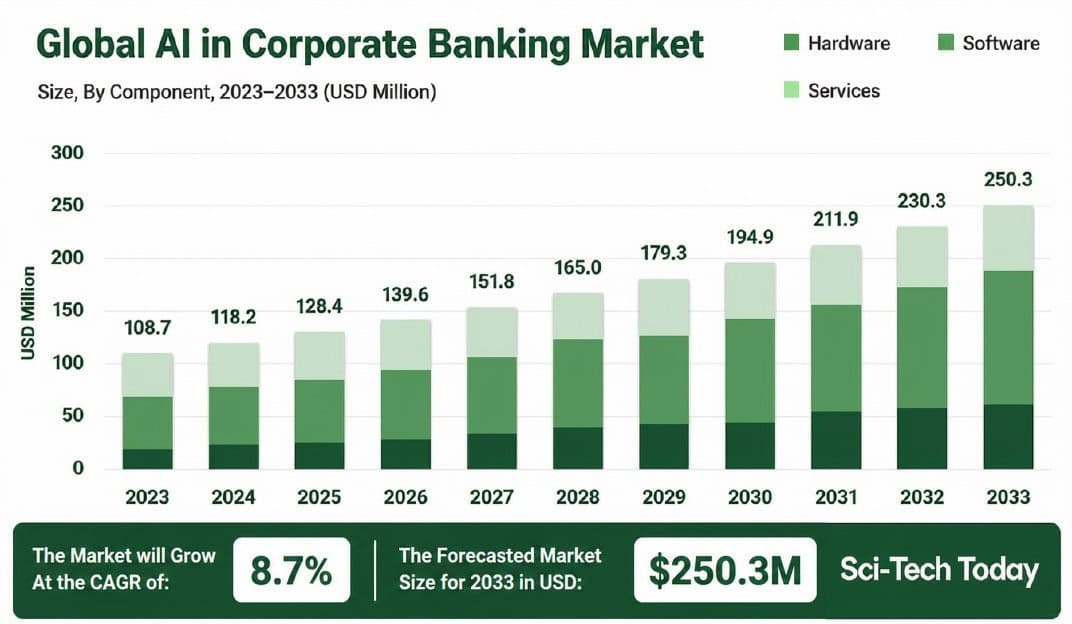
- The global AI in corporate banking market is projected to reach USD 128.4 million in 2025 and USD 139.6 million in 2026.
- The market is forecast to grow at a CAGR of 8.7% from 2023 to 2033, reaching USD 250.3 million by 2033.
Key Corporate Banking Trends and Digital Transformation
- Corporate Banking Trends 2026 stated that trade finance, wholesale payments, and liquidity services contribute USD 1.3 trillion annually, nearly 50% of wholesale banking income.
- The corporate digital banking market is projected to grow from USD 6.85 billion in 2024 to USD 28.16 billion by 2032.
- By 2028, agentic AI could handle approximately 15% of daily business decisions and feature in 33% of enterprise software.
- HSBC operates more than 600 AI use cases and supports over 3 million annual client interactions through a generative AI assistant.
- Additionally, 88% of clients rated the bank as easy to deal with.
- SWIFT is developing a blockchain ledger with 30 global banks, while BIS Project Agorá involves 7 central banks and 40 private firms.
- J.P. Morgan, HSBC, Citi, and OCBC are advancing tokenized deposits and digital cash solutions.
- ISO 20022 adoption is expected to cover 90% of global cross-border messages by late 2025.
- Around 78% of surveyed corporate clients reported an increase in multi-currency cross-border activity.
Banking AI Predictions
- According to SAS’s report, financial services firms could spend over USD 67 billion on AI by 2028.
- Banks will increasingly use autonomous AI agents to manage customer requests and automate workflows.
- Over 80% of enterprise data is unstructured, and it is growing by 50% to 60% annually.
- AI-powered systems will improve fraud detection and anti-money-laundering compliance.
- Financial media networks could increase noninterest income by 20%-30% within 2 years.
AI Adoption Statistics in Financial Services for 2026
- According to Cambridge CCAF, 81% of financial services firms use AI, and 40% have reached advanced stages of adoption.
- Around 52% of global financial services firms are experimenting with AI agents.
- Fintechs lead traditional financial institutions in agentic AI adoption, with rates of 57% and 45%, respectively.
- KPMG reports that 65% of surveyed U.S. banking leaders see measurable business value from AI.
- Meanwhile, 59% of financial services organizations report meaningful business value.
- 62% of banks have improved efficiency through AI, while 32% report revenue growth.
- 27% of financial services organizations are scaling AI across their enterprises.
- Only 10% are deploying AI agents, while 18% are scaling them across functions.
- Almost 61% feel prepared to manage AI risks, but only 16% are highly confident in workforce readiness.
Corporate Banking AI Adoption and Productivity in 2026
- DBS Credit Assessment rolled out AI tools to approximately 1,500 employees after a 150-person pilot.
- The agents handle more than 70 tasks and prepare draft credit memos.
- Credit-related tasks consume up to 40% of relationship managers’ time.
- DBS aims to reduce this workload by at least 30%, but this remains a target.
- Lloyds reported that AI reduced the time required to process commercial real estate documents from 75 hours to minutes.
AI Investment and Returns in Financial Services
- Statista report stated that in 2025, 65% of financial institutions used AI, with capital markets leading at 68%.
- GenAI adoption exceeded 60%, up from 52% in 2024.
- Financial services AI spending is projected to exceed USD 75 billion in 2026 and reach USD 125.13 billion by 2028, growing at a 29% CAGR.
- Banking AI spending could reach USD 53.14 billion in 2026 and exceed USD 90 billion by 2028, with a 30% CAGR.
- Additionally, 70% of banking CEOs planned to allocate 10%-20% of their budgets to AI.
- Document processing delivers a 32% return on investment.
- By early 2026, 40% of financial institutions reported higher profitability, while 43% saw no change.
- Among firms spending over USD 100,000 annually on AI, 61% reported profitability gains.
- Around 70% of banks expect AI returns within 1-3 years, while 5% expect 5+ years.
Priorities and Spending Trends
- In Q1 2026, KPMG reports that 80% of banks prioritized cybersecurity or data security.
- Meanwhile, 75% focused on operations and 75% on customer experience.
- Additionally, 50% would keep AI investment a priority during a recession over the following 12 months.
- In Q2 2026, 84% of banks said access to lower-cost large language models influenced their AI strategy for the next 6 months.
- Meanwhile, 87% faced pressure to demonstrate AI’s value to investors or boards.
- Cybersecurity ranked as a top investment area for 44% of banks, followed by data and analytics at 40% and collaboration with other institutions at 32%.
Generative AI in the Banking and Finance Market
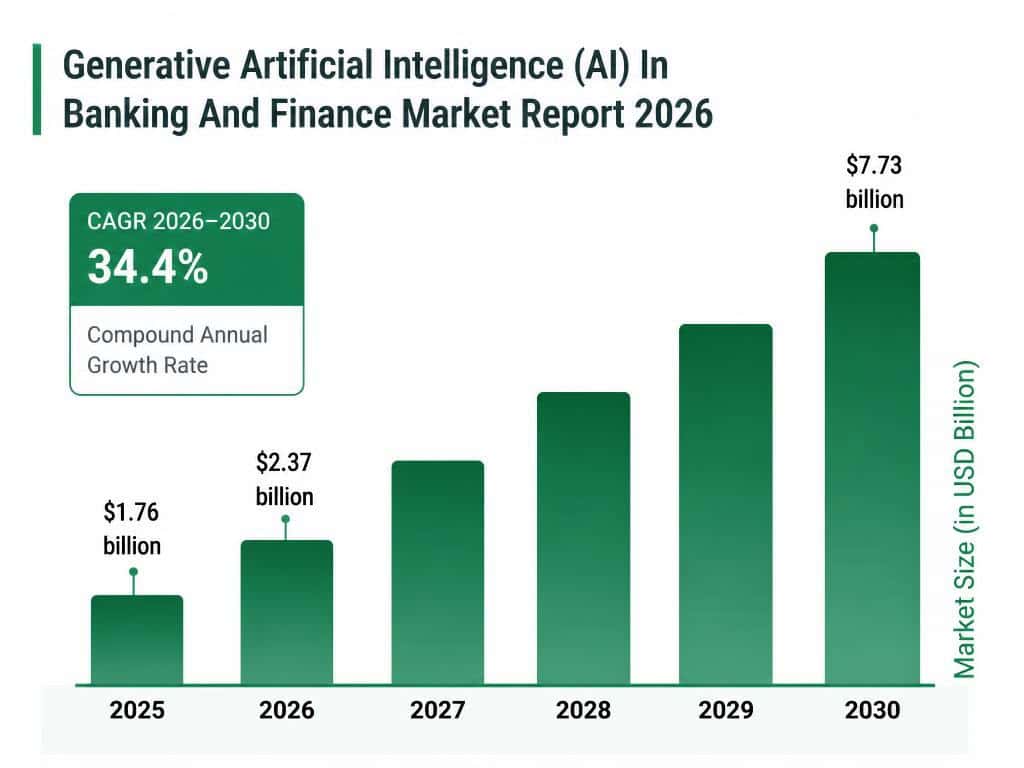
- The market is projected to grow from USD 1.76 billion in 2025 to USD 2.37 billion in 2026.
- Growth continues through 2027, 2028, and 2029, reaching USD 7.73 billion in 2030, with a projected CAGR of 34.4% from 2026 to 2030.
Segmental Analysis
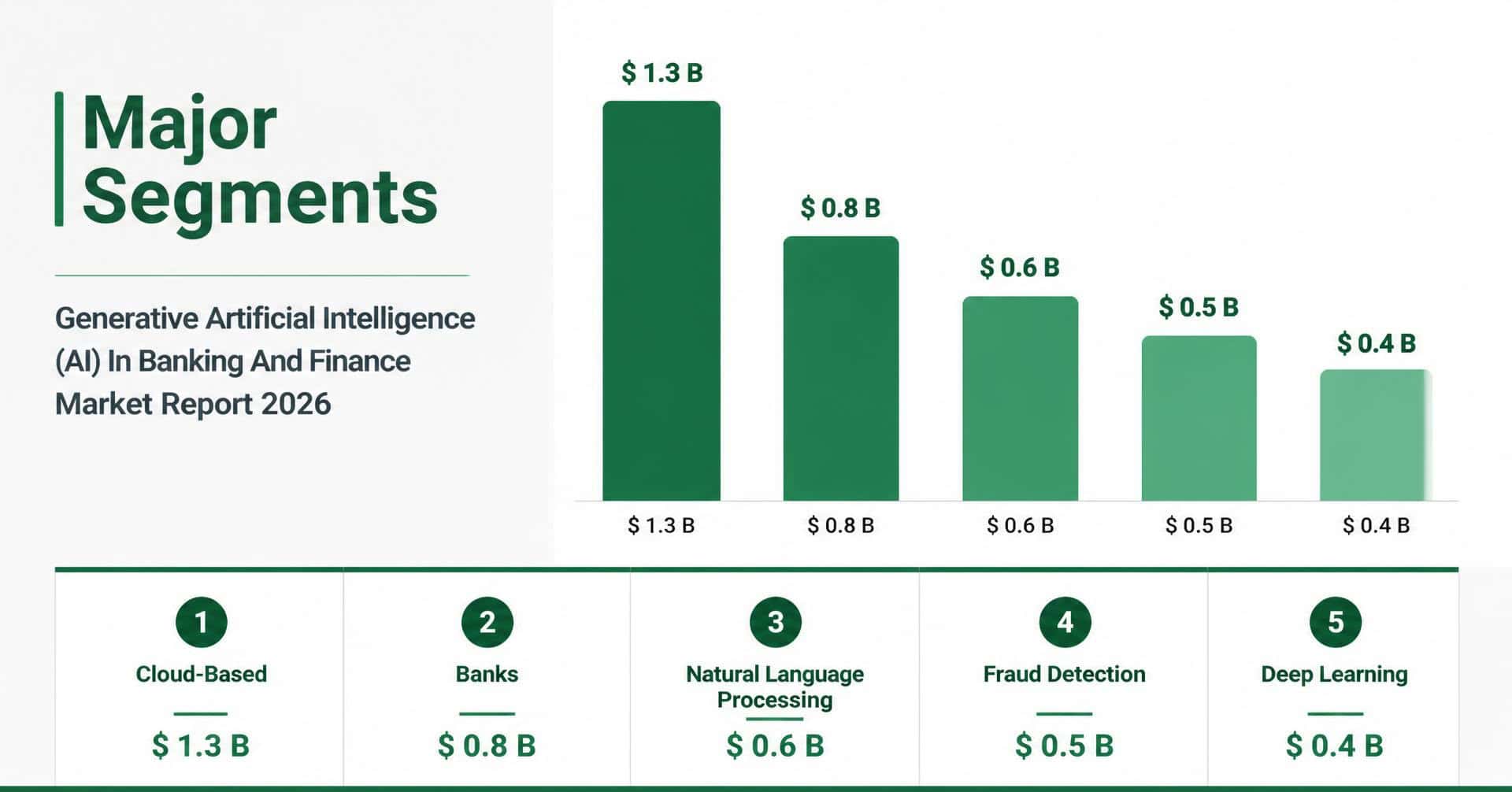
- Cloud-based solutions total USD 1.3 billion, while banks account for USD 0.8 billion.
- Natural language processing reaches USD 0.6 billion.
- Fraud detection totals USD 0.5 billion, and deep learning reaches USD 0.4 billion.
Generative AI Market Share in Banking and Finance
- The top 10 competitors collectively hold 16% of total market revenue, indicating a fragmented market, according to the Business Research Company.
- Leading companies such as Microsoft, Google, IBM, Amazon, Oracle, and Accenture each hold a 2% market share.
- Other competitors, such as Goldman Sachs, SAP, and Wells Fargo, each account for 1% of the market.
Regional Market Report, 2026
- North America leads with USD 891.23 million, followed by Western Europe at USD 484.96 million and Asia Pacific at USD 296.85 million.
- South America reaches USD 28.67 million, the Middle East USD 24.91 million, and Eastern Europe USD 11.54 million.
- Africa accounts for USD 10.05 million, indicating a smaller regional market compared with other regions.
Agentic AI Adoption and ROI Reporting in Banking
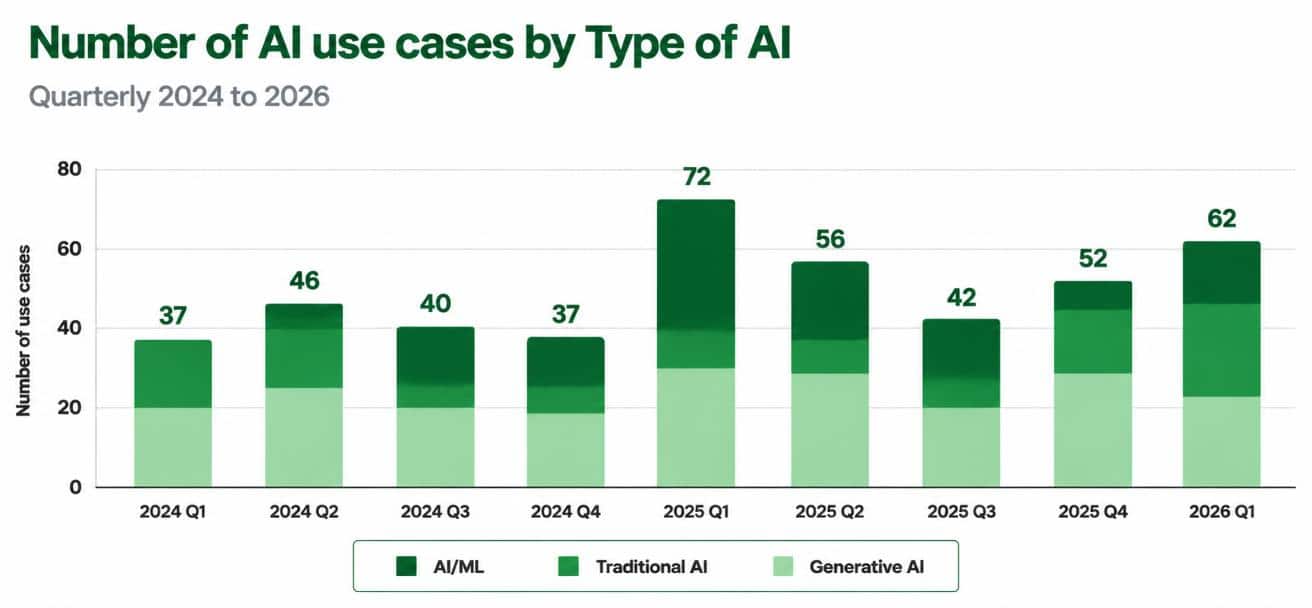
- In Q1 2026, 62 AI use cases were recorded across generative, traditional, and agentic applications.
- Nearly 1 in 3 AI use cases reported in Q1 2026 involved agentic AI, up from 15% in Q4 2025.
- Anthropic was the most referenced vendor, while specialized providers accounted for 68% of deployments, focusing on credit, anti-money laundering, and treasury.
- In Q1 2026, 38% of use cases reported outcomes, and 15 of 50 tracked banks disclosed overall AI returns.
- DBS and BNP Paribas met their 2025 targets, while Santander began quarterly reporting toward its €1 billion goal for 2028.
Financial Impact of AI Adoption in Banking
- Generative AI could increase U.S. banking operating profits by USD 340 billion.
- According to Roland Berger, AI could unlock USD 1 trillion in global banking revenue by 2030 and reduce compliance, operations, and customer service costs by up to 25%.
- AI could also save the industry around USD 1 trillion by 2030 through automation and better decisions.
- AI could raise fee-based income from around 30% to 40% of total bank revenue.
Workforce Transformation and AI in Corporate Banking
- PwC found that 42% of financial services leaders had assessed AI’s impact on workforce needs.
- Nearly 80% expected staff numbers to fall by at least 20% within five years.
- 62% planned to hire AI-skilled workers, 61% intended to retrain employees, and 57% planned to work with external AI providers.
- KPMG found that 80% of banking CEOs said AI was changing workforce development, up from 61% in 2024.
- Meanwhile, 83% prioritized reskilling and 34% expected workforce reductions.
- 79% said AI was reshaping entry-level skills; 30% cited skills gaps; 64% focused on retraining; 68% redesigned roles; and 60% hired AI talent.
- Cambridge research found expected AI productivity gains of 79% in technology and data, 75% in operations, and 69% in front-office roles.
- Additionally, a 44% growth in commercial banking jobs is expected by 2030.
Banking Technology Spending Trends in 2026
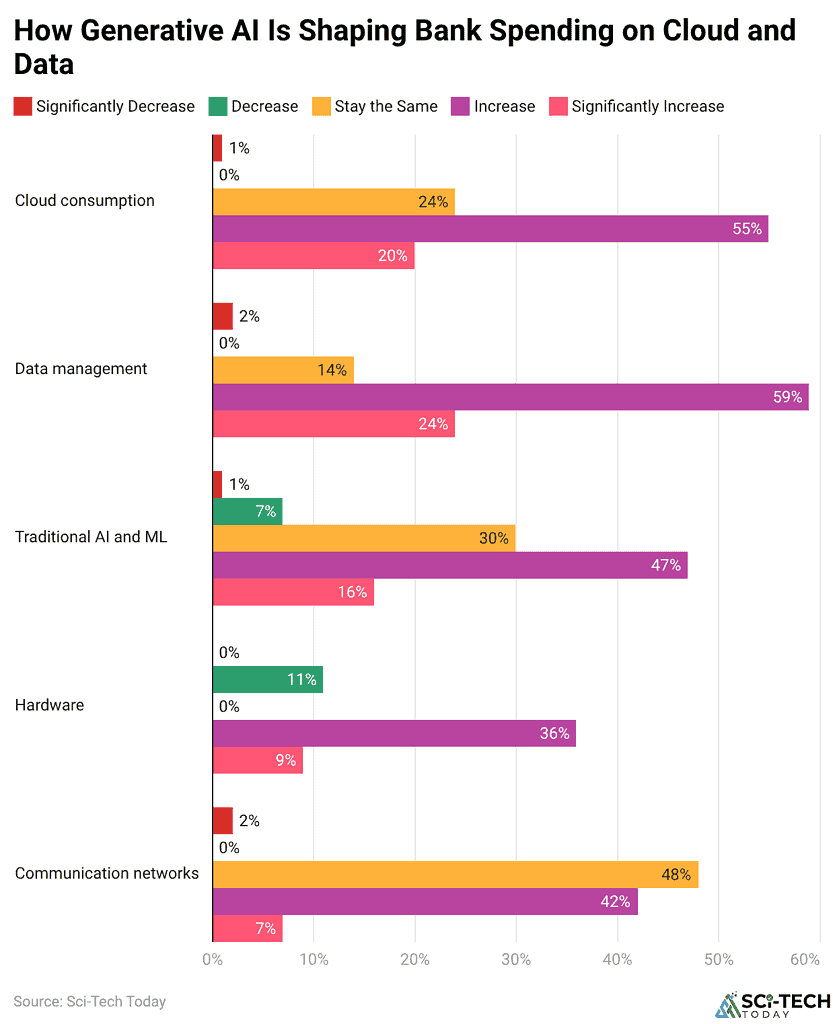
| Technology Category | Increase | Rise Significantly | Remain Unchanged | Decrease | Fall Significantly |
| Cloud | 55% | 20% | 24% | – | 1% |
| Data Management | 59% | 24% | 14% | – | 2% |
| Traditional AI and Machine Learning | 47% | 16% | 30% | 7% | 1% |
| Hardware | 36% | 9% | – | 11% | – |
| Communication Networks | 42% | 7% | 48% | – | 2% |
AI Adoption in U.S. Banks
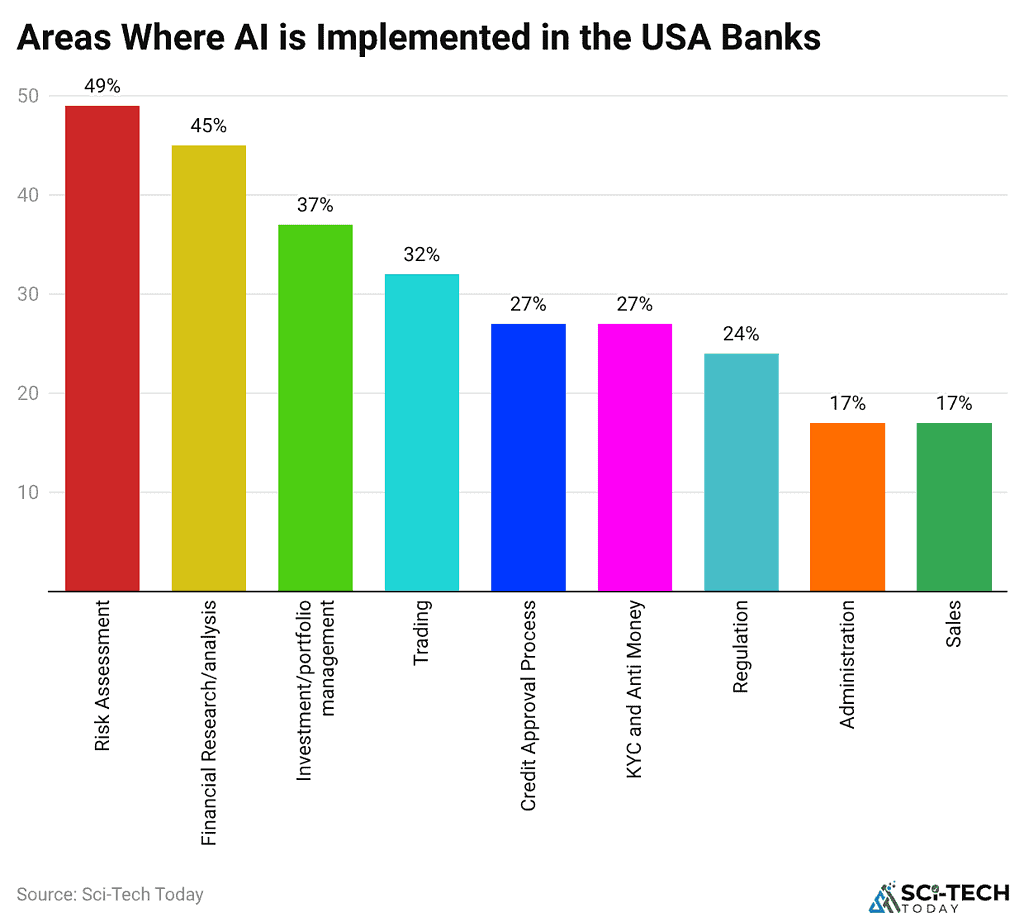
- Risk assessment has the highest AI adoption at approximately 49%, followed by financial research and analysis at 45%.
- Investment and portfolio management records 37% adoption, while trading reaches 32%.
- Credit approval, KYC, and anti-money laundering each show 27% adoption.
- Regulatory activities account for 24% of adoption.
- Administration and sales each record 17% adoption.
AI Handling of Banking Queries in North America, 2025
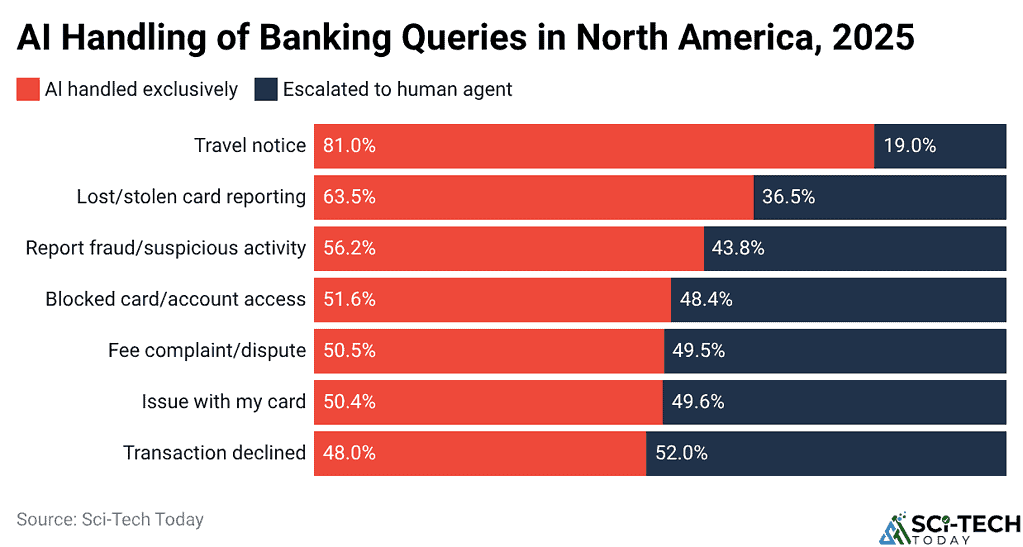
- AI handled 81% of travel-notice inquiries and 63.5% of lost-or-stolen card reports.
- Human support remained important for transaction issues, with 52.0% of declined transactions escalated to agents.
- AI resolved 56.2% of fraud reports, 51.6% of access issues, 50.5% of fee disputes, and 50.4% of card-related issues.
Warp Up
AI is helping corporate banks work smarter, save time, and serve business clients more effectively. It also helps banks spot risks, detect fraud, and make better decisions. However, protecting customer data and complying with banking regulations remain important.
As AI continues to grow, banks must use it carefully while keeping human judgment in the process. This balance will help them improve services, build customer trust, and stay competitive in a changing financial industry.
FAQ
AI supports fraud detection, credit risk assessment, cash flow forecasting, loan processing, compliance monitoring, and personalized corporate banking services.
No, AI will support corporate bankers, but human relationships, trust, and judgment remain essential.
Corporate banks should enforce AI governance, protect data, audit models, and maintain human oversight.