








Introduction
Upselling Statistics: Upselling is still one of the most effective strategies for generating revenue using an existing customer base, yet in its 2026 version, it has little to do with the basic “upgrade to premium” style of upselling. The new systems create an actual customer need, anticipate the next best offer, successfully convey its message, and measure effectiveness based on retained profit instead of just having a bigger first sale. The major change is that upselling is no longer product-focused, but rather customer-value focused.
The information provided below presents valuable insights that companies should be aware of, such as the upselling conversion rate standards for 2026, how upselling helps to maintain customer retention and lifetime value, as well as how automated processes incorporating artificial intelligence are changing the picture significantly.
Top Picks
- 42% of sales professionals think understanding what a customer needs is most important in closing an upgrade sale.
- 40% of sales professionals think building genuine customer trust is the key to successfully upselling.
- 39% of sales professionals believe customers value sales when customers have been offered something that is of value.
- 37% of sales professionals believe a post-goal-achievement offer works best.
- 57% of sales professionals believe sales cycles are lengthening.
- 73% of B2B buyers reported that they avoid sales reps who spam them with irrelevant outreach.
- 71% of customers want personalized interaction, and 76% are frustrated when they don’t receive it.
- 93% of marketers believe personalization boosts leads and sales.
- Personalization can grow revenue 5–8% and reduce service costs 20–30%.
The Importance of Upselling in 2026
- Upselling offers a means for firms to grow their income stream from current clientele with fewer resource outlays in order to capture new clients.
- There is also the reality that the profitability of upgrade offerings is not directly proportional to the volume of upgrades sold.
- There needs to be a marriage of customer demand, supply and support constraints, long-term value, and long-term viability rather than focusing exclusively on the volume of upgrades sold.
- There is real value in the creation of upgrades when customers receive real value, and the firm achieves an optimal return on their investment.
- Upselling offerings that increase the demand for support, increase the cost of execution, result in refunds, and lose customers may actually hurt the company’s overall bottom line. This requires a careful financial review.
- A central figure is the incremental lifetime contribution margin. It estimates the additional dollars an upgrade provides.
- Incremental Lifetime Contribution=Upgrade Revenue−Discounts−Fulfillment Costs−Implementation Costs−Support Costs−Refunds−Expected Churn Cost
- For subscription business models, such as SaaS suppliers, financial services, telecommunication firms, and B2B entities, it should also incorporate renewal likelihood, prospects of future expansions, usage-based service costs, and risks of downgrades or cancellations to make the distinction between profitable upgrades and short-term revenue hikes that sink long-lasting customer relationships.
Upselling Success Statistics 2026
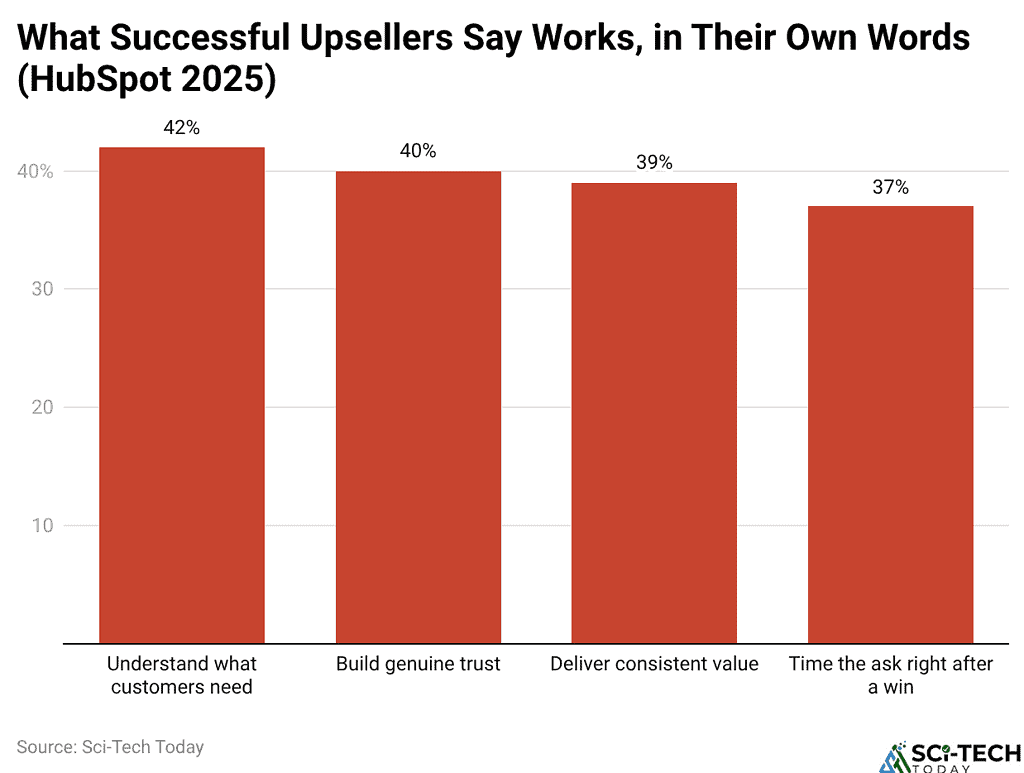
- Understanding customers, trust, and timing are the pillars of effective upselling. HubSpot’s 2025 sales research confirms that customer relationships are a more critical element than price, even in the case of upgrades.
- Understanding customers’ needs is of critical importance, said 42% of survey respondents, followed by 40% for the need for trust, and 39% for consistent value.
- Almost as important (37%) was the need to offer a product only when a customer reaches a target goal.
- A customer has to clearly understand the benefit of a product or service for upselling to be effective.
- Instead of a sales calendar, a company has to follow the evolution of the customers’ needs, the use of a product or service, customer satisfaction, and changes in requirements.
- The discount offers have an impact on purchase decisions; there is no substitute for trust or a clear benefit of an upgrade.
- An essential aspect of all sales processes is how a customer experiences a service; a fact that a greater percentage of salespeople (57%) are seeing their sales cycle getting longer.
- It is equally important to note that a significant percentage of buyers (73%) avoid sellers who make sales overtures that do not concern the buyer.
- Offering an upgrade with the wrong information and a total disregard for the customer’s situation will cause more harm than good.
- The practical implications of this for businesses are to associate upselling with customer key stages.
- First, the sales team needs to create value and understand which priorities are important for a customer, as well as which upgrade the customer truly requires.
- In this sense, it will make the proposals more personalized while allowing the company to foster good customer relations and increase revenue sustainably without the need for discounts or pressure in sales.
Impact of AI and personal approach on Upselling in 2026
- The role of the personalized approach together with the use of artificial intelligence is transforming the upselling process, as it enables companies to make timely and useful offers.
- Customers are more likely to accept recommendations that are tailored to their needs rather than common recommendations, which is what businesses focus on in 2026.
- Evidence indicates that 71% of customers prefer personalized experiences and 76% of consumers are frustrated when they don’t get them.
- Additionally, HubSpot indicates that 93% of marketers think that personalization leads to more conversions.
- However, only one of four employers is content with the way they employ personal data to create personalized campaigns, which indicates a certain gap in the perception of the importance of personalization and the application of personalization in practice.
- For instance, Salesforce indicates that 73% of B2B consumers avoid sales representatives who reach out to clients with irrelevant requests.
- In addition, statistics provided by Salesforce state that 74% of customers dislike having to tell their story more than once to various agents. These numbers show how important customer data, connected systems, and shared background information are.
- The Next Best Experience framework from McKinsey states that AI-powered next-best-experience programs can improve revenue by 5%-8% and cut costs by 20%-30%.
- AI enables businesses to identify valuable upselling possibilities, choose the right communication mediums, and individualize recommendations depending on the customer’s activity.
- While doing so, companies can test personalized offerings via email, sales efforts, and landing pages with the help of data improvement initiatives.
- According to Salesforce’s research, top sales teams use AI counselors 1.7 times more often than low-performing teams.
- Salespeople expect AI coaches to lessen the research process by 34% and content generation by 36%. However, it is crucial that personalization remains meaningful and not merely automated.
- Effective upselling requires using accurate data, suitable recommendations, and human intuition.
- Companies need to assess the incremental income, conversion rates, and customer satisfaction levels to understand whether personalization performs well or not.
B2B SaaS vs. B2C Ecommerce Upselling Benchmarks
| Dimension | B2B SaaS upselling | B2C ecommerce upselling |
| Primary outcome | Sustainable growth leads to improved NRR. | Better AOV and contribution margin for each completed order. |
| Common benchmark | Successful organizations often aim for the NRR of 110% to 120%, while those that are more enterprise-focused may go beyond 120%. | AOV increase, attach rate, conversion at checkout, margin, and return: there is no single AOV criterion that fits all. |
| Typical offer | New seats, higher usage levels, modules, premium customer support, analytics, etc. | Advanced version, larger package, set of products, additional product, warranty, delivery enhancement, subscription. |
| Core buyer signal | Account status, feature usage rate, actual usage level, number of users, timing of the deal, and customer welfare. | Shopping cart structure, category views, order of browsing, price reaction, technology and recency of sessions. |
| Sales cycle | Several weeks or months, often requiring several decision-makers to take part in the process. | Seconds to days, generally consists of one shopper. |
| Key platform data | CRM data, software telemetry, customer success, among other types of information. | Commerce system sources, session metrics and analysis, cart moments, product range and history, inventory and marketing approval. |
| Major risk | Premature expansion leading to either an increase in churn or a downgrade. | Disrupting the checkout or presenting unrelated upsells that can harm base conversion. |
| Most useful test | Cohort or account-level holdout measuring NRR, expansion ARR, adoption margin and churn. | Session-level A/B test studying incremental AOV, finish rate of orders, gross margin, and returns. |
Upselling Mistakes to Avoid
1. Treating all customers in the same way
- Static segmentation can deliver premium proposals to clients who may not use them, have no need for them, or even have refused them already.
- The best strategies incorporate customer behavior, product use, account age, and pricing eligibility.
2. Flooding customers with promotions
- According to Gartner, almost half of personalized messages go to an unintended audience, so one needs to be careful regarding their number.
- One should synchronize promotional emails, ads, in-app messaging, and client outreach.
3. Pitching an upgrade during the negative experience
- Customers having issues with billing, cancellations, implementation, support, or outages should not be sold anything.
- One needs to focus on solving the issue relating to the customer’s problem first before assessing the customer’s readiness.
4. Treating all customers in the same way
- Static segmentation can deliver premium proposals to clients who may not use them, have no need for them, or even have refused them already.
- The best strategies incorporate customer behavior, product use, account age, and pricing eligibility.
5. Flooding customers with promotions
- According to Gartner, almost half of personalized messages go to an unintended audience, so one needs to be careful regarding their number.
- One should synchronize promotional emails, ads, in-app messaging, and client outreach.
6. Pitching an upgrade during the negative experience
- Customers having issues with billing, cancellations, implementation, support, or outages should not be sold anything.
- One needs to focus on solving the issue relating to the customer’s problem first before assessing the customer’s readiness.
Conclusion
The year 2026 sees upselling being most successful when suggestions are in accordance with true customer demands, shown value, and timing. Research emphasizes the importance of trust, individualization, and relevant communication, while artificial intelligence helps businesses find upgrade possibilities and provide customized offers on a large scale. It should be noted, however, that increased transaction amounts do not guarantee increased profitability.
Companies have to take into consideration such points as implementation, customer service, fulfilment, refunds, and the risk of loss when assessing upgrades. While B2B SaaS teams have to keep track of their revenue growth and customer retention, e-commerce companies have to focus on order value, conversion, and margin.
FAQ
Upselling is a method that proposes to clients to buy a better version of a product or service they are considering, or an expanded version that is more suitable for them.
Upselling allows companies to increase their income by working with existing customers and, at the same time, improving their clients’ experience and reducing dependence on new customers.
Personalization provides companies with data and helps them understand customers’ preferences, behavior, and the way they use a product so they can come up with the right offers.
With AI, it is easier to identify upselling opportunities and analyze customers’ needs to generate personalized and relevant offers effectively.
It is vital to monitor the statistics of the company: the incremental revenue made thanks to upselling efforts, contribution margin, conversion rates, retention rates, customer satisfaction scores, support costs related to upselling, and churn rates.

Sources