









Introduction
Social Media ROI Statistics: In 2026, social media continues to be an important source of marketing returns: 48% of marketers regard Instagram as one of the three main social network platforms for ROI, and 49% consider short videos as one of the most effective types of content in terms of returns, according to HubSpot survey data.
Nonetheless, this data shows marketers’ stated experience rather than an average return that any business can expect. It is crucial to understand the difference between these meanings when it comes to using social media ROI data to create a budget and assess a campaign.
The data below differentiates between platform preference, ad revenue attribution, purchasing behavior, and measurement methods, indicating older studies.
Top Highlights
- Instagram is among the top 3 social media networks for ROI, and short-form video is one of the best content types.
- 86% of the surveyed participants use Facebook. Instagram, in turn, was utilized by 82% of marketers, and 72% used LinkedIn.
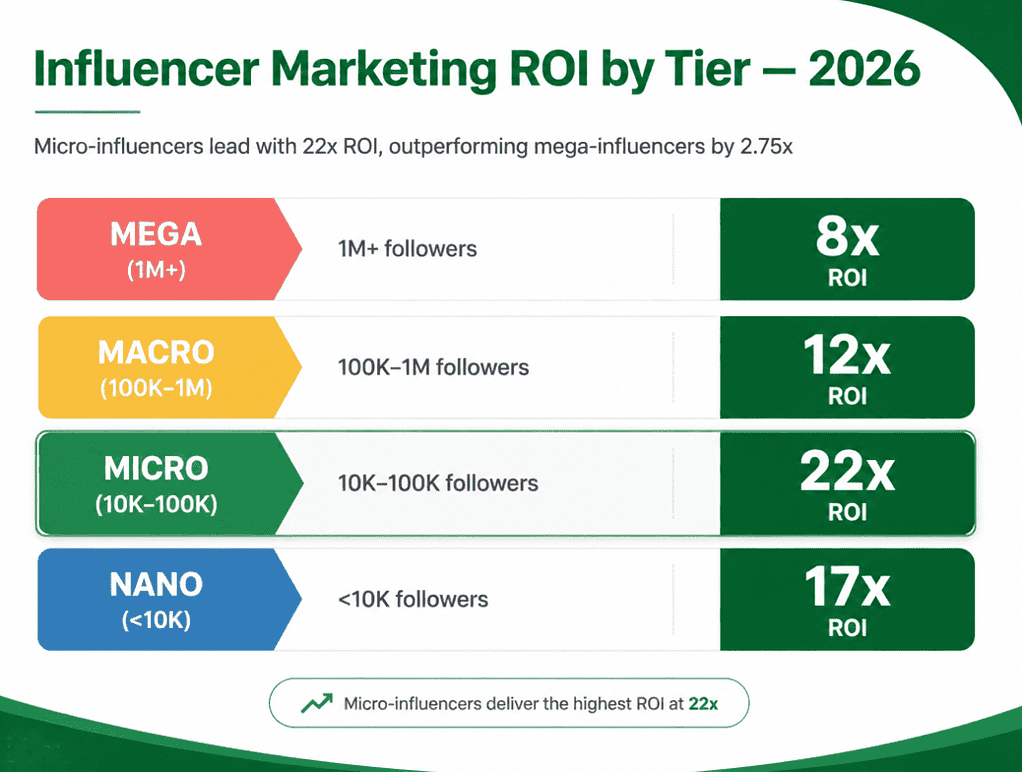
- Micro-influencers provide, on average, 22x ROI on advertising, though results do vary between individual marketing campaigns.
- The overall ROI from short-form video was found to be the greatest by 71% of surveyed marketers. The corresponding percentage for long-form video was only 22%.
- A majority of consumers (87%) value authenticity and therefore trust user-generated content over content published by a company.
- For 67% of marketers, the goal when evaluating the results of their social media marketing campaigns is to determine the resulting revenue.
- Retention rates for consumers engaged through social media tend to be around 20–30% higher.
- NMI’s 2026 data shows that instant rewards programs will encourage 87% of shoppers to visit those stores.
- Paid media ads represent about 30% of total marketing budgets as of Gartner’s 2025 CMO Survey, so evaluating ads’ costs to returns is important.
What Is Social Media ROI?
- ROI for social media measures the business value that social media campaigns produce for the money, time, and resources that have been spent.
- ROI shows if a social media marketing campaign helps support the company’s business goals.
- How a company chooses to measure the ROI for its social media depends on the campaign’s objectives.
- Brand awareness campaigns may use metrics like new followers, shares, audience size, and impressions to assess the effectiveness of the content.
- Likes and comments provide insights to show engagement with the company’s audience.
- Although engagement does not equate to the business growth that the campaign seeks, businesses should connect social media metrics to goals that really matter, such as website traffic, lead generation, conversions, and sales.
- One of the best financial measures of ROI for social media is how much revenue was created, assuming that revenue can be directly attributed to the company’s social media efforts.
- The best measure of ROI for a social media campaign incorporates both campaign performance metrics and business results to enable marketers to understand which of their social media marketing efforts actually generated the most return, and help marketers spend their budget more effectively.
Social media platforms used by marketers worldwide
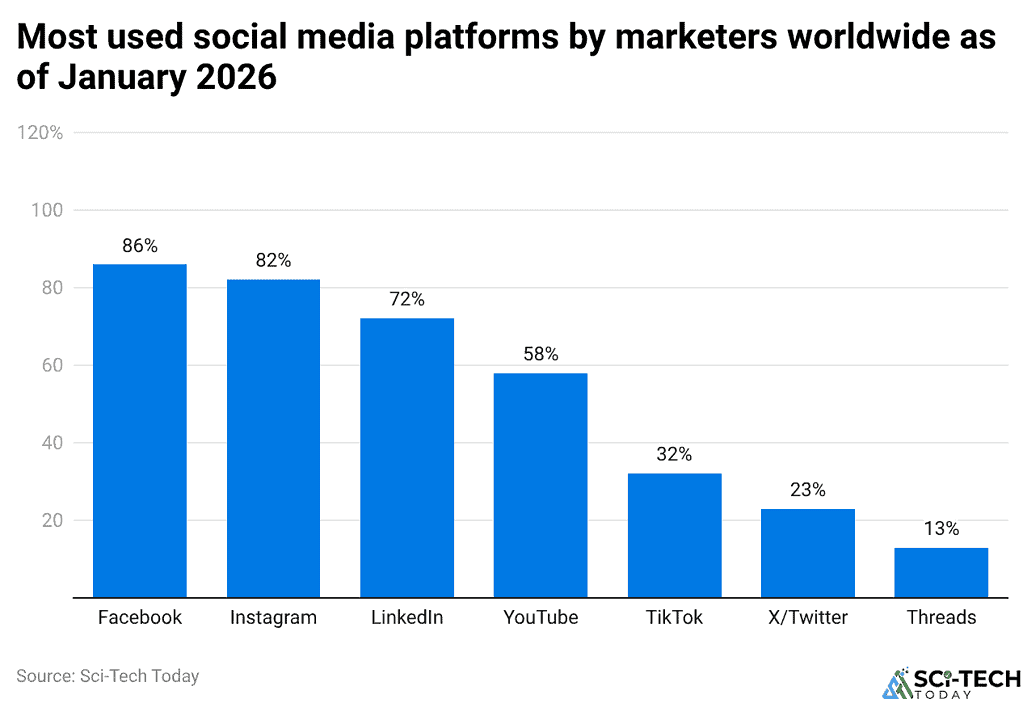
- Social media has the most impact on marketing campaigns in 2026. A majority of the survey participants use Facebook, which makes it the top social media platform for marketing.
- The next platform is Instagram with 82%, and the last is LinkedIn at 72%. Social networks serve as both marketing channels for consumer and professional markets.
- In the near future, social media marketers plan to utilize unpaid media across more channels. 60% of the respondents in the survey said they intend to post organic social media content to YouTube.
- LinkedIn and Instagram were very close and will likely continue to grow the organic side of social media marketing in 2026.
- Social media marketers place the most emphasis on increasing brand visibility and website traffic. This shows social media posts have a function well beyond just simple updates to customers.
- Most B2C marketing firms utilize platforms like Facebook and Instagram because they offer direct access to their target customers.
- B2B firms use platforms like LinkedIn because they allow users to post and share content within a business context.
- The data shows social media planning is about the audience and the objectives rather than how popular a social media channel is.
- For social media to be successful, a social media strategy must encompass audience analysis and clear and measurable social objectives and activities that support the strategy.
- In addition, the strategy should encompass the tracking of social media performance metrics to gauge its contribution to company growth.
Social Media Advertising ROI and Cost Analysis
E-commerce CPA Benchmarks
| Platform | Average CPA | Primary Use Case |
| TikTok | $25 | Trending and impulse products |
| $32 | Lifestyle and fashion products | |
| $38 | Broad demographic targeting | |
| $28 | Home and lifestyle products | |
| YouTube | $45 | Considered purchases |
Return on Ad Spend (ROAS) by Platform
| Rank | Platform | ROAS | Key Performance Factor |
| 1 | LinkedIn B2B | 6.8:1 | High-value leads and longer sales cycles |
| 2 | 6.2:1 | High-intent shopping behavior | |
| 3 | TikTok | 5.1:1 | Viral potential and younger demographics |
| 4 | YouTube | 4.5:1 | Video engagement and premium content |
| 5 | 4.2:1 | Visual products and shopping integration | |
| 6 | 3.8:1 | Broad reach and established platform |
Influencer Marketing ROI Statistics 2026
- A new era in digital marketing has dawned, where more and more brands are relying on trustworthy and relatable content creators to help them engage audiences.
- The industry that supports marketing and influencers alike has forecasted the influencer marketing space to hit $32.55 billion by 2026.
- The performance of micro-influencers was a key point that caught my attention. With 10,000 to 100,000 followers, micro-influencers earn 22 times the ROI compared to the beauty, fitness, and consumer technology industries.
- Micro-influencers have the potential to attract more followers who are actually interested in the brand’s message and consequently drive stronger sales.
- Influencer marketing can generate up to 18 times more ROI than traditional advertising. This means it is potentially one of the most effective advertising channels.
- Still, success depends on the brand’s ability to drive interest, target the right audience, use the right creators, and create good content.
- These numbers speak to brands needing to approach influencer marketing from a quantifiable, goal-driven perspective.
- Focusing on partnerships that align with the brand’s customer base and assessing performance will improve the overall efficacy of a brand’s marketing.
How to Calculate Social Media ROI
- Calculating the ROI of social media is a key part of justifying the cost of social media for a business. The formula for social media ROI is straightforward.
- Social Media ROI = (Total Revenue – Total Investment) / Total Investment
- In this formula, “Total Revenue” means all the revenue that comes in as a result of the social media campaigns, and “Total Investment” means the costs related to the campaigns, such as ad spending, labor, and costs associated with other resources that were used, for instance, cost per click.
- Suppose a business spends $300 in a given month on social media advertising and gains $900 in revenue from the advertising.
- The $600 of returns are then divided by the $300 investment to arrive at an ROI of 2.0. As a result, the campaign made a net return of $2 for every $1 invested, while still covering the cost of the original investment in advertising.
- As a final note, the result should be multiplied by 100 in order to show ROI as a percentage. In this case, positive ROI indicates a profit, while a negative ROI would be a loss.
- Marketers should calculate and regularly report ROI, taking into account all relevant costs in order to assess the campaign accurately.
Social Media ROI by Industry
- Return on investment (ROI) from social media channels differs from one business sector to another as companies have distinct objectives, customer expectations, and buying cycles.
- While the e-commerce sector typically works towards achieving instant sales, B2B businesses lay emphasis on building relationships that will be beneficial in the long term, and health-related companies focus on building trust among consumers while educating them about health issues.
- According to an analysis provided by SocialBu, the ROI of social media for companies operating in the e-commerce sector is about 250% to 400%.
- The performance of each platform is different for products and audiences; i.e., Pinterest delivers a 200% return on investment in the case of home decor products, and Twitter performs poorly in some retail sectors.
- In 2025, revenue from social commerce reached 17.11% of total sales in 2025 with an annual increase of 13.7%.
- Reported average figures of ROI are 300% for TikTok Shop among small businesses, 250% for Instagram Shopping, 280% for Facebook Commerce among established businesses, and 200% for Pinterest Shopping in terms of lifestyle brands.
- B2B social media generally delivers returns on investment (ROI) of between 80% and 150%. The value of customers in this context is often 5 to 10 times higher than in B2C.
- Therefore, the customer needs to look over 3-7 content pieces before contacting a sales representative (96% of B2B marketers use social content in their strategies).
- Customer acquisition costs in B2B are 40-60% higher than in B2C, although social media can reduce sales cycles by 18-25%.
- Healthcare organizations can achieve an ROI of 100–250% by stressing trust and education; patient referrals via social media can be as much as 30–40% higher, with the costs of compliance increasing content costs by 15–25%.
- The benchmarks discussed above tell us the ROI is contingent on aligning strategies with business objectives.
Social Media Content Formats That Deliver the Best ROI
- The effectiveness of social media differs depending on the framework used and the style of the content.
- The use of video, user-generated content, and influencer marketing gives consumers multiple ways to reach out to potential customers.
- As stated by the results of Statista’s December 2024 survey, marketers reported short-length video having the best ROI rate of 71%, compared to long-length videos that accounted for 22% and live videos with just 6%.
- TikTok has a 4.25% engagement rate, which is less than the 30.81% reach achieved with Instagram Reels, i.e., almost twice as many as with the usual Instagram posts.
- 50 billion views are generated daily thanks to YouTube Shorts, while Facebook has just 15% of video content, although it is known that this social network prefers video content.
- If talking about landscape vs. vertical and square video production, vertical and square videos can bring consumers about $2 more profit than the landscape video format.
- The credibility of user-generated content comes from revealing authentic experiences regarding brands.
- According to TurnTo’s research, user-generated content influences 90% of purchases, with 87% of consumers believing it is more trustworthy than traditional marketing.
- The production of user-generated content requires 50-70% less time and effort than that of traditional marketing, generates 4-6 times more interaction, and makes customers ready to pay a premium of 10-15%.
- Reportedly, 92% of people trust user-generated content more than ads.
- According to Sprout Social data, 86% of customers make at least one purchase thanks to influencers every year.
- A YouTube influencer with a few hundred thousand or a million subscribers achieves an engagement rate of 4.14%.
- TikTok is called the most effective influencer marketing platform by 50.1% of the marketers, while 20% point out the highest efficiency of Instagram and 21% each mention YouTube and Facebook.
- The above figures show that marketers need to combine user-generated content, engaging videos, and influencer partnerships.
- The use of affiliate links and promo codes can help in measuring efficiency in terms of direct sales, while brand awareness and customer loyalty require other methods of evaluation.
Customer Lifetime Value: Measuring the Long-Term ROI of Social Media
- CLV (customer lifetime value) is essential for businesses as it provides insight into social media performance apart from sales.
- In contrast to just viewing the value from a single transaction, CLV identifies revenues generated over the entire customer journey, including repeat purchases, referrals, and new sales opportunities.
- 68% of marketing professionals make revenue attribution, according to Sprout Social, the main aspect to focus on.
- The use of ROI from social media will provide insights into customer relationships’ role in driving the business. This translates into a higher price paid by customers acquired via social media, which may be 15%-25% higher than that of conventional customers.
- Furthermore, those engaging with brands through social networks tend to have 20% to 30% higher retention rates.
- Engaged customers are 40-50% more likely to recommend brands to others, leading to 35% higher cross-selling.
- Thus, the integration of CRM data will help prove the link between interactions made via social media and sales.
Social Media ROI Trends in 2026
- Artificial intelligence (AI), social commerce, and new platforms are revolutionizing social media ROI.
- With these innovations, companies can better their campaigns, make purchasing easier, and connect with their target customers, but the success of these solutions largely depends on how they are implemented and how the consumers behave.
- AI tools like Meta’s Advantage+ Shopping Campaigns automate targeting, creative testing, and budget optimization.
- The available benchmarks demonstrate that using AI suggestions can improve engagement by 15-25% and using an AI-based audience targeting may enhance conversion rates by 30-40%.
- Moreover, predictive analytics and sentiment analytics help marketers to detect trends and alter campaigns quickly.
- Social commerce facilitates direct purchases through social platforms. Social commerce has already been adopted by one-half of the Gen Z population, and research proves that in-app shopping increases conversion rates by 25-35%.
- The predictions show that by 2028 the social commerce market may reach $1 trillion, with a yearly growth rate of about 13.7%.
- In-app purchases can also reduce customer acquisition costs by 20-30% and raise average order value by 15-20%.
- According to reports, BeReal had a growth of 313%, which confirms the efficiency of new platforms; however, there is no certainty about future effectiveness.
- For example, a budget allocation of 80% to 20% (recurrent vs. new platforms) can be an alternative to maintain the balance between stability and trials.
- Marketers should try AI technologies, optimize the process of purchasing, and test new platforms while monitoring measurable results.
- The diversification of investments and continuous evaluation of their effectiveness will help companies to mitigate risks and find prospects.
Social Media ROI Strategy
- Effective social media ROI starts with budgeting according to the goals of the business, audience behavior, and the success of the platform.
- The optimal investment strategy will depend on the business objective of generating online sales or attracting B2B customers.
- As for e-commerce companies, the suggested budget for Instagram would be 35%; for TikTok – 25%; for Facebook – 25%; for YouTube 10%; for LinkedIn – 5%.
- Overall, the approach focuses on the nature of the product, audience engagement, and possibilities for purchasing.
- When it comes to B2B and SaaS companies, the suggested distribution is 40% for LinkedIn, 20% for Facebook, 15% for YouTube, 15% for Instagram, and 10% for TikTok.
- This distribution helps businesses take advantage of the benefits of targeting professional audiences, generating leads, showcasing their products, and gaining more visibility for their brands.
- Quarterly budget reviews help businesses to define the best-performing channels and readjust expenditures when the results start to change.
- Instead of considering these percentages as strict rules, it is important to see them as a point of departure for marketers and to adjust their ratios as per campaign statistics, conversion rates, acquisition costs, and financial yield from sales.
Common Social Media ROI Mistakes and How to Avoid Them
- A complete and accurate measurement of social media return on investment, or ROI, is not merely about counting the number of likes, impressions, or sales attributed to social media campaigns.
- In other words, organizations need to differentiate between engagement, metrics of conversion, and actual profit in order to be able to determine whether or not their campaigns are generating true financial results.
- One of the common mistakes is referring to return on ad spend (ROAS) as profits.
- The fact is that although revenue figures may sound quite impressive, advertising expenses, economic expenses associated with production and labor, as well as agency and technology costs reduce the amount of return that a company receives.
- According to the report entitled “2025 CMO Spend Survey” by Gartner, media spending accounted for 30.6% of marketing budgets.
- According to the 402 marketing specialists who responded to the survey and worked at companies generating more than $1 billion.
- Another issue with ROI assessment is an over-reliance on last-click attribution. Last-click attribution may fail to consider previous interactions that affected the purchase.
- In their research published in Marketing Science, Brett Gordon and colleagues investigated 15 Facebook advertising experiments which included around 500 million user-experiment observations and 1.6 billion impressions.
- The results showed that observational models might not be able to reproduce causal effects determined through randomized experiments.
- Therefore, marketers must check the tracking, factor in all costs, measure qualified leads and paying customers separately, and rely on controlled experiments if it is possible.
- These practices allow businesses to differentiate attractive dashboard metrics from real, incremental business results.
Conclusion
In 2026, social media return on investment is going to be influenced by more factors than just the popularity of a given platform, engagement, or advertising revenue. Research shows that short-form video usage, influencer partnerships, user-generated content, and social commerce play important roles in attracting customers and making conversions. However, the results may differ depending on the industry, audience, campaign objectives, and measurement methods.
To calculate return on investment, companies must add up relevant costs and attributable revenue and simultaneously keep track of customer acquisition costs, customer retention rate, and customer lifetime value. Furthermore, it is important to differentiate return on ad spend from profit to profit.
FAQ
Social media ROI is the financial profit from social media operations compared to the total expenses incurred in this regard.
According to HubSpot’s survey, Instagram reached the top three platforms with the highest ROI according to 48% of respondents.
Short video has become the main type of content. According to the Statista survey conducted in December 2024, 71% of marketers had the largest ROI from this format.
Have data tracking tools in place, calculate all the expenses incurred, try out various campaigns, assess customer value, and adjust your spending based on the reliable performance data available.