








Starter
AI Laptop Statistics: AI laptops are computers with special hardware that runs AI tasks right on the device. Regular laptops depend mostly on the internet and the cloud for AI, but these combine a normal processor and graphics chip with a neural processing unit, a chip made to handle AI work well. This allows features like live speech-to-text, background noise removal, photo improvement, smart search, and built-in assistants. They also use less battery power and keep more of your data on your own device.
AI laptops are changing how laptop makers, chip companies, and software developers compete, because a new wave of products is being built around on-device AI. Businesses like the faster work and better privacy, while everyday buyers like the useful features. Still, there are open questions about how helpful these features really are, how much they cost, how well software supports them, and how fast people will upgrade. As apps improve, AI laptops will likely go from a premium extra to something people expect in every laptop.
Chosen by the Editorial Team
- Gartner forecasts AI laptops at 58.7% of total laptop shipments in 2026, up from 35.7% in 2025.
- TechInsights projects AI-capable notebooks will rise from 45% of roughly 240 million shipments in 2025 to 84% in 2028 and 95% in 2029.
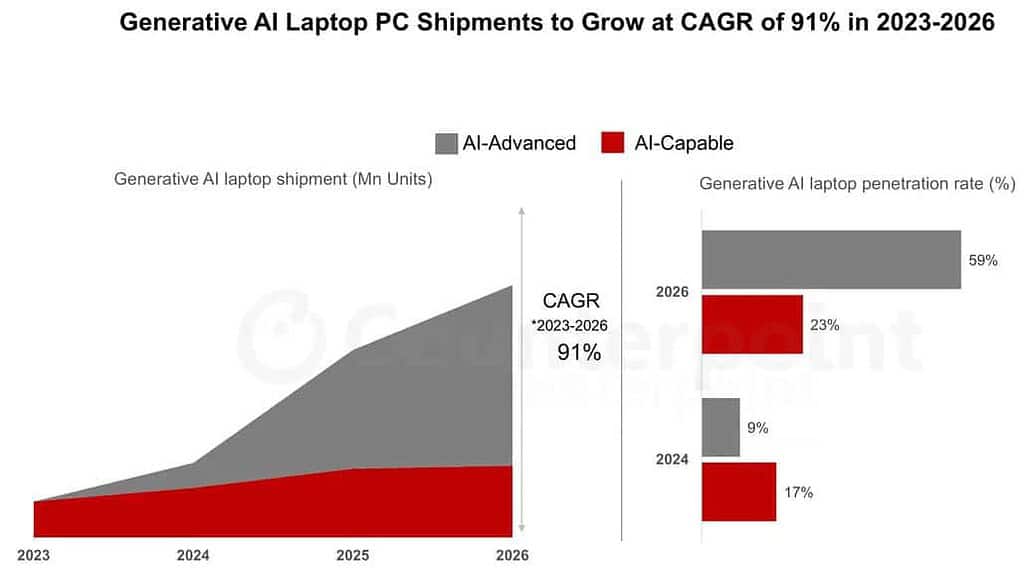
- Counterpoint expects AI-Advanced laptops to reach 59% of shipments in 2026, up from 9% in 2024, with generative AI laptop shipments growing at a 91% CAGR from 2023 to 2026.
- In 2026 research, 60% of surveyed organizations were piloting or deploying AI PCs, and 81% had deployed, piloted, or planned adoption within 12 months.
- Among businesses, 66% reported higher employee productivity and 58% cited improved data security as an on-device AI benefit.
- Copilot+ laptops require an NPU delivering at least 40 trillion operations per second, along with 16GB RAM and 256GB storage.
- HP’s EliteBook X G2q, announced in January 2026, offers up to 85 TOPS of NPU performance, the highest figure listed in the file.
- Pricing spans a wide range: the HP OmniBook 3 dropped to USD 599.99 from USD 799.99 (about 25% off), while the 15-inch Surface Laptop fell to USD 1,150 from USD 1,599.
Recent AI Laptop Developments
- In June 2026, Samsung launched Galaxy Book6 Edge at USD 2,099.99, combining up to 80 TOPS AI performance with 1TB storage.
- In April 2026, Samsung introduced Galaxy Book6 Enterprise Edition with Intel vPro and up to 49 TOPS NPU performance, targeting enterprise AI workloads.
- In January 2026, HP announced EliteBook X G2q with up to 85 TOPS NPU performance, supporting concurrent on-device AI applications.
- In January 2026, Samsung unveiled Galaxy Book6 laptops, reporting up to 50 TOPS NPU performance and 60% faster CPUs than the previous generation.
- In January 2026, ASUS announced Zenbook S14 with up to 50 NPU TOPS, claiming 40% faster performance and 10% lower power consumption.
- At CES 2026, ASUS unveiled Zenbook A16, pairing an 80 TOPS NPU with an 18-core Snapdragon processor in a 1.2kg chassis.
- At CES 2026, Lenovo announced the ThinkPad X1 Carbon Gen 14 Aura Edition, scheduling availability from Q1 2026 with estimated pricing from USD 1,999.
- At CES 2026, Lenovo announced the ThinkPad X1 2-in-1 Gen 11 Aura Edition, scheduling Q1 2026 availability with estimated pricing from USD 2,149.
- In May 2025, Microsoft introduced its 13-inch Surface Laptop with a 45 TOPS NPU, 16GB RAM, and up to 23 hours’ video playback.
AI Notebook PC Shipment Stats
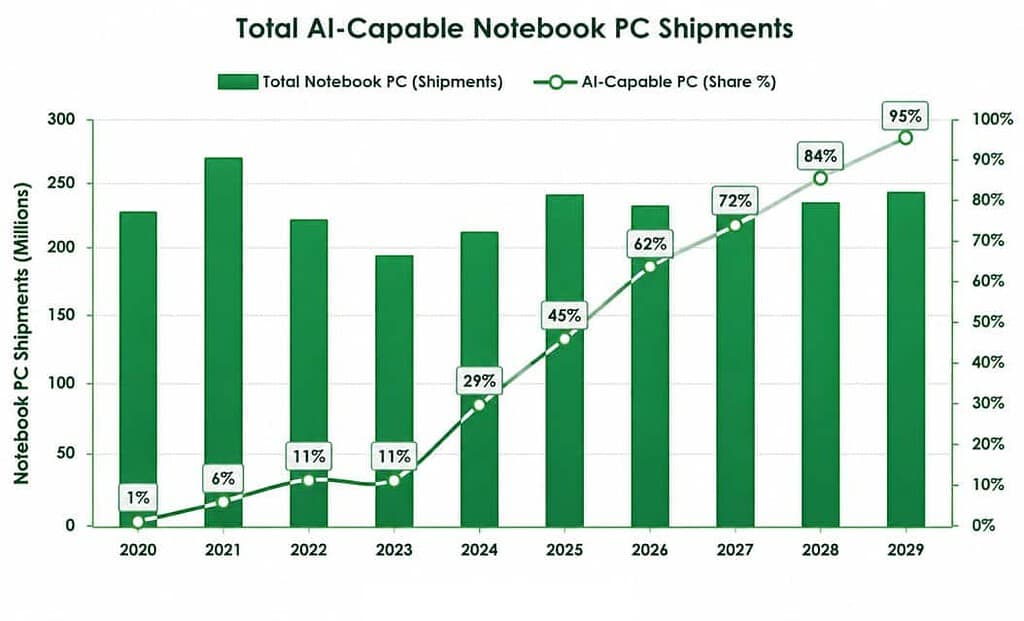
- In 2025, total notebook PC shipments are projected at approximately 240 million units, while AI-capable notebooks are expected to account for 45% of shipments.
- In 2028, total notebook PC shipments are forecast at approximately 235 million units, with AI-capable notebooks expected to represent 84% of total shipments.
- In 2029, total notebook PC shipments are estimated to reach approximately 245 million units, and AI-capable notebooks are projected to capture 95% of shipments.
Use Cases of AI in Laptops
- Copilot+ laptops translate audio from 44 languages into English captions, supporting multilingual meetings, lectures, and entertainment.
- Intel’s 2026 Core Ultra Series 3 provides up to 50 trillion NPU operations per second for on-device AI workloads.
- NVIDIA’s CES 2026 updates promise up to 3× faster creative AI performance in applications such as ComfyUI.
- NVIDIA reports up to 35% faster performance in tools including Llama.cpp, LM Studio, and Ollama, supporting private laptop-based assistants.
- DLSS 4.5 introduces 6× Multi Frame Generation on compatible RTX 50-series laptops, generating additional frames for smoother gameplay.
- NVIDIA RTX AI PCs support local 4K video generation, helping creators produce high-resolution content without exclusively relying on cloud processing.
- Windows 11 Studio Effects provides AI background blur, eye-contact correction, automatic framing, and voice focus locally on supported laptops.
- Copilot+ laptops use NPUs exceeding 40 trillion operations per second to accelerate AI experiences, including creating images with Paint’s Cocreator.
Global AI Laptop Shipment Stats
- Global AI laptops are forecast to capture 58.7% of total laptop shipments in 2026.
- AI laptop shipment penetration rises from 35.7% in 2025 to 58.7% in 2026, a calculated increase of 23 percentage points.
- Non-AI laptops consequently represent 41.3% of projected 2026 laptop shipments, calculated as the complement of Gartner’s 58.7% forecast.
- Across laptops and desktops combined, AI PCs are forecast to represent 54.7% of worldwide PC shipments in 2026.
- Worldwide AI PC shipments are projected at 143.113 million units in 2026; this includes desktops, not just laptops.
- AI desktops are forecast to reach 42.1% of desktop shipments in 2026, trailing AI laptop penetration by 16.6 percentage points.
Generative AI Laptop Shipments and Adoption
- Generative AI laptop PC shipments are forecast to grow at a CAGR of 91% from 2023 to 2026.
- AI-Advanced laptops are projected to account for 59% of total laptop shipments in 2026, up from 9% in 2024.
- AI-Capable laptops are expected to represent 23% of total laptop shipments in 2026, compared with 17% in 2024.
- Together, these categories are forecast to account for 82% of laptop shipments in 2026, up from 26% in 2024.
- AI-Advanced adoption is expected to rise by 50 percentage points, while AI-Capable adoption increases by 6 percentage points between 2024 and 2026.
AI Laptop Adoption Across Business and Consumer
- 2026 research across 500+ decision-makers in five countries found 60% of surveyed organizations piloting or deploying AI PCs.
- 81% of surveyed organizations had deployed, piloted, or planned AI Laptop adoption within 12 months, according to 2026 findings.
- 66% reported increased employee productivity in 2026 enterprise AI Laptop research; these findings cover PCs broadly, not laptops exclusively.
- 58% cited improved data security as an on-device AI benefit in 2026 research, highlighting a business adoption incentive.
- A forecast projected 40% of software vendors prioritizing on-device AI investment by the end of 2026, supporting business and consumer use cases.
AI Laptop by Device Type
- ROG Zephyrus G16 offers up to 24GB GDDR7 VRAM, 50 TOPS NPU, and a 240Hz OLED display.
- ZBook Ultra G1a supports up to 128GB unified memory, 96GB graphics allocation, 50 TOPS, and 4TB storage.
- ROG Flow Z13 combines a 13.4-inch touchscreen, 180Hz refresh rate, 50 TOPS, and up to 128GB memory.
- XPS 16 offers up to 64GB LPDDR5X memory and a 16-inch 3.2K OLED touchscreen.
- Zenbook A16 combines 18 CPU cores, up to 80 TOPS, 48GB memory, and claimed 21-plus-hour video playback.
- IdeaPad Slim 5x Gen 11 offers Snapdragon X2 Plus, up to 80 TOPS, and up to 32GB memory.
- MacBook Pro M5 Max supports up to 128GB unified memory, 40 GPU cores, and 614GB/s memory bandwidth.
Windows AI Laptop and Copilot+ Laptop Statistics
- In 2026, Copilot+ laptops require NPUs delivering at least 40 trillion operations per second, alongside 16GB RAM and 256GB storage.
- In 2026, selected Copilot+ AI laptops advertise up to 67% longer battery life than previous laptop generations.
- The 2026 XPS 14 configuration with a 2K display advertises battery life reaching 31 hours.
- The 2026 Dell’s 16 Plus AI laptop advertises up to 20 hours of battery life, with listed pricing starting at USD 799.99.
- An October 2026 listing prices the Vivobook 16 Copilot+ at USD 829.99, featuring a 50-TOPS NPU, 16GB RAM, and 512GB SSD.
- An October 2026 listing prices the Swift Go 16 AI at USD 1,149.99, including 32GB RAM, 1TB SSD, and a 16-inch touchscreen.
- An October 2026 listing prices the Venture Pro A15 AI+ at USD 1,339, featuring a 15.6-inch touchscreen and Ryzen AI 7 350.
AI Laptop Pricing Insights
| AI laptop/configuration | Reported 2026 price | Additional pricing statistic |
| HP OmniBook 3, Snapdragon X, 16GB RAM, 512GB SSD, 14-inch OLED | USD 599.99 | Previously USD 799.99; $200 reduction, approximately 25% off |
| Lenovo Yoga 7i 2-in-1, Core Ultra 5 322, 16GB RAM, 512GB SSD | USD 749.99 | Regular price: approximately USD 1,250; approximately USD 500 off |
| HP OmniBook 3, Snapdragon X, 16GB RAM, 256GB SSD | Approximately USD 500 | Regular price approximately USD 700; approximately USD 200 off |
| Lenovo Yoga 7a, Ryzen AI 7 445, 16GB RAM, 1TB SSD | USD 1,079 | Reported discount of USD 400, before an additional eligible promotional code |
| Lenovo Slim 7i Aura Edition, Core Ultra 7 256V, 16GB RAM, 1TB SSD | USD 1,124.94 | Listed configuration includes a 14-inch OLED display |
| HP OmniBook 5 16, Snapdragon X, 16GB RAM, 512GB SSD | USD 950.82 | Listed configuration includes a 16-inch OLED display |
| Surface Laptop, 7th Edition, 15-inch | USD 1,150 | Previously USD 1,599; a USD 449 reduction |
| Fujitsu FMV Zero Godzilla Edition, Ryzen AI 5 430, 16GB RAM, 256GB SSD | From USD JPY 265,100 | Approximately USD 1,680 at reporting-time exchange rates |
| Fujitsu FMV Zero Godzilla Edition: processor upgrade | Additional JPY 19,800 | Upgrade from Ryzen AI 5 430 to Ryzen AI 7 445 |
| Fujitsu FMV Zero Godzilla Edition: memory upgrade | Additional JPY 55,000 | Upgrade from 16GB to 32GB RAM |
AI Laptop Market Size
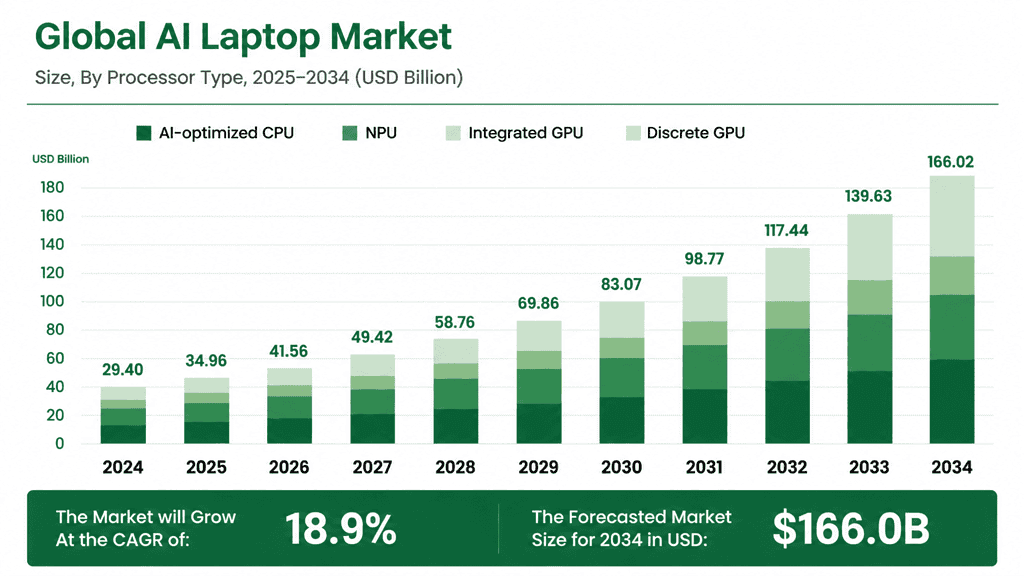
- The global AI laptop market is forecast to grow at a compound annual growth rate (CAGR) of 18.9% during 2025–2034, reaching approximately USD 166.0 billion by 2034.
- The market is divided into four processor categories: AI-optimized CPU, NPU, integrated GPU, and discrete GPU.
- In 2025, the market is estimated to reach USD 34.96 billion.
- In 2026, the market is projected to increase to USD 41.56 billion.
- In 2034, the market is expected to reach USD 166.02 billion, which is rounded to USD 166.0 billion in the forecast summary.
In Summary
AI laptops are slowly changing from a special, high-end feature into something common. Forecasts show that more laptops with AI abilities will be sold each year, and the AI chips inside them keep getting faster. Many businesses are interested because these laptops can boost productivity and protect data.
Prices now range from low-cost to high-end models. Still, many buyers may not really need one, and how useful it is depends on how well software supports it. As AI that runs on the device gets better, these laptops will likely become what people expect from every new laptop.
FAQ
An AI laptop is a PC with hardware, often an NPU, designed to run AI features locally. It can handle tasks like noise cancellation, background blur, local chatbots, and image generation more efficiently.
Not necessarily. If you mainly browse, write documents, or stream video, a normal laptop is enough. AI laptops make more sense for frequent AI users, creators, and people who want local privacy and speed.
An NPU is a Neural Processing Unit built to run AI workloads efficiently. It handles tasks like video effects and local AI models while using less power than a CPU or GPU.
Some can, especially with enough RAM and a capable NPU or GPU. Smaller models may run locally, but large models often still need cloud services.
Not automatically. AI features can help with streaming, upscaling, and background tasks, but gaming performance still depends mainly on the GPU, CPU, cooling, and display.
Often yes, because they include newer NPUs and premium components. However, prices vary widely, and standard laptops can also run many AI apps through the cloud.