









Beginning
Intelligent Network Statistics: Intelligent networks are making digital connections faster, smarter, and more reliable. They use artificial intelligence, automation, and real-time data to manage network traffic, identify issues, and improve performance. Unlike traditional networks, these systems can adjust to changing demands without constant human input. This helps businesses reduce downtime, protect data, and make better use of network resources. Meanwhile, the growth of 5G, cloud computing, and the Internet of Things (IoT) is creating greater demand for intelligent networking.
Today, these networks support everything from telecom services to connected devices. As digital needs continue to grow, intelligent networks are becoming essential for building efficient, flexible, and reliable communication systems.
Featured Pick
- The global Intelligent Network market value reached USD 3.81 billion in 2025 and is forecast at USD 4.56 billion in 2026.
- Software automation led the market with a 41.35% revenue share in 2025.
- North America holds a 30% market share, while Europe accounts for 26%.
- Nokia, Infinera, and Cisco jointly held 19.55% of the global optical and core intelligent network market in 2025.
- AI tools are now part of the daily lives of 74% of U.S. adults.
- 30% of enterprises would automate more than 50% of their network activities by 2026.
- AI-related traffic accounted for nearly USD 3 billion in annual wireless network operating and capital costs by the end of 2025.
- Around 90% of organizations report positive returns from networking AI.
- Only 49% report network readiness for AI workloads.
- Telcos expect to invest an average of USD 87 million in autonomous networks over the next 5 years.
- Network intelligence should identify outages within 5 minutes and detect performance issues in under 15 minutes.
Intelligent Network Market Size
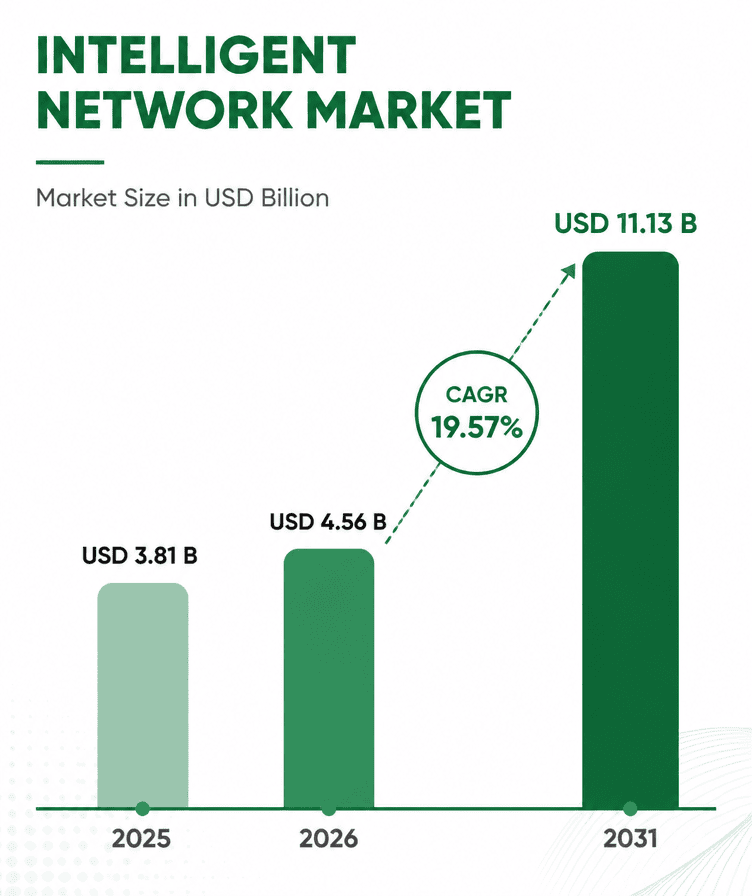
- The global intelligent network market reached USD 3.81 billion in 2025.
- Spending is projected to expand to USD 4.56 billion in 2026.
- Rising at a 19.57% CAGR, total sector revenue will reach USD 11.13 billion by 2031.
Key Segment Trends
- Mordor Intelligence reported that Software automation led the market with a 41.35% revenue share in 2025. Services are projected to grow at a 23.3% CAGR through 2031.
- Cloud/SaaS held a 54.25% share in 2025, and hybrid deployments are expected to grow at a 27.6% CAGR.
- Large enterprises captured a 60.70% share. Moreover, SMEs are forecast to grow at a 25.9% CAGR.
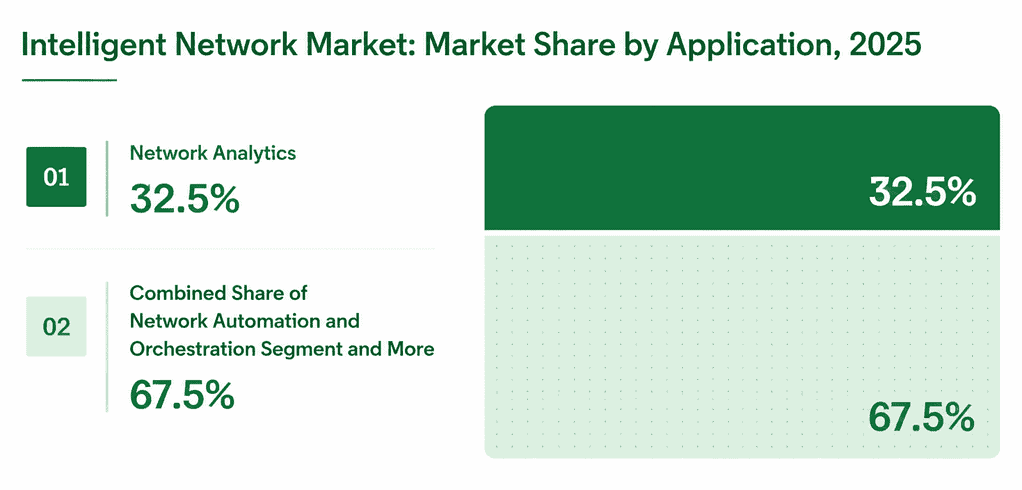
- Network analytics accounted for 32.5% of the share. Intent-based networking is projected to grow at a 26.9% CAGR.
- Telecom providers led with a 46.40% share, and hyperscale cloud providers are expected to grow at a 24.1% CAGR.
- Nokia, Infinera, and Cisco jointly held 19.55% of the global optical and core intelligent network market in 2025.
Regional Outlook
- Fortune Business Insight noted that North America holds a 30% market share, while Europe accounts for 26%.
- Asia-Pacific region leads with a 32% share.
- China contributes 14%, followed by Japan (8%), Germany (9%), and the UK (7%).
- The rest of the world accounts for 12% of the share.
Intelligent Network Companies Statistics
| Company | Statistics |
| Cisco | Cisco’s market cap was USD 419.89 billion on Oct. 28, 2026, versus USD 439.13 billion on Oct. 27.In 2026, revenue reached USD 63.33 billion, while net income totaled USD 13.27 billion. |
| Huawei | Huawei reported 2025 revenue of CNY 880.94 billion (USD 126.02 billion).ICT revenue reached CNY 375.01 billion (USD 53.6 billion), up 2.6%. |
| Ericsson | Ericsson’s market capitalization reached USD 34.49 billion.In 2025, sales totaled SEK 236.7B, equivalent to USD 24.2 billion. |
| Nokia | Nokia’s market capitalization reached USD 46.70 billion.In 2025, sales rose 3% to EUR 19.89 billion (USD 23.4 billion).Nokia acquired Infinera for USD 2.3 billion. |
| Juniper / HPE | HPE acquired Juniper for USD 14 billion, with JNPR shares ceasing trading on July 2, 2025.HPE’s market capitalization reached USD 80.09 billion. |
| Dell | Dell’s market capitalization ranged from USD 261.93 to 318.09 billion.Dell held an estimated 7.4% share of the enterprise-networking market. |
| Ciena | Ciena’s market capitalization reached USD 45.42 billion.In 2025, revenue rose 19% to USD 4.77 billion, with a USD 5.0 billion backlog. |
| IBM | IBM reported a market capitalization of USD 236.52 billion as of October 27, 2026. |
Key Use Cases of Network Intelligence
- The Network Detection and Response market is projected to reach USD 4.34 billion in 2026, with a 10.9% CAGR through 2031.
- SOC teams reportedly receive 2,992 alerts daily, with 63% unaddressed; AI-assisted triage can take about 2 minutes.
- Performance management held 29.30% of the network analytics market in 2025.
- Motadata reported that 30% of enterprises would automate more than 50% of their network activities by 2026.
- Cloud-based NDR is forecast to grow at 13.5% during 2026-2031.
- Telecom is projected to hold 58.14% of the network analytics market in 2026.
- In 2025, 84% of organizations explored or piloted AI observability, according to APM Digest.
- At least 40% of major cloud-native organizations are expected to adopt autonomous observability systems.
AI Adoption and Wireless Network Usage
- According to the Wireless Infrastructure Association’s 2026 AI Report, AI tools are now part of the daily lives of 74% of U.S. adults.
- Around 59% of U.S. adults access AI apps while traveling or away from home.
- AI applications generate at least 4.2% of total wireless network traffic in the United States.
- AI-related traffic accounted for nearly USD 3 billion in annual wireless network operating and capital costs by the end of 2025.
- More than 50% of U.S. adults use mobile data alone or alongside Wi-Fi to access AI services.
Enterprise AI in Networking Report
- According to Extreme Networks, 90% of organizations report positive returns from networking AI, while 63% achieve financial gains in USD within one quarter.
- 79% of leaders have deployed AI agents for network optimization, security, and troubleshooting.
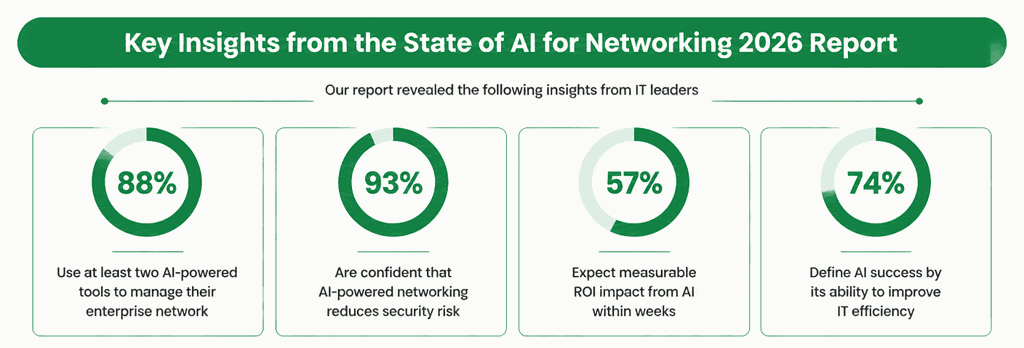
- 88% of IT teams use at least two AI tools to manage enterprise networks.
- 93% report reduced security risks, and 57% expect measurable ROI within weeks.
- 74% of enterprises measure AI success primarily by improvements in IT efficiency.
Software-Defined Networking Market Analysis
- The SDN market is projected to reach USD 3,477.9 million in 2026.
- The market is forecast to expand at a CAGR of 22.1% from 2026 to 2033, resulting in USD 14,062.8 million by 2033.
- Cloud service providers are expected to account for 51.0% of the global market in 2026.
- North America is projected to hold 36.6% of global market revenue.
Artificial Intelligence Data Center Networking Market Statistics
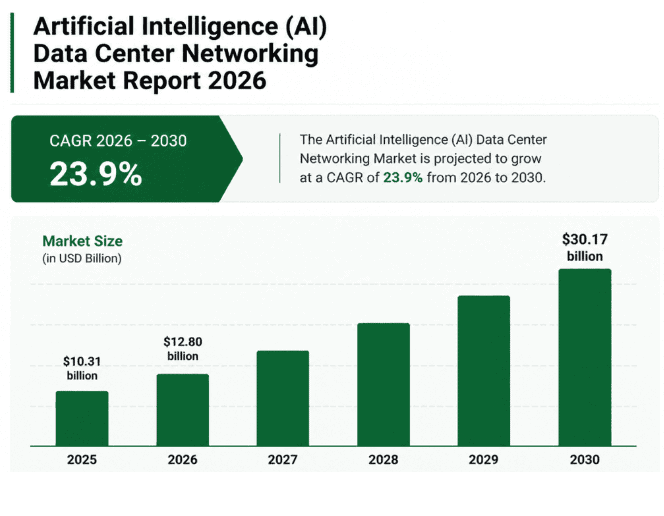
- The Artificial Intelligence Data Center Networking market reached USD 10.31 billion in 2025, with spending expected to rise to USD 12.80 billion in 2026.
- Growing at a 23.9% CAGR from 2026 to 2030, revenue is forecast to hit USD 30.17 billion by 2030.
- North American regional market is expected to rise from USD 5 billion in 2025 to USD 14 billion by 2030, at a 24% CAGR.
- The United States market is forecast to grow from USD 4 billion in 2025 to USD 12 billion by 2030, also at a 24% CAGR.
- Hardware is projected to capture 56% of the market, worth approximately USD 21 billion, by 2030.
- From 2025 to 2030, hardware is expected to add USD 14 billion, software USD 7 billion, and services USD 4 billion.
- AI and high-performance computing contribute 2.7% to annual market growth, hyperscale data centers 2.5%, and security and automation 2.2%.
Leading Companies Market Share
- The market remains fragmented, with the top 10 companies accounting for 36.25% of total revenue.
- NVIDIA leads with a 5.63% share, followed by Cisco at 5.49% and Arista Networks at 4.37%.
- Broadcom holds 3.93%, while Huawei accounts for 3.5% and Hewlett Packard Enterprise captures 3.32%.
- Juniper Networks represents 3.1%, followed by Microsoft at 2.7%.
- Amazon Web Services holds 2.5%, while Google accounts for 1.71% of the market.
Storage Area AI Network Market Trends
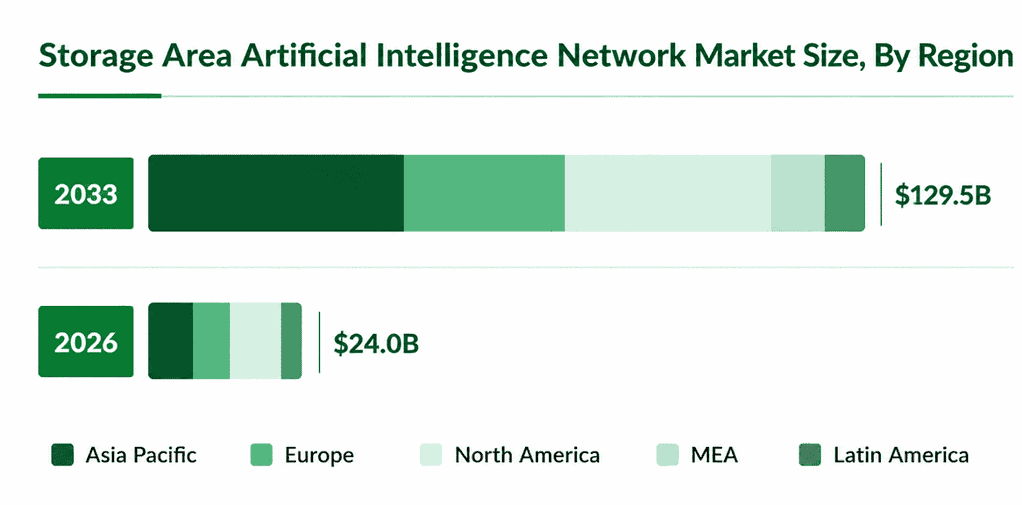
- The global storage area AI network market was valued at USD 19.7 billion in 2025 and is expected to reach USD 24 billion in 2026.
- The market is projected to grow to USD 129.5 billion by 2033, with a CAGR of 27.2% from 2026 to 2033.
- North America led the market with a 31.8% revenue share in 2025, while Asia Pacific is expected to grow fastest.
- Hardware accounted for 57.2% of market revenue in 2025.
- File storage accounted for 32.6%, while branding and advertising accounted for 32.4%.
Why IT Operations Are Adopting Network Intelligence in 2026
- According to Broadcom’s report, only 49% report network readiness for AI workloads. It is followed by site congestion (46%), poor visibility (39%), traffic-flow congestion (38%), and latency (37%).
- Although 99% have a cloud strategy, 95% report visibility gaps, and 87% face blind spots due to cloud and internet dependencies.
- 99% use automation, but only 27% have mature systems; 70% remain in early stages.
- 76% rely on third parties for network operations, increasing demand for AI-assisted troubleshooting.
- 92% plan to use AI networking, but only 23% have deployed it.
- Meanwhile, 47% want intelligent traffic shaping, and 46% seek predictive analytics.
- 59% use vendor AI features, while 52% train AI models on IT/security data.
- 67.7% expect faster task execution, and 58.3% expect fewer errors and less manual work.
- 56% strongly believe AI-driven network management improves business outcomes, up from 50%.
- IT Operations Analytics is valued at USD 23.43 billion in 2026 and is forecast to reach USD 30.13 billion by 2030.
- 71% do not fully trust AI to make autonomous network decisions.
Autonomous Network Investment and Strategy Statistics
- A report published by Capgemini stated that Telcos expect to invest an average of USD 87 million in autonomous networks over the next 5 years.
- These initiatives could deliver USD 150 million to USD 300 million in operating expense savings per organization over 5 years.
- The expected return on investment ranges from 1.7x to 3.4x, with payback periods of 2.9 to 1.5 years in conservative and optimistic scenarios, respectively.
- Only 17% of telcos have a complete autonomous network strategy with clear goals and timelines.
- 51% of operators have roadmaps covering only the next 1-2 years, limiting long-term planning.
- Only 15% of organizations have appointed a dedicated autonomous networks leader, while 31% are still seeking one.
Metrics to Measure Network Intelligence Performance
- A report published by Motadata states that Network intelligence should identify outages within 5 minutes and detect performance issues in under 15 minutes.
- IT teams should pinpoint the source of a network problem within 20 minutes and continue improving each quarter.
- Organizations should aim to cut resolution time by 20%-30% within two quarters compared with pre-deployment levels.
- Keeping the ratio below 20 alerts per genuine incident helps teams reduce false alarms and focus on real problems.
- Network intelligence should achieve at least 70% accuracy when predicting network saturation one quarter ahead.
- Configuration-related issues should account for less than 15% of all incidents within the first two quarters.
Intelligent Network Statistics by Common Outage Drivers
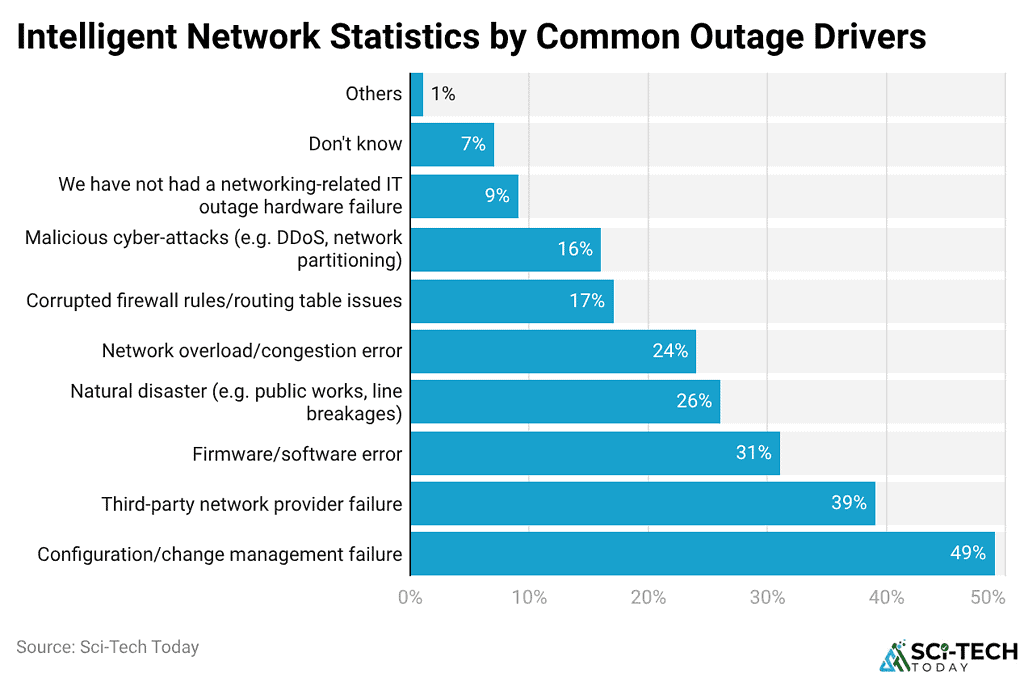
- Configuration errors cause 49% of network outages, while service provider failures account for 39%.
- System bugs contribute to 31% of outages, followed by natural disruptions at 26% and network congestion at 24%.
- Firewall misconfigurations cause 17% of outages, while cyberattacks account for 16%.
- Around 9% of organizations report zero outages, while 7% are unsure about the causes.
- Other causes account for the remaining 1% of reported outages.
Summary
Intelligent networks are becoming an important part of modern digital infrastructure. By connecting devices and managing data more efficiently, they help businesses improve performance, reduce delays, and strengthen security. The growing use of AI, IoT, cloud computing, and 5G and 6G will further drive their adoption.
However, high implementation costs and data security risks remain challenges. Despite these concerns, intelligent networks will support better connectivity and help industries meet their changing technology needs.
FAQ
Intelligent networks are used in telecommunications, smart cities, healthcare, transportation, manufacturing, energy, and cybersecurity systems.
Intelligent networks detect threats in real time, identify vulnerabilities, and automatically respond to cyberattacks.
Traditional networks follow fixed rules and require manual management, while intelligent networks use AI to adapt, optimize performance, and automatically detect problems.