









Introduction
Edge Computing Adoption Statistics: Edge computing has become one of the fastest-growing enterprise technologies in 2026, as organizations start to process data nearer to where it is produced rather than depending only on centralized cloud infrastructure. It’s like everyone is in a rush now between the quick wave of AI applications, Industrial IoT (IIoT), 5G networks, autonomous systems, smart manufacturing, healthcare, and connected vehicles; edge adoption has been speeding up across the world.
Enterprises are putting in billions of dollars toward edge infrastructure to cut down latency, strengthen cybersecurity, trim bandwidth spending, and make real-time analytics possible. Based on IDC, Gartner, Statista, and several other studies, edge computing has basically left the “trial” stage and moved into bigger deployments across manufacturing, retail, telecommunications, logistics, healthcare, and energy, which makes it a key element in enterprise digital transformation, especially in 2026.
Editor’s Choice
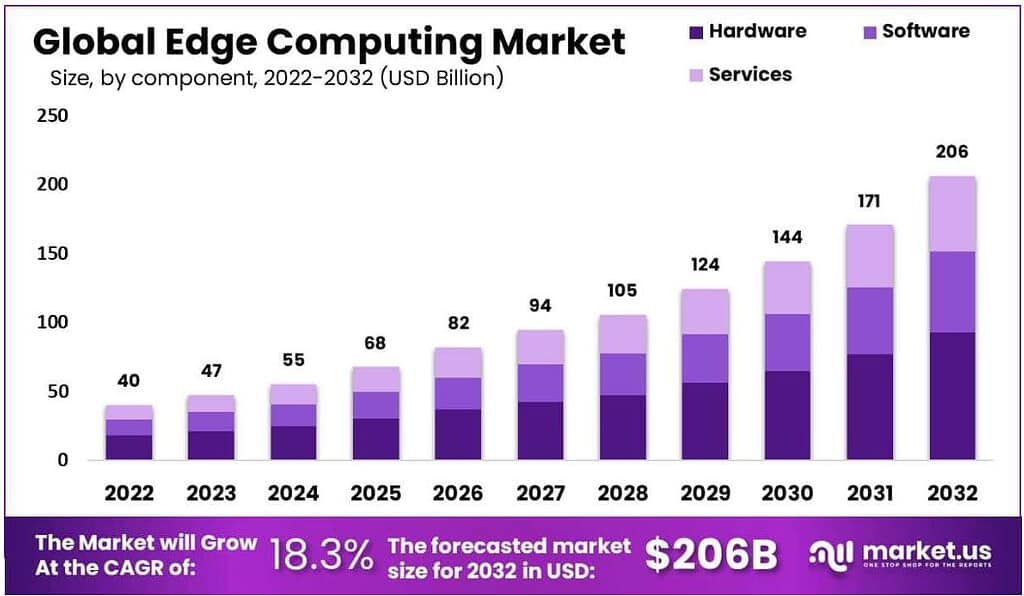
- The global edge computing market is expected to rise from USD 82 billion in 2026, up to USD 206 billion by 2032, growing at a strong 18.3% CAGR.
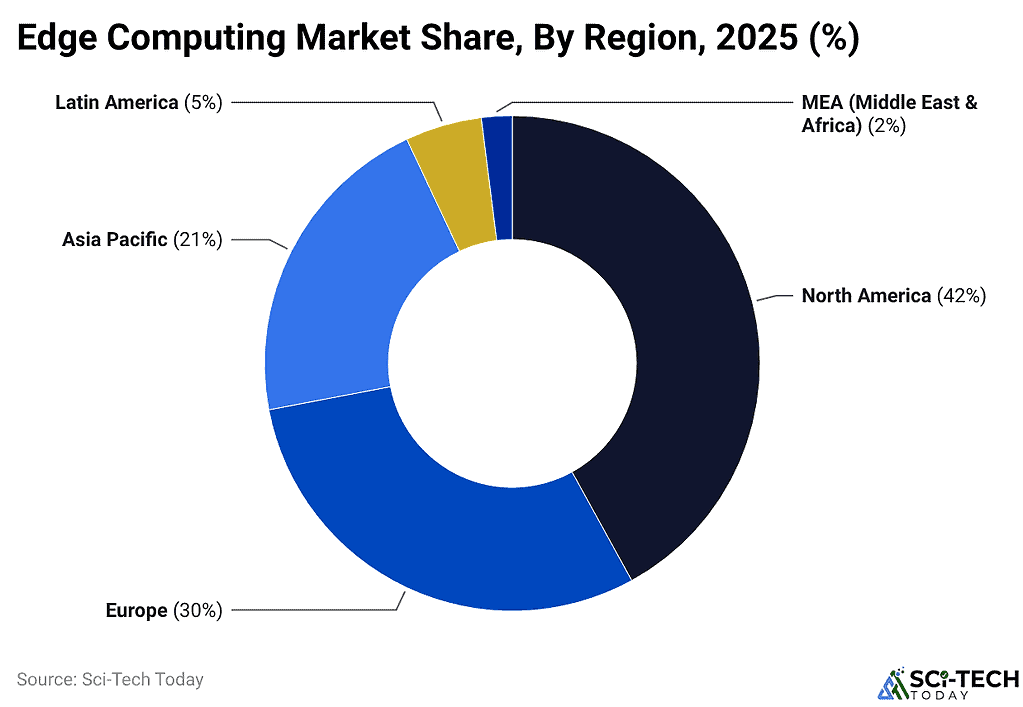
- North America holds 42% of the global edge computing market, keeping the lead thanks to solid AI efforts plus cloud infrastructure investments.
- Europe accounts for 30%, while Asia Pacific sits at 21%, powered by industrial automation and the rapid rollout of 5G.
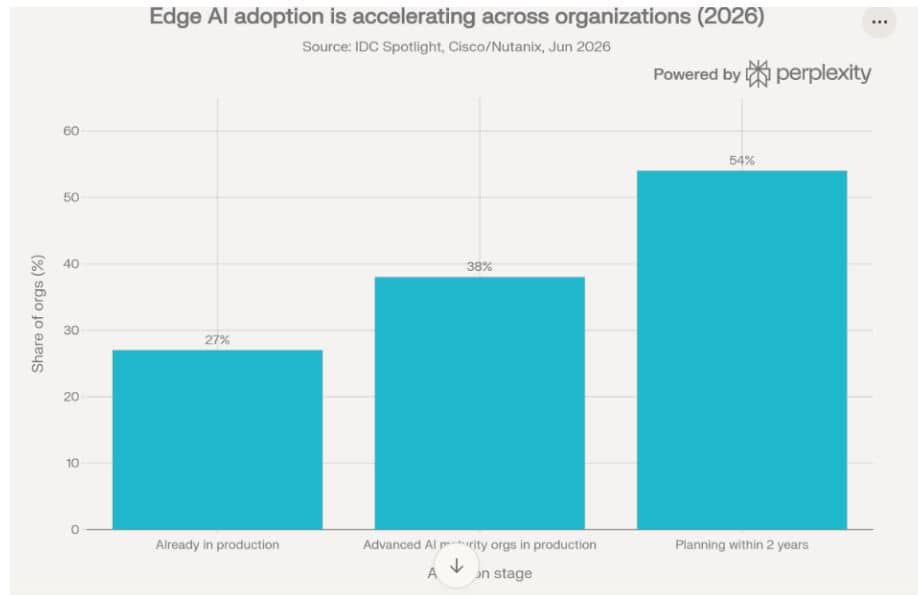
- 27% of organizations have already deployed Edge AI in production, which shows the movement from experimenting to enterprise scale.
- Among AI-mature enterprises, 38% already run Edge AI in production, meaning those digitally advanced companies are picking it up faster.
- In addition, 54% of organizations plan to implement Edge AI within the next two years.
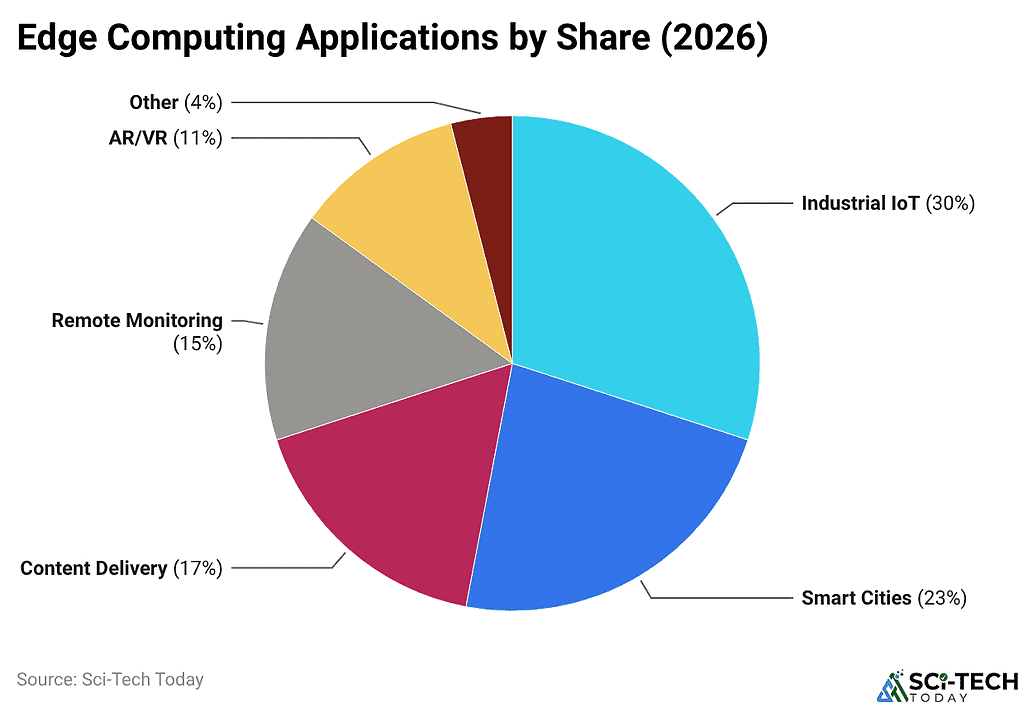
- Industrial IoT is roughly 30% of edge computing use cases, so manufacturing ends up being the biggest adoption slice, sort of, yes.
- Smart cities make up 23% of edge deployments, and that also points to edge computing becoming more important for “smart” urban infrastructure over time.
- On the network side, modern 5G plus MEC setups can get you close to 10 ms latency, while newer deployments are aiming at sub-1 ms kind of performance for mission-critical workflows.
What Is Edge Computing?
Because there are so many devices now that can connect, more and more of them need faster computing with low latency for lots of different scenarios. This is pushing computation out toward the “edge” of the network. The Linux Foundation describes this in “Third Act of the Internet”. Basically, the edge of the network is where a lot of future data storage and processing will happen, and that is why we got the phrase edge computing. In plain terms, edge computing means moving computing capability to the local areas of a network. That tends to bring better performance, lower latency, and reduced operational costs. For example, smart home gadgets do almost nothing computationally. With edge computing, those smart speakers could be handling and processing the user’s request fully right on the device itself.
Edge Computing Global Market Growth
(Source: market.us)
- According to market.us, the edge computing market seems to be moving into some kind of sustained high-growth phase because organizations are processing data nearer to where it’s actually coming from. This is to support real-time applications, AI workloads, and also all those connected devices.
- The whole market is expected to grow at a compound annual growth rate (CAGR) of 18.3%, and that number basically shows solid enterprise interest along with ongoing infrastructure investments.
- Revenue also moved up, from about USD 40.0 billion in 2022, to USD 47.0 billion in 2023, then USD 55.0 billion in 2024, and USD 68.0 billion in 2025.
- The upward momentum is forecast to keep going, with market revenues reaching USD 82.0 billion in 2026, USD 94.0 billion in 2027, and USD 105.0 billion in 2028, which basically signals edge computing is turning into a key piece of today’s digital infrastructure.
- The growth projections go to USD 124.0 billion in 2029, USD 144.0 billion in 2030, USD 171.0 billion in 2031, and then USD 206.0 billion by 2032.
- The above future figures emphasize a steady long-term expansion path, placing edge computing among the quickest-growing technology arenas this decade.
- In fact, overall revenue is expected to increase more than fivefold between 2022 and 2032 as deployment keeps accelerating across many industries.
Edge Computing Market Growth By Region
(Reference: precedenceresearch.com)
- In the 2025 regional distribution of the edge computing market, it really did show a kind of obvious clustering in developed digital economies, like adoption is not evenly spread.
- North America still takes the lead across the whole market with a 42% share, which points to its heavy spending on cloud infrastructure, artificial intelligence, and edge innovations.
- Europe lands at 30%, basically because enterprise digitalization keeps ramping up, plus industrial automation programs keep moving forward.
- Asia Pacific makes up 21%, and this is tied to fast 5G rollout, along with the expansion of smart city initiatives.
- Latin America sits at 5%, while the Middle East and Africa (MEA) only holds 2% left, suggesting that there are still fresh chances as digital infrastructure keeps getting built out over time.
Edge AI Adoption Across Organisation
(Source: linkedin.com)
- In 2026, Edge AI is kind of hitting a turning point, because more and more organizations stop treating it like a side experiment and start running it for real.
- The IDC Spotlight, specifically the Cisco/Nutanix view from June 2026, notes that 27% of orgs already have Edge AI deployed in production, which is a signal that this isn’t only for the earliest adopters anymore.
- Instead, it looks like an everyday operational ability that various industries are building into their stacks. It gets even more noticeable with digitally mature companies, where 38% of the advanced AI-maturity group have Edge AI running in production.
- 54% of organizations are planning to implement Edge AI within the next two years, so the future adoption pipeline seems pretty healthy. This expansion is being pulled along by use cases like computer vision, predictive maintenance, AI-supported diagnostics, and fraud detection.
- The research also underlines that real-time responsiveness has become a practical requirement, not just a nice-to-have performance preference, plus there are pressures like data sovereignty rules and the growing expense of sending huge amounts of raw data to the cloud.
- So overall, the takeaway is that Edge AI is transitioning into a core enterprise tool. With production deployments already happening, and investment plans showing up close by, it suggests steady market growth and wider adoption across industries that live and breathe data.
Edge Computing Market Growth By Applications
(Reference: market.us)
- A more granular kind of breakdown of edge computing applications from Market.us sort of shows Industrial IoT holding the biggest slice, at 30%. In that case, they’re using edge computing for real-time data analysis and predictive maintenance too, in manufacturing environments.
- Smart cities sit at 23%, and they rely on edge nodes for traffic optimization and those public safety systems.
- After that, content delivery comes in at 17%, basically because there’s a strong need for low-latency multimedia streaming, like it has to be quick and responsive.
- Remote monitoring applications covering asset tracking, infrastructure, and healthcare devices take 15% of the market.
- Augmented and virtual reality applications make up the remaining 11%, mainly supported by ultra-low-latency edge processing, which gives more immersive experiences. Finally, the leftover 4% is spread across other emerging uses.
The 5G And Multi-Access Edge Computing (MEC) Catalyst
- In 2026, this is a pretty big milestone for telecom infrastructure, because operators increasingly mix 5G networks with Multi-access Edge Computing (MEC) to enable ultra-low-latency digital services.
- Edge-enabled 5G architectures already hit average end-to-end latencies of about 10 milliseconds, and the more advanced deployments are aiming at under 1 millisecond, which sets the stage for mission-critical apps like autonomous vehicles, cloud gaming, and industrial automation.
- Technical white papers note that Control and User Plane Separation (CUPS) helps place User Plane Functions (UPFs) at edge locations, so the data path gets shorter, and sub-10 millisecond response times become more realistic.
- AsiaSat’s spectrum analysis notes that Ultra-Reliable Low-Latency Communications (URLLC) aims for around 1 millisecond radio latency, while MEC processing tends to keep the total network latency in the 1-10 millisecond range that safety-critical applications still need.
- On the data center side, further research suggests that putting MEC platforms right next to 5G base stations can cut latency from traditional wide-area network levels to something like 10 milliseconds, and there’s a roadmap toward the sub-1 millisecond target that’s outlined by the GSMA.
- Telecom providers are also rolling MEC deployments out across edge data centres, plus enterprise campuses, ports, and smart cities, to back connected vehicles, drones, IoT, and immersive AR/VR experiences.
- Engineering studies add that private 5G networks tied to MEC have already shown sub-1 millisecond median downlink latency in controlled setups.
- The localized compute can stand in for older wired industrial networks, for robotics, real-time quality inspection, and closed-loop manufacturing.
- Overall, this convergence of 5G and MEC seems to be turning telecom from a simple connectivity provider into a distributed computing platform, capable of powering the next generation of intelligent, latency-sensitive digital services.
Edge Computing Component Breakdown: Hardware Vs. Software
| Component | Baseline spend (USD B) | Share of USD 40.0 B baseline | Indicative 2025–2026 share or trend from tier‑one studies | Long‑term trajectory insight |
| Hardware | 18 | 45% | Hardware holds 34–47% share in 2025–2026, with the server sector alone above 45.5%. | Dominates initial CAPEX to build edge nodes, but grows slower than software and services as infrastructure saturates and refresh cycles stabilize. |
| Software | 11 | 27.50% | The software segment flagged as fastest‑growing, driven by edge AI platforms and orchestration. | Expected to gain a larger share as AI orchestration, workload placement, and data governance become the primary value levers once hardware is in place. |
| Services | 11 | 27.50% | Services projected to record the highest CAGR, with managed services expanding at 13.87% and services overall at 26.5%. | On track to eclipse appliance sales as enterprises embrace edge‑as‑a‑service and shift budgets from CapEx to OpEx subscription models. |
Edge AI Computing Recent Innovations
- 2026 is sort of a major turning point for edge AI, where the momentum seems to drift away from just software and more into real hardware and intelligent computing arrangements.
- Gartner’s 2026 market trend research points out that a lot of software businesses are now putting money into edge AI semiconductor startups, basically because chip architecture is becoming the clear competitive lever.
- In the same spirit, Lattice Semiconductor says that when dedicated Neural Processing Units (NPUs) get paired with stronger CPUs and GPUs, plus Small Language Models (SLMs) that are actually more capable, you can move AI workloads that used to be stuck in the cloud onto edge devices by themselves.
- Meanwhile, the Edge AI Technology Report 2026, produced by Wevolver with input from Synopsys, Nordic Semiconductor, and other industry players, describes the “mixed” or heterogeneous computing architecture as the main path.
- Over on the software layer, abstraction layers are getting better, and techniques like model quantization and model distillation are helping deployment become more efficient across many different hardware setups.
- At the same time, newer ideas and standards like Model Context Protocol (MCP) and Agent-to-Agent (A2A) communication are making hybrid edge-cloud teamwork feel more solid and less fragile.
- IIT Kanpur calls out neuromorphic computing as the next breakthrough, and it suggests that purpose-built NPUs have finally climbed to the performance level needed for real-time inference right on the edge.
Conclusion
Edge computing has kinda evolved into a core enterprise technology; it actually supports real-time analytics, AI inference, and super low-latency decision-making across multiple industries. Its fast adoption is being pulled along by Industrial IoT, 5G, Edge AI, smart cities, and autonomous applications that really need data to be handled locally, not somewhere far away.
When enterprises start moving past the initial pilot phase, the spending seems to shift toward smart software platforms, managed services, and specialized AI hardware things that can squeeze the best edge performance out of the whole setup. Also, the way edge computing is converging with AI, cloud, and next-generation networking is turning into this very distributed digital backbone that should help future innovations. In the next few years, edge computing will likely stay a major catalyst for enterprise digital transformation worldwide.
FAQ
The global edge computing market is projected to hit USD 206 billion by 2032, while growing at an 18.3% CAGR.
North America leads, with around 42% market share. After that comes Europe at 30%, then Asia Pacific at 21%.
As of 2026, 27% of organizations have already deployed Edge AI in production mode, and 54% are planning to implement it within two years.
Industrial IoT is the biggest application category; it accounts for 30% of global edge computing deployments.
Together, 5G and Multi-access Edge Computing (MEC) help bring latency down to roughly 10 milliseconds, and later rollouts are aiming for sub-1 millisecond performance, especially for real-time workloads like autonomous vehicles and smart factories.

Sources