








Opening
Volunteering Statistics: Volunteering is a simple way to give your time, skills, and support to people and communities that need it. Every year, millions of people volunteer for causes they care about, from helping local charities and schools to protecting the environment and supporting people in need. Volunteering is not only about giving back. It can also help people learn new skills, meet others, build confidence, and create meaningful experiences.
Today, volunteer work takes many forms, including in-person, online, community-based, and disaster-relief efforts. But how many people actually volunteer, and what motivates them to take part? In this article, we explore key volunteering statistics, trends, and facts.
Featured Choice
- More than 1 billion people worldwide volunteer, highlighting the massive global scale of volunteerism.
- 63 million Americans volunteer, representing about 25% of the U.S. adult population.
- 83% of volunteers are motivated by supporting causes they care about.
- 62% of nonprofits say recruiting volunteers is a “big problem.”
- 25.6% median employee participation was recorded in corporate volunteering programs in 2026.
- Companies with fully embedded volunteer programs achieve 70% participation, compared with just 7.1% for ad-hoc programs.
- 86.3% of companies run annual volunteering campaigns.
- 60% of companies offer paid Volunteer Time Off (VTO), while 21% plan to introduce it.
- 96% of recent volunteers report being satisfied with their volunteering experience.
- 80% of volunteers also donate financially, making them four times more likely to donate and contributing 2.4 times more on average.
Types of Volunteer Work
- Development and Management: A good number, 40% of volunteers, take part in fundraising activities, while another 30% concentrate on administrative activities of the non-profit organizations.
- Community-Based Services: About 25% of the volunteers dedicate their services to social services, which include working in different types of shelters, food provision units, community support programs, and other charity work.
- Education and Child Service: 20% of the volunteers are engaged in schools, coaching activities, or agencies that focus on the welfare of children.
General Volunteer Statistics
- According to Double the Donation, an estimated 63 million Americans volunteer, representing about 25% of the adult population.
- As of 2026, Worldwide, more than 1 billion people volunteer.
- About 38.2% of nonprofits report that volunteers contribute 500+ hours each year, either remotely or in person.
- Most U.S. volunteers are between 35 and 44 years old, making this the largest volunteer age group.
- Around 72% of volunteers support only one organization, while 18% volunteer with two organizations and 10% support three or more.
- Volunteer recruitment remains a challenge, with 62% of nonprofits saying recruiting volunteers is a “big problem.”
Global Corporate Volunteering Trends
- Corporate volunteering is becoming a regular business function. The Goodera VQ Report 2026 analyzed 3,000+ companies and detailed data from 240 organizations.
- Median employee participation reached 25.6% in 2026, up from 22.2% in 2024.
- Among 76 companies tracked for 3 years, participation grew at a 19.7% CAGR.
- Program maturity remains critical: participation averages 7.1% for ad-hoc programs, 20% for early-stage programs, 37% for established programs, and 70% for fully embedded programs.
- Volunteer engagement remains relatively light, with a median of 6.2 hours per volunteer. Average hours rose from 5.9 hours in 2024 to 7.1 hours in 2025 and 7 hours in 2026.
- Companies using all 4 volunteering accelerators achieve 3.1x higher participation. Annual campaigns deliver 2.6x, VTO 1.4x, and digital platforms 1.3x higher participation.
- 86.3% of companies run annual campaigns, highlighting program structure as a key driver of participation.
Corporate Onboarding Volunteer Team Statistics
- A report published by Double the Donation, 20% of nonprofits say they onboard volunteer teams mainly in response to corporate requests.
- Around 44.2% describe their corporate volunteer onboarding as informal and handled on a case-by-case basis.
- 58.1% say limited staff capacity is their biggest challenge when scaling corporate volunteer onboarding.
- 44.4% report that scheduling and logistics are their biggest operational challenges when managing corporate volunteer groups.
Stewarding Teams
- 29.6% of nonprofits mainly thank corporate volunteer groups by tagging companies and employees in LinkedIn posts.
- 34.2% follow up with corporate groups within 24 hours, while 57% do so within a week.
- Nearly 40% say 50%-75% of their corporate volunteer groups return for another event.
- 62.9% can confidently identify their top 5 corporate volunteer partners using data.
- 41.7% say limited staff time is the biggest barrier to turning one-time volunteer groups into long-term partners.
- 44% of organizations are just beginning to develop their corporate volunteer engagement strategy.
Volunteer Management Statistics
- According to Amra and Elma, the global volunteer management platforms market is expected to reach USD 3.11 billion by 2028, growing at 18.9%.
- The market could grow from USD 1.24 billion in 2023 to USD 3.42 billion by 2030, at a 10.1% CAGR.
- Corporate volunteering platforms are projected to reach USD 2.32 billion by 2033, with a 9.29% CAGR.
- 75.7 million Americans, or 28.3% of people aged 16+, formally volunteered between September 2022 and 2023.
- Around 83% of volunteers are mainly motivated by supporting causes they care about.
- Corporate volunteer participation averages 33%, while only 3% participate in employee volunteer grant programs.
- 18% of formal volunteers now serve online, highlighting the shift toward digital volunteering.
- 80% of nonprofits consider email effective for volunteer recruitment.
- In-person events (73%) and websites (71%) remain key recruitment channels.
- Instagram (53%), LinkedIn (48%), and Facebook (44%) are growing engagement channels.
- Regular volunteers have a 27% higher chance of finding employment.
Volunteer Participation by Region
(Source: ilostat.ilo.org)
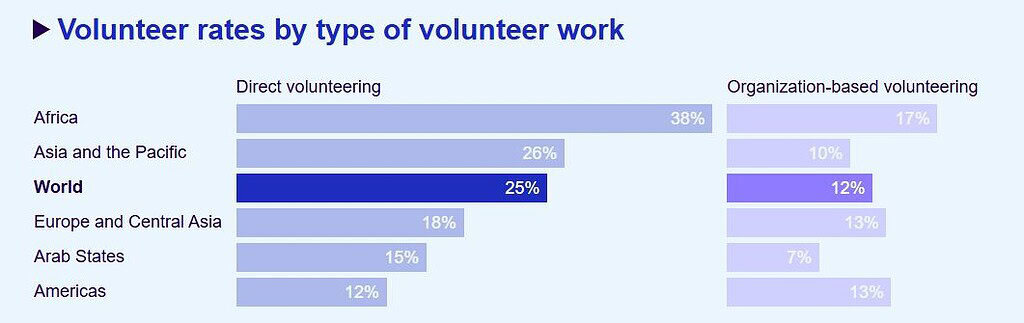
- Globally, 25% of people participate in direct volunteering, compared with 12% in organization-based volunteering.
- Africa has the highest rate of direct volunteering at 38%, while organization-based volunteering is 17%.
- Asia and the Pacific record 26% for direct volunteering and 10% for organization-based volunteering.
- Europe and Central Asia show 18% direct volunteering and 13% organization-based volunteering.
- The Arab States report 15% direct volunteering and the lowest organization-based volunteering rate at 7%.
- The Americas have the lowest direct volunteering rate at 12%, while organization-based volunteering stands at 13%.
By Sex
| Region | Total | Men | Women |
| World | 35% | 37% | 32% |
| Africa | 59% | 63% | 54% |
| Asia and the Pacific | 32% | 35% | 29% |
| Americas | 30% | 31% | 29% |
| Europe and Central Asia | 24% | 24% | 24% |
| Arab States | 24% | 28% | 19% |
Likelihood to Volunteer by Age
(Source: memberjungle.com)
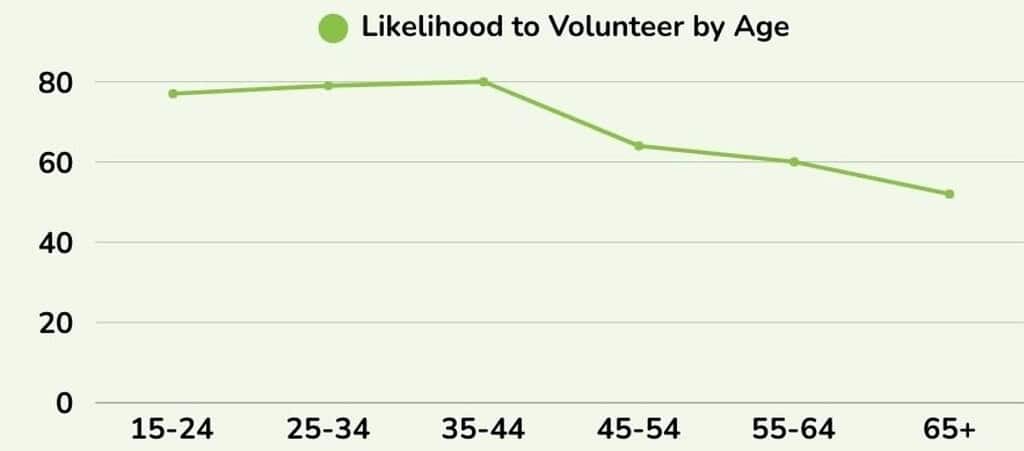
- Volunteer likelihood is highest among people aged 35-44, at approximately 80%.
- Participation is also strong among the 25-34 and 15-24 age groups, at around 79% and 77%, respectively.
- The rate declines to about 64% for individuals aged 45-54 and 60% for those aged 55-64.
- Adults aged 65+ show the lowest likelihood to volunteer, at approximately 52%.
- Overall, volunteering interest declines noticeably after age 44.
Volunteer Grant Statistics
(Source: doublethedonation.com)
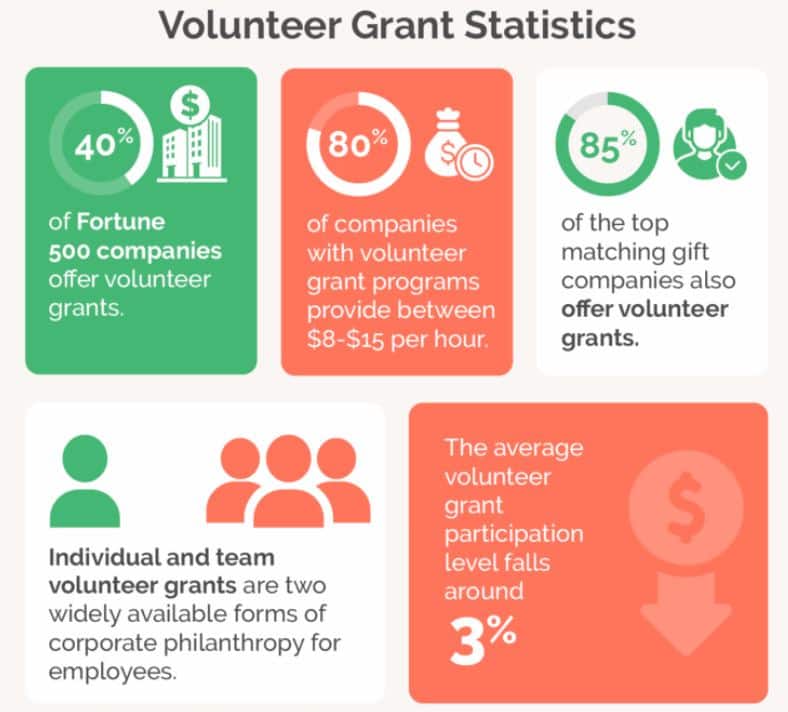
- Around 40% of Fortune 500 companies offer volunteer grant programs, indicating broad corporate support for employee-led community activities.
- Among companies with volunteer grant programs, 80% provide grants of USD 8- USD 15 for each volunteer hour completed.
- In addition, 85% of leading gift-matching companies also offer volunteer grants.
- Individual and team volunteer grants are two commonly available forms of corporate philanthropy.
- The average employee participation rate in volunteer grant programs is approximately 3%.
Volunteer Time Off Statistics
- 60% of companies offer paid Volunteer Time Off (VTO), while another 21% plan to introduce it later this year.
- 49% of people say work commitments are their biggest barrier to volunteering, while 30% volunteer because they have enough time.
- Companies with VTO programs provide an average of 20 hours, or about 2.5 days, per employee annually.
- 67% say paid volunteer leave would create a better volunteering experience, while 62% prefer volunteering during work hours.
- 71.4% of nonprofits have not discussed VTO with volunteers, and 41% never mention VTO or grants at events.
- 32.9% say supporters show interest in VTO, matching gifts, or volunteer grants after learning how these programs work.
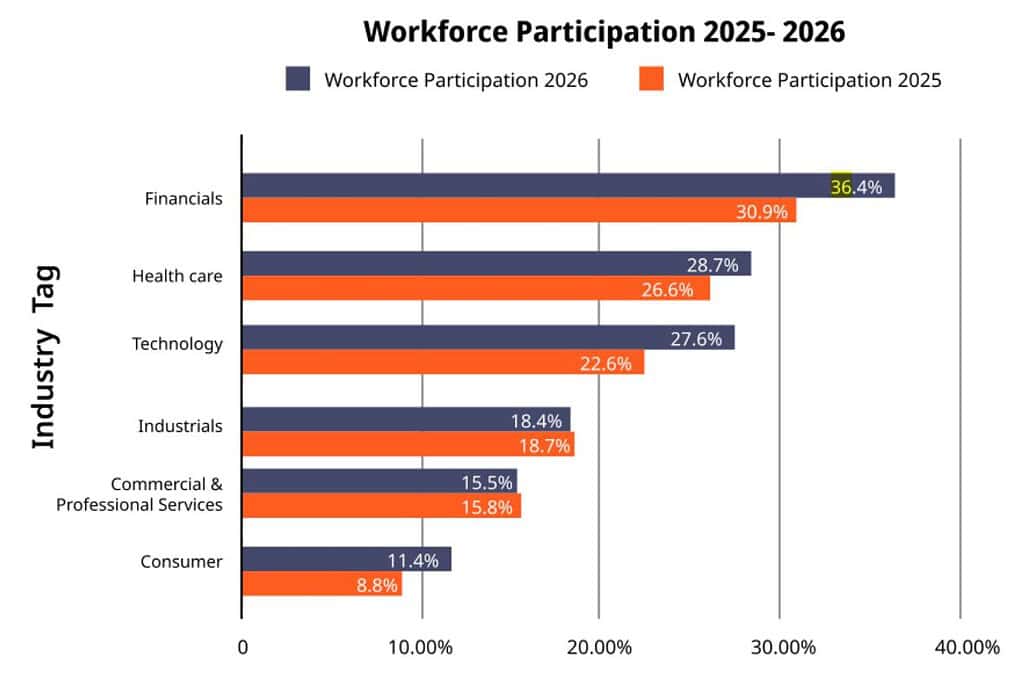
Volunteering Workforce Participation by Industry, 2025-2026
(Source: website-files.com)
- Financial services recorded the highest workforce participation, increasing from 30.9% in 2025 to 36.4% in 2026.
- Health care participation rose from 26.6% in 2025 to 28.7% in 2026.
- Technology showed strong growth, rising from 22.5% to 27.6%.
- Industrials declined slightly from 18.7% in 2025 to 18.4% in 2026.
- Commercial and professional services also decreased marginally, from 15.8% to 15.5%.
- Consumer-sector participation increased from 8.8% in 2025 to 11.4% in 2026.
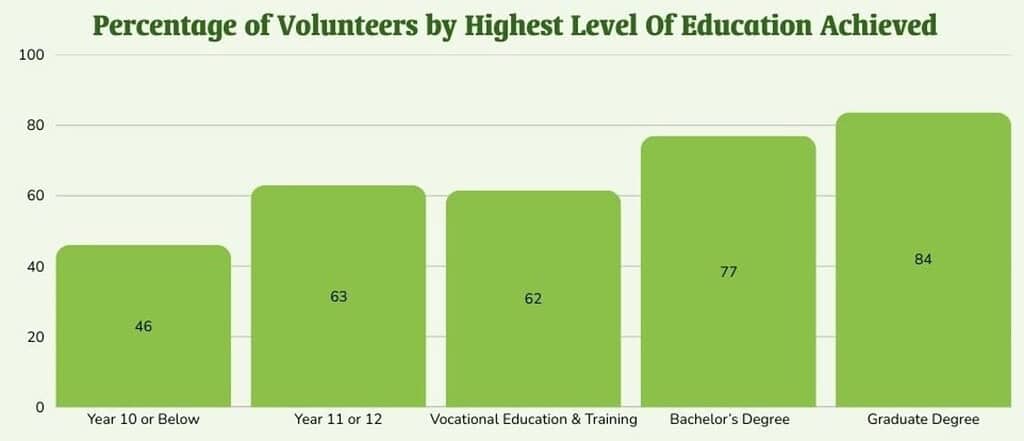
By Education Level
(Source: memberjungle.com)
- Volunteer participation is lowest among people with Year 10 or below education, at 46%.
- The rate increases to 63% for individuals completing Year 11 or 12.
- People with vocational education and training show a participation rate of 62%.
- Participation rises further to 77% among individuals with a bachelor’s degree.
- Graduate degree holders report the highest volunteer participation rate at 84%.
Volunteer Accelerator Adoption
- VQ 2026 includes data from 240 companies, with workforce participation reaching 25.6%.
- Employees contributed an average of 6.2 volunteer hours per volunteer.
- Annual volunteer campaigns were adopted by 86.3% of companies.
- Volunteering platforms and Volunteer Time Off (VTO) programs were each used by 65.0% of companies.
- Dollars for Doers (DFD) programs were available at 40.8% of companies.
Volunteering Satisfaction Statistics
- According to ncvo.org.uk, 96% of recent volunteers were satisfied with their experience, while 54% were very satisfied.
- 69% of volunteers had recommended or would recommend volunteering to others.
- 96% of frequent volunteers enjoyed volunteering, compared with 90% of occasional volunteers.
- Also, 93% of frequent volunteers felt they made a difference, versus 85% of occasional volunteers.
- 93% of Australian sport volunteers reported positive changes, while 95% linked volunteering with better wellbeing, as per a report shared by ausport.gov.au.
- Regular sport volunteers recorded a 35.8% wellbeing score, compared with 28.0% among non-volunteers or one-time volunteers in 2021.
- In the 2023 UK survey, 81% felt well supported, 83% knew how to raise concerns, and 40% valued recognition.
- A 2026 Cambridge University Press study stated that volunteering was linked to higher life satisfaction.
- Research covering 30,023 Europeans aged 50+ across 12 countries linked volunteering with higher life satisfaction and perceived health and lower depression.
Benefits of Volunteerism
- 35% of people volunteer to socialize, often supporting multiple organizations.
- Volunteers experience 38% fewer nights in the hospital.
- Regular volunteers have a 27% higher chance of finding employment.
- 82% of hiring managers prefer candidates with volunteer experience, while 85% are willing to overlook other CV weaknesses.
- 96% of employees who volunteer through their companies report a positive workplace culture.
- Volunteers make up one-third of the nonprofit workforce.
- 85% of nonprofits say skills-based volunteers improve their capacity and long-term effectiveness.
- 64.5% of nonprofits identify increasing donations as their main goal for expanding corporate volunteer programs.
- 80% of volunteers also donate financially, making them 4 times more likely to donate and giving 2.4 times more on average.
- 71% of employees value companies that support volunteering and philanthropy.
- 84% of employers say volunteerism effectively engages employees.
- Companies report 52% less turnover among new employees who participate in volunteering programs.
- 88% of consumers want to know about a company’s CSR efforts, including employee volunteering.
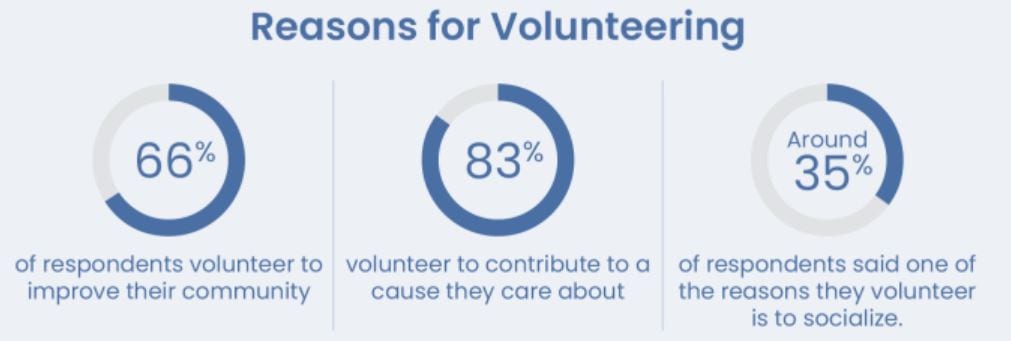
Key Reasons for Volunteering
(Source: 360matchpro.com)
- The strongest motivation is supporting a cause that people care about, cited by 83% of respondents.
- Improving the local community is another major reason, with 66% of respondents volunteering for this purpose.
- Social interaction also influences participation, as around 35% of respondents said they volunteer partly to socialize.
Barriers to Volunteering
- Time is the main barrier, reported by 40% of respondents.
- Cost is the second-largest challenge at 14%, followed by burnout and health concerns at 12% each.
- Lack of confidence and lack of transport each affect 8% of respondents.
- A lack of appreciation or recognition is cited by 7%.
- Negative prior volunteering experiences are the least common barrier at 5%.
Final Analysis
Volunteering is a simple way to help others and make a real difference. It brings people together, supports communities, and helps important causes move forward. At the same time, volunteers can learn new skills, gain experience, and build strong connections. Whether you give a few hours or help regularly, every effort matters.
In the end, volunteering is not just about giving your time; it is also about creating positive change and growing as a person.
FAQ
Volunteering supports communities, helps people in need, and allows individuals to contribute to meaningful causes.
Volunteering builds skills, improves confidence, reduces stress, creates connections, and gives people a sense of purpose and community.
The three main types are formal volunteering, informal volunteering, and social action volunteering.