









Introduction
Voice AI Agents Statistics: Voice AI agents have kind of grown out of the old-school interactive voice response (IVR) into more autonomous assistants that can talk through a call, answer questions, qualify leads, set up appointments, solve customer issues, process payments, and then actually carry out business workflows in real time. They’re mostly powered by large language models LLMs, plus speech recognition and text-to-speech tech, so it’s not just “read a menu” anymore.
In practice, Voice AI agents are now showing up across customer service, healthcare, banking, retail, and sales operations. Enterprises are moving quickly with voice automation, primarily to reduce operational costs, improve customer satisfaction, and keep support running 24/7 without constant human coverage. And as generative AI keeps improving, Voice AI agents are becoming a core part of enterprise digital transformation plans.
The stats below should make the momentum clearer, like market growth, adoption, investment behavior, and future opportunities that are shaping the Voice AI agent industry in 2026.
Editor’s Choice
- The global AI voice agents market is projected to grow from USD 3.5 billion in 2026 to USD 35.2 billion by 2033, expanding at a pretty remarkable 39% CAGR.
- 42% of businesses had already adopted AI voice assistants in 2025, while 58% plan deployment by 2026.
- AI voice systems now manage 70% of routine customer calls.
- AI voice interactions cost only USD 0.50-1.00 per conversation, compared with USD 5-8 for human-assisted support.
- AI voice agents achieve 90% customer satisfaction, which beats traditional IVR systems by as much as 60 percentage points.
- AI voice technology reduces average handle time by 40% while increasing first-call resolution by 15%.
- North America snagged 38.1% of the global market, and Asia Pacific is expected to grow the fastest.
- About 61% of debt collection agencies and 42% of dental and veterinary practices have already put AI voice solutions in place.
- AI really shines financially, showing 331%-391% three-year ROI, USD 10.3 million in labor savings, and as much as 50% less call abandonment.
- The speech and voice recognition market is projected to grow from USD 9.66 billion in 2025 to USD 23.11 billion by 2030.
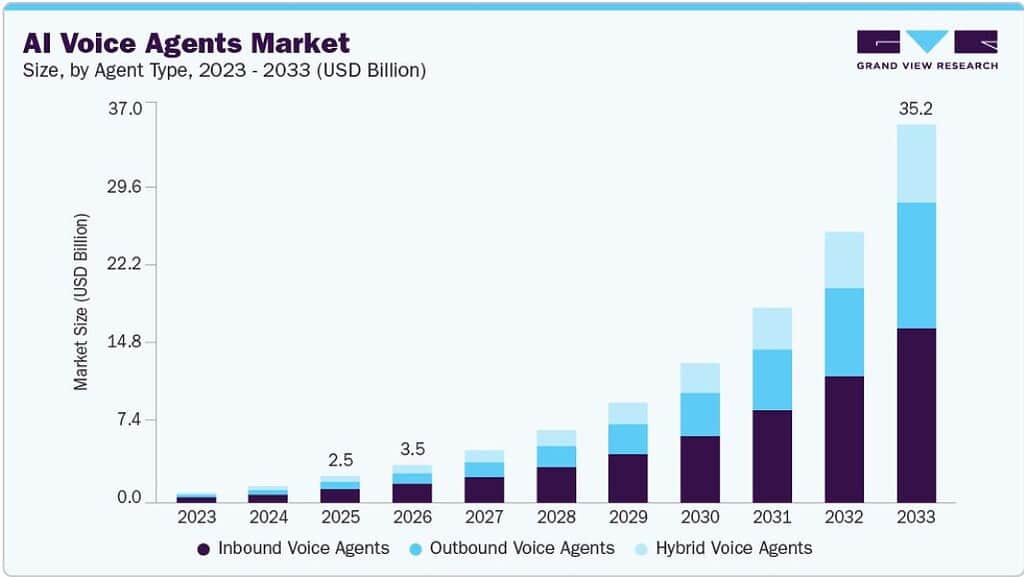
AI Voice Agents Market Witnesses Explosive Growth
(Source: grandviewresearch.com)
- The AI voice agents market is going into a phase of exceptional expansion, as companies increasingly roll out voice-enabled automation to make customer experiences better and to streamline operations.
- According to Grand View Research, the global market was valued at USD 2.5 billion in 2025, and it is on pace to reach USD 3.5 billion in 2026, also projected to touch USD 35.2 billion by 2033, with a 39.0% CAGR.
- Among the solution types, inbound AI voice agents actually led the market, taking a 52.1% revenue share in 2025. That shows their key role in managing customer conversations efficiently.
- For applications, customer support automation came out on top, as most organizations seem to be prioritizing AI-powered voice assistants to lift service quality while also cutting operational costs a bit.
- On the regional side, North America held the biggest market share at 38.1% in 2025, helped by strong tech adoption and ongoing enterprise investments.
- Meanwhile, Asia Pacific is forecast to grow the fastest through 2033.
- The United States also kept the largest country-level market share, which kind of reinforces its leadership in AI innovation.
- AI voice agents are shifting from simple virtual assistants into more mission-critical business tools, and that is where a lot of the opportunity sits for automation, customer engagement, and sustained market growth over time.
Businesses Rapidly Embrace AI Voice Agents For Customer Service
| Metric | Value | Source |
| Businesses using AI voice assistants | 42% | Gartner, 2025 |
| Routine calls handled by AI | 70% | Google Cloud, 2025 |
| Customer satisfaction with AI voice | 72% | Zendesk, 2025 |
| Same metric (2022) | 53% | Zendesk, 2022 |
| Businesses planning AI voice deployment (2026) | 58% | Gartner, 2025 |
(Source: adai.news)
- According to Gartner (2025), AI voice tech has moved past the early trials and is turning into a mainstream business tool because improvements in natural language understanding now help create more human-like chats.
- In 2025, 42% of businesses had already adopted AI voice assistants, which shows a growing sense of confidence in voice-driven automation for customer engagement.
- AI is taking on a bigger chunk of customer conversations, with 70% of routine calls now being handled by AI voice systems, and that lets organizations lighten operational load while also replying faster and more consistently, even when things get messy.
- According to Zendesk (2025, 2022), satisfaction with AI voice interactions rose to 72% in 2025, from 53% in 2022, so that’s a 19-percentage-point jump within only three years, and it seems tied to voice agents doing a better job with context, handling interruptions, and keeping those natural multi-turn conversations going.
- Looking ahead, adoption will likely speed up even more, since 58% of businesses plan to deploy AI voice solutions by 2026, so voice AI is starting to feel like a strategic priority, not just some experimental gadget.
- As more companies rely on AI voice agents to automate everyday interactions without dropping service standards, voice-enabled customer support will probably become a core part of digital transformation strategies, for real.
AI Voice Agents Deliver Strong ROI Through Higher Efficiency and Lower Costs
| Metric | Value | Source |
|---|---|---|
| Average handle time reduction | 40% | Five9, 2025 |
| First-call resolution improvement | 15% | NICE, 2025 |
| Cost per interaction (AI vs. human agent) | $0.50-1 vs. $5-8 | IBM, 2025 |
| 24/7 availability impact on customer satisfaction | 18% lift | Zendesk, 2025 |
| Agent burnout reduction (AI handling routine calls) | 25% | Genesys, 2025 |
(Source: adai.news)
- AI voice technology is proving to be one of the most impactful enterprise AI investments because it delivers measurable gains in productivity, cost savings, and customer satisfaction at the same time.
- One of the more noticeable operational improvements is something like a 40% reduction in average handle time, so businesses can resolve customer queries much faster while also boosting agent productivity.
- AI voice also tends to lift service quality by raising first-call resolution rates by 15%, so there’s less need for repeat interactions, and overall the customer experience feels smoother than before.
- When we look at typical interaction costs, an AI-powered conversation often comes in around USD 0.50 to USD 1, whereas a human-assisted interaction can land at USD 5 to USD 8, and that really underlines the cost advantage of automating routine customer chats.
- There’s the always-on element too, because 24/7 AI voice support is tied to an 18% increase in customer satisfaction, mainly because people get help right away, no matter business hours.
- As AI takes over repetitive inquiries and the mundane, low-value questions, it can also help reduce agent burnout by 25%, which lets human representatives focus on more complex and higher-value conversations.
- AI voice agents are doing more than just cutting costs for improving service quality, supporting employee well-being, and strengthening customer loyalty, making it one of the clearest examples of enterprise AI delivering measurable business value.
AI Voice Adoption Statistics By Industry
(Source: ainora.lt)
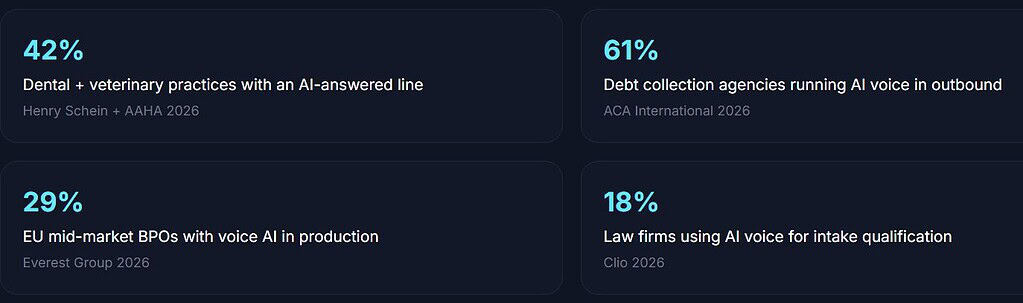
- The data says that AI voice tech has moved, like, way past the experimental phase, and it is now being picked up by industries where high call volumes and customer contact directly hit business outcomes.
- ACA International (2026), the most visible traction shows up with debt collection agencies, where 61% are already running AI voice for outbound outreach, and this basically means that organizations with repetitive customer conversations are moving first with implementation.
- Healthcare-related companies are doing something similar too, because 42% of dental and veterinary practices operate AI-answered phone lines, which points to the rising need for automated appointment coordination and customer support.
- Everest Group (2026) shows that across Europe, the use keeps broadening, especially among outsourced service providers, where 29% of mid-market BPOs have already put voice AI into production settings.
- Cilio (2026), the legal sector seems to be going slower and a bit more selectively, with only 18% of law firms using AI voice for intake screening, so the adoption is cautious, yet still increasing, mostly aimed at automating the first client interactions, while keeping humans for the heavier legal tasks.
- Places with repetitive, well-structured dialogue are seeing quicker returns, and professional service areas are gradually weaving AI into customer-facing workflows.
- AI voice in 2026 is becoming a practical business infrastructure investment, with adoption accelerating in sectors where automation can improve responsiveness, reduce manual workloads, and deliver measurable operational value.
AI Voice Agent Vs Traditional IVR In User Satisfaction
(Source: retellai.com)
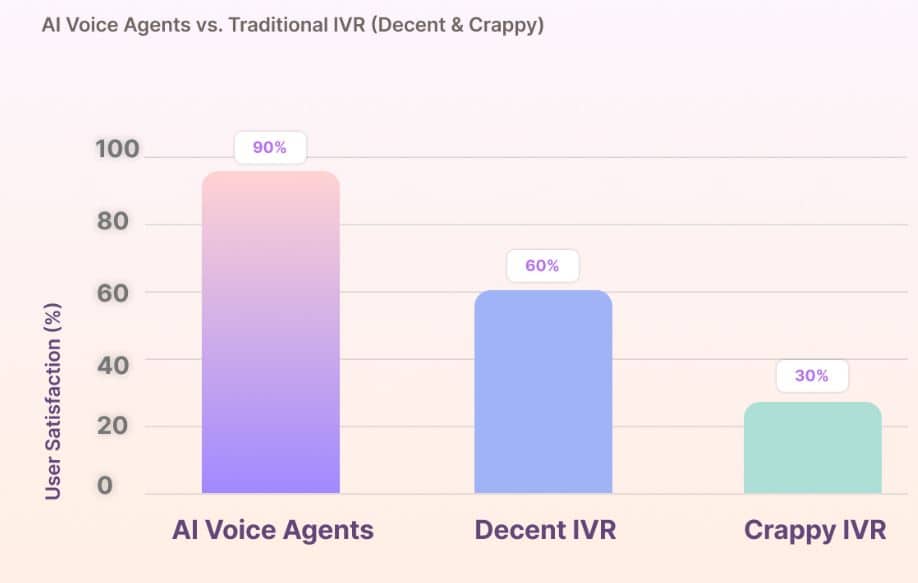
- The comparison clearly shows that AI voice agents have kinda reworked the customer service experience, delivering much higher user satisfaction than traditional Interactive Voice Response (IVR) systems do.
- AI voice agents hit a 90% user satisfaction rate, which is way above decent IVR systems at 60%, and also above poor-performing IVR solutions sitting at just 30%.
- So there’s this 30% advantage over standard IVR platforms and, honestly, a 60% lead over outdated IVR systems. This difference also mirrors a growing preference for intelligent, human-like interactions, rather than those stiff, menu-based arrangements.
- Modern AI voice agents can process natural language, detect what the user really means, handle interruptions, and give contextual replies, so the whole back-and-forth feels quicker and more tailored to the person.
- At the same time, even well-designed traditional IVR systems only satisfy about 60% of users, so it seems menu-driven interactions still add friction during the customer journey.
- For poorly optimized IVR systems, the picture gets worse fast; satisfaction drops to 30%, meaning customers quickly get annoyed with long lists, repetitive prompts, and low flexibility.
- The above data implies that organizations investing in AI voice agents are not only doing a contact center upgrade; they’re boosting customer loyalty, improving brand perception, and building a support experience that runs more efficiently.
Modern AI Voice Agent Technology Stack
- In 2026, the AI voice agent market isn’t really about one breakthrough technology only, more like the overall strength of its whole technology stack, even if people keep calling it “the model.”
- On the reasoning layer, advanced large language models such as OpenAI GPT-4o and Anthropic Claude 3.5 help voice agents understand intent, stay anchored to context, and carry on natural conversations, more or less in real time.
- ElevenLabs says its platform hit a reported USD 11 billion valuation in 2026, so investors seem pretty confident in AI-generated speech infrastructure. PlayHT is still in the mix, though Fahim AI in 2026 said ElevenLabs beat it in 7 of 9 evaluated areas.
- The cost is another thing that changes the conversation, since ElevenLabs plans start around USD 5 per month, while PlayHT starts near USD 31.20 per month, so companies end up balancing everyday affordability with that more premium “realism” angle.
- Cartesia notes ElevenLabs’ Flash model can reportedly generate speech with latency as low as 75 milliseconds, while the higher quality model usually lands around 300 milliseconds or more. Then at the orchestration layer things keep getting faster in some places, slower in others.
- Retell AI claims response times roughly 500-800 milliseconds, and when deployments are optimized, those results can drop under 500 milliseconds.
- AInora, on the other hand, reports Bland AI averaging 600-1,000 milliseconds, and Vapi sitting somewhere around 500-1,200 milliseconds.
- Retell AI puts its rate around USD 0.07+ per minute, while Bland AI is closer to USD 0.09 per minute, but Retell AI says it still manages faster responses, which is kinda the whole point.
- Latency stays under about 1 second, but when delays go past 1.5 seconds, the whole user experience drops in a way people really notice. So low-latency architecture is basically becoming a key competitive edge, not some nice-to-have.
- These trends also suggest AI voice platforms are being judged more and more on intelligence, speech quality, pricing, and real-time behavior, not just on the language model behind the scenes.
Recent developments in AI voice Agents In 2026
- Gartner expects 40% of enterprise applications will include task-specific AI agents by the end of 2026, up from under 5% in 2025, plus 25% of customer service conversations are expected to start with a GenAI-powered agent by 2027. Adoption is already sitting around 34% in the U.S., 29% in the UK, and 23% in Germany.
- Bitkom Research says 23% of German firms already use AI voice or chat tools, and another 41% are planning deployments before the end of 2026. Forrester goes even further, citing something like a 331%-391% three-year ROI, including USD 10.3 million in labor savings and a 50% cut in call abandonment.
- McKinsey also reports that AI voice agents can drop cost per call by roughly 50%, while newer systems push containment rates from 20-40% up to about 50-75%, and nudge first-call resolution from around 65% to something like 85-95%.
- Tech capabilities are advancing fast too, not just slowly. The emotional AI space has grown, from USD 19.5 billion in 2020 up to USD 37.1 billion in 2026, and this is helping voice agents sense customer feelings and bring down escalation rates by about 25 %.
- In BFSI, the biggest share still sits at 32.9%, and they’re seeing something like 20-30% less in operational costs, which is pretty telling.
- AI agents are nearing USD 50 billion by 2030, scaling at around 46% per year, and automating nearly 15% of everyday work decisions by 2028.
- Gartner also notes that more than 40% of agentic AI efforts could get canceled by 2027. And Capgemini says trust in fully autonomous AI agents dropped, going from 43% to 27% within a single year, which feels kinda sharp.
- Lastly, the speech and voice recognition market is projected to jump from USD 9.66 billion in 2025 to USD 23.11 billion by 2030.
Conclusion
Voice AI agents have kind of rapidly evolved into a strategic enterprise technology that stitches together automation, conversational intelligence, and measurable business value, and all that. There is strong market growth, more and more enterprise adoption, lower operational costs, and noticeably higher customer satisfaction that keeps pushing investments across different industries. New improvements around large language models, speech recognition, emotional AI, and real-time voice generation keep leveling up performance, while also cutting response times and lowering support costs.
And since organizations are leaning harder into digital transformation, plus customer experience, AI voice agents are starting to look like a must-have piece of everyday business operations. In general, the long-term outlook feels very positive, supported by steady innovation, expanding enterprise use cases, and solid return on investment.
FAQ
The global AI voice agents market is expected to hit USD 3.5 billion in 2026, then climb to USD 35.2 billion by 2033.
Companies are adopting AI voice agents so they can cut expenses, automate customer support, speed up response times, and offer 24/7 service, basically.
A typical AI voice interaction costs around USD 0.50-1.00, while a human-assisted interaction runs about USD 5-8.
Yes, generally. AI voice agents can reach roughly 90% customer satisfaction, which is well above conventional IVR systems.
Debt collection agencies, healthcare providers, BPOs, retail, banking, and legal firms are among the quickest adopters of AI voice technology.