









Introduction
Four-Day Workweek Productivity Statistics: In 2026, the four-day workweek has kind of slid from being a one-off workplace experiment to a measurable productivity move. A lot of orgs in Europe, North America, Australia, and across parts of Asia are trying schedules with fewer hours but with full pay for employees. Instead of staring at the number of hours worked, companies are leaning into results, quicker execution, and that overall health vibe.
Reports coming out of global pilot efforts, universities, and workforce groups suggest that many firms hold steady, or even get better, on productivity once they switch to a shorter work schedule. Alongside that, businesses often mention less absenteeism, lower staff exits, easier recruitment, plus revenues that stay stable or even edge upward. Put together, those signals are pushing governments and employers to treat flexible arrangements as a longer-term productivity tool, not just a temporary perk.
Editor’s Choice
- 90% of organizations kept the four-day workweek running after international trials, showing lasting business belief in reduced-hour approaches.
- 81% of full-time employees say they prefer a four-day workweek, so flexible scheduling is basically a big expectation for workers in 2026.
- 97% of U.S. pilot companies meant to keep the model after they saw improved productivity and higher employee satisfaction.
- 86% of Iceland’s workforce now works reduced hours, or has a formal right to request them, and that’s why it’s often cited as a global benchmark for flexible work.
- Microsoft Japan raised sales per employee by 39.9% while cutting electricity use by 23.1%, suggesting productivity and sustainability can expand together.
- UK pilot companies saw a 57% drop in resignations, and 85% said hiring became simpler, which points to serious retention and talent advantages.
- North American organizations managed to see an 8% weighted bump in revenue, but also cut employee burnout by 68% when they ran four-day workweek trials for a few days.
- In Iceland, all 100% of the trial workplaces kept productivity steady, and about 40% also showed measurable productivity gains, which kind of backs up this idea of reduced-hour efficiency.
- A four-day workweek can cut commuting emissions by roughly 20%, and it lines up with corporate ESG and sustainability priorities in a real way.
- Meanwhile, the UK could wipe out around 558 million commuting miles each week if the approach was adopted nationally, which would meaningfully reduce transport-related emissions.
Four-Day Workweek Trials Demonstrate Strong Long-Term Business Adoption
| Metric | Value | Source |
| Employees/organizations/countries in peer-reviewed trial | 2,896 / 141 / 6 | Nature Human Behaviour, 2025 |
| Companies keeping the schedule after six months | 90% | Nature Human Behaviour, 2025 |
| UK 2025 Foundation pilot firms keeping four-day week | 17 of 17 (100%) | 4 Day Week Foundation, 2025 |
| UK 2025 pilot firms moving to a full four-day week | 12 of 17 | 4 Day Week Foundation, 2025 |
| UK 2025 pilot firms adopting a nine-day fortnight | 5 of 17 | 4 Day Week Foundation, 2025 |
| UK 2025 pilot workers covered | 1,000+ | 4 Day Week Foundation, 2025 |
| UK 2022 pilot companies continuing | 56 of 61 (92%) | Autonomy, 2023 |
| UK 2022 pilot permanent adopters | 18 | Autonomy, 2023 |
(Source: voxbooster.com)
- The newest four-day workweek findings imply the setup is no longer just a side experiment, but it’s turning into a lasting workplace approach.
- A big peer-reviewed study in Nature Human Behaviour (2025) assessed 2,896 employees across 141 organisations, in 6 countries, making it one of the widest international reviews of reduced working hours.
- The results show strong confidence across firms, with 90% of companies staying with the four-day workweek six months after the trial actually ended, so it seems operations stayed manageable and the workforce benefits were substantial enough to keep going.
- In the United Kingdom, the 4 Day Week Foundation (2025) shared results that look equally promising.
- All 17 out of 17 pilot firms (100%) chose to keep shorter working schedules after the pilot wrapped up, suggesting a totally unanimous employer view.
- Out of these organizations, 12 of 17 companies moved over to a full four-day workweek, and 5 of 17 firms went for a nine-day fortnight, which sort of shows that businesses are leaning into flexible options, rather than sticking with one single set-up model.
- The UK pilot itself reached more than 1,000 workers, so it gives a pretty solid, real-world look at employee experiences.
- The four-day workweek is becoming an actual workforce plan, not just theory, with solid employee staying power and wide organizational involvement suggesting a growing trust in flexible work arrangements.
Four-Day Workweek Employee Preference
(Reference: makerstations.io)
- Employee demand for a four-day workweek has gotten to a point where employers really can’t just ignore it anymore.
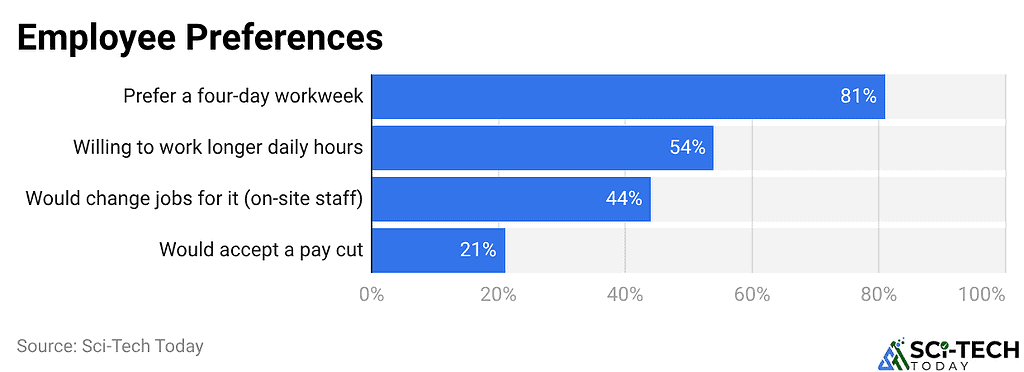
- According to PassiveSecrets (2026), 81% of full-time employees seem to favor a four-day workweek, and that basically points to broad support for a better work-life balance.
- Now, for the people who are into the idea, 89% say they’d still do some kind of trade-off, not fully hands-off about it, and 54% would rather extend their day’s hours instead of taking a hit on their salary.
- At the same time, career flexibility is turning into more than just a nice perk. For example, 44% of on-site employees report they would switch jobs if it meant landing a four-day workweek, which kind of signals that flexible timetables are increasingly affecting how organizations pull in and keep talent.
- Only 21% of workers are willing to accept reduced pay for a shorter workweek, and inside that slice, 51% would take a reduction of 5% or less. So overall, they expect flexibility, but not at the expense of earnings.
- Also, 79% of employees say a four-day workweek would help their mental health, which strengthens the growing relationship between workplace flexibility and employee well-being.
- Taken as a whole, the numbers suggest that organizations will likely lean toward compressed work schedules, rather than reducing pay, as the strategy that matches what employees want while keeping productivity steady, more or less.
Working Hours by Country
(Source: makerstations.io)
- The real success of a four-day workweek really kinda depends a lot on what the current working-hour patterns look like across countries.
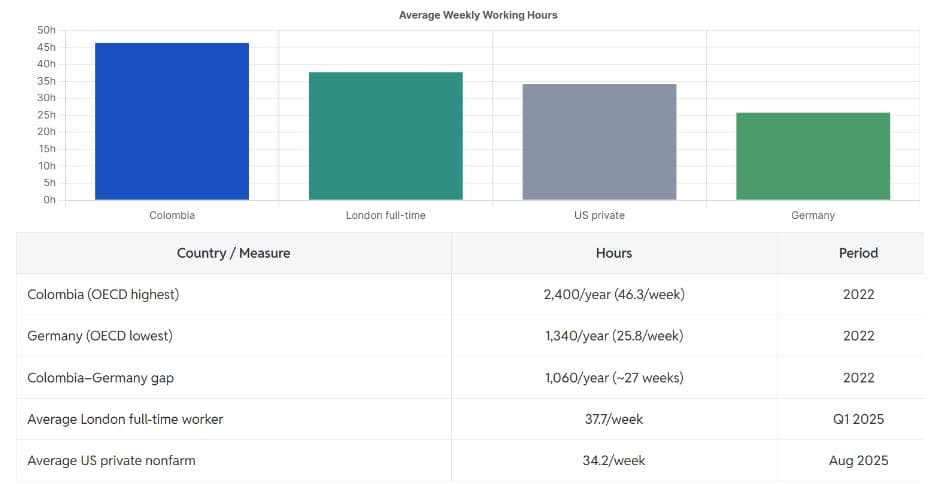
- As the OECD puts it, Colombia logged the highest yearly working time among OECD nations, at 2,400 hours per worker, 46.3 hours per week, in 2022.
- Meanwhile, Germany sat at the lowest level, 1,340 hours per year, or 25.8 hours weekly. So that basically leaves a huge lifestyle mismatch of 1,060 working hours per year, which is about 27 extra working weeks.
- Working routines also shift inside big economies, not just between them. For example, the Office for National Statistics said that the typical full-time worker in London put in 37.7 hours per week during Q1 2025.
- At the same time, the U.S. Bureau of Labor Statistics reported an average of 34.2 weekly hours for private nonfarm employees in August 2025, and that number includes part-time workers.
- Another common example is Iceland. Trials running roughly from 2015 to 2019 led to around 86% of the workforce moving into reduced-hours arrangements, which shows that large-scale adoption is not just a theory when the conditions are supportive enough.
- Most four-day workweek research has leaned heavily on organizations that volunteered themselves, rather than randomised controlled trials.
- The companies that take part may already have more resilient workplace culture, plus a higher degree of receptiveness to adaptable work practices, and that can quietly tilt the outcomes.
- Nature study authors indicate that while current results are promising, broader evidence is still needed to determine how these models perform across diverse industries and organizational environments.
Countries With Major Trials (2015-2026)
| Country | Trial Period | Participants | Status (2026) |
| Iceland | 2015-2019 | 2,500 workers (1% of workforce) | 86% of workforce now has reduced hours |
| United Kingdom | 2022 (6 months) | 61 companies, 2,900 employees | 92% of companies continued; ongoing expansion |
| United States | 2023 (6 months) | 33 companies, 900 employees | 97% planned to continue |
| Australia/NZ | 2022-2023 | Multiple company trials | Several permanent adoptions |
| Japan | 2019 (Microsoft), ongoing govt promotion | 2,300+ (Microsoft); limited broader adoption | Government encouragement, cultural barriers remain |
| Spain | 2021-2023 | Government-funded pilots | Mixed results; some permanent adoptions |
(Source: 4dayjob.com)
The big picture evidence seems to say that the four-day workweek is not just one of those workplace tests anymore; it is a research-backed approach that can lift productivity, employee wellbeing and overall business performance, all while pay stays steady. In country after country, the trials pretty consistently show that organizations can land equal or even better results, even when the team clocks fewer hours.
Iceland
- Iceland ran what is often described as the first major-scale four-day workweek trial in the world from 2015 to 2019, with about 2,500 people, almost 1% of the national workforce, spread across government offices, hospitals, preschools, police departments, and social services.
- In general, people worked 35–36 hours each week, though some folks were on 32.
- 100% of the workplaces managed to keep productivity, about 40% even improved it, and none saw a drop.
- The pilot helped push policy shifts, and by 2026, 86% of Iceland’s workforce either already works fewer hours or can request them, without any solid sign of economic harm.
United Kingdom
- In the UK, the 2022 pilot turned into the biggest coordinated four-day workweek experiment; it involved 61 companies and roughly 2,900 employees, using the 100-80-100 model.
- The results looked strong: 92% of companies kept the shorter schedule or planned to, and about 56% chose it permanently.
- Businesses also described an average 1.4% rise in revenue during the trial, plus a 35% weighted increase versus the previous year.
- Employee wellbeing improved quite a lot, with 71% saying they had less burnout, 54% reporting better mental health, 42% seeing physical health improvements, 40% noting a nicer sleep routine, and 30% a higher sense of life satisfaction.
- At the same time, companies saw resignations drop by 57%, and 85% said recruitment became easier. The average company satisfaction score hit 8.3 out of 10.
North America
- In North America, the coordinated 2023 pilot basically backed up the same message. This trial involved 33 companies, about 900 employees, and 97% of the organizations said they intended to keep the model going.
- Companies reported a weighted revenue lift of 8%, and employee satisfaction rose from 6.7 to 8.9 out of 10.
- Researchers also noted 68% lower burnout, 76% better work-life balance, 45% improved sleep, 44% less stress, and a 35% reduction in employee turnover, plus 90% of employers saying hiring felt simpler.
Japan
- Japan showed that workplace redesign can push productivity gains even further.
- In Microsoft Japan’s 2019 month-long trial with 2,300 employees, sales per employee climbed 39.9%, electricity costs went down by 23.1%, and paper printing fell by 58.7%.
- 92.1% of employees said they wanted the program to continue, so workforce support looked strong, even though the company later switched back to a more traditional schedule due to wider cultural and business expectations.
New Zealand
- New Zealand’s Perpetual Guardian trial in 2018, it gave another pretty solid business case.
- The company rolled out a 32-hour workweek for 240 employees, leading to a 20% bump in productivity and a 24% uplift in work-life balance, and a 7% drop in stress.
- At the same time, employee engagement moved from 66% to 78%, leadership satisfaction went from 71% to 82%, stimulation scores improved from 72% to 82%, and team empowerment climbed from 72% to 80%. The organization decided to keep the model running for good.
- Overall, these international trials seem to show that cutting working hours can still keep productivity steady or even improve it, while also boosting employee wellbeing and supporting retention, plus recruitment and operational efficiency.
- The rollout differs depending on industry and local culture, but the data keeps pointing in the same direction: the four-day workweek looks like a workable and scalable workplace innovation.
Four-Day Workweek Environmental Impact and ESG Goals
- The four-day workweek has kinda moved beyond an employee wellness idea, into something that looks more like a “measurable” ESG and sustainability play.
- The data that’s out there suggests that fewer office days can reduce energy use, trim commuting-related emissions, and also make day-to-day operations run more efficiently, all while the business results stay solid.
- One of the better documented cases comes from Microsoft Japan in 2019, during their Work Life Choice Challenge. They simply closed offices every Friday for one month, and not just as a nice slogan.
- In that trial, they recorded a 23.1% drop in office electricity consumption, plus a 58.7% decrease in paper printing, and at the same time they reported a 40% rise in productivity.
- Those kinds of figures matter because they show how organizations can lower operational resources without weakening output, which makes the approach pretty relevant for ESG disclosures and corporate sustainability metrics.
- Transportation is also a big piece of the puzzle for emissions reduction, because it’s tied to roughly 14% of global greenhouse gas emissions.
- Studies indicate that getting rid of one commuting day per week with a four-day schedule can cut commuting-related emissions by about 20%, which comes out to ~6.07 kg tCO₂e per employee in modelled scenarios.
- In the UK, national modelling goes even further, estimating that a four-day workweek could wipe out as much as 558 million commuting miles every week, which would then lower fuel burn and transport emissions in a meaningful way.
- There’s also a 2021 Stop The Clock report, which projects that if this spreads nationwide, it could reduce UK carbon emissions by 127 million tonnes each year; that’s a 21.3% cut in the country’s carbon footprint.
- The environmental wins get even better when organizations pair four-day schedules with hybrid or remote work.
- Research suggests that fully remote employees can trim greenhouse gas emissions by as much as 54%, while just one remote workday each week drops emissions by about 2%, and two to four remote days can cut them by up to 29%.
- The numbers feel like they’re pointing in the same direction: shorter workweeks plus flexible work models give companies measurable improvements in energy efficiency, Scope 2 and Scope 3 emissions, and longer-term ESG outcomes.
Conclusion
The four-day workweek has basically shifted from a nice idea into a validated productivity approach that helps both employers and employees. Large pilot programs keep showing that organizations can maintain or raise productivity, while also easing burnout, turnover, and absenteeism. Companies also describe better hiring results, stronger employee morale, and steady or even growing revenues without lowering pay.
Beyond what happens at the desk, the model backs ESG goals by reducing energy use and commuting-related pollution. Even though rollout details differ across industries and countries, the larger research picture still suggests that output-based work arrangements are becoming a credible, sustainable option compared to old-style schedules. As workplaces continue to modernize, the four-day workweek should take on a bigger role in future workforce planning.
FAQ
Yes. Several global trials reported that productivity held steady or improved after companies reduced weekly working hours.
Iceland is leading, with 86% of its workforce either working reduced hours or having the right to request those changes.
Yes. Around 90% of organizations in international studies continued the model after pilot programs ended.
It reduces burnout, improves mental health, enhances work-life balance, and strengthens employee retention.
Yes. It reduces office energy use, lowers commuting emissions, and contributes to improved corporate ESG performance.