








Brief Overview
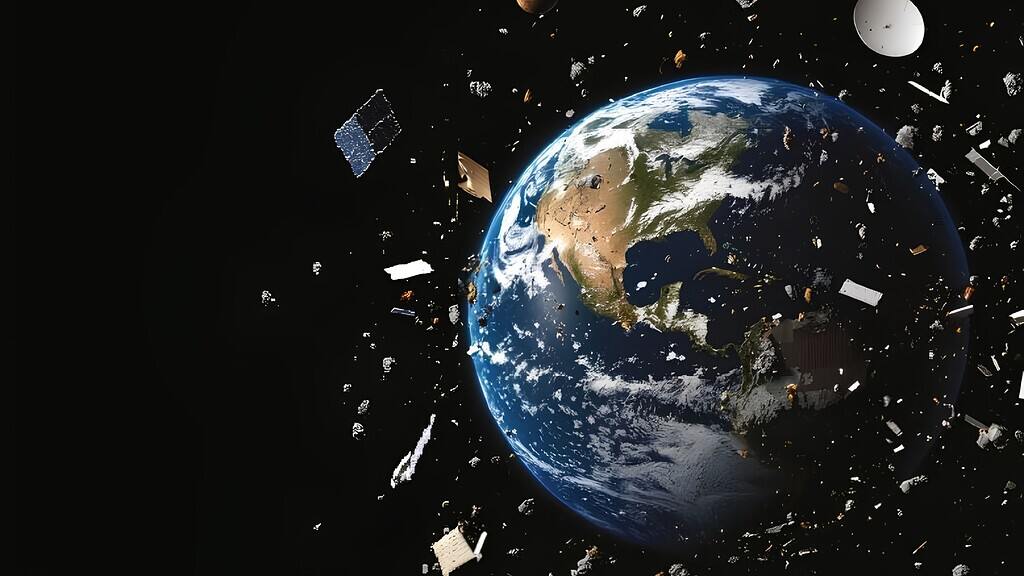
Space Debris Statistics: Space debris, or space junk, refers to those non-functioning things currently in Earth’s orbit of Earth. These refer to all unmanned satellites, spent rocket stages, fragments from collisions, and even little paint chips.
Owing to the fast expansion of space exploration coupled with satellite launches, space debris is becoming a challenging issue in the year 2026; that is, it threatens operational satellites, the International Space Station (ISS), and even future missions. In this article, we will find out the consequences and mitigation of Space debris statistics.
Brief Overview
- According to space debris statistics, there are around 1.2 million pieces of space debris larger than 1 cm (including over 54,000 objects larger than 10 cm) in Earth’s orbit and are likely to pose a considerable risk to satellites.
- Russia has successfully launched about 4,100 spacecraft, while the United States has a total of about 6,000+ spacecraft (including large constellations like Starlink).
- As of 2025, there are approximately 54,000 pieces of debris larger than 10 cm in diameter, and any collision with this type of object can cause catastrophic fragmentation of satellites.
- The overall valuation of the global space debris removal market in 2025 is USD 1.10 billion and will rise to USD 4 billion by 2032 at a CAGR of 27%, as propelled by increased satellite launches and awareness surrounding space sustainability.
- Space debris statistics reveal that of launching about 450 satellites for defence purposes in 2025, the vast majority were successful, emphasising the growing demand for space operations.
- The first active debris removal mission was launched by such leading players as Astroscale Japan Inc. with the ADRAS‑J mission in 2024. China’s 2007 ASAT test generated 3,000 debris fragments.
- Space surveillance tracks 35,000 objects, among which about 26,000 are considered to be debris pieces greater than 10 cm, while there were over a million pieces that were more extensive than 1 cm and that remain untracked.
- About 30 near encounters with other satellites or debris occur in a year for satellites within the 500-600 km orbital range.
- Although with the participation of more than 150 organisations and 15+ countries, ESA’s ‘Zero Debris Charter’ introduced in 2023 aims at being debris neutral concerning operations by 2030.
- Space debris statistics state that there was an increase in large debris objects from about 15,000 prior to 2011 to about 30,000 by the end of 2021, while 550 objects are reckoned to re-enter the atmosphere each year.
- Smaller debris fragments have been estimated at around 130 million, flying five times faster than a bullet and posing a threat that remains out of tracking.
- Nature places the chances of one annual collision in crowded orbit at 550 km, under which Starlink satellites reside at 50%.
- Launched in 2023, ESA’s Zero Debris Charter aims for debris-neutral operations by 2030, with participation from over 150 organisations and 15+ countries.
- From 2011 to 2025, the number of large debris objects (those over 10 cm) grew from 15,000 to about 54,000, but every year, about 600–700 of them come back to Earth’s atmosphere.
- Smaller debris fragments, which are estimated to number around 130 million, fly at speed five times as fast as a bullet, thus posing untrackable threats.
- Space debris statistics estimate a 50% chance of having at least one collision every year in an orbit that is crowded at 550 km – the height where Starlink satellites are located.
Space Debris and Satellites
(Source: statista.com)
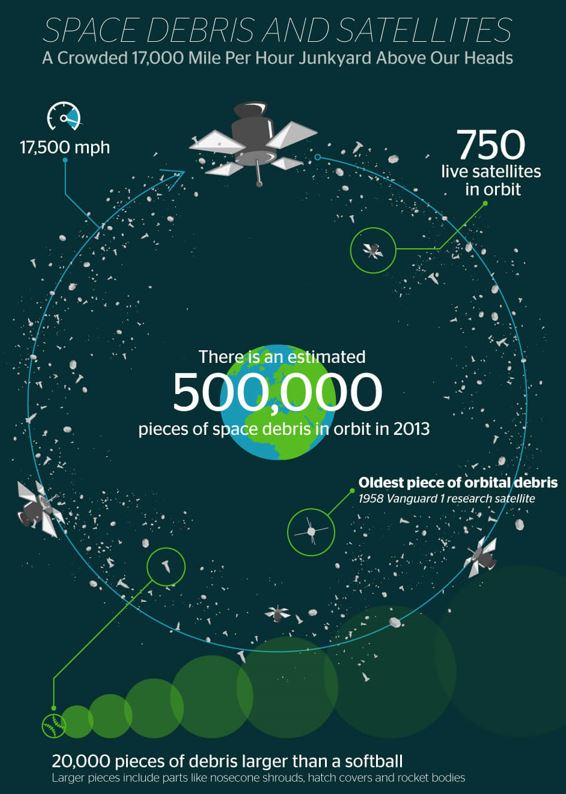
- According to space debris statistics by NASA, the Earth’s orbit has surpassed being fully occupied; it is almost crowded with an estimated 1.2 million pieces of debris consisting of varying sizes-from small fragments to larger items such as nosecone shrouds, hatch covers, and rocket bodies.
- Although there is so much space junk up there, very few reports of actual major accidents have been recorded.
- For instance, in 1996, a so-called piece of space junk damaged a French satellite with wreckage from a rocket sent up ten years earlier.
- In 2008, an abandoned Russian satellite ran into a U.S. Iridium satellite, vanquishing the latter completely and adding further to the above problem.
- The recently announced milestone for Russia was the launch of the Olympic torch into orbit as a prelude to the Winter Games in the city of Sochi.
- Having thus far sent into orbit 4,024 spacecraft, Russia (and the USSR before it) has launched only about half that number, 1,950 spacecraft in all, by the United States.
Speed and Impact Energy Of Orbital Debris
- Objects in low Earth orbit travel at approximately 28,000 km/h, moving nearly 10 times faster than a rifle bullet, making even tiny fragments extremely hazardous due to their immense speed.
- In head-on collision scenarios, relative velocities can reach a staggering 54,000 km/h, dramatically amplifying the destructive potential of orbital debris impacts.
- A 1 cm aluminum sphere traveling at 10 km/s carries kinetic energy equivalent to a hand grenade, while a 10 cm object at the same speed delivers energy comparable to roughly 7 kg of TNT, enough to completely destroy a satellite.
- The International Space Station (ISS) can only withstand impacts from objects up to about 1 cm.
Space Debris Floating in Earth’s Orbit by Size
(Reference: statista.com)
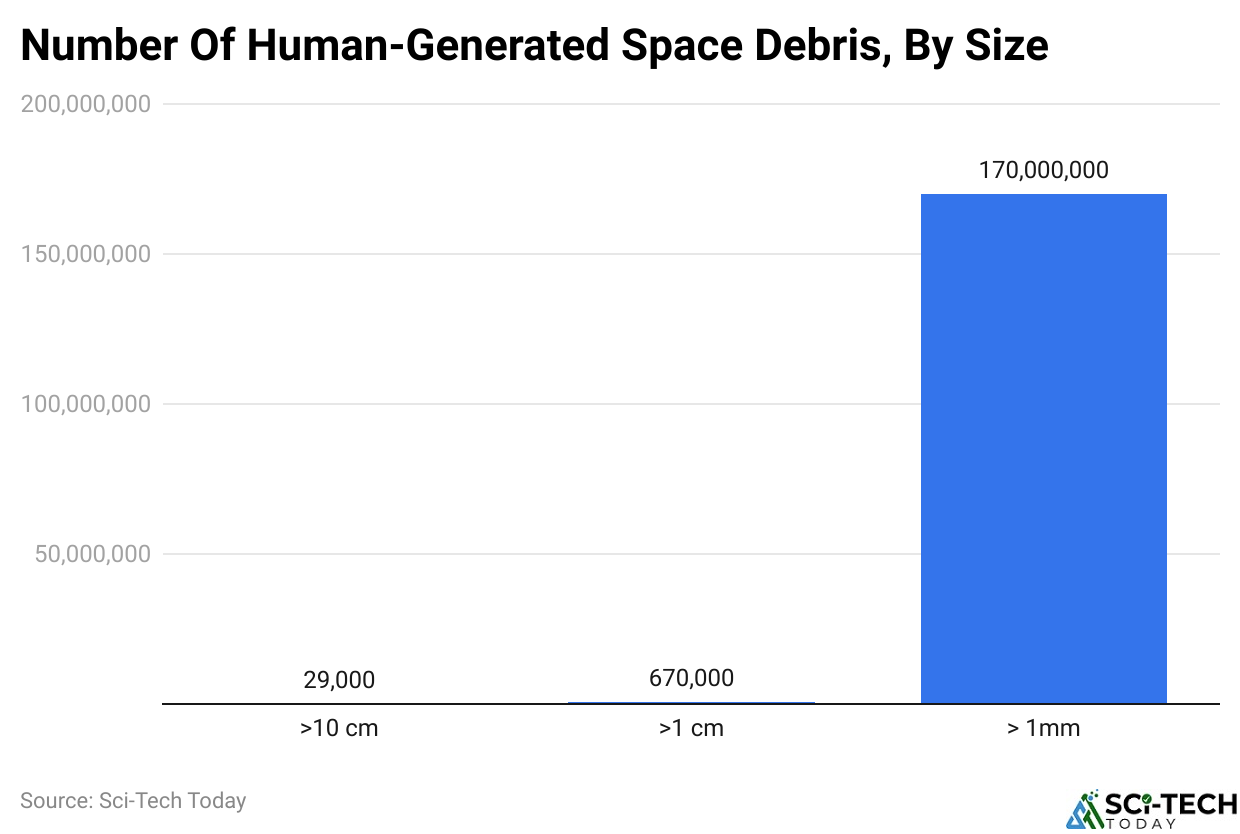
- Space debris statistics indicate that presently, about 29,000 pieces of manmade debris larger than 10 centimetres are floating in the above orbit as of July 2013.
- This natural body of human-made objects poses looming threats to satellites and other orbital equipment.
- According to the European Space Agency, a collision with such an object could lead to catastrophic fragmentation of a typical satellite, resulting in more debris in orbit.
Space Debris by Orbit Regime
- Low Earth orbit (LEO) is by far the most congested region, containing 15,902 tracked debris objects, sitting below roughly 2,000 km altitude where collision risks are highest despite atmospheric drag eventually clearing objects over time.
- Geostationary orbit (GEO) at 35,786 km altitude holds 1,489 debris objects, posing a long-term concern since debris here faces virtually no natural removal mechanism and can remain in orbit for millions of years unless actively moved to a graveyard orbit.
- Medium Earth orbit (MEO), home to navigation constellations like GPS and Galileo, contains only 249 debris objects, making it significantly less congested compared to LEO and GEO.
- Highly elliptical orbit (HEO) has the least amount of debris at just 32 objects, reflecting its limited use compared to other orbital regions, though objects here still require careful monitoring due to their unique orbital paths.
Exponential Growth in the Space Debris Removal Market
- According to space debris statistics, the emerging global market for space debris removal has dramatically witnessed growth over the past few years.
- The market, valued at USD 1.10 billion as of 2025, is expected to grow to USD 4 billion as early as 2032 with a CAGR (compound annual growth rate) of 27%.
- The main trends are advanced technology developments, increased cooperation between debris removal companies, improvements in tracking and removal techniques, and strengthened international cooperation. The ever-increasing number of satellite launches propels the market growth.
- According to space debris statistics, there were about 450 satellites launched internationally for defence purposes in 2025, up from 186 in 2022, and the vast majority were successful.
- Out of the about 185 launches made by the United States in 2025, roughly 173 were successful, while of the about 90 launches attempted by China in 2025, around 88 were successful in reaching orbit. Thus, this increasing number of satellite activities has created a very big need for efficient solutions in debris removal.
- Leading players in the space end-of-life management space are innovating to build capabilities for sustainable space. For further instance, the ADRAS‑J was launched in February 2024 by Astroscale Japan Inc., marking the world’s first active debris removal mission, and completed its inspection operations and began controlled deorbit in early 2026, with the follow‑on ADRAS‑J2 removal mission contracted for launch around 2028.
- Regionally, North America was the biggest market in 2025, whereas Europe remains a strong growth region during the forecast period.
- The key regions in the market include Asia-Pacific, Western Europe, Eastern Europe, North America, South America, the Middle East, and Africa.
- The report covers countries such as Australia, Brazil, China, France, Germany, India, Indonesia, Japan, Russia, South Korea, the UK, the USA, Canada, Italy, and Spain.
Number Of Spent Rocket Bodies and Pieces of Debris by Country
(Reference: statista.com)
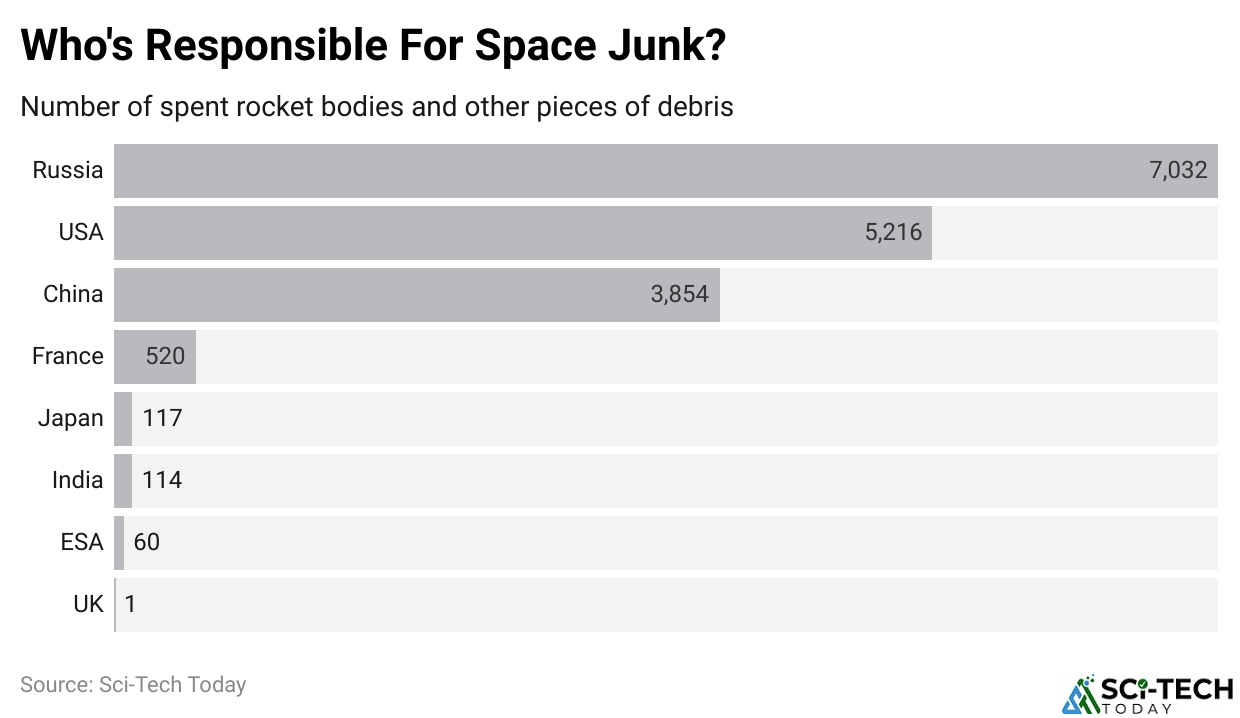
- Most of this debris comes from three countries: Russia, the United States, and China. Russia’s November 2021 anti-satellite (ASAT) test against Cosmos‑1408 created over 1,500 trackable debris pieces and continued to threaten the International Space Station through 2025.
- The Secure World Foundation claims that at least 16 such ASAT debris-generating tests have been carried out so far; among the most damaging, though not the only one, was China’s destruction in 2007 of one of its satellites, which created around 3,000 fragments of debris.
- The first ASAT test was initiated by the U.S. in the 1950s, and a minimum of three debris-generating tests have been conducted since; two were conducted in the 1980s, and one was in 2008.
- As observed by the OECD, debris removal is not an easy affair. The expenses incurred in the creation and deployment of the debris-removal mechanisms are very costly, such that there is a chance that this activity might cause more debris in case of failure.
- Also, a very critical issue is the potential of debris retrieval leading to the compromise of sensitive information on how the object was designed.
- These can be the reasons for countries being more prone to collaborate with other countries in the cleanup efforts in space.
- ClearSpace-1 from the European Space Agency and Japan’s Commercial Removal of Debris Demonstration (CRD2) mission are some of the numerous missions meant to eliminate growing clutter.
- One of the solutions currently being examined would be the use of either ground-based or space-based lasers to redirect debris carefully and create artificial atmospheres to alter their orbits.
- However, such techniques rely on getting far more advanced capabilities of space situational awareness and tracking than are currently available.
- Space debris statistics show that the need is clearly urgent, especially with companies like Boeing and SpaceX intending to shoot up to 65,000 satellites within a few years into near-Earth space.
- Without effective solutions, the risks of collision and debris accumulation are bound to keep increasing, endangering the future of space exploration and satellite operations.
Tackling Space Traffic and Debris Challenges in Low Earth Orbit
- The year 2024 has been entered in the record books as the year with the highest satellite launches, with over 4,500 satellites deployed in low Earth orbit.
- Most of these satellites joined large commercial communications constellations at altitudes between 500 and 600 km above Earth. Two-thirds of all active satellites now operate in this orbital band, creating increasing challenges for operators to avoid collision.
- Besides the high density of satellites, there is also huge space debris in LEO. Out of the 35000 tracked objects by space surveillance networks, nearly 26000 are discovered to be debris pieces larger than 10cm.
- Space debris statistics reveal that there are over 1 million debris fragments of sizes larger than 1cm containing micro-satellite structures, as estimated by the European Space Agency (ESA).
- ESA calculates that across the 500-600 km orbital range, satellites encounter almost 30 conjunction events—close approaches to satellites or debris—on average per year.
- In 2023, ESA launched the Zero Debris Charter. This charter aims at achieving debris-neutral operations by 2030 and has received signatures from over a dozen countries and about 100 organisations, both commercial and.
- The progress achieved by this initiative has been substantial. The annual rise in the deorbiting payloads since 2019 and the steady increase in those rocket bodies entering Earth’s atmosphere since 2017 demonstrate significant results, with over 630 objects now re-entering the atmosphere each year by 2025.
- More than half of these reentries were controlled last year. However, notwithstanding these advances, ESA insists on stricter measures to prevent LEO from becoming a non-usable debris field.
- The Space Agency has instituted debris mitigation requirements for mission partners and granted an €86 million (USD 93.4 million) contract to ClearSpace SA to conduct an active debris removal mission.
The Risks of Space Debris
- Low-Earth satellites can stay in orbit for a long time because they lose momentum very slowly. As the air molecules around them are sparse, they will eventually burn up in the atmosphere. This may take decades or sometimes centuries. For this reason, the orbit around the Earth is becoming very crowded.
- The number of large objects, measuring over 10 centimetres, nearly quadrupled between 2011 and 2025, with the count going from about 15,000 to more than 54,000.
- The same constant figure exists regarding the objects that re-enter Earth’s atmosphere every year; around 600–700 objects drop on average each year by 2025.
- Besides this number of larger objects, there are around 130 million fragments smaller than one centimetre that can travel at nearly five times the speed of a bullet but cannot be tracked.
- Most of these were from old satellites, while others were from tiny chips of paint from rocket launches.
- For instance, the estimates for space debris presented in Nature predict that at the 550 km orbit of crowdedness near the Earth, where the Starlink satellites are, there is a 50% likelihood that there will be a collision within the period of a year.
- Each collision creates more fragments within the orbit, adding to a series of increasing probabilities of further collisions; that is, an issue known to compound the “Kessler Syndrome.” This was found by a NASA study in 2005: stopping all satellite launches at that time would not have been enough for the Kessler syndrome to be avoided entirely.
- In the worst scenario, this could even attain an average density of space debris, making rocket launches almost impossible from Earth, because either safety was not guaranteed or the probability of collision with debris was too high to allow rockets to reach orbit.
Ending
One of the global issues which require immediate attention from all countries would be space debris. Space debris statistics have shown that it requires taking into account the cost-benefit ratio of above USD 2 billion per year, which is more than ever before in financial and operational considerations. Countries and corporations need to cooperate with international organisations in order to keep the space of our planet safe for future generations.
FAQ
Russia, the United States, and China are responsible for the vast majority of space junk that currently resides in orbit. Over the last decade, these three countries alone have contributed to more than 90% of falling space junk, as well as to the majority of debris still in orbit.
Yes, people have been narrowly missed or struck by falling space debris, though direct personal injuries are extremely rare.
Debris left in orbits below 600 km normally fall back to Earth within several years. At altitudes of 800 km, the time for orbital decay is often measured in centuries. Above 1,000 km, orbital debris will normally continue circling the Earth for a thousand years or more.