








Foreword
Contactless And Tap To Pay Usage Statistics: Contactless payments are changing the way people pay for everyday purchases. Instead of entering a PIN or handling cash, shoppers can simply tap a card, smartphone, or smartwatch to complete a transaction in seconds. This growing trend is making payments faster, easier, and more convenient for both consumers and businesses. As digital wallets and contactless cards become more common, tap-to-pay is quickly becoming a preferred payment option across stores, restaurants, transport systems, and other services. But how widely are people using contactless payments, and what is driving this shift? This article explores the latest statistics on contactless and tap-to-pay usage, adoption trends, consumer preferences, and the key factors shaping the future of digital payments.
Best Pick
- The global contactless-payment market is projected to reach USD 41.1 billion in 2026, up from USD 35 billion in 2025.
- Hardware is expected to contribute USD 20.5 billion, followed by solutions at USD 11.7 billion and services at USD 8.9 billion.
- Smartphones are forecast to lead the device segment with a 48% market share in 2026.
- Retail is expected to account for the largest share of end use, at 35%.
- Europe is projected to remain the largest regional market, reaching USD 21.14 billion in 2026.
- Asia Pacific is forecast to reach USD 13.7 billion and post the fastest growth, with a 20.3% CAGR.
- North America is expected to generate USD 9.32 billion, including USD 5.01 billion from the U.S.
- More than 65% of U.S. in-person card transactions are expected to be contactless in 2026.
- Over 85% of U.S. debit and credit cards now support tap-to-pay functionality.
- Apple Pay’s U.S. user base could reach 67 million in 2026, reinforcing digital wallets’ role in everyday payments.
Evolution of Contactless Payments
- Contactless payments began gaining real-world use in 1995, when South Korea introduced the UPass card using RFID.
- NFC was developed by Sony and Philips in 2002 and standardized under ISO/IEC 18092 in 2006.
- Google Wallet launched in 2011, followed by Apple Pay in 2014 and Samsung Pay and Android Pay in 2015.
- Wearable payments expanded through Apple Watch in 2015 and Fitbit Pay in 2018, according to a report shared by Global Payments Integrated.
Contactless Payment Trends
- Contactless payments have become a mainstream option in the U.S., with 65%+ of in-person card transactions using contactless technology in 2026, according to Sleft Payments.
- More than 85% of U.S. credit and debit cards now support contactless payments, while digital wallet usage has increased by 40% since 2023.
- Contactless transactions typically take 2-3 seconds, compared with 812 seconds for chip-based payments.
- NFC technology enables secure tap-to-pay transactions through cards, smartphones, and wearables such as smartwatches.
- Small businesses need NFC-enabled terminals, which generally cost USD 200-500, to accept contactless payments.
- Restaurants, retailers, transit systems, healthcare providers, and event venues are increasingly adopting contactless payment solutions.
- Emerging technologies, including biometric payments, tap-to-pay on phones, IoT payments, and potential CBDC applications, could further expand adoption.
- Businesses can improve adoption through staff training and clear “Tap to Pay” signage.
Global Contactless Payment Market Size
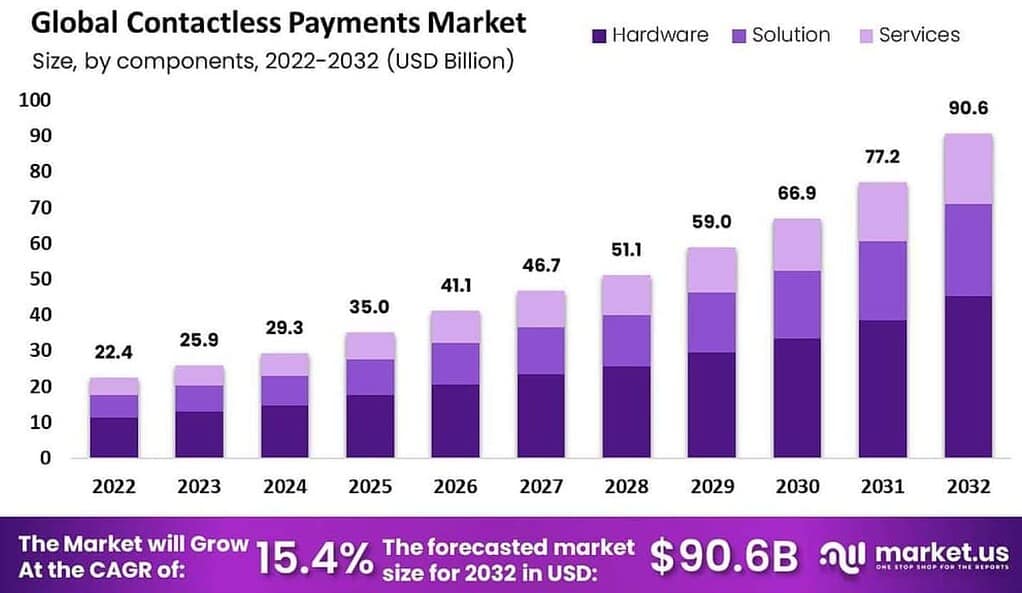
(Source: market.us)
- The global contactless payment market is projected to reach USD 41.1 billion by 2026, up from USD 35 billion in 2025, driven by the rise in digital transactions.
- Within this, hardware is expected to contribute USD 20.5 billion, solutions USD 11.7 billion, and services USD 8.9billion in 2026.
- Analysts note steady year-on-year growth of roughly 9% in 2026.
Market Segmentation
- Coherent Market Insights reported that Smartphones are expected to lead the device segment with a 48% market share in 2026, supported by growing adoption of NFC-based mobile wallets. GSMA projects more than 6.9 billion smartphone connections worldwide by 2026.
- The solution segment is forecast to hold a 62% share in 2026, driven by demand for integrated payment platforms and digital wallets.
- Global payments industry revenue exceeded USD 2.2 trillion in 2022 and reached USD 2.4 trillion in 2023.
- Retail is expected to capture the largest end-use share at 35% in 2026, supported by POS and mobile payment adoption.
- Europe remains a leading region due to widespread NFC card use, strong banking infrastructure, and contactless payments across retail and public transport.
Regional Contactless Payment Market Analysis: North America
- North America generated USD 8.39 billion in 2025, accounting for 18.40% of global revenue.
- The market is expected to reach USD 9.32 billion in 2026, according to Fortune Business Insights.
- Widespread NFC adoption, contactless cards, mobile wallets, and transit payments are driving regional growth.
- The U.S. leads the region and is expected to generate USD 5.01 billion in 2026.
Europe
- Europe generated USD 19.26 billion in 2025, representing 42.40% of global revenue.
- The market is projected to reach USD 21.14 billion in 2026, supported by smartphones, digital wallets, and cashless payment initiatives.
- The U.K., Germany, and France are major contributors, with revenues of USD 5.81 billion, USD 4.06 billion, and USD 0.68 billion, respectively.
Asia Pacific
- Asia Pacific generated USD 11.9 billion in 2025, capturing 26.20% of the global market.
- Revenue is projected to reach USD 13.7 billion in 2026.
- The region is expected to record the fastest growth, with a 20.3% CAGR, driven by digital wallets, instant payment systems, supportive regulations, and cross-border payments.
- India and China are expected to generate USD 2.2 billion and USD 4.23 billion, respectively, in 2026.
South America and the Middle East & Africa
- South America generated USD 3.44 billion in 2025, representing 7.60% of global revenue, and is expected to reach USD 3.92 billion in 2026.
- Middle East & Africa generated USD 2.44 billion, accounting for 5.40%, and is projected to reach USD 2.7 billion in 2026.
- GCC countries are expected to hold USD 0.41 billion in market share in 2025.
- Growth across these regions is supported by smartphone adoption, fintech innovation, and government initiatives.
Mobile and Digital Wallet Payment Trends
- Mobile and digital wallets have exhibited remarkable growth and are being recognized as the fundamental components of the global payments system.
- The USA, having established itself as the pacesetter in the mobile payment market, reported around 4.4 billion mobile transactions in 2022.
- The mobile payment volume in the United States is anticipated to nearly reach 8.3 billion transactions per year by 2027, approximately 89% in total increase over the five years.
- This booming activity has to do with the fact that more customers are becoming comfortable with mobile payments, and consequently, acceptance by more vendors and platforms.
- Meanwhile, the powerful digital payment market is growing, wide open, with its arms.
- There is a global digital payment revenue projected to increase from US$96.19 billion in 2022 to US$111.11 billion in 2023, equivalent to a compound annual growth rate of 15.5%, doing the math for the whole year.
- This strong pace of growth is expected to continue through 2027, when the market is forecast to reach nearly US$198 billion, therefore confirming the cash and traditional payments long-term decline.
- Digital wallets are on their way to establishing a leading position in the e-commerce industry.
- They were already responsible for 48.6% of the global e-commerce transaction value in 2021, which was a little over US$2.6 trillion.
- The number of digital wallets will further increase their share, and by 2025, it will be 52.5%, according to the estimates.
- In the United States, adoption is moving along at a slightly slower rate compared to other regions, but nevertheless, it is still a steady growth.
- Digital wallets’ share of U.S. e-commerce transaction value was 29.2% in 2021 and is estimated to increase to almost 33% by 2025, thus marking the acceptance of these payment methods among American consumers.
- One such trend is Apple’s continued success in 2023, when over 55.8 million people in the United States used Apple Pay, nearly 10% more than in 2022.
- It is anticipated that the number of users will climb to about 67 million by 2026, approximately 23% of the total U.S. population.
- This permanent increase indicates that mobile wallets, especially those of Apple Pay, will eventually take over as the main form of payment for consumers in the forthcoming years.
Post-COVID Growth In Contactless Payment Methods
- The evidence brought forth by the pandemic shows it was a huge driving force behind the instant and wide use of contactless payment systems everywhere.
- There was an awesome 410% rise in contactless payments from 2020 to 2025, which indicated that modern buyers have no turning back when it comes to the electronic way of getting things done.
- Health and safety plus convenience were the two main reasons behind such a dramatic change, with 72% of consumers admitting that they have switched to contactless purely for the hygiene and convenience factors, and if at all, that number would have been higher in 2025.
- Digital wallets thus became an essential part of physical retail, almost tripling their share from 29% of all in-store sales in 2023 to 38% in 2025.
- Healthcare and essential service providers, among others, quickly turned to contactless, and the usage increased by 82% in 2025.
- Such services ensured that customers and staff minimized their physical contact. To meet such demands, banks and other financial institutions meanwhile issued over 610 million contactless cards.
- Adoption was driven by daily cases in the US, with supermarkets alone reporting a 65% rise in contactless payment usage in the period of 2023-2025.
Global In-Store Payment Trends
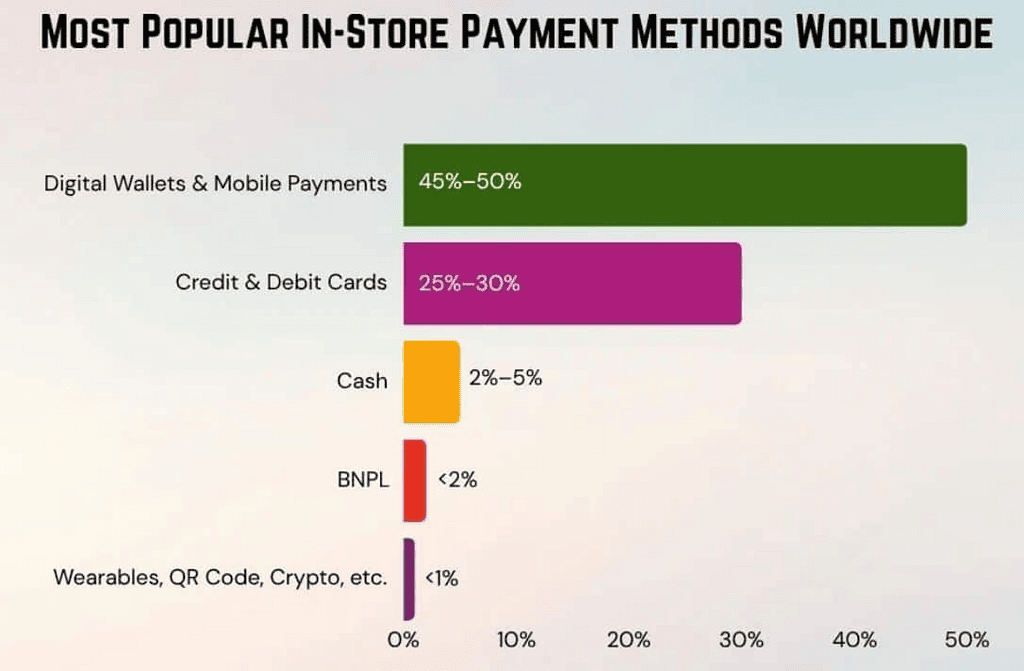
(Source: coinlaw.io)
- Digital wallets and mobile payments lead globally, accounting for 45%-50% of in-store transactions.
- Credit and debit cards, including contactless cards, represent 25%-30% of global in-store payments.
- Cash usage has fallen sharply, now accounting for only 2%-5% of in-store payments in developed markets.
- Buy Now, Pay Later (BNPL) accounts for less than 2% of in-store transactions, with stronger online adoption.
- Wearables, QR codes, crypto, and bank transfers collectively account for less than 1% of global in-store payments.
QR Codes and Tap To Pay
- Payments via QR codes are witnessing a steep global rise, which is primarily attributed to their low cost and easy installation.
- An estimation made by Juniper Research points out that the total value of QR code payments will grow from US$2.9 trillion in 2023 to almost US$4.8 trillion by 2028, which is a 59% growth.
- A significant portion of this growth is projected to develop in the markets where QR codes are cost-effective substitutes for the conventional card infrastructure.
- QR codes are budding as one of the primary elements in digital wallet utilization.
- The share is assumed to reach around 40% of the total world digital wallet transactions by the year 2025.
- Yet, this proportion is less than the 47% logged in 2020, indicating that the QR codes were vital in the very beginning phase of the pandemic, but their grip is loosening as other contactless methods, tap-to-pay cards, and NFC-enabled wallets, for instance, are being adopted and made available more easily.
- The use of QR codes is a consumer preference that is highly dependent on the context.
- The U.S. is one of the countries where QR code payment acceptance in restaurants is extremely low.
- According to the study conducted by TouchBistro, no one out of the 1,000 surveyed Americans said that they would like to use QR codes in sit-down dining for payment purposes, which reveals the unwillingness to accept QR code payments in those locations where personal interactions are considered to be the most important and simplicity is the main criterion.
- On the other hand, the trend of tap-to-pay payments is becoming very strong, especially in the retail sector.
- The use of tap-to-pay technology in face-to-face transactions outside the U.S. is at 74% worldwide. The U.S. is not keeping pace with the rest of the world in this technology, but the adoption is getting faster and faster.
- Currently, the tap-to-pay share of in-person transactions in the U.S. is 34%, which signifies a 700% increase compared to three years ago, and more than 10% since 2021. This movement represents a clear preference for the faster, hassle-free payment methods that consumers can use with barely any effort.
Global and Regional Contactless Payment Penetration
- According to datos-insights.com, Europe led adoption, with 71% of card transactions made contactlessly, compared with 36% in the Americas in 2024.
- Around 89% of global POS terminals were NFC-ready in 2024, with penetration projected to exceed 96% by 2028, as per a report published by Connectedworld.
- Contactless adoption reached 93.4% in the UK, 95% in Australia, and 97% in Singapore, highlighting near-saturated markets.
- In the U.S., nearly 90% of consumers use contactless payments, according to Marqeta.
U.S. Adoption and Innovation
- LinkedIn’s report further stated that more than 65% of U.S. in-person card transactions are contactless, while over 85% of cards support the technology.
- Digital wallet usage has grown by 40% since 2023, and transactions typically take 2-3 seconds, compared with 8-12 seconds for chip payments.
- Emerging technologies include palm-scan payments, longer-range NFC, biometric authentication, and AI-based fraud detection.
Consumer Perspective On Contactless Payments
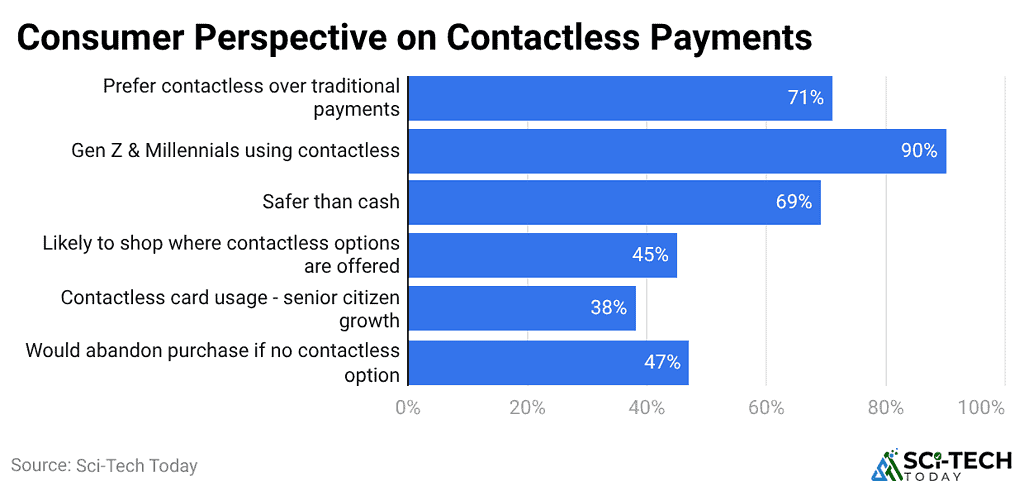
(Reference: coinlaw.io)
- The consumers’ opinions are very much in favour of the contactless payment methods, which are an indication of how much they have become a part of consumers’ daily lives.
- The term “contactless payment” was preferred to “cash” by 71% of the global population in 2025.
- The acceptance is the highest among young people, with 90% of U.S. Gen Z and Millennial users having employed a contactless payment method at least once in the past month.
- The issue of safety is also a key factor, as 69% of consumers consider contactless payments to be safer than cash, because people are less likely to come into contact with germs and there is a lower risk of theft.
- The retail aspect has a direct relationship with convenience when it comes to spending behavior.
- Contactless payment options are attractive to 45% of shoppers, and nearly half of the world’s consumers (47%) would reject a transaction if contactless payment were unavailable.
- Spending behavior related to this convenience factor is also different across income groups.
- In the case of the U.S., households with annual incomes of US$100,000 and over are 2.3 times more likely to use mobile wallets as their main payment method than those with lower incomes.
- However, the trend is different for the seniors who are increasingly adopting contactless payments.
- Educating the older population and simplifying the process of interaction with such technologies has led to a 38% rise in the use of contactless cards by seniors over the last two years.
The Evolution of POS Payments Technology
- Point-of-sale technology advancements have been the primary driver of contactless payments expansion.
- During the period between 2020 and 2025, 72% of U.S. retailers updated their POS systems to accommodate contactless transactions.
- On a global scale, smart POS terminals that can process mobile wallets and QR codes have accounted for 44% of total POS shipments.
- The acceptance of mobile wallets by small businesses has also seen a dramatic rise, with 57% of U.S. small merchants receiving mobile wallet payments in 2025, as opposed to only 42% in 2020.
- Retailers are also adopting more sophisticated features, with 19% having integrated biometric authentication into their POS systems, thereby improving security and speeding up the transaction process.
- There was a 38% rise in the number of contactless vending machines worldwide, thus allowing fully touch-free purchases.
- AI-powered POS systems are in the process of being rolled out to monitor customer spending patterns, and 2025 pilot programs indicate a possible sales increase of as much as 20%.
Top Contactless Payment Trends To Watch In 2026
- Tap-to-pay: Contactless payments are becoming mainstream, with tap payments accounting for over 70% of card transactions, according to digipay.guru.
- Embedded payments: The market is expected to exceed USD 360 billion in revenue by 2027, as payments become integrated into everyday apps.
- Digital wallets: More than 50% of global e-commerce payments use wallets such as Apple Pay, Google Pay, and PayPal.
- Biometric payments: Biometric technology is projected to authenticate over USD 2.5 trillion in transactions in 2025.
- Wearables: Wearable payments grew 24% YoY in 2025, driven by smartwatches, rings, and other connected devices.
- Voice payments: Voice-based payments are projected to process more than USD 20 billion annually by 2025.
- SoftPOS: Tap-to-phone adoption increased by 44% in 2024, expanding contactless acceptance among small merchants.
- A2A payments: UK account-to-account payments grew 56% in 2024.
- Instant payments: Real-time settlement adoption increased by 30% globally over the past year.
- AI and security: AI fraud detection can reduce false positives by 30%, while blockchain and tokenization strengthen payment security.
- Loyalty and sustainability: Gamified banking increased repeat transactions by 22%, while 68% of consumers preferred green payment options.
- AR/VR payments: Metaverse-related payments are projected to exceed USD 15 billion by 2026.
Final Thoughts
Contactless and tap-to-pay payments are changing how people pay every day. Their speed, ease, and convenience make them a popular choice for both shoppers and businesses. As more stores accept contactless payments and consumers use smartphones, cards, and digital wallets, adoption is likely to keep growing. Better security and wider access will further support this shift. Overall, tap-to-pay is becoming a simple, fast, and trusted part of modern payments.
FAQ
A PIN may be required for higher-value transactions or certain security checks.
Yes, many smartwatches support contactless payments through compatible digital wallets and payment cards.
Report the lost card immediately to your bank to block unauthorized contactless transactions and request a replacement.

Sources