









Introduction
User-generated content Statistics: In 2026, user-generated content UGC is kind of the main engine behind digital marketing, social commerce, and how people actually engage with brands. People are trusting genuine posts from other users more than traditional advertising, so brands keep putting money into creator communities, customer reviews, those short-form videos, testimonials, and social commerce in general. And with artificial intelligence moving faster than before, UGC discovery, moderation, and personalization are getting smoother, which lets companies roll out “real” campaigns across several channels without losing that human vibe.
From online reviews that nudge purchasing choices to creator-driven commerce that can generate billions in sales, UGC is now sitting among the top performers in digital marketing, bringing better engagement, lower acquisition costs, and usually higher conversion rates than content made only by brands. This article on User-generated content statistics will present the global market trends, UGC conversion, and social media platforms.
Editor’s Choice
- The global UGC marketing market is expected to jump from USD 6.7 billion in 2024 to USD 132.73 billion by 2034, growing at a sharp 34.8% CAGR.
- In 2024, North America accounted for 36.6% of the global UGC market, and the U.S. alone produced USD 2.08 billion in revenue.
- Also, 92% of consumers trust user-generated content more than traditional brand advertising, so authenticity is the strongest lever for confidence.
- Meanwhile, 79% of shoppers say UGC directly affects what they buy, and it tends to outperform branded material and even influencer-produced content.
- Products that feature customer reviews can reach up to 270% higher conversion rates, which is basically social proof showing up in numbers.
- And if product pages are enriched with UGC, conversions can rise by 161%, while adding just 10 reviews may lift conversions by around 45%.
- Websites incorporating customer reviews and images experience up to 308% longer visitor engagement, increasing purchase intent and browsing time.
- On YouTube, users upload over 500 hours of video every minute, highlighting the enormous scale of creator-driven content.
- TikTok UGC is 22% more effective than branded content, generating 46% higher engagement than traditional advertising campaigns.
- 86% of consumers believe AI-generated content should be clearly disclosed, reinforcing that transparency is now essential for maintaining brand trust.
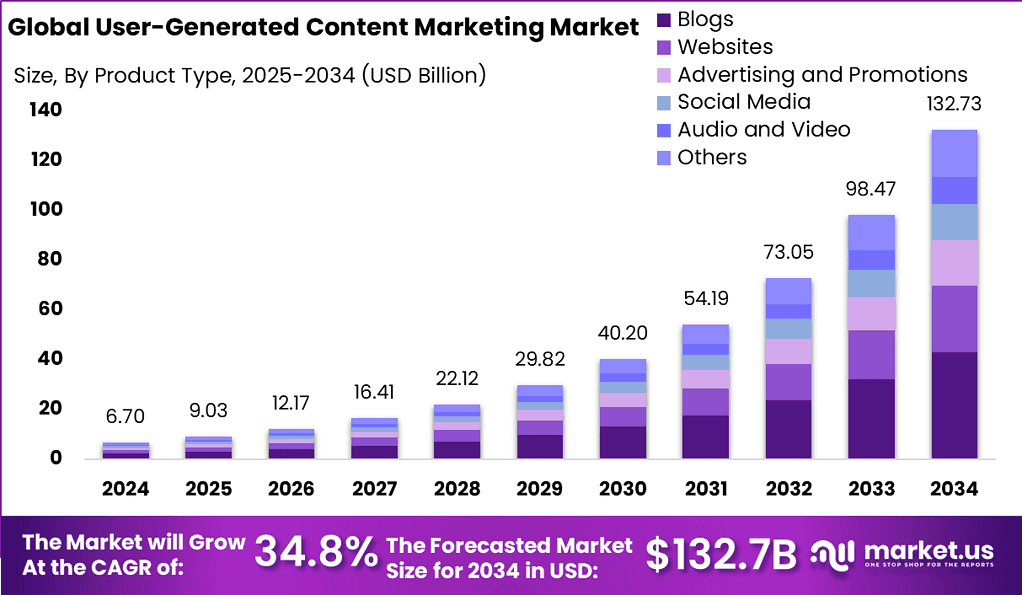
Global UGC Marketing Market Size and Growth
(Source: market.us)
- The User-Generated Content UGC marketing industry is kinda entering a phase of big expansion, pushed by a stronger appetite for real, community-led brand engagement.
- In fact, the global UGC marketing market is forecasted to climb from USD 6.7 billion in 2024 all the way to USD 132.73 billion by 2034, which comes out to a striking 34.8% CAGR.
- North America stayed the biggest regional chunk in 2024, taking up 36.6% of worldwide revenue, roughly USD 2.4 billion.
- Meanwhile, the United States generated USD 2.08 billion on its own, and it’s expected to grow at a solid 32.6% CAGR through the forecast years.
- Looking at market segmentation, blogs showed up as the number one UGC content type, grabbing 32.5% of the global market, mainly because they do a good job with customer engagement and brand storytelling.
- On the demand side, enterprises led adoption with a 63.1% market share, pointing to how larger firms are leaning on user-created material to build consumer trust, boost perceived authenticity, and support stronger long-term marketing results.
Why User-Generated Content Has Become a Must for Brands in 2026
- By 2026, User-Generated Content UGC has turned into more than a nice option; it’s basically a strategic necessity.
- Consumers are making purchase decisions on social platforms more and more, not so much on traditional websites. Because of this shift toward social commerce, brands are now prioritizing authentic customer-made content that affects buying decisions right where users tend to hang out online.
- At the same time, with AI-generated content spreading quickly, the appetite for real, unedited customer moments has gone up, too, so authenticity ends up being a key differentiator for brand trust.
- UGC also brings pretty big benefits for search visibility and content scalability, and it kind of keeps getting more relevant as modern SEO and AI-powered Answer Engine Optimization AEO mature.
- Lately, these systems seem to reward pages that show first-hand experiences and genuinely useful info, so user-created reviews, testimonials, and product demonstrations can raise organic discoverability in a real way.
- From a production side, brands can assemble large-scale content libraries by letting customers participate, not only by paying for costly professional campaigns. That makes UGC one of the most cost-efficient paths for stretching digital marketing reach in 2026.
Trust, Influence, and Authenticity
- Across different studies, UGC tends to beat brand-created content on trust almost every time.
- Nielsen data compiled by ShortStack shows that 92% of consumers trust UGC more than any kind of brand-created advertising.
- Stackla’s research further says 79% of people report that UGC “highly impacts” their buying decisions, while only 13% respond the same way for brand content, and 8% for influencer content.
- Stackla finds that only 9% of consumers see branded content as truly authentic, but 56% say they’d be more influenced by a photo or video from a real customer than from any other content format.
- Kristian Larsen’s 2026 synthesis adds that shoppers are 2.5 times more likely to trust UGC compared with brand-created content, and UGC performs about 8.7 times better than professional content when it comes to engagement.
- Buzzinly cites Emplifi data and says 80% of Gen Z rely on user-generated videos like unboxing videos, “get ready with me” clips, and peer demos to nail the final purchase decision. It really tweaks the discovery and evaluation journey in practice.
UGC conversion statistics
- User-Generated Content (UGC) has shifted from being only a trust-building tactic to more of a measurable revenue engine. The conversion statistics make it feel more concrete.
- According to the Northwestern University Spiegel Research Center, products with customer reviews deliver 270% higher conversion rates for lower-priced items, so authentic buyer feedback lowers the buying hesitation, quite noticeably.
- Bazaarvoice also says that UGC-enabled product pages produce 161% higher conversion rates compared with pages that don’t include reviews, ratings, or customer-generated photos.
- If you just add 10 product reviews, conversion rates can jump by around 45%, which suggests even a limited set of customer feedback can meaningfully improve buying confidence.
- Engagement metrics kinda underline the commercial value of UGC. As Marketing LTB puts it, webpages with customer reviews, images, and galleries show up to 308% more time on site.
- Longer browsing sessions usually mean there are more moments for conversion, and that often turns into extra revenue opportunities too.
- These statistics point out how UGC not only builds consumer confidence, but also helps website performance, which basically makes customer-generated content one of the most effective approaches for boosting conversions, engagement, and return on marketing investment.
User-Generated Content Statistics Across Social Media Platforms
User-generated content (UGC) keeps shaping consumer activity across the world’s biggest social media platforms, and the numbers vary a bit by platform, as audiences create, share, and react differently depending on where they are.
- According to Statista, 65% of Americans say social networking platforms such as Facebook are their most-used type of social media.
- Facebook also stacks up serious engagement, reporting around 4 million post likes every minute.
- Meta adds that video ads with audio in a 9:16 layout can drive 12% higher conversions per dollar, plus 15-second mobile-optimized video ads lower conversion costs by 12.3% compared with video ads that aren’t optimized.
- All of this makes it pretty clear that Facebook remains a high-performing venue for UGC-driven campaigns.
YouTube
- Statista says that more than 500 hours of video get uploaded to YouTube every minute, which comes out to something like 30,000 hours each hour.
- At the same time, upload volumes climbed by 40% from 2014 to 2020, so yeah, it keeps growing. Also, 58% of Americans name video-sharing apps like YouTube and Instagram among the social media channels they use most often.
- On Instagram, engagement is still incredibly strong, with 694,000 Reels being sent through direct messages every minute.
- When it comes to what people want, preferences lean toward entertaining and inventive content too: 50% look for funny posts, 46% prefer creative stuff, 41% want information or insights, and more than 30% are after highly interactive experiences.
- Meta adds that vertical Reel ads with audio can deliver over 35% better click-through rates, and 28% of e-commerce marketers point to Instagram as the platform that produces the most engaging UGC.
- Messaging platforms are getting a bigger role as well, not just for chatting, but for user-generated suggestions. GWI notes that WhatsApp is the messaging platform people prefer most among users aged 35 and up.
- Statista reports the service handled around 41.6 million messages per minute in 2023, which basically signals massive everyday usage.
- 84% of German respondents said WhatsApp was the most helpful platform for looking into products before buying, compared with 74% in the UK and only 24% in the United States.
- So there are clear regional differences in how consumers lean on messaging during the purchase process.
TikTok
- TikTok still ends up beating a bunch of the old-school social platforms when it comes to how people actually engage with content.
- Statista says individual TikTok profiles pull in about 32,108 views on average, which is way above the 23,782 average views that business accounts see.
- There’s also another Statista piece that basically notes that more than 90% of video views on both TikTok and YouTube come from influencers, not, like, brands or media companies.
- UGC on TikTok tends to perform 22% better than branded stuff, plus it shows 32% higher engagement versus Facebook ads, and 46% higher engagement than traditional advertising.
- The above numbers kind of confirm that genuine, creator-led content keeps outpacing the conventional campaign style you see from brands, especially on the fastest-growing social networks today.
User-generated content keeps hitting daily engagement record highs in 2026
- User-generated content is still steering a lot of digital media consumption, and the audiences seem to spend even more time now clicking around and staying with creator-led material.
- GlobalWebIndex, aka GWI, together with eMarketer data suggest that people globally spend roughly 2.5 hours a day on social media across all kinds of formats, while Gen Z is closer to 3 hours.
- Out of the platforms, TikTok takes the lead with 1.9 hours of daily usage, which is a 34% lift from last year.
- Reuters Institute says that AI-powered content recommendation feeds bumped up average session time by 22 minutes per user per day across the major social media platforms. And this continued lift in daily scrolling seems to show a pretty clear move toward personalized, user-made experiences instead of the older brand-led messaging, kind of plainly.
- When people spend more time engaging with creator content that feels real, brands also get more chances to expand visibility via customer participation and community-driven narratives.
- The above figures suggest that user-generated content is still among the strongest engagement drivers, so in 2026, it’s becoming a more valuable part of digital marketing plans.
The Rise of “Paid UGC” vs. Organic Content
- The economics for paid User-Generated Content (UGC) have shifted pretty hard toward brands, and now it’s one of the fastest-growing creative approaches in 2026.
- Backstage (2026) notes that the average cost for a paid UGC video went down from USD 209 in 2024 to about USD 197 in 2025, basically because the creator marketplace keeps getting larger and purchasing gets easier.
- When you compare this with macro-influencer efforts, which usually charge USD 5,000 or more per post, plus another 20-50% for usage rights, paid UGC looks like a much more affordable content pathway.
- Influence4You (2026) also estimates that UGC videos are 3-10 times cheaper than traditional studio productions, and that brands can generate a whole year’s social content for roughly EUR 80,000 (USD 92,900-93,000).
- Influence4You reports that UGC-style advertisements are around 30% more effective than professionally produced commercials while also delivering about 4 times higher click-through rates (CTR) and, at the same time, lowering cost-per-click (CPC) by 50%.
- According to UGC Factory, brands that run continuous creative testing with paid UGC saw a 24% lift in conversions, achieved 350% growth in Meta advertising spend, and kept customer acquisition costs (CPA) under USD 70 across Meta and TikTok campaigns.
- Yotpo (quoted by InBeat) found that shoppers who engage with UGC convert at 161% higher rates than shoppers who do not engage with customer-generated content.
- McKinsey & Company also reports that consumers are 76% more likely to even consider and then purchase from brands that deliver personalized experiences.
- Paid UGC brings affordability plus stronger engagement and better conversion outcomes, so it stays one of the most measurable and cost-efficient digital marketing investments heading into 2026.
Brand Safety and AI-Generated “Fake UGC”
- The fast adoption of generative AI has kinda shifted how consumers weigh online stuff, and transparency is now a critical thing for brand credibility.
- In the Meltwater & YouGov (2026) report, 51% of global consumers say they are uncertain or sceptical about a future that is shaped by generative AI, and 73% point to AI-generated misinformation as a big concern when they interact with brand content.
- Emplifi Consumer Trust Survey (2026) shows 31% of consumers completely distrust AI-generated content, but 63% still trust organic user reviews as one of the most reliable sources for product information.
- Pangram (2026) notes that 67% of online users have run into AI-generated content that was just false or kinda misleading, and 69% trust content that is created by humans more than AI-generated material.
- Trustpilot also says 89% of consumers depend on online reviews before they buy anything, and the Australian Competition and Consumer Commission (ACCC) found that 37% of online businesses were already messing with reviews.
- Verified purchase reviews have become more and more valuable for building consumer confidence, and also for safeguarding brand reputation.
- Meltwater & YouGov (2026) found that 86% of consumers think AI-generated content needs to be clearly disclosed.
- In the same research, 32% say they would trust a brand less if they later found undisclosed AI-generated content.
- Only 15% reported their trust would stay the same or maybe even get better.
- On the other hand, MediaScience & Adelaide University (2026) concluded that transparent AI disclosure does not really harm brand recognition, consumer sentiment, or even overall brand attitude.
- Clear AI labeling and open content practices are something close to a must-have if brands want to protect consumer trust and preserve long-term brand value in 2026.
Conclusion
User-generated content is now one of the strongest forces shaping digital marketing in 2026, honestly. People seem to lean way more toward authentic reviews, customer videos, testimonials, and those peer recommendations over the usual advertising. So UGC becomes this real engine for trust, engagement, and yes, conversions too. And it’s not slowing down either; the fast growth of social commerce, creator economies, plus AI-powered personalization keeps pushing UGC adoption across different industries.
But at the same time, there are bigger worries about AI-generated misinformation, which makes verified customer content feel more valuable, and brands need to communicate in a transparent way. With companies putting more money into community-led marketing, UGC is expected to stay a key plan for long-term growth, customer loyalty, and durable competitive advantage.
FAQ
UGC is content like reviews, photos, videos or testimonials that come from customers, not from brands.
It strengthens trust, boosts interaction, raises conversion rates, and acts as genuine social proof that nudges buying decisions.
Ratings, reviews, and real-user material cut down uncertainty for shoppers, so product pages can reach much higher conversion rates over time.
Channels like TikTok, Instagram, YouTube and Facebook are often among the most effective for getting UGC traction and supporting social commerce.
AI can help brands find, moderate, and tailor UGC, but disclosure has to be clear, or else consumers may not buy it. People still tend to trust authentic human-created content more than AI-generated material, so clarity matters.

Sources