









Introduction
Hyper-Personalization ROI Statistics: Hyper-personalization has sort of turned into one of the biggest, highest-return investments for customer experience, digital marketing, and AI-driven commerce in 2026. And unlike the older style of personalization, hyper-personalization basically stitches together real-time behavioural signals, artificial intelligence, machine learning, customer journey analytics, first-party data, and predictive modelling, so the result is a super tailored experience across websites, apps, email, retail locations, and customer support channels. Since many organizations are still moving toward privacy-first marketing, hyper-personalization keeps showing up as a major competitive edge, improving customer engagement, pushing conversion rates up, lifting customer lifetime value, and also trimming acquisition costs.
This article explores the latest hyper-personalization market statistics, ROI benchmarks, email performance, industry trends, revenue impact across business models, and the measurable financial benefits that make hyper-personalization one of the most valuable digital transformation investments in 2026.
Editor’s Choice
- The global hyper-personalization market is projected to reach USD 30.38 billion in 2026, expanding at a solid 18.1% CAGR.
- Businesses that implement advanced personalization often see 5–15% revenue growth, while also improving marketing efficiency by 10–30%.
- About 80% of businesses say customer spending is higher, and personalized experiences raise purchases by an average of 38%.
- Personalization can generate 5–8× ROI on marketing spend, and around 70% of retailers report at least 400% ROI from these personalization efforts.
- AI-powered personalization solutions usually claw back their investment in about 9 months, and then drive something like 10–40% revenue growth.
- Hyper-personalized emails can end up with as much as 9× higher transaction rates, while behavior-triggered messages show an 11.4× uplift.
- For AI-engaged B2C e-commerce visitors, you can see a 12.3% conversion rate, which is nearly 4× better than the 3.1% baseline.
- Meanwhile, personalized recommendation engines feed roughly 35% of all e-commerce revenue.
- With personalized email marketing, the ROI lands around USD 36–USD 42 for every USD 1 spent, then climbs to USD 45–USD 68 per USD 1 specifically in retail and e-commerce.
- Digitally native companies tend to pull in 25% of total revenue from personalization.
Hyper-Personalization Market Growth Statistics 2026
(Source: thebusinessresearchcompany.com)
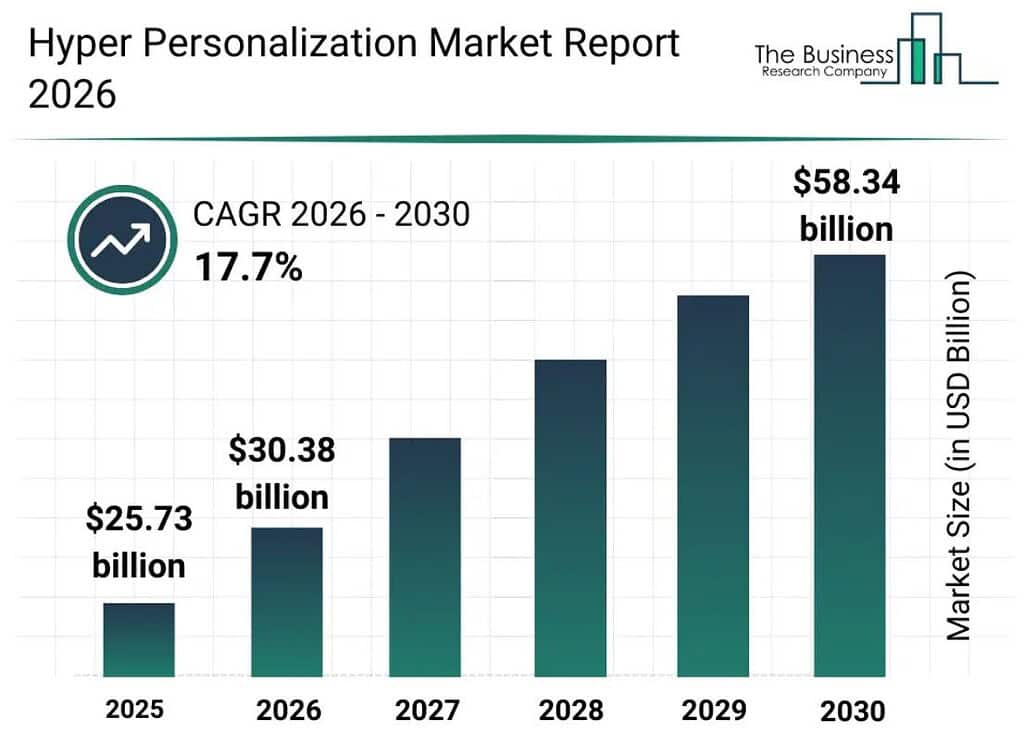
- According to The Business Research Company (2026), Hyper-personalization is getting pretty close to a main competitive lever for businesses, mainly because they keep pouring money into AI-based customer experiences and data-led marketing.
- In fact, the global hyper-personalization market apparently hit USD 30.38 billion in 2026, up from USD 25.73 billion in 2025, which is an 18.1% CAGR. That figure really points to quick enterprise take-up across many sectors.
- The constant adoption of digital marketing platforms, the ongoing growth of e -commerce, plus higher internet penetration, better social media engagement, and the rising use of CRM tools together with marketing automation technologies.
- On top of that, the online retail ecosystem keeps widening, and it’s this that is accelerating the craving for tailored customer journeys.
- As per the United States Census Bureau, August 2024, U.S. e-commerce sales rose by 6.7% (±1.2%) year over year in Q2 2024 while total retail sales grew by 2.1% (±0.4%) over the same stretch.
- Online commerce is growing faster than overall retail, and that’s why many companies are now prioritizing hyper-personalization to nudge customer engagement up, increase conversions, and build stronger loyalty.
Hyper-Personalization ROI Statistics
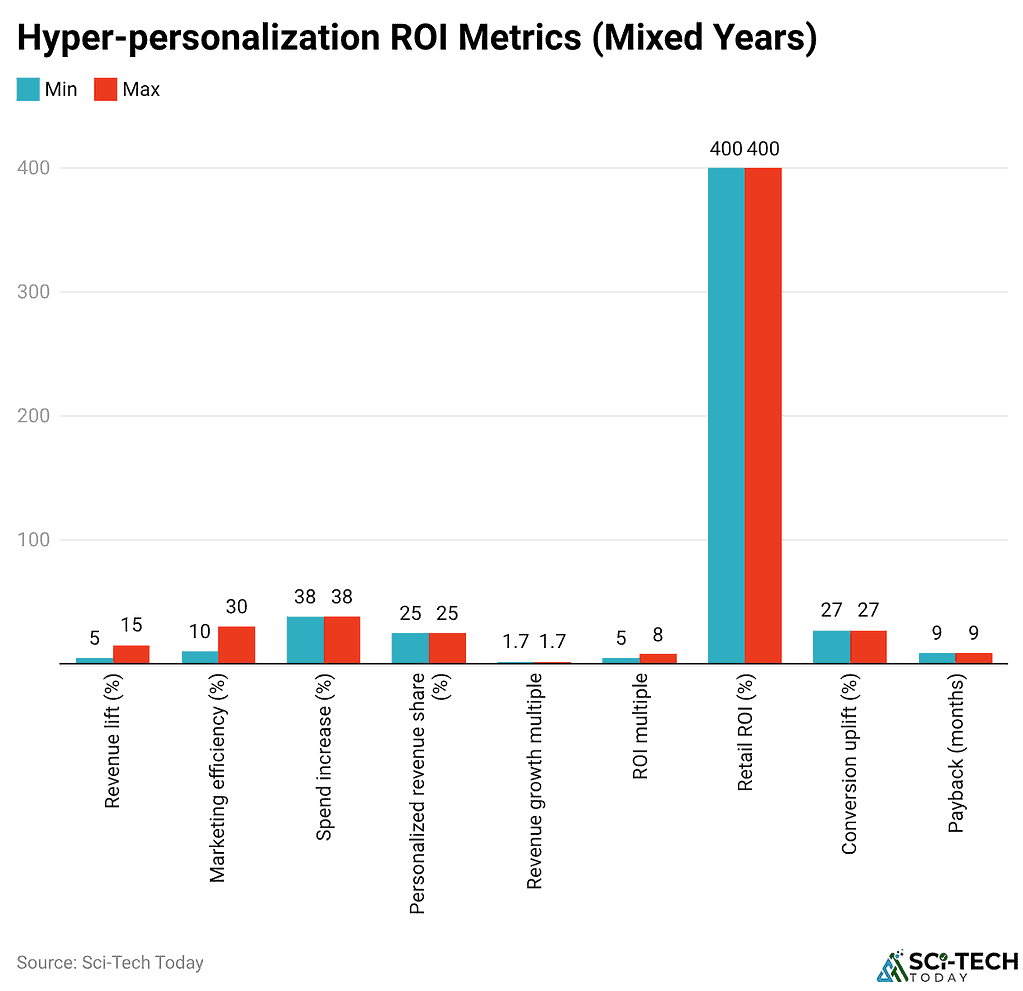
- Personalisation has shifted from being just a marketing boost into a sort of real, proven growth approach that actually lifts revenue, improves customer value, and makes operations more efficient too.
- As McKinsey explains, brands using advanced personalisation tend to see 5% to 15% revenue growth, and at the same time push marketing efficiency up by 10% to 30%.
- About 80% of businesses say customer spending has risen, and they often report around 38% higher purchases when experiences are personalised.
- On top of that, personalised marketing can contribute as much as 25% of a brand’s total revenue.
- Companies that deliver these tailored journeys also tend to reach 1.7 times higher year-over-year incremental revenue, plus they move beyond the usual metrics with customer lifetime value that can be more than doubled.
- McKinsey, again cited by McKinsey, notes that personalisation may drive something like 5 to 8 times ROI on marketing spend, while also pushing sales upward by 10% or more.
- Boston Consulting Group (BCG) adds that 70% of retailers investing in personalisation report results of at least 400% ROI.
- AI-enabled personalisation tools, meanwhile, typically recover the investment within 9 months, and that often goes along with 10% to 40% revenue improvements.
- For instance, 48% of personalisation leaders are more likely to exceed revenue targets than firms with average capabilities.
- Also, 54% of executives who are strongly committed to personalisation manage to surpass annual revenue goals, compared with only 15% in less committed organisations.
- Advanced data-driven personalization further strengthens marketing outcomes, sort of in a very direct way.
- Dynamic message personalization has produced around 27% higher conversion rates, while advanced customer data strategies deliver 20% higher customer lifetime value and 15% lower customer acquisition costs.
- Overall, the evidence suggests that organizations investing in AI-powered personalization keep pulling ahead of competitors, not just with more conversions but also with sturdier customer loyalty, quicker ROI, and sustainable long-term business growth.
Hyper-Personalized Emails Statistics
- Email personalization is really turning into one of the top digital marketing plays, and AI helps it work harder.
- According to the Campaign Monitor Global Email Benchmark Report (2026), which reviewed 30 billion email sends from 200,000 brand accounts across 48 countries during 2025, AI-powered hyper-personalized emails reached transaction rates up to 9 times higher than traditional batch and blast campaigns.
- The best outcomes came from triggered behavioral emails sent within 60 minutes after a customer action, and those achieved a strong 11.4× higher transaction rate than non-personalized email campaigns.
- More widely, personalized emails generate 6 times higher transaction rates than generic messages, showing the practical value of tailoring the message to individual customer preferences and also their behaviors.
- These findings indicate that marketers are moving beyond simple audience segmentation toward real-time, AI-driven personalization that responds instantly to customer interactions.
- As businesses continue investing in intelligent automation, hyper-personalized email campaigns are expected to become a key driver of customer engagement, higher conversions, and long-term revenue growth.
ROI By Segment and Channel
| Segment/channel | 2026 hyper-personalization impact |
| B2C ecommerce – AI-engaged visitors | 12.3% CVR vs 3.1% baseline (≈4× lift) |
| Ecommerce – revenue share from personalization | 35% of revenue from recommendation engines |
| B2C leaders – revenue vs static | Up to 40% more revenue, +26% CVR |
| B2B personalization ROI | 500–800% average ROI, up to 2,000% |
| B2B revenue growth | 1.4× revenue growth from personalization |
| Email – global average ROI | USD 36–USD 42 per USD 1 spent |
| Email – retail/ecommerce ROI | USD 45–USD 68 per USD 1 spent, 4,500% ROI |
| Personalized vs generic email ROI | USD 52 vs USD 19 per USD 1 spent |
| Personalized email transactions | 6× higher transaction rate |
| Segmented vs unsegmented email revenue | 760% more revenue |
Revenue Impact Of Personalization Across Business Models
(Source: mckinsey.com)
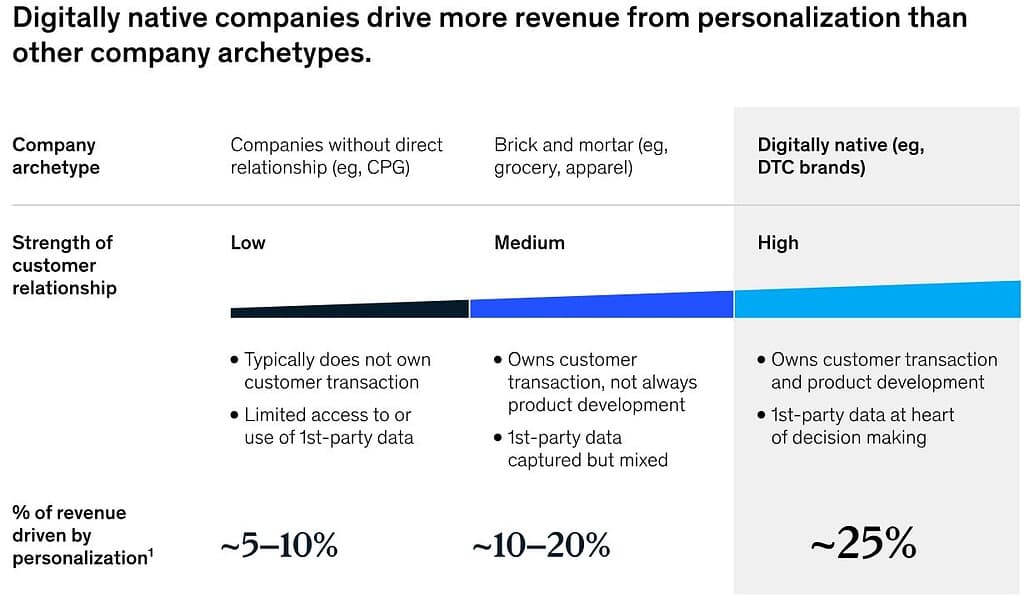
- The chart sort of points out a strong link between customer relationships, first-party data, and the money impact tied to personalization.
- If a company has only a little direct relationship with customers, like a lot of consumer packaged goods (CPG) brands, then personalization typically produces something like 5%–10% of revenue.
- For businesses with a medium-strength customer relationship, say brick-and-mortar retailers such as grocery or apparel brands, things improve. In that case, personalization can land around 10%–20% of revenue. They own customer transactions, and they collect first-party data, though it’s often broken up and scattered across different channels, so it does not always work together cleanly.
- At the top, the best results show up for digitally native companies, including direct-to- consumer (DTC) brands.
- For them, personalization makes up roughly 25% of total revenue. Their edge is that they control both customer transactions and product development while putting first-party data right at the center of business decisions.
- Overall, the data kind of demonstrates that when organizations have deeper customer insights, plus a unified data approach, they reliably unlock more revenue through personalization. So, first-party data management becomes a real competitive advantage in the digital economy.
Traditional vs. Hyper-Personalization: The ROI Gap
| Metric | Traditional Personalization | Hyper-Personalization (AI-Driven, Real-Time, Predictive) |
| Personalization Approach | Traditional segmentation (name use, broad lists) | Hyper-personalization (AI-driven, real-time, predictive) |
| Typical Conversion Uplift | 2–3% increase in conversions compared to generic campaigns | 10–15% increase in conversions across customer journeys |
| Typical Revenue Lift | Low single-digit revenue gains | 5–15% revenue lift, with 25%+ for high-performing organizations |
| Marketing Efficiency / ROI Impact | Limited, often marginal improvement in marketing ROI | 10–30% improvement in marketing efficiency and 5–8× ROI on marketing spend |
Hyper-Personalization Industry Trends 2026
- AI-powered recommendation engines are, like, slowly replacing those rule-based personalization systems, you know.
- And now first-party and zero-party data strategies are turning into the base layer for personalization that still respects privacy requirements, without making things messy.
- Generative AI is also making it possible to create personalised content on the fly, across websites, email, advertising, and even customer support.
- Meanwhile, Customer Data Platforms (CDPs) stay kinda the central infrastructure for real-time customer profiles, and they keep getting more important.
- Predictive analytics and next-best-action engines are increasingly showing up in banking, healthcare, retail, manufacturing, travel, and B2B sales too.
Conclusion
Hyper-personalization has turned into one of the most valuable investments in digital business; it blends AI, predictive analytics, and first-party data into experiences that feel very relevant to the customer. Research pretty consistently indicates that organizations adopting advanced personalization see stronger revenue growth, better marketing efficiency, higher customer lifetime value, and faster returns on investment.
AI-powered recommendation engines, real-time behavioral targeting, and hyper-personalized email campaigns are changing how customer engagement works across industries. And as privacy-first marketing keeps speeding up the move toward first-party data, companies that invest in hyper-personalization will be better set to increase loyalty, maximize marketing ROI, and hold onto long-term competitive advantage in an increasingly digital economy.
FAQ
Hyper-personalization uses AI, real-time customer information, and predictive analytics to deliver highly individualized customer experiences, in a way that feels almost specific.
The global hyper-personalization market is projected to reach USD 30.38 billion in 2026, growing at an 18.1% CAGR.
Studies show hyper-personalization can generate 5–8× marketing ROI, and many retailers report 400% or higher returns.
Hyper-personalized emails can deliver up to 9× higher transaction rates, while behavior- triggered emails achieve 11.4× higher transactions than generic campaigns.
First-party data makes accurate, privacy-compliant personalization possible, which helps businesses boost conversions, strengthen customer loyalty, and support long-term revenue growth.

Sources