








Introduction
Demand Creation Statistics: In 2026, demand creation sits near the top of many growth plans as many buyers now look up brands, read details, and compare options before engaging with sales teams. Demand capture targets people who already show active intent, while demand creation aims at awareness and preference first, for buyers who are not searching yet. At the same time, because of budget constraints, marketers still face higher pressure to show results.
According to a Gartner report find that marketing budgets are at an average of 7.8% of company revenue in 2026, and 15.3% of marketing budgets are for AI spending. HubSpot reports that 93.2% of marketers see personalized or segmented experiences as a driver for more leads or purchases, indicating modern demand creation tends to blend brand work, content, tailored messaging, AI tools, paid media, and clear outcome tracking.
This article will present the recent demand creation within the framework of demand generation in the market in 2026.
Top Highlights
- 95% of B2B buyers are out of the market at any given moment, and only 5% are in-market.
- A 48-month replacement cycle with a 3-month decision window means about 93.75% of buyers are outside the buying window.
- B2B buyers spend just 17% of their journey engaging with supplier sales teams.
- 86% of enterprise buyers list vendors they already know before they start evaluation.
- Hockeystack points to an average of 222+ touchpoints for B2B deals.
- 52% more organic traffic is brought by Educational B2B blogs, which supports early-stage demand creation.
- 80% of B2B leads from social media come via LinkedIn.
- 70% of B2B marketers report video performs better than other formats for engagement.
- LinkedIn CPMs are often $30–$80+, while Programmatic display CPMs run around $5–$15.
- 70% better returns in a 12- to 24-month window than firms that focus on capture alone, as for the Firms that do both demand creation and demand capture see about
- Many teams begin by putting 8 to 12% of ARR toward total demand work.
- Newer companies often split spend by 50% for demand creation, 35% for capture, and 15% for conversion.
- WARC expects global ad spending to reach $1.30 trillion in 2026, which is 9.1% more than the year before.
- HockeyStack benchmarks moved from 222 touchpoints in 2023 to 266 in 2024 for the B2B SaaS side.
What is demand creation?
- Demand creation is how a firm builds awareness, interest, education, and preference for a product or a category before a buyer shows strong intent to buy. Which include:
- Demand creation brings in fresh interest.
- Demand capture turns that interest into action.
- Demand generation is a broader label that may include both.
- For instance, someone who watches an educational video on cyber risk may not be shopping for cyber software at that moment.
- If a company shares research, runs thought leadership, or posts training content, it can lay out the issue and introduce its solution before the person starts comparing vendors.
Demand Creation vs. Demand Capture vs. Demand Generation
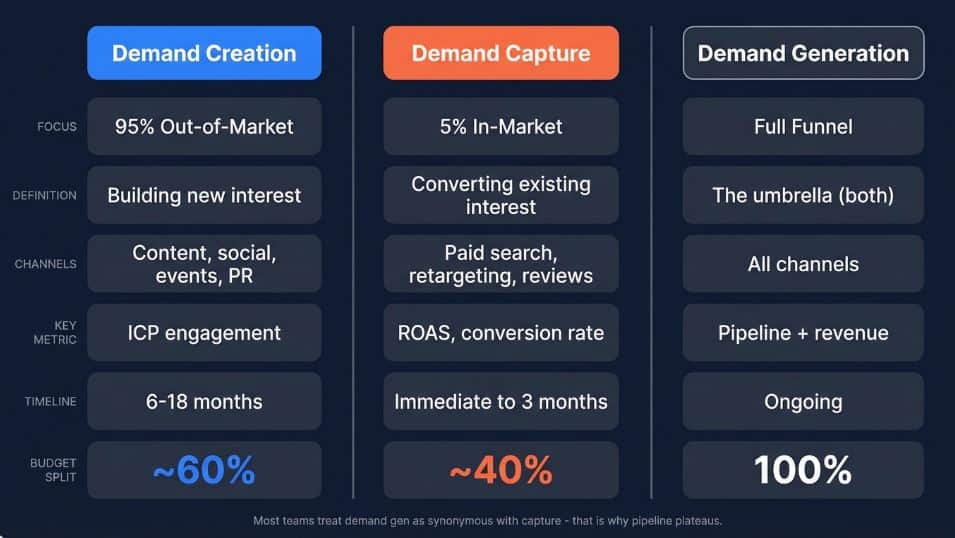
(Source: prospeo.io)
- The three concepts, demand creation, capture, and generation, describe different roles within the same B2B growth system.
- Demand creation aims at people who are the future buyers for the organisation, with about 95% still out of the buying window, while Demand capture targets the small group, near 5% of the market, indicating the marketer leans only on capture, who are already ready to buy can limit the next wave of pipeline can dry up.
Demand Creation
- Demand creation is about getting noticed and building early interest, as marketers use content, social posts, events, and public relations.
- The work often takes 6 to 18 months to show clear results, with ICP engagement sharing guidance and suggesting spending about 60% of the budget here is a common signal to watch.
Demand Capture
- Demand capture takes attention and turns it into action, which includes paid search, retargeting, and review sites.
- Results can show up fast, sometimes right away, and often within about three months, with teams tracking ROAS and conversion rate as key indicators.
- The framework puts roughly 40% of the budget into capture.
Demand Generation
- Demand generation covers the full funnel from start to finish and blends both the creation steps and the capture steps.
- The main outcomes to report are pipeline and revenue, rather than focusing only on short-term conversions.
- The overall takeaway is to keep time and spend split between building demand later and using that demand today.
Demand Creation: Reaching Buyers Early Matters
(Source: prospeo.io)
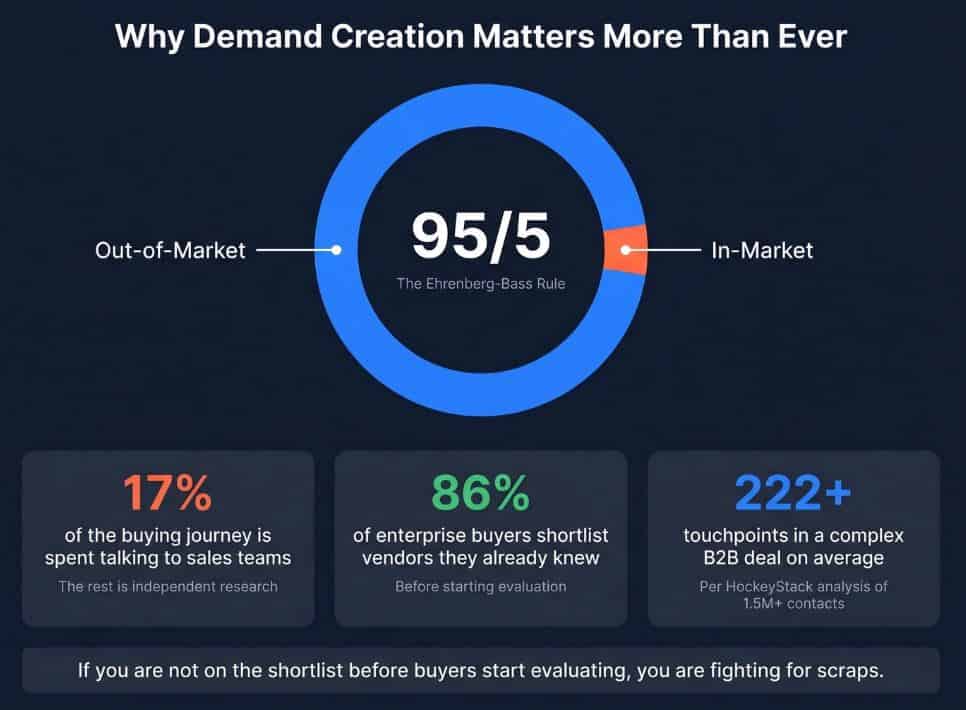
- The data above in the picture is a clear issue for B2B firms; depending only on demand capture alone is not enough.
- The Ehrenberg-Bass Institute and the LinkedIn B2B Institute, using the 95/5 Rule, report that as many as 95% of B2B buyers are out-of-market at any given time, and most buyers are not actively shopping.
- If a company takes a typical 48-month replacement cycle and a 3-month decision period, the math gets tight.
- Only 6.25% of the market would be in-market at a given time, which leaves 93.75% outside the buying window.
- Gartner’s B2B Buying Journey Study finds that B2B buyers do not lean heavily on sales early, as buyers spend about 17% of their journey talking with supplier sales teams, meaning most research happens independently.
- Gartner study finds that 86% of enterprise buyers pick a short list from vendors they already know before formal evaluation.
- So the early stage matters, as it creates content awareness, useful content, and steady brand visibility, which play a big role in getting into the buyer’s consideration set.
- According to HockeyStack, the average buyer path includes 222 or more touchpoints in complex B2B deals, based on analysis of more than 1.5 million contacts.
- The report shows that demand creation cannot be treated like a single push, but it is more like repeated exposure across many moments.
- Prospeo’s Demand Creation: The 2026 B2B Playbook highlights that the company lifted lead generation by 150% from one year to the next, and it reported 1,500% SEO ROI after moving to a creation-first plan.
- Another firm cited 300% ROI tied to thought leadership events, showing that spending effort before buyers enter the market can help future pipeline.
Demand Creation Statistics and Strategies for B2B buyers
- Demand creation is about awareness and teaching. It targets the 95% of the B2B market that is not shopping for a solution right now.
- Demand creation aims to help people notice a real issue and to position the company as a dependable information source before they begin formal evaluation.
- Demand creation runs over time, but it is not just a short push meant to catch people who already show buying intent.
- In B2B, education-based blog posts can bring in 52% more organic traffic, suggesting leaving a lot of this material ungated.
- At the awareness stage, form walls can block access for people who are still trying to understand the problem, and the useful educational material can be seen more widely before prospects are ready for sales.
- Social channels such as LinkedIn and Oktopost B2B data, plus video engagement figures from Content Marketing Institute or Vidyard benchmarks, demonstrate that 80% of social lead flow in B2B comes from LinkedIn.
- Executive and individual thought leadership claiming steady expert content helps buyers feel more familiar with the brand earlier.
- For Video format, 70% of B2B marketers report that video works better than other content types for engagement, pointing to short videos under three minutes.
- It also notes podcast appearances as a way to reach buyers while they research or go about daily routines.
- Paid awareness shows that Programmatic display CPMs are around $5 to $15, pointing to a way to reach potential buyers, and LinkedIn CPMs are often $30 to $80 or more.
- So programmatic can help keep broad visibility at a lower cost for B2B groups. LinkedIn can still help with tighter professional targeting.
- Demand creation model that aims to reach buyers before they are actively shopping, as it relies on education, thought leadership, video, and paid awareness instead of fast lead capture marketing.
B2B Demand Generation Budget Split
- A demand generation budget has to cover both long-term market building and near-term pipeline work.
- In practice, budget allocation should change as a company grows rather than follow one fixed formula.
- In the early stage, a suggested plan is 50% demand creation, 35% demand capture, and 15% demand conversion towards content, thought leadership, and organic reach, and also fits when buyers are not ready to spend big on paid ads.
- At the $5M to $30M ARR growth stage, the mix changes to 40% creation, 40% capture, and 20% conversion, aiming to hold onto new interest while continuing to build awareness.
- Once a business reaches the $30M+ ARR scale, the recommended split becomes 35% demand creation, 40% demand capture, and 25% demand conversion.
- The higher conversion share reflects how much more value sales enablement can add to a pipeline that is already in place.
- On the channel level, content creation and posting take about 25 to 30%, SEO and other organic work sit near 10 to 15%, and paid search and social are usually in the 20 to 25 % range.
- Events and sponsorship roughly sit at 10 to 20%, and marketing tech and tools make up about 10 to 15%, while Partnerships and co-marketing are often lower, around 5 to 10%.
- The above statistics point towards benchmarks rather than universal rules.
- Companies should shift their spend based on their industry, who they sell to, the length of the buying process, and existing strengths.
- If organic traffic is already strong, there is less need to push as much budget into paid investment; while the enterprise business sells to larger buyers, which makes sense to put more money into events.
- The most effective budget is therefore tied together awareness, capturing demand, and turning it into deals rather than treating each step like a separate world.
Demand Creation Budget Allocation
(Source: prospeo.io)
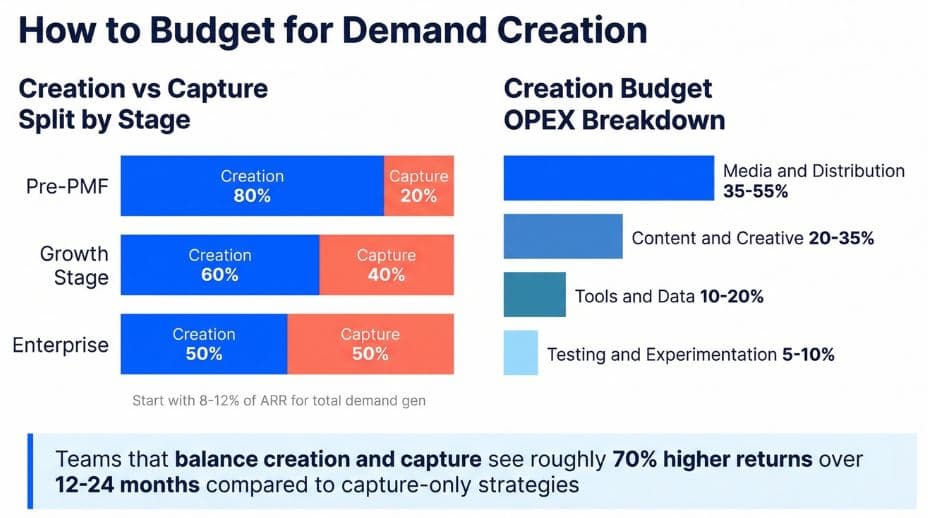
- The budgeting framework for demand creation should be viewed as an investment in the future pipeline, rather than an expense of brand awareness.
- The suggested approach is to allocate 8-12% of the ARR to demand generation, with 60% of that amount allocated to demand creation and 40% to demand capture. Binet & Field’s empirical studies split the 60/40% regarding investment in both media and brand.
- According to Bain & Company’s “Day One List” research, the balance between the two should be adjusted depending on the maturity of the business, with pre-product-market-fit companies considering an 80%/20% split and enterprise-level businesses using a 50%/50% ratio.
- Internal allocation of the creation budget also guides different areas of the spend. In this category, media and distribution comprise the largest share (35-55%), content and creative (20-35%), tools and data (10-20%), and testing and experimentation (5-10%).
- The allocation of the creation budget points to the allocation to data, technology, and experimentation-driven activities, which shows the importance of media and content, as well as the relatively small portion of the budget.
- The framework is to build the demand generation budget from the revenue goals backwards.
- The business can begin with their revenue target, estimate the required pipeline using win rates, calculate marketing’s expected contribution, and then work backwards through conversion rates to determine spending.
- The statistical information highlights the value of their approach by stating that companies using the balanced approach to demand creation and capture achieve 70% higher returns in 12-24 months than those focusing on demand capture only.
- The value of their methodology is further emphasized by the statement that the additional investment in brand should be justified by long-term economic benefits rather than short-term revenues.
Global Advertising Investment Creates a Massive Demand-Creation Opportunity
- Ad spending is still very large in 2026. WARC estimates that worldwide ad spend will land near $1.30 trillion. That is about a 9.1% rise from the prior year.
- WARC also notes that close to 80% of ad money now goes to retail media, paid search, and social platforms.
- Brands can get in front of people earlier in the customer journey before they enter the final purchase stage.
- Paid social, video, creator content, search, retail media, podcasts, and other digital experiences can all help shape interest that shows up later.
- Looking ahead, WARC expects the global ad market to reach about $1.40 trillion in 2027, with 7.9% growth.
- The above numbers suggest that the competition for attention should keep getting tougher because spending more on ads alone will not automatically pull in new demand, while firms likely need clearer differences, better audience insights, and work that performs in creative terms.
Three-Stage Demand Creation Funnel
- The strategy of demand creation funnels suggests that demand creation works better when marketing keeps pace with how much the buyer already knows, rather than pushing a product before the timing is right.
- The strategy is split into three windows based on time before the purchase: 6–8 months out, 3–6 months out, and 1–3 months out.
- In the first 6–8 months, many people will not see a clear issue yet, but may not feel it is urgent. So the work here is to spark interest using research, industry signals, simple frameworks, and strong viewpoints.
- From 3–6 months out, buyers usually have a firmer sense of the problem and start looking at the types of solutions that could fit.
- Such content includes case studies, side-by-side comparisons, and ROI worksheets that can guide how they sort their options.
- Then, in the final 1–3 months, prospects move into active vendor review. Demand creation at this point links more closely to demand capture tactics like product demos, direct comparisons, and hands-on sales follow-ups that matter most.
- HockeyStack reported that a B2B SaaS deal took 222 touchpoints in its 2023 review.
- In 2024, the latter benchmark rose to 266 touchpoints, showing how long and can be involved modern B2B paths.
- The model is all about shifting how the buyer thinks sooner, earning trust over time, and making it easier to reach vendor consideration rather than about producing more content for its own sake.
Conclusion
In 2026, demand building is shifting toward reaching people before they start shopping in a clear buying stage. The core issue is that most B2B buyers are mainly out of market, making early awareness, education, thought leadership, and brand familiarity important for future pipeline. Many buyers also do their research independently, making useful content and a steady online presence more valuable than it used to be.
LinkedIn, video, SEO, paid placements, and in-person events can help, but only when aligned with buyers’ needs and business outcomes. Demand creation pushes for longer tracking, using pipeline, revenue, and broader market engagement, rather than short-term lead volume alone, while budgets should evolve with business maturity.
FAQ
About 95% of B2B buyers are out of market at any given time.
It helps create awareness and preference before buyers evaluate options in a more direct way.
B2B buyers spend about 17% of the buying journey working with supplier sales teams.
LinkedIn accounts for 80% of B2B social media leads, based on the cited data.
The framework recommends roughly 8 to 12% of ARR for total demand generation, with adjustments for business maturity.