








Overview
Predictive AI Statistics: Predictive AI gives businesses a better idea of what could happen next. Instead of looking only at past results, it studies data, finds patterns, and uses them to make future predictions. Businesses can use these insights to forecast sales, understand customer needs, spot fraud, manage risks, and plan daily operations. The technology is also becoming more useful as companies collect more data from customers, devices, and digital platforms.
By turning large volumes of data into clear predictions, predictive AI can help teams make faster, smarter decisions. As AI continues to grow, predictive tools are becoming an important part of business planning, helping organizations prepare for changes rather than simply react to them.
Featured Pick
- The global predictive AI market is expected to grow from USD 22.1 billion in 2025 to USD 27.0 billion in 2026.
- In 2026, cloud-based deployment is expected to be USD 18.9 billion, while on-premises stands at USD 8.1 billion.
- Large enterprises were expected to hold a 61.69% share in 2026.
- North America increased from USD 8.61 billion and a 38.70% share in 2025 to USD 10.66 billion in 2026.
- Automation of decision-making accounts for 19%.
- 95% of companies use AI-powered predictive analytics in their marketing strategies.
- 51% of business owners use predictive AI to prevent fraud.
- The global spending on AI services is projected to reach USD 585.5 billion in 2026.
- Around 80% of businesses use AI today, making it a standard organizational practice.
- AI-based predictive maintenance reduces equipment downtime by 35%- 45%.
Key AI Predictive Analytics Statistics
- Stanford HAI reported USD 581.7 billion in global corporate AI investment in 2025, up 130%.
- AI agent task success increased from 20% in 2025 to 77.3%.
- McKinsey surveyed 1,993 participants across 105 nations, finding 88% AI usage and 62% agent experimentation.
- Gartner reported average GenAI spending of USD 1.9 million in 2024, while fewer than 30% of AI leaders were satisfied with returns.
- MIT NANDA found that 95% of GenAI pilots had no measurable P&L impact.
- Walmart’s predictive AI saved more than USD 55 million.
- Gartner expects over 40% of agentic AI projects to be canceled by 2027.
Global Predictive AI Market Size
(Source: market.us)
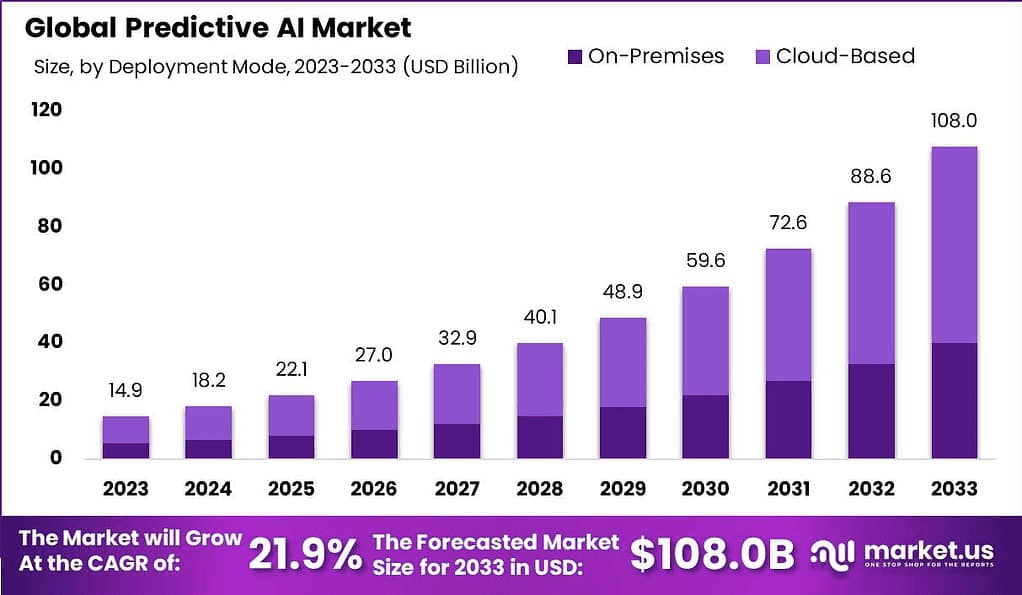
- The global predictive AI market is expected to grow from USD 22.1 billion in 2025 to USD 27.0 billion in 2026.
- By 2033, the market is forecast to reach USD 108.0 billion.
- The market is projected to expand at a strong CAGR of 21.9% from 2023 to 2033.
Segmental Analysis
- In 2026, cloud-based deployment is expected to be USD 18.9 billion, while on-premises stands at USD 8.1 billion, giving cloud roughly 70% of the total.
- Fortune Business Insights stated that cloud deployment led the market with a 79.11% share.
- Large enterprises were expected to hold a 61.69% share in 2026.
- Demand forecasting accounted for 0.12% of the market share.
- BFSI was projected to lead end users with an 18.15% share.
- North America increased from USD 8.61 billion and a 38.70% share in 2025 to USD 10.66 billion in 2026.
- Asia Pacific grew from USD 4.73 billion and a 21.30% share in 2025 to USD 5.91 billion in 2026.
- Europe rose from USD 6.85 billion and a 30.80% share in 2025 to USD 8.52 billion in 2026.
Predictive AI Lifts Data Analysis Performance
(Reference: scoop.market.us)
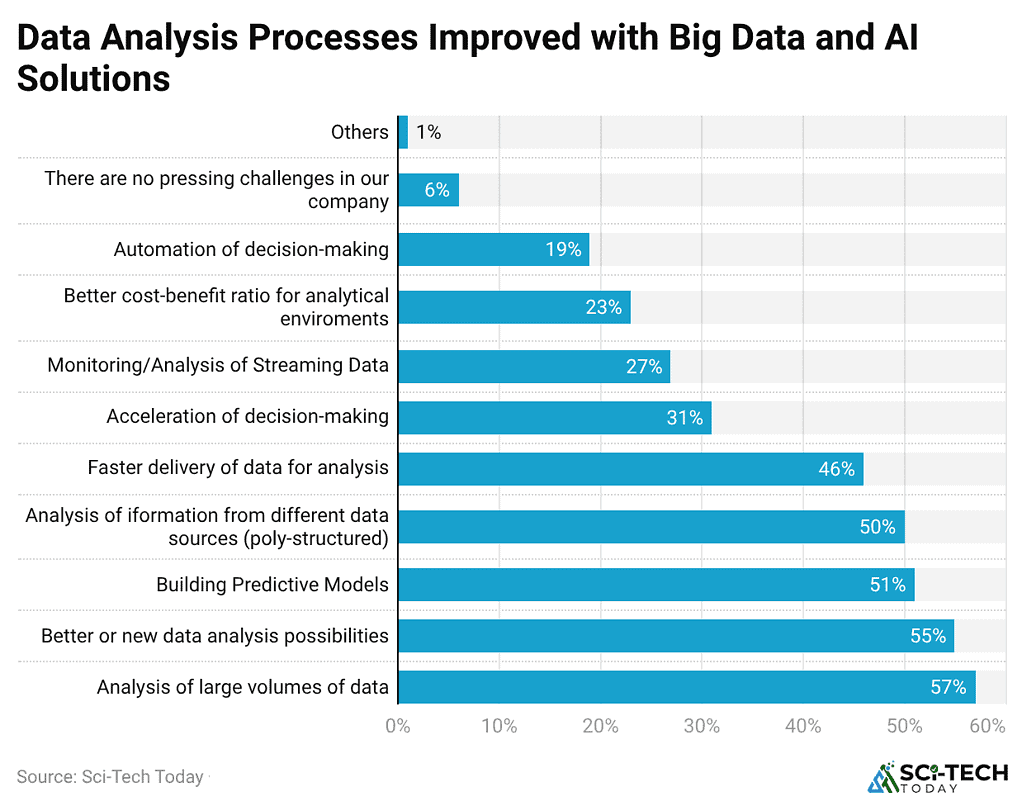
- Analysis of large volumes of data is cited by 57%.
- Better or new data analysis possibilities follow at 55%, and building predictive models stands at 51%.
- 50% report analyzing information from different (poly-structured) data sources.
- Meanwhile, faster delivery of data for analysis is reported by 46%.
- Acceleration of decision-making is cited by 31%, followed by monitoring/analysis of streaming data (27%), and a better cost-benefit ratio for analytical environments (23%).
- Automation of decision-making accounts for 19%.
- Only 6% report no pressing challenges, and the remaining 1% report other challenges.
Predictive AI Integration Statistics
- According to Market.us Scoop, 84% of marketing executives struggle to make accurate, data-driven decisions about consumer behavior.
- 95% of companies use AI-powered predictive analytics in their marketing strategies, while 44% report full integration.
- Among fully integrated companies, 90% still face challenges with daily data-driven decisions.
- Key issues include outdated data (38%), lengthy model development (35%), and overloaded data scientists (42%).
- Other barriers include misalignment between models and marketing goals (40%) and incorrect or incomplete data (37%).
AI Predictive Analytics in Recruitment
- According to Virtasant, Unilever employs 170,000 people worldwide and operates across 190 countries.
- The company receives 1.8 million applications annually for about 30,000 positions.
- Unilever saved about 70,000 interview hours each year.
- The company screened more than 1 million applicants annually and provided personalized feedback.
For Employee Retention and Engagement
- U.S. companies lose an estimated USD 160 billion annually because of employee turnover.
- IBM, with more than 350,000 employees, uses AI to predict turnover risk with 95% accuracy.
- The company saved nearly USD 300 million in retention costs and increased employee engagement by 20%.
- Highly engaged workforces report 23% higher profitability and 81% lower absenteeism.
- Weave used Lattice AI to analyze employee feedback, reducing review time by 30 hours per survey.
- Weave also achieved a 95% increase in eNPS.
- Only 35% of HR leaders feel confident in their technology strategy.
Key Predictive AI Use Cases
- Doit Software reported that 51% of business owners use predictive AI to prevent fraud.
- Additionally, 63% of financial institutions identify fraud detection as a key driver of AI investment.
- 33% of businesses use predictive AI to recommend products based on customer behavior.
- These teams focus 40% more on predictive AI and machine learning, and AI could generate 50% more sales leads.
- 73% of business leaders say AI reveals otherwise missed insights, while 48% expect better decision-making.
Predictive AI Adoption Statistics
- According to Xtendedview, the global spending on AI services is projected to reach USD 585.5 billion in 2026.
- AI software spending is expected to increase from USD 282.9 billion in 2025 to USD 453.2 billion in 2026.
- AI cybersecurity spending could nearly double from USD 25.9 billion in 2025 to USD 51.3 billion in 2026.
- Around 88% of organizations use predictive AI in at least one core business function.
- Global enterprise AI spending is forecast to reach USD 2.59 trillion by 2026.
- About 72% of enterprises have scaled AI models into production.
- Nearly 30% of businesses are redesigning operations around AI adoption.
- Manufacturing AI spending grew 48% year over year in 2026.
By Industry
- Around 50% of healthcare providers are expected to adopt AI-powered predictive analytics.
- By 2026, 45% of global supply chains are expected to use AI for predictive analytics.
- 95% of companies use predictive AI in marketing, but only 44% have fully integrated it.
- Only 44% of companies have fully integrated predictive analytics into their operations.
(Source: cloudfront.net)
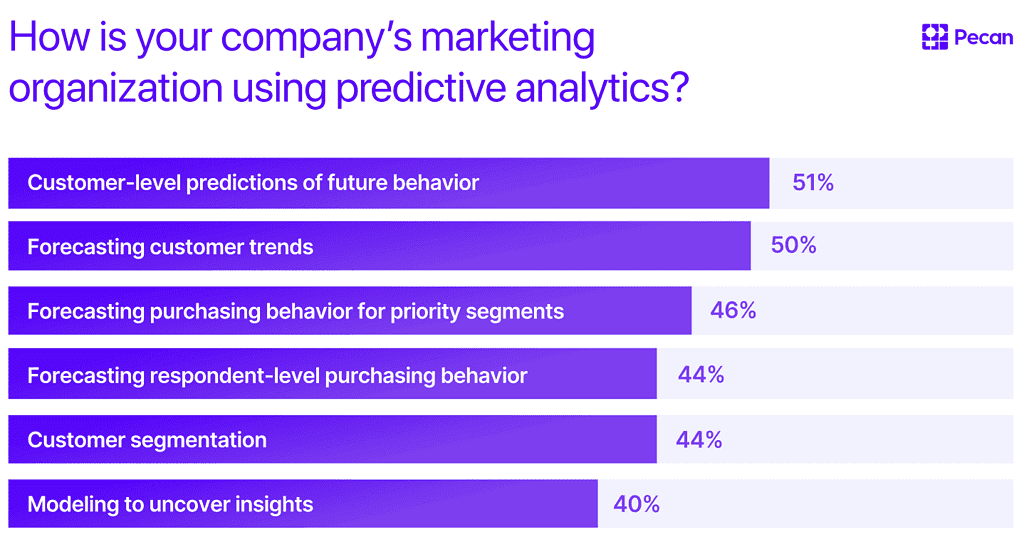
- 51% of companies use predictive analytics to understand future customer behavior, while 50% use it to forecast customer trends.
- 46% of companies apply predictive AI to forecast purchasing behavior among priority customer groups.
- 77% of financial institutions use predictive analytics, up from 37% the previous year.
- Meanwhile, 89% of financial leaders consider these skills essential.
- Financial institutions using predictive analytics reported a first-year ROI of 200%-500%.
- In media and entertainment, 32% of executives expect AI forecasting to improve operational insights, while 60% use AI monitoring.
- As of 2026, the predictive AI market in media and entertainment is expected to reach USD 2.1 billion.
Among Businesses
- The 2026 AI Index reports that 91% of organizations in developing markets and 90% in North America use AI in at least one business function.
- In the 2025 global survey, 21% of organizations regularly used AI in service operations. Besides, 23% used it for product or service development.
- Among Indian enterprises using AI at scale, 56% applied it to strategy and operations.
- About 40% of Indian organizations reported significant or full AI use, compared with 28% globally.
(Reference: demandsage.com)
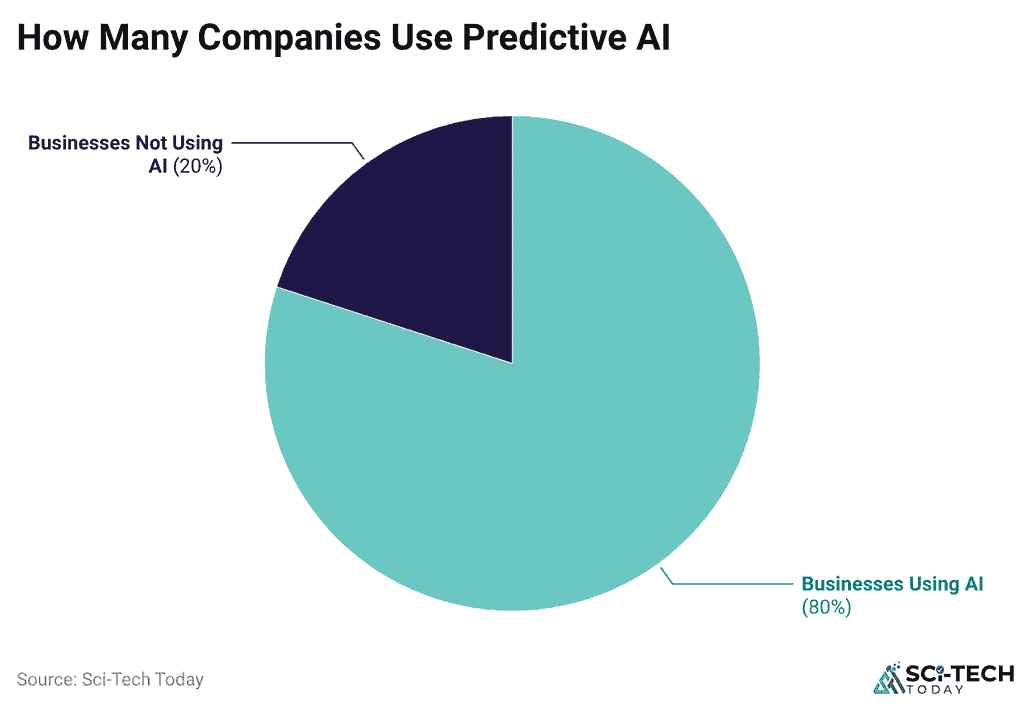
- Around 80% of businesses use AI today, making it a standard organizational practice.
- The remaining 20% still do not use AI.
- PepsiCo saves approximately 4,300 workdays annually by using predictive AI for inventory management.
- Amadeus uses predictive AI to process up to 100,000 transactions per second.
- EY has saved 250,000 hours through smart document automation.
Predictive Analytics Software at a Glance
| Tool | Best for | Pricing |
| Prophet | An open-source option | Free |
| Scios | User decisions | By request |
| SAS Viya | Automated forecasting | By usage: USD 0.55/SAS unit/hour |
| One Model | People analytics | By request |
| SAP Analytics Cloud | Generative AI | By request |
| Qlik | Interactive forecasting | From USD 2,750/month |
| ThoughtSpot | Ease of use | From USD 125/month for 5 users |
| Alteryx One | Low-code data preparation | Predictive analytics in the Professional plan; contact for pricing |
| DataRobot | AutoML | Contact for pricing |
| Microsoft Azure Machine Learning | Enterprise MLOps | Pay-as-you-go from USD 70.08/month/instance |
AI-Driven Predictive Maintenance Market Growth
(Source: xtendedview.com)
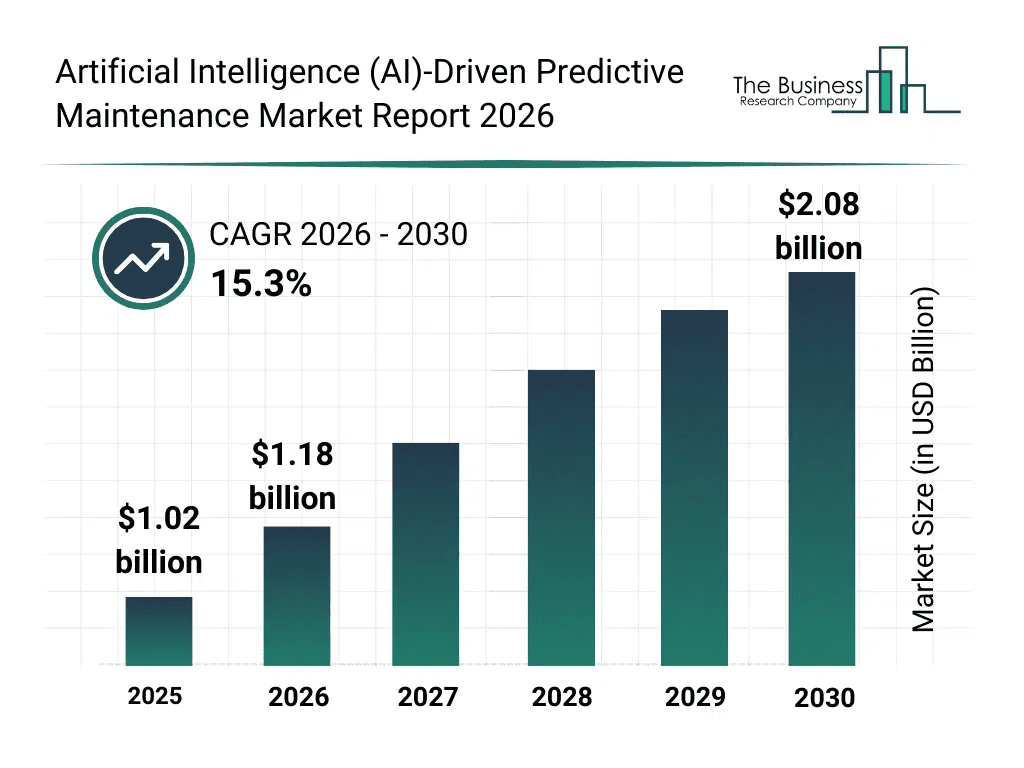
- The market is projected to grow from USD 1.02 billion in 2025 to USD 2.08 billion by 2030.
- It is expected to reach USD 1.18 billion in 2026, with a 15.3% CAGR through 2030.
How AI Powers Predictive Analytics: Pattern Recognition and Feature Extraction
- AI detects complex patterns in large datasets that traditional methods may miss.
- ResearchGate.net suggested that CNNs reduced CIFAR-10 error rates from 28.5% to 6.7% between 2011 and 2021.
- These models typically contain 7- 152 layers and process 650,000–60 million parameters.
- Healthcare CNNs achieved 97.1% accuracy compared with 76.3% for traditional methods, enabling 157,000 additional early diagnoses annually.
- RNNs achieved a MAPE of 3.8% versus 12.7%, improving forecasting accuracy by 70.1%.
Adaptive Learning and Model Refinement
- AI models continuously learn from new data and adjust predictions as conditions change.
- Adaptive systems improved accuracy by 0.3% to 0.5% daily during the first 30 days.
- They achieved 22%-34% higher accuracy than static models.
- Transfer learning reduced training time by 78.3% and labeled-data requirements by 83.6%.
- Organizations reported an average annual value of USD 3.4 million from improved decision-making.
AI Predictive Maintenance: Benefits and Performance Gains
(Source: sqmagazine.co.uk)
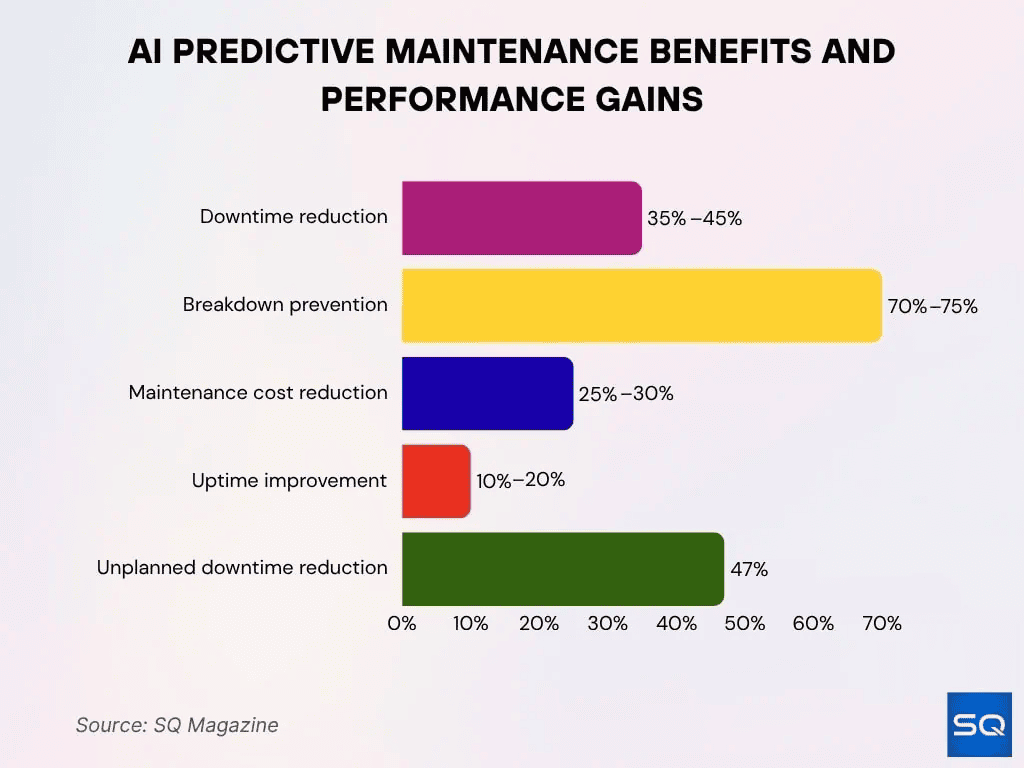
- AI-based predictive maintenance reduces equipment downtime by 35%- 45%.
- It prevents 70%-75% of sudden machine breakdowns.
- Maintenance spending falls by 25%-30% as repairs shift from emergency fixes to planned maintenance.
- Overall equipment uptime improves by 10%-20%.
- Unplanned downtime, the costliest type of stoppage, drops by 47%.
Top Benefits of Predictive AI
| Benefit | Share of respondents |
| Better decision-making | 84% |
| Improved forecast accuracy | 79% |
| Reduced operational costs | 71% |
| Increased productivity | 68% |
| Better customer experience | 63% |
| Faster business insights | 58% |
Challenges in Predictive AI Adoption
- For 84% of marketing executives, consumer behavior predictions still feel like guesswork.
- Despite fully adopting predictive AI analytics, 90% of companies struggle with daily data-driven decisions.
- Data scientists feel overwhelmed, a key adoption hurdle cited by 42% of companies.
- Another 40% struggle to align models with marketing goals.
- Data quality remains a concern, as 38% report delays in data updates.
- Another 37% struggle with incorrect or incomplete data.
- Model development takes too much time for 35% of organizations.
- Additionally, 40% struggle with disorganized data as a major obstacle.
- High manual data science costs remain a major challenge, cited by 40% of respondents.
Wrap-Up
Predictive AI is changing how businesses plan, solve problems, and make decisions. It uses past data to spot patterns and estimate what may happen next. From healthcare and finance to sales and customer service, its uses are growing quickly.
However, reliable data, privacy, security, and responsible use remain important. As AI technology continues to improve, predictive AI can help businesses work more efficiently, manage risks, and make better-informed decisions.
FAQ
Predictive AI analyzes past data, identifies patterns, and uses them to forecast likely future outcomes.
Predictive AI helps forecast demand, detect fraud, predict risks, improve decisions, and personalize customer experiences.
Predictive AI forecasts outcomes, while Generative AI creates new content such as text, images, and code.

Sources