









Brief Overview
AI In Insurance Statistics: Artificial intelligence is rapidly reshaping how insurers assess risk, process claims, and interact with policyholders. The global AI in insurance market reached roughly USD 10 billion in 2025, growing at a pace few insurance technology segments have matched, while adoption has moved well past early experimentation, with 64% of US insurance agencies now using AI in at least one workflow, rising to 91% among larger agencies.
Generative AI specifically has seen even faster uptake, with nearly nine in ten insurers exploring it and over half already deploying it across claims, underwriting, and customer service. The operational gains are measurable too: insurers using advanced AI systems report up to 75% faster processing speeds and notably higher accuracy in risk assessment.
In this article, we explored the key statistics, use cases, and emerging trends shaping AI’s role across the insurance industry.
Key Points from the Article
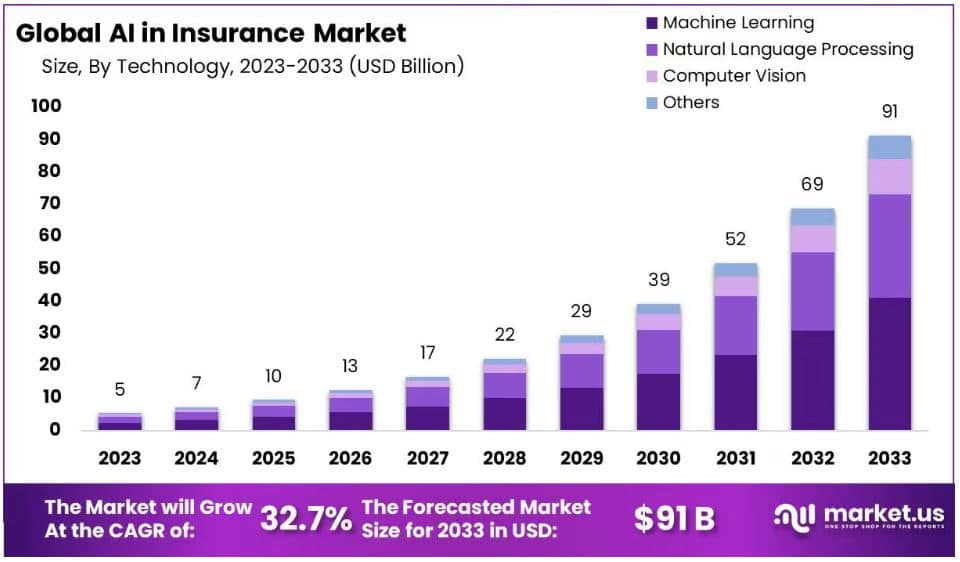
- The global AI in insurance market could grow from USD 10 billion in 2025 to USD 91 billion by 2033, at a 32.7% CAGR.
- By mid-2024, 76% of insurers used generative AI in at least 1 business function, but only 10% used it company-wide.
- Full AI adoption increased from 8% in 2024 to 34% in 2025, rising by 26 percentage points.
- AI reduced claims-processing time by 75%, from 30 days to 7.5 days.
- Aviva used more than 80 AI models and saved approximately USD 82 million on motor claims in 2024.
- AI-powered underwriting can reduce processing time by 80%, while AI can lower claims-processing costs by 20% to 30%.
- Around 81% of insurance CEOs view generative AI as a major investment priority, while 90% of executives named AI their leading strategic initiative for 2025.
- Although 55% of customers worry about privacy, 60% would share personal data for customized insurance offers.
Global AI in Insurance Market Share
- The market was valued at USD 10 billion in 2025 and USD 13 billion in 2026.
- The value is forecast to reach USD 52 billion in 2031 and USD 69 billion in 2032.
- By 2033, the global market is expected to reach USD 91 billion.
- The market is projected to grow at a compound annual growth rate of 32.7% during the forecast period.
(Source: market.us)
AI Adoption and Growth Insights in Insurance
- By mid-2024, 76% of insurance companies had introduced generative AI in at least 1 business function. However, only 10% had expanded it across the entire organization.
- Many insurers are shifting from general-purpose large language models to small language models designed for specific insurance tasks.
- The global AI-in-insurance market was valued at USD 2.85 billion in 2024 and could reach USD 11.92 billion by 2029, growing at a CAGR of 33.1%. This would add USD 9.07 billion in market value.
- North America held a 38.2% market share and generated about USD 1.0 billion in revenue. Asia-Pacific could grow fastest at a 38.1% CAGR.
- Insurers invest between USD 25 million and USD 100 million annually in AI, while large companies spend USD 100 million to USD 500 million.
- Full AI adoption increased from 8% in 2024 to 34% in 2025, a rise of 26 percentage points.
- AI reduced claims-processing time by 75%, from 30 days to 7.5 days. Routine claims fell from 7–10 days to 24–48 hours, while policy verification became 99% faster, dropping from 15–20 minutes to seconds.
AI Integration Challenges in Insurance
- Around 81% of insurance CEOs consider generative AI a top investment priority.
- About 90% of insurance executives identified AI as their main strategic initiative for 2025.
- Nearly 70% of CEOs are concerned about the growing competition for skilled AI professionals.
- Workforce training is an important challenge for 77% of insurance leaders. Companies need to improve employees’ AI knowledge and practical skills before using the technology at scale.
- Skills and resource shortages are the biggest barriers for 52% of insurance organizations.
- Data problems affect 40% of insurers. Poor, incomplete, or disconnected data can reduce the accuracy of AI systems.
- Regulatory challenges are a concern for 36% of insurers, especially when AI is used for underwriting, claims, pricing, and customer decisions.
How Generative AI Improves Insurance Sales
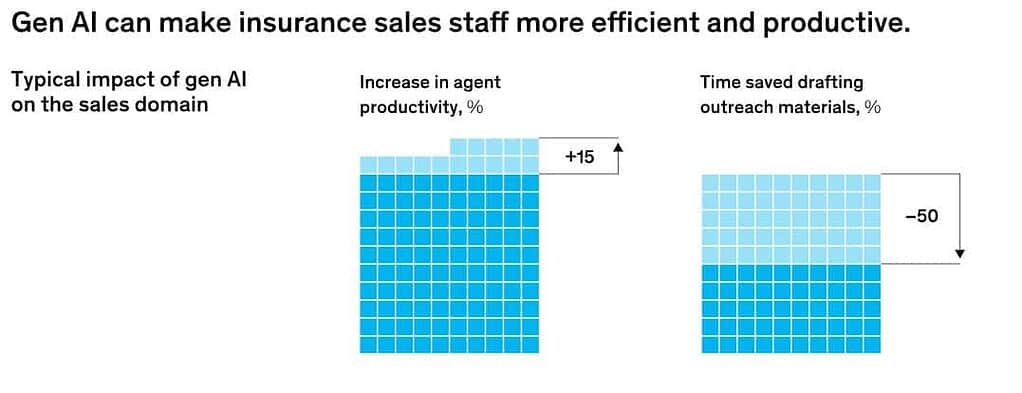
- Generative AI can help insurance sales employees work more efficiently and complete their tasks faster.
- Using generative AI can increase an insurance sales agent’s productivity by 15%.
- Generative AI can reduce the time spent creating customer outreach materials by 50%.
(Source: mckinsey.com)
Real-World AI Applications in Insurance
- UK insurer Aviva introduced more than 80 AI models to improve claims processing and customer outcomes.
- These models reduced the time required to assess liability in complex claims by 23 days.
- Aviva improved the accuracy of sending claims to the correct teams by 30% and reduced customer complaints by 65%.
- In 2024, Aviva’s AI transformation in motor claims generated savings of more than GBP 60 million, equal to about USD 82 million.
- Another insurer used intelligent automation to provide customer quotes and sell policies. After implementation, 80% of transactions moved online, while the likelihood of customers recommending the insurer rose by 36 percentage points.
- An insurance company introduced a 24/7 chatbot for customer support outside normal working hours. This increased the number of potential customers purchasing policies by 11%.
- Another insurer uses AI to create approximately 50,000 claims-related messages every day.
How Consumers Use AI in Insurance
- Insurance customers want AI to make claims faster, provide personalized offers, and improve digital services. However, 55% of customers still have concerns about the privacy of their personal information.
- Around 30% of insurance customers are willing to use AI-powered chatbots for routine questions.
- About 60% of consumers are willing to share personal information in exchange for personalized insurance offers. AI can help insurers analyze this information and recommend suitable products.
- Insurance companies using AI-powered personalized messages have reported an average increase of 15% to 20% in customer satisfaction.
- Around 45% of insurance customers expect a fully digital claims process, with AI helping insurers process claims more quickly.
- About 25% of policyholders are interested in using AI tools for risk assessment and loss-prevention advice.
- Gen Z and Millennials are 2 times more likely than older consumers to prefer AI-powered self-service insurance options.
- Nearly 70% of consumers believe AI can help insurance companies provide more accurate pricing.
- Customers are 3 times more likely to change insurers if their current provider does not offer smooth digital services or AI-supported interactions.
Insurance Premiums Outpace Profits
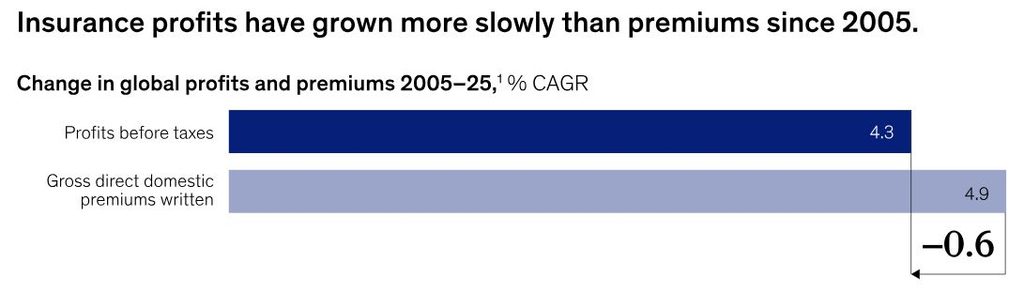
- From 2005 to 2025, global insurance profits before taxes increased at a compound annual growth rate of 4.3%.
- During the same period, global gross direct domestic premiums written grew at a faster compound annual growth rate of 4.9%.
- This means insurance premiums grew 0.6 percentage points faster than profits each year.
- The difference was larger in life and health insurance, where premiums grew 1.1 percentage points faster than profits.
- In property and casualty insurance, the difference was smaller at 0.1 percentage points.
(Source: mckinsey.com)
How AI is Transforming B2B Insurance
- AI can reduce insurance claims-processing costs by 20% to 30%.
- Around 60% of insurance executives believe AI will play an important role in improving operational efficiency within the next 3 years.
- AI-powered underwriting can reduce the processing time for complex insurance policies by up to 80%.
- Insurers using AI to detect fraud have reported a 5% to 10% improvement in fraud identification and prevention.
- About 85% of insurance leaders believe AI will transform their workforce and require employees to develop new skills.
- AI-powered predictive maintenance can reduce equipment breakdowns in commercial insurance by 25%.
- By 2025, AI-driven automation was expected to handle 70% of routine tasks in insurance back-office operations.
- AI can help insurers identify recovery opportunities from responsible third parties, improving recovery rates by 10% to 15%.
- Companies that adopted AI early achieved returns of 1.5 times to 3 times their investment within 3 years.
Improved Insurance Marketing and Advertising Using AI
- AI-powered personalization can increase conversion rates in insurance marketing campaigns by up to 20%.
- Insurers using AI for predictive marketing analytics have reduced customer acquisition costs by 10% to 15%.
- Around 85% of insurance marketers planned to increase their use of AI for highly personalized customer communications by 2025.
- AI-powered lead-scoring models have improved the quality of insurance sales leads by 30%.
- AI-supported dynamic pricing can match advertisements to individual customer risk profiles, improving advertising efficiency by 5% to 10%.
- AI can create marketing materials such as policy explanations and frequently asked questions, reducing content creation time by an average of 40%.
- Insurance companies using AI to improve marketing campaigns have reported a 15% to 20% increase in campaign return on investment.
- AI-powered chatbots on insurance websites have increased lead generation by 25% compared with traditional online forms.
AI and Digital Strategy in Insurance
- Around 70% of insurance companies are adding AI to their main digital transformation strategies.
- Insurance industry spending on AI technology was expected to reach USD 11 billion by 2025.
- About 80% of insurers are adopting cloud-based AI solutions because they provide better flexibility, speed, and scalability.
- Machine learning is the most widely used AI technology in insurance, with 75% of companies testing or using it.
- AI-supported data analytics is a leading investment priority for 90% of insurance chief information officers.
- The use of generative AI in insurance is expected to reach 40% by 2026, mainly for creating content and personalized customer messages.
- Cybersecurity spending for protecting insurance AI systems is forecast to increase by 20% every year.
- Around 60% of insurers consider application programming interface integration a major priority because it helps connect separate systems and allows AI tools to share information.
Recent AI in Insurance Developments
- On August 5, 2026, Gallagher Re reported that global InsurTech funding reached USD 2.44 billion across 95 deals in Q2 2026, with AI-focused firms receiving 99.1%, or USD 2.42 billion.
- On August 5, 2026, AI-powered travel-insurance platform Faye raised USD 50 million in Series C funding, bringing its total funding to USD 100 million and its valuation to about USD 500 million.
- On August 3, 2026, Plymouth Rock launched home-insurance quotes through ChatGPT across 6 U.S. states, allowing customers to compare coverage and continue to purchase without completing traditional forms.
- On July 8, 2026, Allianz confirmed plans to cut up to 1,800 jobs in its travel-insurance division as AI takes over more claims and customer-service tasks.
- On July 7, 2026, Duck Creek Technologies acquired AI-native underwriting company Sends Technology Solutions to connect automated underwriting with core policy operations; the financial terms were not disclosed.
- On March 12, 2026, UnitedHealth said it planned to invest nearly USD 1.5 billion in AI during 2026 and expected the technology to generate almost USD 1 billion in annual savings.
- On February 17, 2026, AI-native insurance technology company mea Platform secured a USD 50 million minority growth investment from Scottish Equity Partners to expand product development and customer adoption.
The End
AI in insurance has moved from cautious experimentation to a genuine operating advantage, with the market on pace to nearly triple by 2033 and full-scale adoption jumping from 8% to 34% in just a year. The operational proof points are hard to ignore, and Aviva alone saved over GBP 60 million by deploying more than 80 AI models across its claims process.
Still, the industry’s biggest obstacles aren’t technical: skills shortages, messy data, and regulatory uncertainty remain top concerns for insurers even as they keep investing. With InsurTech funding increasingly flowing toward AI-focused firms and major carriers like UnitedHealth and Allianz restructuring around automation, 2026 looks like the year AI stopped being a side project and became core insurance infrastructure.
FAQ
Insurance companies use artificial intelligence to automate routine tasks, speed up claims, and assess risk with greater accuracy.
Specialized insurtech platforms and major carriers now offer coverage specifically for artificial intelligence risks, including hallucinations, algorithmic bias, and model underperformance.
Insurance companies use specialized core platforms, customer relationship management tools, and data systems to handle policies, claims, and daily operations.
Agentic AI in insurance refers to autonomous artificial intelligence systems that can independently plan, make decisions, and execute multi-step workflows to achieve specific goals rather than just responding to single prompts.
Yes, insurance companies use artificial intelligence and automated algorithms to process, flag, and deny claims, particularly in health insurance and prior authorization reviews.
AI in insurance is the use of artificial intelligence technologies like machine learning, predictive analytics, and natural language processing to automate, speed up, and improve daily insurance work.