








First Glance
AI In Agriculture Statistics: Artificial intelligence is changing how food is grown, watched over, and delivered. Farming already causes a big share of the world’s greenhouse gases and uses most of the world’s fresh water. AI now helps with planting, watering crops, controlling pests, and taking care of farm animals, all the way from the farm to the store. In India, farmers growing chili peppers used AI through a program called Saagu Baagu and got bigger harvests while using less pesticide and fertilizer. GPT-4, an AI tool, has even done better than some real farming experts on official exams.
Still, not many farms use AI yet. Only a small number of US farms say they use it, based on one recent survey. Studies of past research also show that most AI farm tools are still being tested and are not yet used widely in real fields.
This article shares the newest facts about AI in farming.
Must Reads in the Editor’s Eye
- The global AI in agriculture market was valued at USD 1.2 billion in 2022, projected to reach USD 10.2 billion by 2032, a 24.5% CAGR.
- GPT-4 achieved 93% accuracy on agronomist certification examinations.
- Farmer. Chat could cut extension-service costs from USD 35 to USD 0.35 per farmer, a 99% reduction, though the effect on yields has not been empirically tested.
- Pests and diseases cause losses of up to 40% of global crop yields each year.
- Taranis detected tar spot across 41% of a cornfield in Bourbon, Indiana, creating an estimated USD 86,280 profit opportunity for enrolled growers.
- Fewer than 2% of US agricultural firms reported using any type of AI in a Business Trends and Outlook Survey conducted from December 2023 to early 2024.
- Improved agricultural connectivity could generate more than USD 500 billion in global GDP by 2030.
- Conversational AI deployed at scale could cost less than USD 1 per farmer interaction, down from roughly USD 30 to USD 35 for conventional in-person advisory services.
Global AI in Agriculture Market Statistics
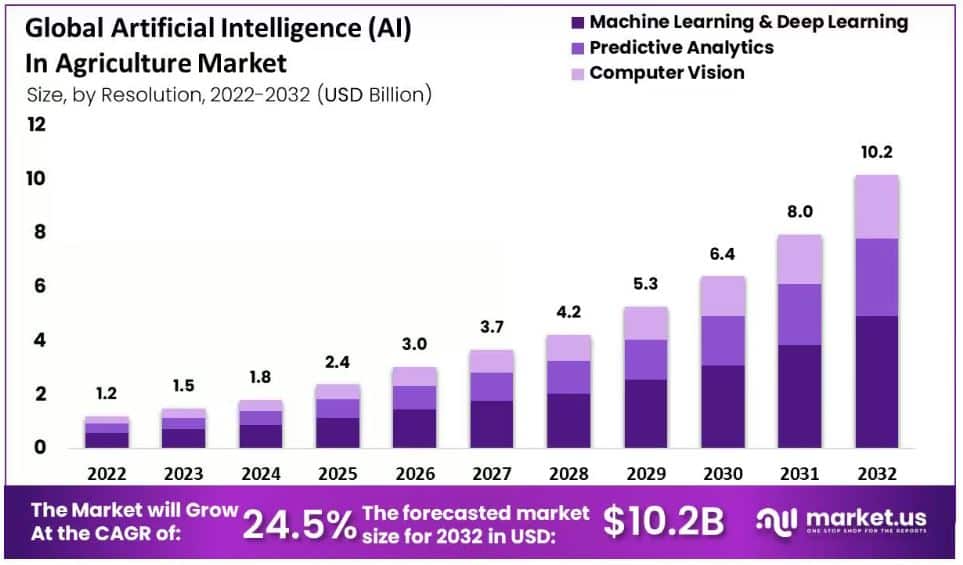
(Source: market.us)
- The global AI in agriculture market was valued at USD 1.2 billion in 2022.
- It is expected to reach USD 2.4 billion in 2025 and USD 3.0 billion in 2026.
- The market could rise further to USD 8.0 billion in 2031 and USD 10.2 billion by 2032.
- Overall, the market is expected to grow at a compound annual growth rate of 24.5% during the forecast period.
Recent AI in Agriculture Developments
- On September 29, 2026, Farmers Business Network partnered with Google AI Futures Fund to develop an AI Context Engine that will support task-specific agents using a 360-degree view of individual farms.
- On September 28, 2026, Singapore’s National Research Foundation awarded Illinois ARCS a four-year, USD 10 million grant to develop AI-powered agricultural digital twins, with more than 15 researchers expected to participate.
- On September 21, 2026, Google and the Gates Foundation announced USD 100 million for organizations scaling AI-based climate and crop information to 200 million smallholder farmers across Sub-Saharan Africa and South Asia, up from 50 million.
- On September 16, 2026, Tadaa Technology secured a USD 52 million partnership with E Agro Digital to build the EzyTrace AI agricultural supply-chain platform for Malaysia’s Ministry of Agriculture and Food Security.
- On June 10, 2026, Leaf Agriculture raised USD 13 million in Series B funding to expand its agricultural data infrastructure, which provides cleaned and structured farm data for developing AI applications.
- On March 10, 2026, Indian bovine-genetics company Verdant Impact raised USD 3 million in seed funding to expand its Pashu.AI platform after recording eightfold revenue growth since its previous financing round.
- On January 15, 2026, SAP and Syngenta announced a multiyear partnership to integrate AI across Syngenta’s manufacturing, supply chain, research, and grower services as the industry prepares to feed a projected 10 billion people by 2050.
- On January 7, 2026, Heritable Agriculture and KWS announced an AI-driven crop-breeding partnership targeting genes with at least a 15% trait effect and commercial availability within five years.
Generative AI in Agricultural Advisory Services
- GPT-4 achieved 93% accuracy on agronomist certification examinations.
- Farmer.Chat could potentially reduce extension-service costs from USD 35 per farmer to USD 0.35 per farmer, a 99% reduction, but the report says its effects on yields and costs have not been empirically tested.
- Farmer.Chat has reached 15,000 farmers across Ethiopia, India, Kenya, and Nigeria.
- Malawi has more than 20 million residents, and Chichewa, the language supported alongside English by UlangiziAI, is spoken natively by about half of them.
- Colombia’s AgroasesorIA pilot aimed to serve at least 700 coffee producers over six months.
| AI tool or program | Indicator | Statistical data |
| GPT-4 | Agronomist examination accuracy | 93% |
| Farmer.Chat | Traditional extension cost | USD 35 per farmer |
| Farmer.Chat | Potential AI-enabled cost | USD 0.35 per farmer |
| Farmer.Chat | Potential cost reduction | 99% |
| Farmer.Chat | Farmers reached | 15,000 |
| Farmer.Chat | Countries covered | 4 |
| UlangiziAI | Population of Malawi | More than 20 million |
| UlangiziAI | Native Chichewa speakers | About 50% of Malawi’s population |
| UlangiziAI | Languages supported | 2 |
| AgroasesorIA | Targeted coffee producers | At least 700 |
| AgroasesorIA | Pilot duration | 6 months |
AI-Powered Pest and Disease Management Statistics
Global Crop Losses
- Pests and diseases cause losses of up to 40% of global crop yields each year.
Taranis Case Studies
- At a soybean farm in Whitewater, Wisconsin, early detection of brown stem rot reportedly prevented USD 37,000 in crop losses.
- At a cornfield in Bourbon, Indiana, Taranis detected tar spot across 41% of the field.
- The recommended fungicide treatment cost USD 40–USD 50 per acre, with an estimated retailer profit of USD 12 per acre.
- The total profit opportunity across the affected acreage was estimated at USD 86,280 for growers enrolled in the program.
Brazil’s Agro 4.0 Program
- An AI-supported monitoring system reduced pesticide use by 30% at a soybean farm in Mato Grosso, Brazil.
Trapview
- Trapview’s AI-based pest-monitoring system covers more than 60 pest species.
- The company reports a 5% improvement in crop yields and quality, together with aggregate user cost savings of EUR 118 million.
AI Adoption Barriers and Technology Costs in Agriculture
United States
- Fewer than 2% of U.S. agricultural firms reported using any type of AI in the Business Trends and Outlook Survey conducted from December 2023 to early 2024.
Farmer Concerns
- A survey of more than 5,000 farmers found that 47% considered high technology costs a leading concern.
- In the same survey, 30% identified an unclear return on investment as a major barrier to technology adoption.
Technology Costs
- Precision-agriculture systems, including sensors, drones, and specialized software, can cost between USD 30,000 and USD 300,000.
- Machinery and equipment prices in Sub-Saharan Africa were 35%–39% higher than prices in the United States.
- Machinery and equipment prices in North Africa were 13%–15% higher than prices in the United States.
| Indicator | Value |
| U.S. agricultural firms using AI | Fewer than 2% |
| Farmers surveyed | More than 5,000 |
| Concerned about technology costs | 47% |
| Concerned about unclear ROI | 30% |
| Precision-agriculture system cost | USD 30,000–USD 300,000 |
| Sub-Saharan Africa equipment premium | 35%–39% |
| North Africa equipment premium | 13%–15% |
Economic Value of Agricultural Connectivity by 2030
- Improved agricultural connectivity could generate more than USD 500 billion in global GDP by 2030.
- In the fruits and vegetables sector, connectivity could create USD 190.0 billion, equal to 8.9% of the sector’s output.
- In the cereal and grain sector, it could generate USD 174.3 billion, or 9.2% of the sector’s output.
- In the livestock sector, connectivity could create USD 116.9 billion, representing 7.7% of the sector’s output.
- In the dairy sector, it could generate USD 20.1 billion, equal to 4.1% of the sector’s output.
- East Asia and the Pacific could receive USD 237.5 billion in value, equivalent to 8.2% of the region’s agricultural output.
- Latin America and the Caribbean could gain USD 64.2 billion, or 12.2% of the region’s agricultural output.
- South Asia could receive USD 61.1 billion, representing 6.4% of the region’s agricultural output.
- Europe and Central Asia could gain USD 53.8 billion, equal to 8.8% of the region’s agricultural output.
- North America could receive USD 45.7 billion, or 8.7% of the region’s agricultural output.
- The Middle East and North Africa could gain USD 61.1 billion, representing 7.8% of the region’s agricultural output.
Cost Reduction in the Agricultural Advisory Models
- Conventional in-person agricultural advisory services cost approximately USD 30–USD 35 per farmer annually after accounting for staffing, travel, and training expenses.
- Video-mediated group-extension programs can reduce delivery costs to approximately USD 3.50 per farmer while supporting improvements in farming knowledge, practice adoption, and yields.
- Compared with the lower end of conventional extension costs, the video-based model reduces the cost per farmer by approximately 88%. This figure is calculated from the costs reported in the source.
- Phone and interactive-voice-response-based services such as Ama Krushi can lower annual delivery costs to as little as USD 0.15 per farmer.
- These mobile advisory services have generated benefit-cost ratios of 9:1 or higher when operated at scale.
- Early estimates suggest that generative AI could reduce delivery costs by another tenfold compared with earlier digital advisory models.
- Conversational AI deployed at scale over existing digital infrastructure could cost less than USD 1 per farmer interaction.
IoT and AI Use in Precision Agriculture
- As of Q1 2026, farm management remained the largest reported application, accounting for 35%.
- Weather forecasting represented 20%, supporting timely farm decisions.
- Agricultural learning and information systems accounted for 15%, improving access to farming knowledge.
- Pest control represented 13%, supporting crop monitoring and prevention.
- Crop-market management accounted for 10%, helping farmers assess prices and demand.
- Agricultural supply-chain and business support represented the remaining 7%.
Wrap Up
AI is becoming a core part in agriculture, from precision farming and pest detection to livestock management and advisory services, with the global market set to grow steadily through 2032. Low-cost generative AI tools are slashing extension costs for smallholder farmers, while major investments from Google, SAP, and research institutions signal accelerating adoption.
Still, high technology costs, unclear returns, and limited infrastructure keep adoption low in regions like the US, pointing to a gap between AI’s potential and real-world farm deployment.
FAQ
AI analyzes data from sensors, drones, and satellite imagery to give farmers precise insights on soil conditions, water needs, and crop health, allowing targeted irrigation, fertilization, and pesticide use rather than treating entire fields uniformly.
Yes, AI models analyze historical yield data, weather patterns, soil conditions, and satellite imagery to forecast crop yields with greater accuracy, helping farmers and supply chains plan harvesting, storage, and distribution more effectively.
AI powered image recognition tools can scan photos of crops to identify early signs of disease, nutrient deficiencies, or pest infestations, often before visible damage spreads, allowing farmers to respond faster and reduce crop loss.
AI is used in livestock farming to monitor animal health and behavior through sensors and cameras, detect early signs of illness, track feeding patterns, and optimize breeding decisions to improve overall herd productivity.
AI enables autonomous tractors, harvesters, and drones to navigate fields, perform tasks like planting or spraying with precision, and operate with minimal human intervention, helping address labor shortages and improve efficiency.
Common challenges include high upfront costs, limited internet connectivity in rural areas, a lack of technical expertise among farmers, data privacy concerns, and the need for AI models to adapt to diverse crops and local farming conditions.