









Introduction
Sales Prospecting Statistics: Sales prospecting in 2026 is expected to be better targeted, involve greater use of AI, and not be solely dependent on high activity volume. Evidence includes a shift to authentic data, multichannel approaches, buyer relevance, and measures of successful conversations and meetings, rather than raw outreach volume.
This article reviews prospecting statistics from studies on cold calling, cold emailing, customer behaviour, SDR efficiency, and multichannel prospecting.
Top Selection
- Top salespeople achieve the highest goals at a rate of 81% compared to the rest of the salesperson population’s 56%.
- Top salespeople achieve their business goal at a rate of 48% versus 37% for other sellers.
- 67% preferred not to have a salesperson at any point in the process.
- AI was used in 45% of surveyed B2B buyers’ purchasing processes.
- 70% of surveyed B2B buyers preferred an entirely digital buying process.
- 69% of B2B buyers preferred verifying AI insights with sales reps.
- Belkin determined that an email cold- outreach campaign averaged a reply rate of 0.45%.
- Cold calling has a success rate of 2.7%, based on an analysis of reports published in 2026 by Cognism.
- Social media was the most successful medium for a cold outreach sales prospect contact, with a response rate of 42%.
- Emails had a 26% response rate, and cold calls had a 23% response rate.
Top Performing Sales Prospecting Statistics
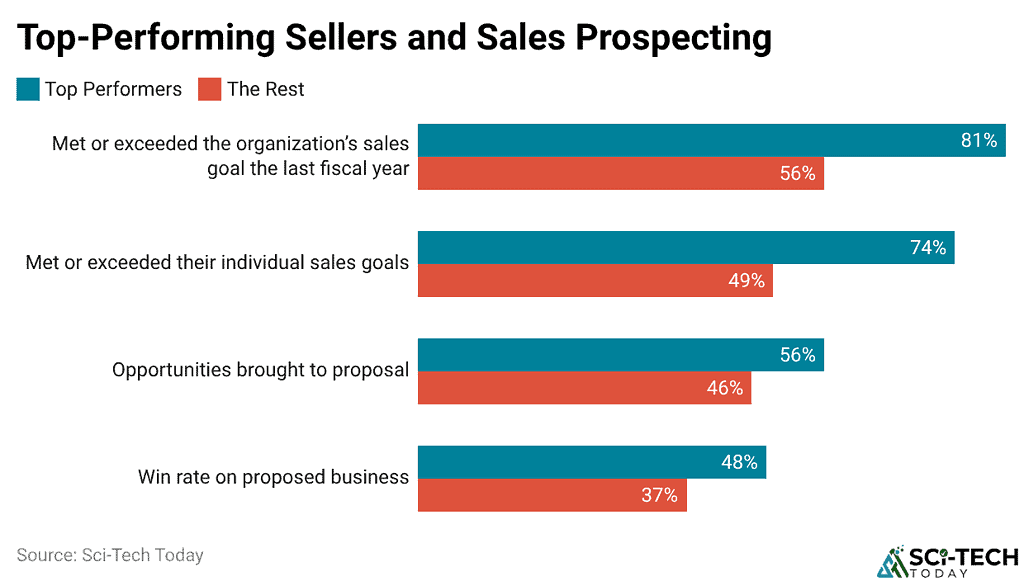
- Top-performing salespeople are getting ahead thanks to their approach to prospecting, which focuses on targeting, their value proposition, and discussions that are relevant for potential customers.
- The above chart shows some of the differences between top performers and salespeople in terms of the necessary metrics.
- In terms of success rates, it is apparent that 81% of top-performing salespeople reached the sales metrics set by their company, which stands in stark contrast with only 56% of the passed salespeople.
- In addition, when it comes to individual sales performance, 74% of successful people reached their goals compared to 49% of those who failed. This serves as an indicator that proper prospecting and a decent working process can lead to better results in sales.
- It is clear that success rates are different even in further stages of the sales funnel. For example, 56% of the time, the best-performing salespeople got to the contract signing stage, whereas other people succeeded only 46% of the time.
- They were also more successful in terms of winning deals, at 48% against 37%. This shows that top-performing people are probably better at finding potential clients and creating value in the deals.
- The process of advantage starts even before the proposal is submitted. It has been observed that the top achievers formulate a proper value proposition, target the right buyers at the appropriate seniority levels, and adjust first meetings according to the needs of the customer.
- The results of the research show that top performers attain 2.7 times more conversions and 1.8 times higher quality returns, including meetings, conversations, and demonstrations.
- It’s important to prioritize relevant outreach and valuable conversations with buyers instead of increasing the volume of activity.
- The correct prospecting can enhance the quality of opportunities and the conversion rate of sales teams.
Sales Prospecting Statistics: Evolution of B2B Buyer Behavior
- The concept of sales prospecting in B2B remains in a state of constant evolution because the process of gathering information about solutions becomes more independent on the side of buyers.
- According to Gardner’s research results, there are some key trends that emphasize what sales teams should devote attention to: the focus on relevance, the importance of timing, and the current needs of buyers.
- Based on the findings of a Gartner poll of 646 B2B buyers, it follows that 67% of buyers want to make their purchases without the agent’s participation, suggesting that the prospective client values the opportunity to explore their options on their own.
- In this regard, sales associates should be more focused on the insights, guidance, and information that help the buyer and improve their decision-making process instead of simply telling them about the product.
- The same research conducted by Gartner claims that 45% of buyers have already employed AI in their last purchase.
- AI can provide buyers with help in searching vendors, comparing solutions, and preparing their questions before talking to sales associates.
- Standard sales messages would not yield strong results, while information linked to particular challenges of businesses can be more effective.
- According to the research of Gartner, B2B clients verify seven sources of information prior to their purchasing activity. Their customers’ opinions are formed by their experiences with various touchpoints.
- The goal of prospecting is to understand and cater to buyer behavior by responding to intent signals and aligning outreach with priorities.
- Sales reps must balance automated messaging with research-led, meaningful outreach. Relying on static sequences and contact lists is not prospecting.
- The focus should be on sending the right message at the right time, as prospecting should facilitate the initiation of a conversation.
Lead Generation Statistics: Building Trust with Digital and Intent-Based Outreach
- Modern lead generation moves beyond simple buyer profiles. Digital buyer profiles are driven by a need for information.
- As AI matures and digitally self-service B2B buyers increase, sales must focus on intent-based and digital outreach.
- According to Gartner, 70% of B2B buyers want to use a completely digital buying process without ever interacting with a salesperson.
- For instance, self-service information must be readily accessible. Buying processes shouldn’t require premature buyer outreach.
- Although buyers prefer a self-service process, digital independence must still be paired with human expertise.
- Gartner reports 69% of buyers must validate AI recommendations with sales.
- This creates potential for sales reps to pair research with practical solutions, add real-world business context, and provide verified answers to customers.
- B2B teams can use AI to support prospect research and prioritization, provided it isn’t used to create fabricated personalization.
- Intent signals are useful in finding opportunities, but the message itself must be verifiable.
- Ultimately, high-quality lead generation utilizes responsible AI combined with human oversight to facilitate meaningful communication while adhering to buyer expectations. This style of B2B sales meets buyer expectations and encourages productive and efficient dialogue with prospects.
Cold Email vs. Cold Calling Statistics: Which Channel Performs Better in 2026?
- Performance of B2B prospecting can vary, depending on how results are measured.
- The 2026 study of 7.5 million cold emails sent during 2025 by Belkins found that the average reply rate for the cold emails was 0.45 %.
- The study noted the highest reply rates in February at 0.54 % and the lowest reply rates in December at 0.35 %.
- During the first half of the year, the average reply rate was 0.5 %, and during the second half of the year, the average reply rate was 0.4 %.
- The highest reply rate occurred in the morning (8 am to noon) with 0.54 %.
- Companies with 0-10 employees experienced a reply rate of 0.72 %, while organizations with 10,000+ employees saw a 0.22 % reply rate.
- Reply rates for founders and owners were 0.57%, for C-level executives were 0.42%, and for VPs were 0.32%.
- Cognism’s 2026 cold calling analysis showed that with a database of more than 200,000 calls, their cold calls had an average success rate of 2.7% compared to 2.3% previously.
- A success was defined as setting up a meeting or a next step. For their own team, they recorded 11.3%, which they recognised as an internal result.
- In terms of cold calling efficiency, Cognism noted that on average, a contact would answer after 1.55 attempts.
- After three calls, 93% of the contacts answered. SDRs saw a 13.3% contact rate compared to 14.4% for warm calling account executives.
- Communication can happen over different timeframes via emails, whereas calling allows for instant dialogue.
Rise of Multichannel Prospecting Sequences
- Traditional B2B selling processes have relied on using one outreach method to try and make contact with prospects.
- Today’s sellers rely on multiple communication channels such as email, phone, and LinkedIn, as well as outreach assets to contact prospects.
- McKinsey, HubSpot, and Cognism show in their research that combining methods works best.
- A survey from McKinsey B2B Pulse shows buyers engage with ten outreach channels on average to try and make contact during their buying process.
- McKinsey’s “Rule of Thirds” says that roughly one-third of buyers in every stage prefer a particular communication channel: in-person, over-the-phone with another person, or a digital option.
- The 2025 State of Sales report from HubSpot surveyed salespeople, and the results showed that social media (42%) is the highest converting method for cold sales outreach compared to email (26%) and cold calling (23%).
- There are publications that report response rates of 287% for cold outreach that utilizes 3 or more channels, but there is insufficient evidence to support these findings.
- Furthermore, many sources claim that coordination between emails, phone, and LinkedIn can result in 55% to 65% more meetings.
- However, the supporting methodologies for these claims are not publicly available and thus cannot be relied upon as absolute facts.
- Cognism analyzed 200,000 cold sales calls in their 2026 cold-calling research and found the average industry response rate for cold sales calls was 2.7%.
- Their internal response rate was 11.3%, showing the importance of quality, targeting, and execution.
- Effective multichannel prospecting is messaging, verified buying signals, and a reason for every touchpoint.
- Digital sales rooms provide information and resources for case studies, pricing, and the implementation process to enable self-research options.
- The real metric for success is qualified engagements and conversion, and not the volume of sales outreach.
Conclusion
According to forecasts for 2026, prospecting for sales will rely heavily on relevance to customers, verified data, and coordinated communication rather than on outreach volume. Research from RAIN Group indicates that those achieving higher performance in sales also obtain better results in winning offers. Meanwhile, data from Gartner highlights that customers prefer to conduct independent research and use digital self-service. As per information from Belkins, the average reply rate for cold emails is 0.45%, and the success rate of cold calls, as per Cognism, is 2.7 %.
However, these figures alone merely illustrate separate results. Research from McKinsey and HubSpot suggests that a multichannel approach is proven to be efficient. Sales teams need to test channels in relation to their target audience as well as pay attention to qualified discussions, meetings, and opportunities.
FAQ
According to Belkins’ report, the average reply rate for cold email was 0.45% in 2025 as per the report on 7,530,489 emails sent.
Cognism has reported a cold calling success rate of 2.7%, measured by bookings of meetings or securing clear next steps in the process.
According to HubSpot research findings from 2025, 42% of sales professionals stated that social media is the highest-performing channel, followed by email at 26% and calls at 23%.
According to McKinsey’s B2B Pulse study, B2B buyers use, on average, 10 channels to complete the purchasing process.
It enables sales teams to connect with customers in their preferred way, assists searchers in gathering information, and helps generate opportunities for qualitative communication.