








Introduction
Email Outreach Statistics: Email outreach is still one of the easiest channels to track and one of the cheaper ways to get leads, keep prospects engaged, and support revenue goals in 2026. Meanwhile, the economics of outreach have changed, and the bigger lists and higher send counts do not automatically mean better results now. Benchmarks show typical performance and state that email marketing sends land at about 35% to 42% open rates and around 2% to 3% click-through rates. Cold B2B outreach usually sees much smaller response numbers, often close to 3% to 4% on average. At the same time, Email marketing returns about $36 for each $1 spent.
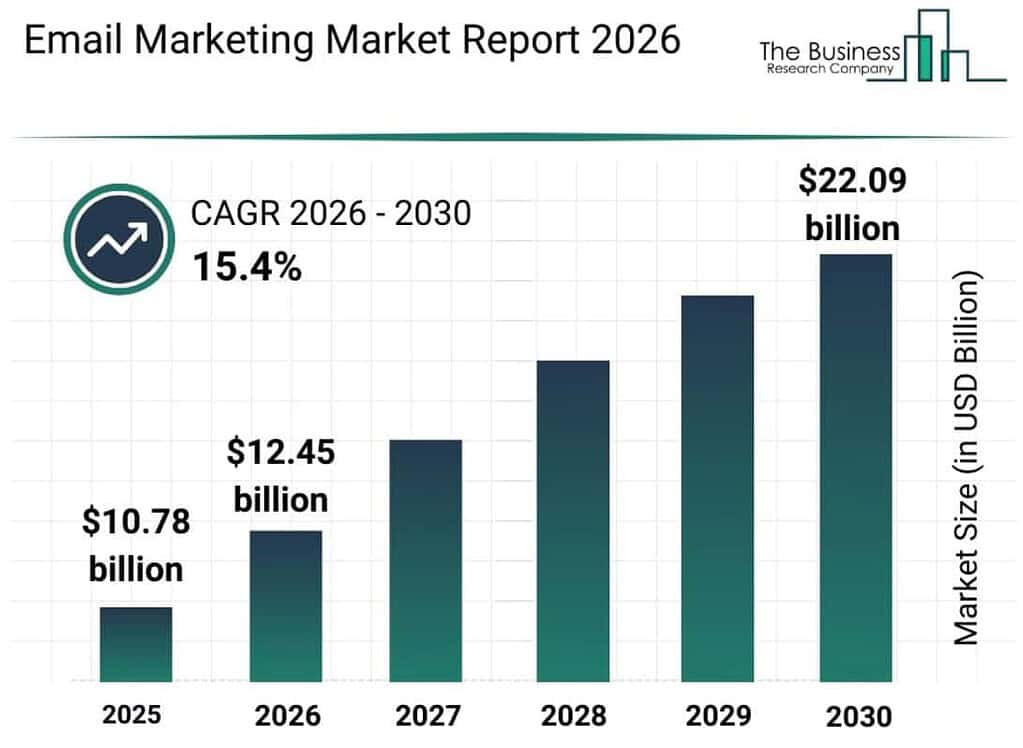
The overall market is also expected to keep growing, with the global email marketing market forecast to hit $12.45 billion in 2026. These numbers demonstrate the importance of relevance. Personal touches. Deliverability. Automation matters, and measurable revenue outcomes now matter more than email volume.
Editor’s Top Picks
- The global email marketing market is expected to rise from $10.78 billion in 2025 to $12.45 billion in 2026.
- Cold email replies average about 3.43%, and some top teams using deep personalization report 8% to 15% in their best campaigns.
- Belkins reports cold email reply rates fell 15% from 2023 to 2024, likely because inbox space has gotten tighter.
- Roughly 28% of B2B email addresses go bad each year, which is why database checks are important.
- Using more than one channel can improve results, with 20% higher close rates, 20% lower CAC, and sales cycles that are about 25% shorter than single-channel outreach.
- In Belkins’ data, the first follow-up email pulled an 8.4% reply rate, while by the fifth follow-up, it dropped to 3.8%.
- Emails that ran about 75 to 100 words saw a 21.4% response rate, and messages over 200 words were at 3.8%.
- According to Mailchimp data, segmented campaigns had a 14.31% higher open rate than campaigns that were not segmented.
- AI-assisted campaigns can reach approximately 8%–15% reply rates by using verified data, relevant signals, and human review, versus below 1% for generic AI outreach.
- Salesforce research indicates sellers expect AI agents to reduce prospect research time by 34% and email drafting time by 36%.
Email Marketing Market Growth
(Source: thebusinessresearchcompany.com)
- A new report from The Business Research Company expects the email marketing market to move from $10.78 billion in 2025 to $12.45 billion in 2026; this increase suggests email marketing is gaining ground within digital marketing.
- Several things are driving this shift as more people use digital marketing tools by the growing usage of digital marketing channels, wider use of e-commerce platforms, increased penetration of the Internet, more frequent usage of customer data analytics, as well as the falling costs of CRM system installation.
- Now many companies can lean on email to talk with customers and keep them interested.
Email Sales Outreach Strategy
- Belkins, in its 2026 research on sales email outreach, says results now lean more on strategy, how relevant the message is, and whether reps follow up, rather than blasting more emails.
- The report also says cold email reply rates dropped 15% from 2023 to 2024; the decline suggests that generic outreach at high volume is not working as well, with the main reason being that inboxes are crowded.
- According to Belkin’s report, based on real operating number finding looked at a large set of activity and reviewed 16.5 million cold emails.
- It also reviewed more than 20 million LinkedIn outreach attempts, which included 5 million cold calls. Because of that, the findings are based on real operating numbers.
- Belkins estimates that about 28% of B2B email contacts become invalid each year, and the usual cause is job changes, such as people moving to new roles.
- Regular verification helps keep deliverability steady, which also cuts down on time spent sending messages that never land.
(Source: belkins.io)
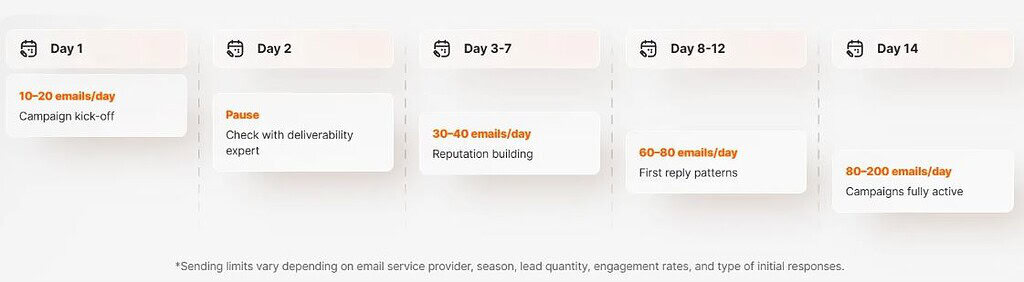
- Experts suggest that keeping in mind the rules of email marketing is a wise move when sending cold emails, and the official limit set by them is between 30 and 50 cold emails sent per day from one inbox.
- In order to scale up the process, one should use as many inboxes as possible among the different email addresses rather than sending more emails from one single inbox.
- The study shows that email marketing can benefit from the growth of multichannel marketing.
- As of 2024, the data from Belkins confirms the theory that using different communication channels positively affects marketing success as it increases closing rates by 20%, decreases costs of customer acquisition by 20%, and shortens sales durations by 25%.
- For instance, prospective buyers targeted by a campaign that consists of messages sent via email, LinkedIn, and telephone can convert at a rate 3 times higher compared to those who received messages through one specific channel.
- The timing of following up also plays an important role for marketers, while the Belkin study in 2025 proved that combining email marketing with a little LinkedIn help achieves an 11.87% reply rate.
- The initial follow-up email received an 8.4% response rate, which decreased to 3.8% by the fifth follow-up.
- The dispatch of more than four follow-ups increased the unsubscribe and complaint rates by over three times.
- Belkins thus recommends limiting the follow-up sequence to three emails before altering the subject matter or repositioning.
- Belkins advocates measuring the email outreach by reply, bounce, spam complaint, meeting booked, and show-up, not only by the amount of work done.
- According to its research, the most successful strategy is the one featuring precise data, targeted messages, controlled follow-ups, and measurable conversion results.
Email Outreach Statistics by Engagement, Personalization and Responses
- The efficacy of email outreach is directly influenced by timing, relevance, personalization, message length, and follow-up strategy.
- The 2026 cold email statistics of Amra & Elma indicate that typical cold emails are opened by 15% to 25% of recipients, pointing to the fact that when the subject line is catchy and the sender is trustworthy, a considerable number of recipients will still want to open the emails.
- 40%-60% pertains to permission-based marketing techniques, and cold outreach techniques are characterized by lower open rates but a higher targeting efficiency.
- Performance in responses has become harder to achieve, as the 2026 benchmark data from Instantly and Reachoutly reveals that the average response rate for cold emails has fallen to 3.43% as a result of saturated inboxes and powerful spam filters.
- Uniquely, superior, highly personalized campaigns achieve 8% to 15%. Write the above paragraphs considering the stark 2026 situation.
- The importance of follow-ups in outreach cannot be denied because the article notes that follow-up emails lead to an increase in responses by 25%.
- Moreover, one referenced study of AI-triggered sequences found that the cumulative response increase was as high as 31.6%, meaning that an initial email should not be viewed as the last chance to obtain a reply; it should be regarded as a first step in the conversation.
- The length of the message also makes a big difference, and it has been reported that emails of 75-100 words produced a response rate of 21.4%, while emails over 200 words got only 3.8%.
- The wider recommended range is 50-125 words, which testifies to the importance of brief messages.
- Personalization may also impact engagement, indicating that simple personalized subject lines can increase the open rates by 26%, while the use of three or more personalization elements provides a 38.2% increase.
- According to Mailchimp, segmented email campaigns have a higher open rate by 14.31% compared to non-segmented ones.
- Timing and mobile optimization should also be taken into account. For example, sending emails on Tuesday morning can achieve a 4.1% reply rate, while, according to Litmus, 87.25% of emails are delivered to the inbox, and 45% of total opens happen on mobile devices.
B2B vs B2C email benchmarks
| Metric | B2B | B2C |
| Average open rate | 37% | 34% |
| Average click rate | 3.0% | 2.0% |
| Average bounce rate | 0.7% | 0.6% |
| Average unsubscribe rate | 0.2% | 0.1% |
Technical Deliverability: Surviving the Google and Yahoo Updates
The Rise of AI in Cold Email Personalization
- The 2026 cold-email situation indicates that AI is more beneficial due to its superior research and targeting capabilities than its automated writing capacity.
- As per Prospeo and Sendr, AI-based cold emailing can have success rates below 1%. The results would see a surge to about 8%-15% if the campaign uses reliable data, relevant signals, and human review.
- Instantly’s benchmarks for the year indicate a 3.43% success rate in outreach emails, pinpointed from billions of emails that were analyzed and listed. However, the leaders’ average success rate is above 10%.
- Thus, companies with results below 1% might need to analyze targeting and relevance, sending volumes, and the quality of the offer rather than just increasing the volume of emails sent.
- Prospeo suggests that thorough personalization can guarantee about a 10-15% success rate instead of the below 1% achieved by the simpler personalization tools.
- Sender confirms its attachment to generic templates that were once again identified as unsuccessful, with their performance sitting at 1%.
- The 2026 report established that salespeople expect AI assistance to cut down prospecting time by 34% and time spent on writing emails by 36%.
- Thus, the practical benefit is not only speed but also efficient allocation of resources for selecting clients and checking quality.
- McKinsey’s estimates show that generative AI may be able to bring about 0.8 to 1.2 trillion in annual productivity in the sphere of sales and marketing.
- Only 21% of leaders from the commercial sector admitted that they fully utilize this technology in B2B sales and purchases.
- AI finds the problem and sorts it out, while a person evaluates it and moulds it into a message.
- The best campaigns include accurate data, timely triggers, a clear message, and a human touch, without absolute reliance on automation.
Conclusion
In 2026, email outreach will become more about precision than volume. Cold email average response rates are not high, while targeted and personalized emails are much more effective. Data quality is crucial as well: about 28% of all B2B addresses are invalid every year. Different strategies, concise messages, strict follow-up practices, segmentation, and high deliverability are becoming crucial.
AI brings efficiency by relieving workload that relates to research and writing, while the evidence suggests that AI-assisted outreach is much better. AI is providing an increase in efficiency levels by lessening the research and drafting efforts; however, the strongest argument is in favour of AI-assisted outreach rather than fully automated outreach. It is believed that sustainable performance can be achieved only through properly combining accurate data about prospects, signals, human logic, disciplined sending, and measurable results like replies, meetings, and conversions.
FAQ
In 2026, the average cold-email reply rate is expected to be 3.43%.
Successful cold-email campaigns can go from 8% to 15%.
It will help achieve up to 20% higher close rates, 20% less CAC, and 25% shorter sales cycles.
The recommendation is to keep outreach emails short, as 75–100 words provide a 21.4% response rate in the cited data.
For campaigns utilizing AI, it is possible to reach 8%–15% reply rates, provided verified facts, signals, and human scrutiny are applied.