









Overview
Digital Health Statistics: In recent years, the digital health industry has undergone transformational growth and a dynamic shift in the delivery of healthcare services. Thanks to the development of technology, healthcare providers, patients, and even businesses utilize more digital telehealth, wearable devices, mobile applications, and Artificial Intelligence (AI) systems, among other tools, to improve the provision of healthcare services, increase effectiveness, and minimize expenditure.
In 2026, the global market for digital health statistics is expected to grow multifold, with the growing number of remote healthcare services and the prevalence rates of chronic conditions contributing to the growth.
Editor’s Choice
- The global Digital Health market was valued at USD 264.1 billion in 2023 and is forecasted to reach a value of USD 1,190.4 billion by 2032, thereby exhibiting a CAGR of 16.7% from 2023 to 2032.
- The average revenue per user (ARPU) is anticipated to reach around USD 129.20. It is projected that the United States will lead global revenue generation with a share of USD 47.12 billion in 2024.
- The Digital Treatment and Care segment will be the biggest in the market, with an estimated share of USD 103.80 billion in the year 2024.
- On July 31, 2025 alone, 192.7 million health records were registered as breached in the United States, further illustrating the need for cybersecurity and making sure that users regard their data as safe.
- The market’s revenue is forecasted to hit USD 181.25 billion by 2026.
- In 2022, around 23.4 million patients in the United States used patient monitoring technology and services, and this number is projected to reach 30 million patients by 2024.
- Digital health statistics reveal that 80% of the population in the United States endorses the implementation of remote patient monitoring, with more than half being avid proponents of the inclusion of technology in health services.
- The number of shipped designs of devices that are worn in the ears grew by 11.2% and amounted to 611.5 million in the year 2025 Forecast Report.
- Approximately 30% (1,266 out of 4,551) of adults are users of wearable healthcare devices. Women, at 16.25%, are the most likely demographic to report usage of these devices.
Digital Health Top Takeaways
- According to Digital Health Statistics, 2024 is expected to have more than 1.4 billion users of digital health services, including fitness bands, smartwatches, online consultations with doctors, and other treatment modalities in the digital space.
- 640 million smartwatch users worldwide expected in 2026
- The COVID-19 epidemic caused a rapid upsurge in the adoption of digital health, especially telemedicine, due to the need to offer services that did not require physical interactions.
- Fitness-related wearables, such as smartwatches, have been around and very popular for a long time, and their growth is also on a steady path.
- The increased prevalence of the internet, mobile phones, and technology, in general, has enhanced the scope of digital health, especially in telemedicine, which respects technological needs such as proper internet stability, functional software, and availability of computers, tablets, or phones for video calls with patients.
- It is important not to create a divide in healthcare provision based on the availability of such tools. Usually, older people suffer from more chronic diseases and need more contact with health services, yet have lower rates of usage of digital health.
- Digital health technologies are difficult to deploy in some medical ailments, though this population, in particular, stands to gain the most from their use.
- Wearable devices, which also include the most common smartphones, are gradually being used to track health indicators for a certain period to generate data that can be used by healthcare providers.
- Moreover, with the rise of people using this type of health-based technology, new doors are being opened within healthcare systems.
- As Digital health statistics reveal, over 75% of participants expressed readiness to share their sensitive health information in case it would facilitate a solution for any health problems or enhance the efficiency of treatment.
- On July 31, 2025 alone, 192.7 million health records were registered as breached in the United States, further illustrating the need for cybersecurity and making sure that users regard their data as safe.
- Although the funding for digital health witnessed a downward trend after the peak during the pandemic, the investment levels have stabilized above the pre-pandemic figures.
- Further developments, like anticipatory changes and how AI will be incorporated into Health Care Transformations, are likely to push the usage and investments of digital health even higher.
Digital Health Market Revenue
- The market’s revenue is forecasted to hit USD 181.25bn by 2026.
- Its CAGR 2026-2031 will be 8.44% and will lead to a forecasted market size of USD 271.82bn by 2031.
- The average revenue per user (ARPU) will be USD 85.01.
- On the international scale, the lion’s share of the market will come from the United States (USD 55.25bn in 2026).
- The biggest segment of the market will be that of Digital Treatment & Care, whose revenue will reach USD 95.05bn by 2026.
Digital Health Market Size
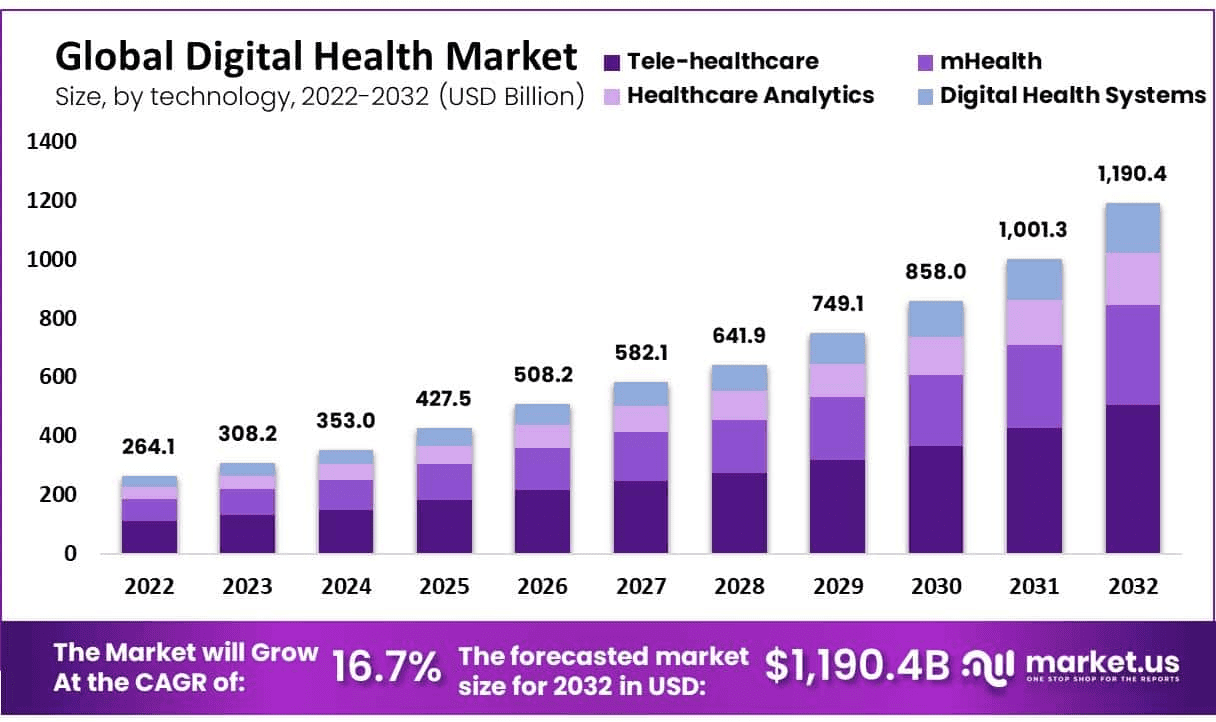
- Digital health statistics state that the market for digital health all over the world is set to undergo massive increases in market size by the year 2032.
- It is expected to cross USD 1190.4 billion by 2023. This represents a very significant increase from USD 264.1 billion in 2023. Other than that, this represents a compound annual growth rate (CAGR) of 16.7% for the period 2023 to 2032.
- Put simply, the reason why there is fast growth in the market is the increased use of some of the digital health components, such as telehealth services, health monitoring devices, digital medical records, and health-related applications.
- The growth has been propelled by factors such as faster technological growth, the increased need for consuming health services remotely, and the rising use of digitally-enabled ways of delivering care services.
- If this trend continues, the movement will grow in value by more than four times in the next ten years, indicating the importance of digital health in health systems across the world.
Digital Health Statistics by Country
United States
- Digital health statistics projected that the Digital Health sector in the US will bring in revenues of about USD 47.12 billion in 2024.
- Furthermore, this revenue is expected to increase at a Compound Annual Growth Rate (CAGR) of 8.24% during the period from 2024 to 2029 and lead to an estimated market size of USD 70.01 billion by 2029.
- It is expected that the average revenue per user (ARPU) would be around USD 247.30. Among the regions of the world, the United States will earn the highest share of global revenues, at USD 47.12 billion, in 2024.
- Digital Treatment & Care is anticipated to be the leading revenue-generating segment, valued at USD 29.91 billion in 2024.
United Kingdom
- The anticipated revenue in the Digital Health market in the United Kingdom is likely to reach USD 5.55 billion in 2024.
- It is projected to grow at a CAGR of 9.13% between 2024 and 2029, reaching a market size of USD 8.59 billion by 2029.
- The ARPU is said to be about USD 180.70, and the largest segment is Digital Treatment & Care, which is expected to generate about USD 3.28 billion in 2024.
India
- It is expected that the Digital Health market in India will touch USD 5.34 billion by 2024.
- It is further expected to grow at a CAGR of 13.14% between 2024 and 2029 to reach USD 9.90 billion by 2029.
- The net healing per user is estimated to be at USD 42.20, wherein the prominent part will be Digital Fitness & Well-Being, catering to USD 3.50 billion in revenue generation by 2024.
Africa
- According to Digital Health statistics, the Digital Health market in Africa is expected to produce revenue of approximately USD 4.86 billion by the year 2024, achieving a CAGR of 9.33% between the years 2024 and 2029, finally resulting in an overall market volume of US$7.59 billion by 2029.
- Furthermore, ARPU is the primary dominant company, with USD 47.17 billion, Digital Fitness & Well-Being being the primary driver, and USD 2.37 billion is expected in 2024.
Europe
- The digital health industry in Europe is forecasted to reach a market size of USD 37.11 billion in the year 2024, growing at a CAGR of 9.07% during the period 2024-2029 and attaining a market volume of USD 57.29 billion by 2029.
- The average revenue per user (ARPU) is forecast at USD 164.90, while Digital Treatment & Care is projected to become the largest segment in terms of revenue, at USD 20.63 billion by 2024.
- From a revenue generation perspective, ATU is likely to dominate the market, with USD 47.12 billion generated by the U.S. digital health market in the year 2024.
Digital Health Statistics by Wearables
(Reference: media.market.us)
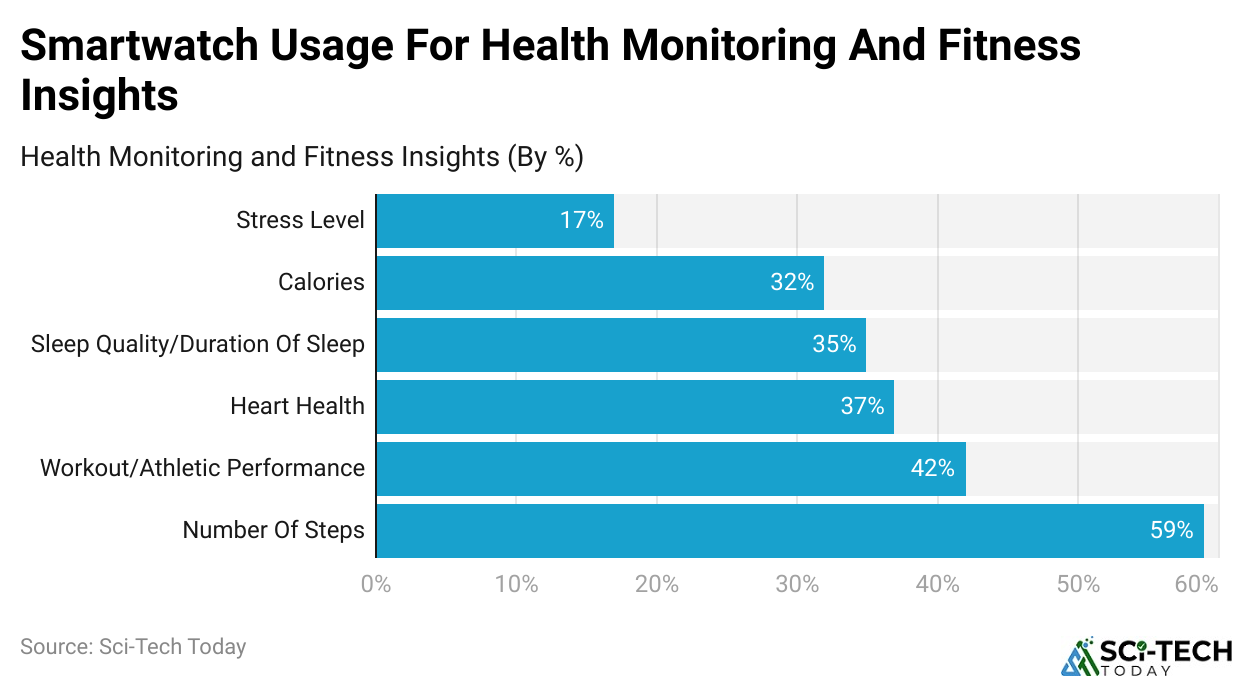
- In terms of Digital health statistics, it has been found that 59% of users use smartwatches to monitor their average daily step count. 42% use it to know how well they are training or performing in sport-related activities.
- There are also 37% of users using the gadget to keep track of their heart health, while 35% of users use it to check their sleep quality and the time spent sleeping.
- 32% of users, on the other hand, use them to find out how many calories they have burned.
- Furthermore, a notable 17% of users are interested in using smartwatches to check their stress levels.
- More than 30% of American adults who reside in households earning at least $75,000 a year own a device such as a fitness tracker or a smartwatch, while only 12% of adults earning below $30,000 a year own such devices.
- Wearable healthcare technologies are likely to be utilized more by women than men, with a rate of use being 16.25%.
- Close to 50% of consumers are using wearable technology on a normal day, while more than 80% are ready to share such information with healthcare centers.
- The number of shipped designs of devices that are worn in the ears grew by 11.2% and amounted to 611.5 million in the year 2025 Forecast Report.
- As per the National Library of Medicine, the accuracy and precision of wearable devices usually lie anywhere between 92% and 99%.
- Over the next 25 years, the market for wearable technology will flourish significantly in healthcare services, resulting in savings of over $200 billion.
Digital Health Statistics By App Usage
(Reference: media.market.us)
- Between the period of early 2021 and the end of 2024, the number of health-related applications available to Android users on the Google Play Store decreased, and by the 2nd quarter of 2024, this count was over 36,260.
- Approximately one in three older adults uses this technology to accomplish their exercise objectives.
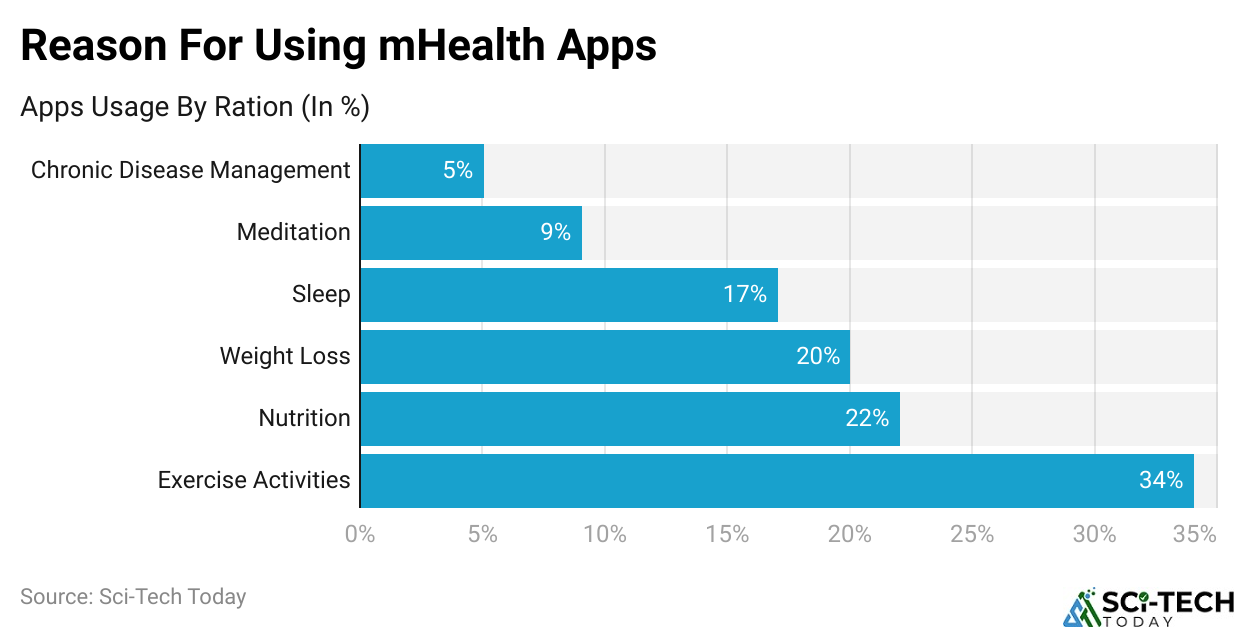
- Digital health statistics reveal that 22% of respondents who downloaded health applications did so for the purpose of better understanding nutrition, while 20% of those users downloaded the applications in order to keep track of their weight loss activities, especially because of the rising cases of obesity.
- Besides, health app usage reached 17% for sleep tracking, 9% for meditation, and 5% for the management of chronic mental disorders and/or stress.
- In the year 2022, the worldwide mHealth revenue stood at USD 50.8 billion, and the value is expected to rise to USD 150.7 billion by the year 2032, during which the compound annual growth rate (CAGR) will be 11.8%.
- For the year-end of 2023, the market is projected to generate USD 56.8 billion in revenue.
- As of 2024, there were more than 337,000 apps related to health in different app stores, mainly targeting individuals within the age bracket of 50-80 years.
- In a recent survey, around 30% of adults reported that they used at least one health app on their smartphones, whereas 16 % of them claimed they had used health apps at least once in the past.
AI Digital Health Market Size
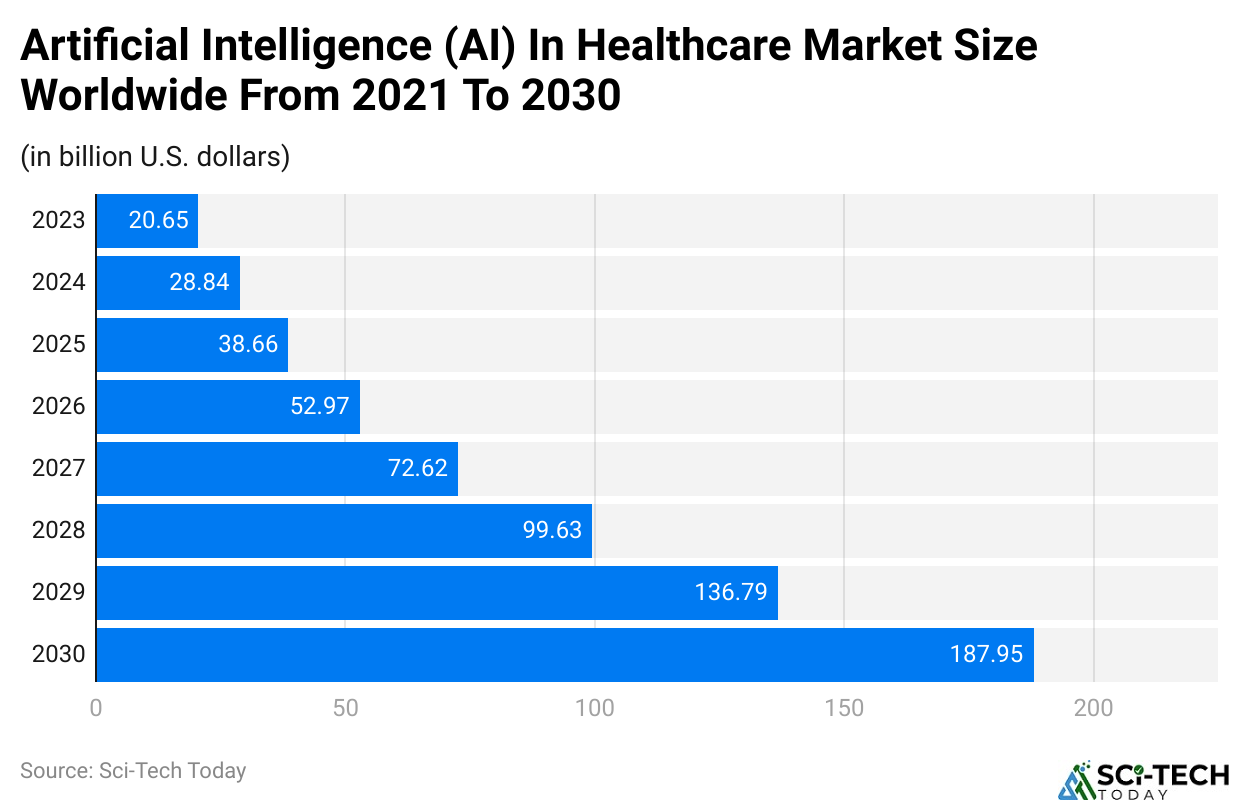
- Over the past several years, healthcare AI has experienced significant growth, with the global healthcare AI market projected to reach USD 187.95 billion by the year 2030.
- As per digital health statistics estimate, the market size is expected to be USD 20.65 billion by the end of the year 2023, then USD 28.24 billion in the year 2024, USD 38.66 billion in the year 2025, USD 52.97 billion in the year 2026, USD 72.62 billion in the year 2027, USD 99.63 billion in the year 2028 and finally USD 187.95 billion in the year 2030.
- The increasing utilization of these technologies is believed to lead to better achievement of healthcare goals for patients, lower rates of medical mistakes, and improvement of care on the whole.
- According to Digital Health Statistics, 38% of adults in the United States believe that AI technology in healthcare has improved the quality of care patients receive, with 45% of men and 30% of women quoting a positive effect.
- The under-29 age group appears to be the most benefited or satisfied with AI in healthcare at 44%, followed by those aged 30-49 at 39%, 50-64 at 33%, and those aged 65 and above at 34%.
Summary
The digital health statistics market in 2026 is poised very well to reach new heights owing to the tremendous development that has taken place in the fields of telemedicine, artificial intelligence, and smart gadgets. Considering that an ever-growing audience is turning to digital technologies for healthcare, it is expected that the market will keep growing, allowing many new ideas and investments in the development of technology.
FAQ
Digital health, also known as eHealth, is the integration of computing platforms, software, and sensors into healthcare and wellness. It uses technologies like telemedicine, wearables, and artificial intelligence to improve disease prevention, diagnosis, treatment, and overall patient outcomes.
Digital health uses the help of technology in order to achieve positive results in the healthcare industry through personalized care for patients face-to-face, through healthcare access via mobile applications, or by diagnosing diseases via neural networks.
The three most popular domains of digital health technologies are telemedicine, wearables, and augmented and virtual reality.