








Opening
Black Friday Vs Cyber Monday Statistics: Black Friday and Cyber Monday are two of the biggest shopping days of the year. Every November, shoppers wait for these events to grab big discounts on electronics, clothing, home products, beauty items, and more. But while both days offer huge savings, they are not exactly the same. Black Friday started as a major in-store shopping event, while Cyber Monday grew as a day focused mainly on online deals.
Today, the lines between the two are becoming less clear as retailers offer discounts across both stores and websites. So, which day gives shoppers better deals? This Black Friday vs. Cyber Monday comparison explores sales, discounts, spending habits, and shopping trends to find out.
Editor’s Selection
- Black Friday and Cyber Monday are increasingly blending into one extended shopping period.
- More than 200 million sessions across 2,000+ retail websites and 71 countries provide a broad view of peak-season behavior.
- The peak shopping window shortened by 5 days in 2025, signaling more concentrated demand.
- Mobile generated 78.7% of peak traffic, but desktop converted at 4.53% versus 2.41% on mobile.
- Black Friday generated USD 11.8 billion in U.S. online sales, up 9.1%-9.2% YoY.
- Mobile purchases accounted for 57.5%, generating USD 8.2 billion, an 8% YoY increase.
- Cyber Monday had 75.9 million online shoppers, including 46.9 million mobile shoppers.
- Health and beauty recorded the highest peak conversion rate at 4.38%.
- North America saw conversion rise 65%, while France posted an 85% increase.
- Gen Z and Millennials remained the strongest BFCM shoppers, with 58% likely to participate.
Key Facts About Black Friday Vs. Cyber Monday
- Black Friday started as an in-store shopping event, while Cyber Monday was created specifically to encourage online shopping.
- The term Black Friday became popular in the 1960s and was initially linked to heavy traffic and large crowds in Philadelphia.
- Cyber Monday was introduced in 2005 by the National Retail Federation and Shop.org to promote online deals.
- Black Friday is no longer limited to physical stores. Retailers now offer major Black Friday discounts online, making the event more competitive with Cyber Monday.
- Cyber Monday has also expanded beyond a single day, with many retailers launching deals earlier and extending them through Cyber Week.
- Mobile shopping has changed both events, as consumers can compare prices, check reviews, and buy products directly from their phones.
- The traditional difference between the two events is narrowing as retailers use similar promotions throughout the Thanksgiving shopping period.
- From a retail perspective, the full Black Friday-to-Cyber Monday period is now more important than either day alone.
How Do Black Friday and Cyber Monday Differ?
- Black Friday traditionally combines physical stores and online channels, while Cyber Monday is primarily an online shopping event.
- Cyber Monday was created in 2005 as an e-commerce-focused alternative to Black Friday.
- In 2025, about 81.7- 85.7 million consumers shopped in stores on Black Friday.
- Black Friday attracted 87.3 million online shoppers, compared with 75.9 million for Cyber Monday.
Black Friday Vs. Cyber Monday Statistics: Peak Season Trends and Retail Insights
- 200+ million sessions across 2,000+ retail websites in 71 countries provide a broad view of 2026 peak-season shopping behavior, according to Contentsquare.
- Black Friday, Cyber Monday, and holiday shopping habits are changing as shoppers adopt new channels and buying patterns.
- Retailers should use benchmark data rather than rely on assumptions when planning their peak-season strategies.
- Examples from ASOS, Hugo Boss, Sephora, Tommy Hilfiger, and Etsy show how leading brands are adapting their digital experiences.
- From an analyst’s perspective, these benchmarks can help retailers identify conversion opportunities, improve customer journeys, and build a more data-driven plan before the 2026 holiday shopping rush.
Shopping Window Trends
- The busiest shopping period around Black Friday and Cyber Monday became 5 days shorter between 2024 and 2025.
- In 2025, website traffic started rising about 16 days before Black Friday, compared with 21 days in 2024.
- Transactions also started increasing later, at 19 days before Black Friday in 2025 versus 24 days in 2024.
- The 5-day shift was consistent for both traffic and transactions, showing that shoppers are concentrating their activity closer to Black Friday.
- Conversion rates peaked 2 days before Black Friday in 2025, compared with 1 day before in 2024.
- This suggests shoppers are making purchasing decisions faster and spending less time browsing before buying.
Mobile Drives Discovery While Desktop Drives Purchases
- Mobile accounted for 78.7% of peak traffic, making it the main channel for product discovery and browsing.
- At its peak, mobile had a 48.8% bounce rate, compared with 45.3% for desktop.
- Desktop achieved a 4.53% conversion rate, nearly twice that of mobile’s 2.41%.
- Desktop conversion increased 64% during peak periods, while mobile conversion increased nearly 80%.
Conversion Growth Drives Peak Revenue
- Desktop revenue per visit increased from USD 5.87 to more than USD 9.
- Mobile revenue per visit increased by nearly USD 2.
- However, average order value fell 16.8% on desktop and 11% on mobile.
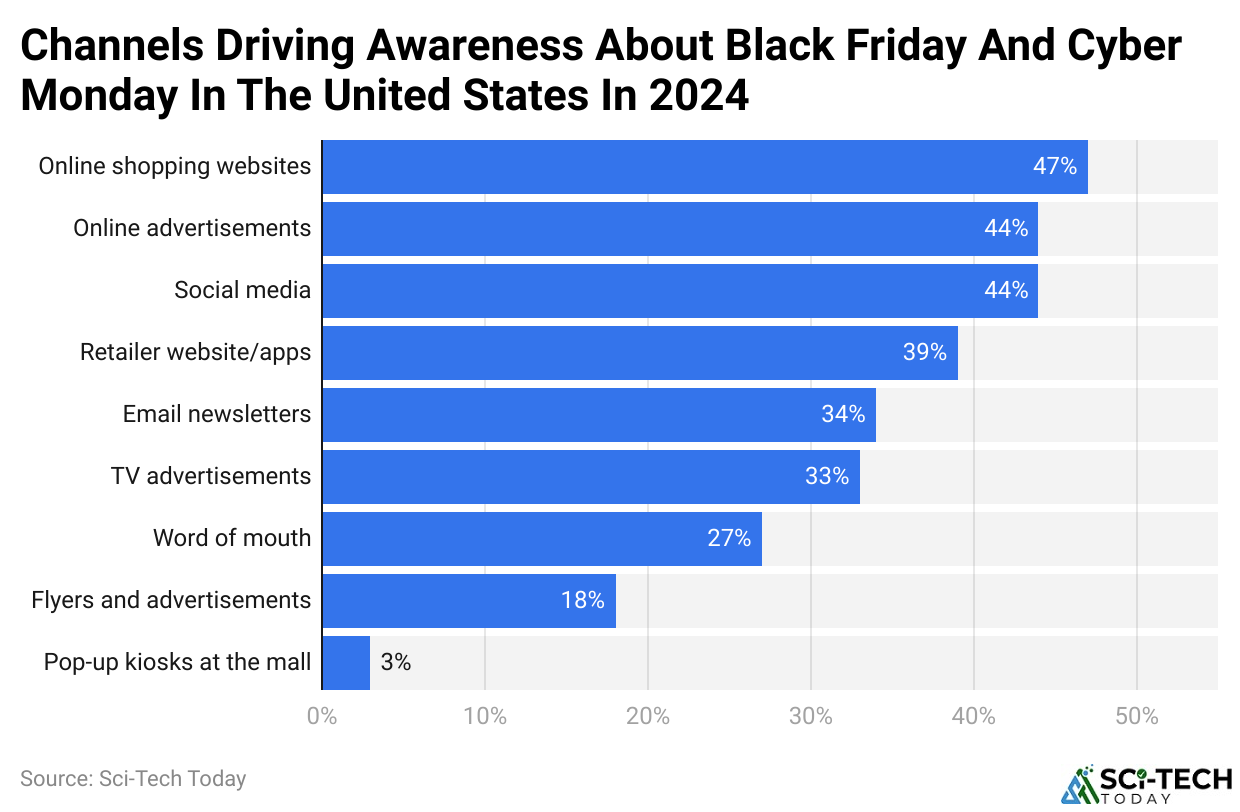
Black Friday And Cyber Monday Awareness Channels
(Reference: statista.com)
- Behold, some pretty terrific stuff is coming from the e-media, especially when it comes to mega-sales like Black Friday and Cyber Monday.
- Black Friday vs Cyber Monday statistics state that in 2024, the United States set a new record when online shopping sites even became the leading source for finding out about mega sales.
- According to the research, 44% of respondents would most probably see ads or social media for Black Friday and Cyber Monday promotions.
- Meanwhile, 39% are interested in coming to retailer websites and apps as prime hunting grounds for information on such events.
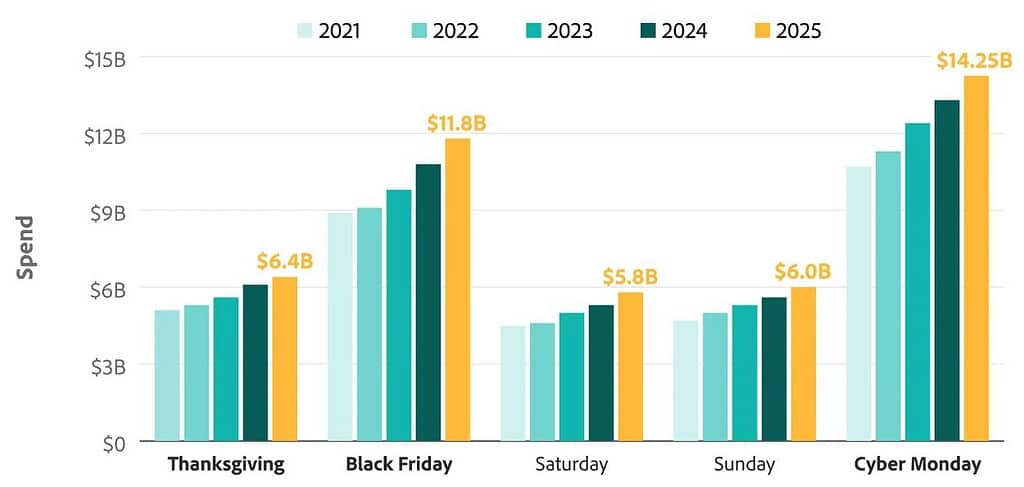
Black Friday Vs. Cyber Monday: Record Online Sales
(Source: adobe.com)
- Black Friday 2025 generated USD 11.8 billion in U.S. online sales, up 9.1%-9.2% YoY from USD 10.8 billion in 2024.
- Cyber Monday exceeded Adobe’s forecast of USD 14.2 billion. rising 7.1% YoY.
Consumer Spending Trends
- Mobile purchases accounted for 57.5%, generating USD 8.2 billion, an 8% YoY increase.
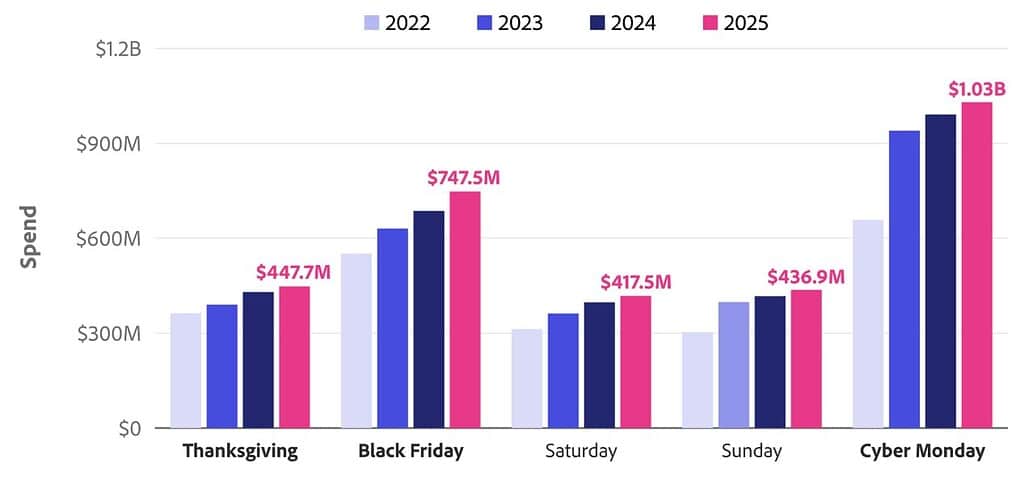
- BNPL spending reached USD 1.03 billion, increasing 4.2% YoY.
- Cyber Monday spending peaked at about USD 16 million per minute between 8am and 10pm.
- Black Friday attracted 85.7 million online shoppers and 80.3 million in-store shoppers.
- Cyber Monday had 75.9 million online shoppers, including 46.9 million mobile shoppers, up 16% YoY.
U.S. Cyber Week BNPL Spending, 2025
(Source: adobe.com)
- Black Friday BNPL spending reached USD 747.5 million, up about 7% from 2024.
- Cyber Monday BNPL spending hit USD 1.03 billion, approximately 3% higher than in 2024.
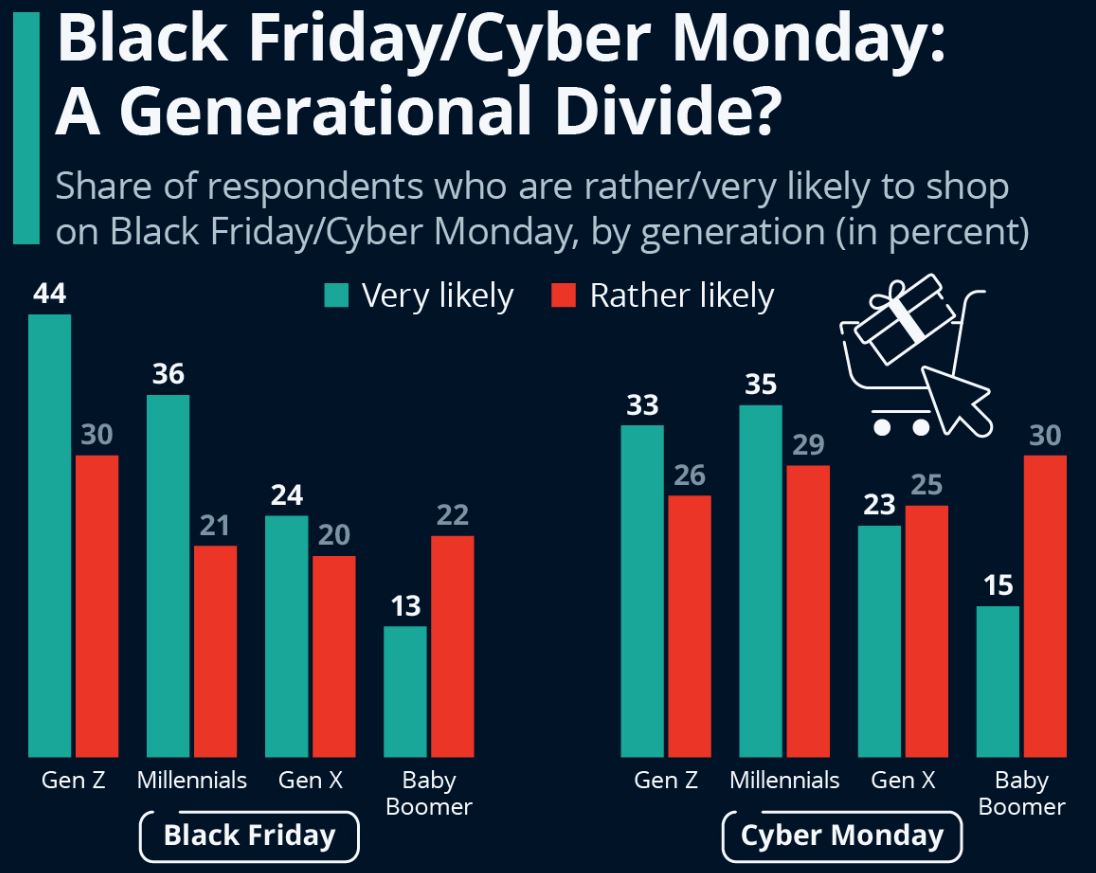
Black Friday Vs Cyber Monday By Generation
(Source: statista.com)
- For Black Friday, Gen Z shows the strongest intent: 44% are very likely, and 30% are rather likely to shop.
- Millennials follow, with 36% very likely and 21% rather likely to shop on Black Friday.
- Gen X records 24% very likely and 20% rather likely, while Baby Boomers show 13% very likely and 22% rather likely intent.
- For Cyber Monday, Millennials lead: 35% are very likely, and 29% are rather likely to shop.
- Gen Z reports 33% as very likely and 26% as rather likely, while Gen X reports 23% and 25%, respectively.
- Baby Boomers have the lowest strong Cyber Monday intent at 15%, although 30% are rather likely to shop.
Which Retail Categories Perform Best?
- Health, beauty, and home goods were strong performers because both conversion rates and AOV increased.
- Health and beauty recorded the highest peak conversion rate at 4.38%.
- Fashion and outdoors were more deal-focused, with strong conversion during the main shopping period.
- Luxury, specialty retail, and consumer electronics faced more pressure.
- Luxury pre-peak conversion fell 29%, while its AOV dropped from more than USD 500 to just under USD 400.
- Food, beverage, and grocery also recorded higher AOV alongside conversion gains.
Regional Differences Between Markets
- North America recorded about a 65% increase in conversion, a 58% rise in revenue per visit, and a 15% decline in AOV.
- EMEA conversion increased by 36%, while revenue per visit rose by 27% and AOV fell by 7%.
- France recorded an 85% increase in conversion, while the UK increased by 48%.
- Japan saw only a 2% increase in conversion.
- APAC conversion increased 54%, but revenue per visit rose only 12% because AOV fell 28%.
What Retailers Can Learn for Black Friday and Cyber Monday?
- Boots used weekly deals, early loyalty access, and limited-time offers to build demand before Black Friday.
- Lovehoney improved its website filters after real-time data showed that shoppers who used filters converted better, increasing conversions by 30%.
- ASOS changed its homepage messaging one week after Cyber Monday to focus on free delivery and app downloads instead of discounts.
- Sephora shifted toward loyalty programs, points events, virtual classes, and member experiences after Cyber Monday.
- Tommy Hilfiger used quick-add buttons to shorten the path to purchase.
- Glossier kept its offer simple: 25% off site-wide and 30% off orders over USD 100, according to a report shared by Contents Square.
- UK Lash used AI-generated review summaries to build shopper trust without overcrowding product pages.
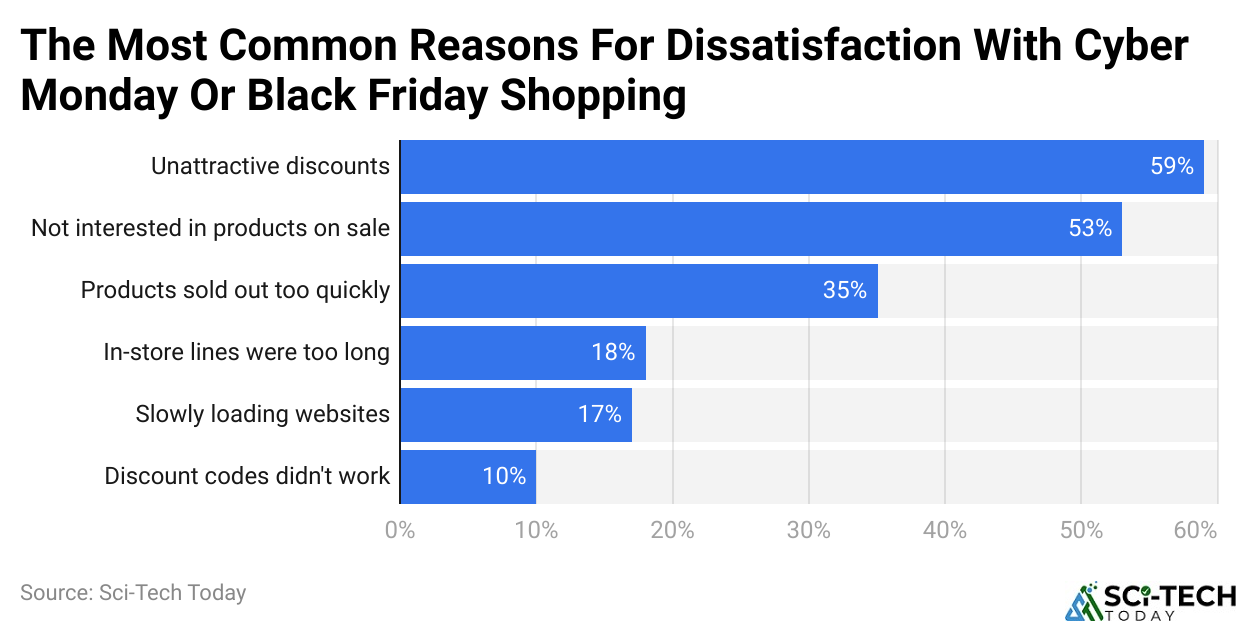
Black Friday Vs Cyber Monday Shopping Reasons
(Reference: enterpriseappstoday.com)
- As per the Black Friday vs Cyber Monday statistics, a good percentage of the consumers, 59%, reported that they were actually not satisfied with their shopping experience on either day due to not offering attractive discounts.
- In addition, 53% of customers were interested in buying some items on sale but were disappointed that the items were sold out in a flash.
- Similarly, 35 out of 100 consumers have experienced the same cash register. Shopping woes did not end there, as 18% of shoppers also complained about long queues at stores.
- Even on the virtual front, 17% thereof bemoaned their slowness in the loading speed of the websites, making their online shopping experience miserable.
- Last, 10% of Americans even complained that the discount codes did not work for them.
Black Friday and Cyber Monday 2025: Demographic Statistics
- Gen Z showed strong BFCM interest, with 58% of Gen Z and Millennials planning to shop, compared with 39% of Gen X and Boomers.
- Millennials showed strong engagement with deals, and 60% were expected to use credit cards for BFCM purchases.
- Gen X and Baby Boomers were less enthusiastic, with 40% reporting lower BFCM interest than two or three years earlier.
- Women showed greater polarization, with 39% reporting declining interest and 15% reporting increased interest.
- Men were less polarized, with 33% reporting declining interest and 8% reporting increased interest.
- Consumers earning under USD 50,000 faced greater affordability pressure, while Deloitte found overall BFCM spending intentions fell 4% YoY to USD 622.
- USD 200,000+ households remained important to retailers because J.P. Morgan found that affluent households dominated Black Friday and Cyber Monday sales.
- Gen Z and Millennials remained the strongest participation group, with 57% planning to shop during BFCM, compared with 38% of Gen X and Boomers in YouGov’s survey.
- Households with children planned to spend USD 2,349 on the 2025 holiday season, more than twice the USD 1,089 planned by households without children.
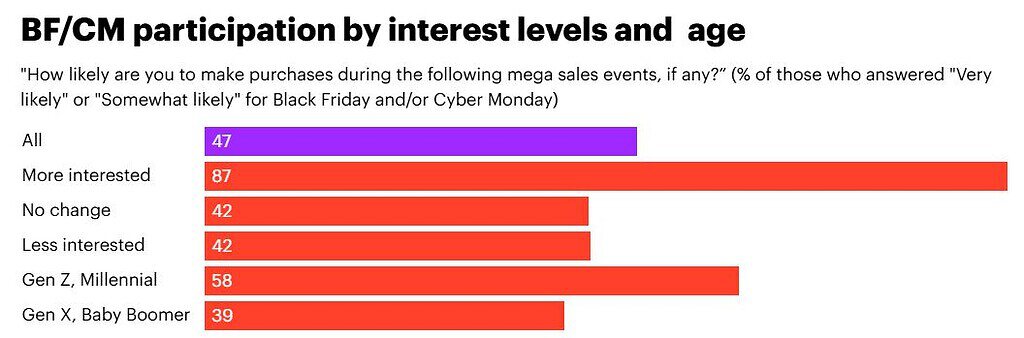
BF/CM Participation by Interest and Age
(Source: yougov.com)
- Overall, 47% of consumers are likely to shop during Black Friday and Cyber Monday (BF/CM).
- Among consumers more interested in BF/CM, 87% are likely to make a purchase.
- Only 42% of consumers with unchanged interest plan to shop during BF/CM.
- Similarly, 42% of less-interested consumers still expect to buy BF/CM deals.
- Gen Z and Millennials show stronger participation, with 58% likely to shop during BF/CM.
- Gen X and Baby Boomers have lower participation, with only 39% likely to purchase.
Category Performance: Black Friday vs. Cyber Monday
- A report published by SureBright further stated that Toys performed strongly on both days, with sales rising 622% on Black Friday and 680% on Cyber Monday.
- Electronics clearly favored Cyber Monday, increasing 452% versus 334% on Black Friday. The category generated USD 55.3 billion, up 8.8% YoY.
- Appliances performed slightly better on Black Friday, rising 476% versus 464% on Cyber Monday.
- Jewelry also saw a surge on Black Friday, up 561%, compared with 478% on Cyber Monday.
- Beauty and personal care showed stronger Cyber Monday momentum, climbing 530% versus 440% on Black Friday.
- Apparel performed well across both shopping days, supported by strong discount-driven demand.
- Electronics accounted for 20%-28% of Cyber Monday’s value share in the U.S.
- In Europe, home and kitchen ranked among the top categories, with air fryers up 240% and vacuum cleaners up 185%.
The Rate Of Discount By Category
| Day | Discount |
| Saturday, November 23 | Electronics: 26.7% Toys: 28.2% Apparel: 22.7% Average: 25.87% |
| Sunday, November 24 | Electronics: 26.9% Toys: 28% Apparel: 24.2% Average: 26.37% |
| Monday, November 25 | Electronics: 27.1% Toys: 27.4% Apparel: 23.7% Average: 26.07% |
| Tuesday, November 26 | Electronics: 27.5% Toys: 26.1% Apparel 22.4% Average: 25.33% |
| Wednesday, November 27 | Electronics: 31.4% Toys: 27.1% Apparel: 23.4% Average: 27.3% |
Remarks
Black Friday and Cyber Monday give shoppers two great chances to save money. Black Friday is known for big discounts in stores and online, while Cyber Monday focuses mainly on online deals. Both days offer strong discounts on electronics, clothing, home goods, and other products. The best choice depends on what you want to buy and where you find the best price. By comparing deals and planning ahead, shoppers can save more and spend wisely.
FAQ
Not always, but Black Friday often has better big-ticket deals, while Cyber Monday favors online discounts.
Black Friday is best for TVs and appliances; Cyber Monday usually offers better deals on electronics, software, and online services.
Black Friday is better for big-ticket purchases, while Cyber Monday often offers stronger online deals on electronics, software, and accessories.

Sources