








Starter
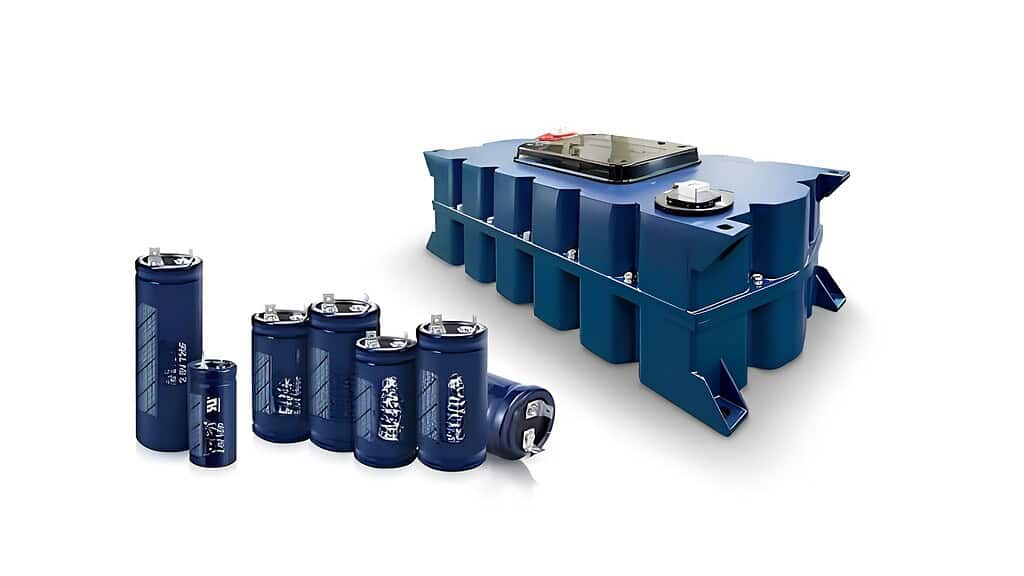
Supercapacitors Statistics: Ever noticed how a camera flash recharges in seconds, or how an electric bus can brake and speed off again almost instantly? That’s a supercapacitor at work, a fast-charging energy storage device that stores power in an electric field instead of relying on a chemical reaction like a regular battery. It can’t hold energy for very long.
Still, it makes up for that by charging and discharging incredibly fast, which is why it’s quietly showing up in electric vehicles, renewable energy systems, and backup power devices everywhere.
In this article, we’ll cover supercapacitor statistics, market size, industry growth, and more.
Key Takeaways by the Editor
- The global supercapacitor market is set to grow from USD 5.0 billion in 2024 to USD 21.7 billion by 2033, at a 17.7% CAGR.
- Electrochemical Double Layer Capacitors (EDLC) led the market in 2023 with over 68% share, built mainly on activated carbon, which accounted for more than 74% of materials used.
- Supercapacitors lose only about 1% of energy during charging, compared to up to 30% for lead-acid batteries.
- Supercapacitors can handle more than 1,000,000 charge-discharge cycles, far surpassing lead-acid batteries (1,000 cycles) and lithium-ion batteries (5,000 cycles).
- Of the 77 supercapacitor startups worldwide, only 39 have secured funding, and the United States leads with 28 companies.
- Clarios acquired Maxwell Technologies in November 2025, a company that had already shipped more than 85 million supercapacitor cells.
- Skeleton Technologies raised EUR 33 million in May 2026, taking its total venture funding to EUR 392 million ahead of a planned 2027 US IPO.
- The automotive sector led supercapacitor demand in 2025, with electric vehicles alone accounting for USD 3.59 billion of the USD 3.72 billion automotive segment.
Global Supercapacitors Market Statistics
- The global supercapacitors market is expected to grow from USD 5.0 billion in 2024 to USD 21.7 billion by 2033, at a strong annual growth rate of 17.7%.
(Source: market.us)
- Electrochemical Double Layer Capacitors (EDLC) were the most widely used type in 2023, making up over 68% of the market.
- Activated carbon was the most popular material used in supercapacitors in 2023, accounting for more than 74% of the market.
- The automotive and transportation sector was the biggest user of supercapacitors in 2023, holding over 32% of the total market share.
Battery and Supercapacitor Performance Comparison
- Supercapacitors lose about 1% of energy during charging, compared with up to 30% for lead-acid batteries.
- Specific energy density is 10–100 Wh/kg for lead-acid batteries, 150–200 Wh/kg for lithium-ion batteries, and 1–10 Wh/kg for supercapacitors.
- Specific power density is below 1,000 W/kg, below 2,000 W/kg, and below 10,000 W/kg, respectively.
- Lead-acid batteries provide around 1,000 cycles, lithium-ion batteries offer 5,000 cycles, and supercapacitors exceed 50,000 cycles.
- Charge and discharge efficiency reaches 70–85% for lead-acid, 99% for lithium-ion, and 85–98% for supercapacitors.
- Fast charging takes 1–5 hours for lead-acid, 0.5–3 hours for lithium-ion, and 0.3–30 seconds for supercapacitors. Fast discharge takes 0.3–3 hours for both battery types and 0.3–30 seconds for supercapacitors.
- Shelf life is 5–15 years for lead-acid, 10–20 years for lithium-ion, and 20 years for supercapacitors.
- Operating temperatures range from -5°C to 40°C, -30°C to 60°C, and -40°C to 75°C, respectively.
| Parameter | Lead-Acid Battery | Lithium-Ion Battery | Supercapacitor |
| Specific energy density (Wh/kg) | 10-100 | 150-200 | 1-10 |
| Specific power density (W/kg) | <1000 | <2000 | <10,000 |
| Cycle life | 1000 | 5000 | >50,000 |
| Charge and discharge efficiency | 70-85% | 99% | 85-98% |
| Fast charge duration | 1-5h | 0.5-3h | 0.3-30s |
| Fast discharge duration | 0.3-3h | 0.3-3h | 0.3-30s |
| Shelf life (years) | 5-15 | 10-20 | 20 |
| Operating temperature (°C) | -5 to 40 | -30 to 60 | -40 to 75 |
Major Advantages of Supercapacitors
- Supercapacitors can withstand more than 1,000,000 charge and discharge cycles with very little performance loss, reducing replacement and maintenance requirements.
- They can operate effectively in demanding environments with temperatures ranging from -40°C to +85°C.
- Their ultra-low equivalent series resistance allows them to deliver large amounts of current almost instantly, making them suitable for applications requiring rapid power bursts.
- Supercapacitors can reach full capacity within seconds or minutes. Unlike conventional batteries, they store energy without relying on slow chemical reactions, which supports frequent and fast charging.
- Overall, their long cycle life, broad temperature tolerance, high-current capability, and short charging time make supercapacitors well suited for automotive, renewable-energy, industrial, and backup-power applications.
Major Supercapacitor Startups
- There are 77 Supercapacitor startups in total, including well-known names like Nanoramic, Skeleton Technologies, Maxwell Technologies, Cap-XX, and Ioxus.
- Out of these 77 startups, 39 have received funding, and 12 of them have reached Series A or a later funding stage.
- The United States has the most Supercapacitor companies with 28 in total, while China and South Korea follow with 7 companies each.
- In 2026, only 1 new Supercapacitor startup has been created so far.
- Looking at the past 10 years, an average of 2 new Supercapacitor companies have been launched each year.
Leading Supercapacitor Startups and Companies
- Nanoramic: Founded in 2009 and based in Boston, United States, Nanoramic develops nanotechnology-based electrodes and supercapacitors for electric vehicles and other energy-storage applications. The Series E company has raised USD 172 million and is backed by GM Ventures, Catalus Capital, and 12 other investors.
- Skeleton Technologies: Founded in 2009 and headquartered in Tallinn, Estonia, Skeleton produces graphene-based supercapacitors, superbatteries, modules, and systems for power grids, data centers, vehicles, and heavy transportation. The Series E company had raised USD 374 million and secured backing from Marubeni, InnoEnergy, and 21 other investors at the time of the source.
- Maxwell Technologies: Founded in 1965 and based in San Diego, United States, Maxwell develops supercapacitor energy-storage solutions for automotive, transportation, renewable-energy, backup-power, communications, industrial, and consumer applications. The company is listed as acquired, with investors including SDIC Innovation, East West Bank, and 3 others.
Supercapacitors Key Industry Players Statistics
- As of Q2 2026, the market remained fragmented, with more than 110 active companies globally.
- Major suppliers included Clarios-owned Maxwell Technologies, Panasonic, Nippon Chemi-Con, KYOCERA AVX, Skeleton Technologies, CAP-XX, LS Materials, Musashi Energy Solutions, VINATech, Ioxus, and CRRC New Energy.
- Clarios acquired Maxwell Technologies in November 2025. Maxwell had shipped more than 85 million supercapacitor cells and continued operating as a standalone U.S. business unit.
- Skeleton Technologies raised EUR 33 million in May 2026, increasing its cumulative venture funding to EUR 392 million.
- LS Materials reported 20 years of ultracapacitor manufacturing experience and a customer base exceeding 500 companies worldwide.
- KYOCERA AVX offered automotive-grade, AEC-Q200-qualified supercapacitors with capacitance ranging from 10 F to 100 F.
- CAP-XX remained focused on thin, high-power prismatic supercapacitors for compact electronics, automotive, and energy applications.
- Ioxus operated under XS Power Batteries, which acquired its assets in 2020.
| Company/market category | Key numeric data as of Q2 2026 |
| Global competitive landscape | More than 110 active companies |
| Maxwell Technologies | More than 85 million supercapacitor cells shipped |
| Skeleton Technologies | EUR 33 million raised; EUR 392 million in cumulative venture funding |
| LS Materials | 20 years of manufacturing experience; more than 500 customers |
| KYOCERA AVX | 10 F to 100 F capacitance range |
| CAP-XX | No verified Q2 2026 market-share figure publicly available |
| Ioxus | Acquired in 2020 |
Automotive Supercapacitors and Usage Statistics
- The global automotive supercapacitor market was estimated at USD 3.72 billion in 2025, while Japan’s automotive segment was valued at approximately USD 333.60 million.
- Asia-Pacific remained the leading region, building on its 50.99% share recorded in 2022.
- Electric vehicles represented the leading automotive application, reaching an estimated USD 3.59 billion in 2025.
- A reliable 2025 figure for the KERS segment’s market share was not publicly available; therefore, the earlier projection of nearly 12% of a USD 7 billion market in 2028 should not be presented as current data.
- For Japan’s wider electronics industry, official data showed electronic-components production of JPY 257.60 billion in January 2025, up 7.5% from January 2024.
Supercapacitor Safety and Design Warnings
- Supercapacitors have very low internal resistance, so if a short circuit happens by accident, hundreds of amps can rush out almost instantly. This can melt circuit board wiring, burn through wires, and cause serious burns.
- Each single cell can usually handle only 2.5V to 3.0V. Going above this limit makes the liquid inside break down quickly, which creates gas, causes swelling, and can eventually make the capacitor burst.
- Unlike regular ceramic capacitors, supercapacitors care about which way the current flows through them. Connecting them backward causes gas to build up inside and damages them.
- Supercapacitors can hold their charge for a long time even after being unplugged. Before touching or repairing a high-power capacitor bank, always make sure it’s fully drained using a bleeding resistor.
Recent Supercapacitors Statistics
- On September 2, 2026, Infineon Technologies and Skeleton Technologies signed an MoU to develop solid-state transformers and GaN-based peak-shaving systems combining Infineon semiconductors with Skeleton supercapacitors for AI data centers.
- On July 22, 2026, DG Matrix and Skeleton Technologies formed a technical and commercial partnership to integrate supercapacitor-based peak-shaving and backup systems into 800-VDC AI data-center infrastructure, a segment projected to serve 39 GW of incremental capacity by 2030.
- On June 25, 2026, Skeleton Technologies announced that its 0.39-liter supercapacitor achieved a UL 810A-certified peak-current rating of 3,500 amperes, approximately 100 times the peak current of conventional batteries.
- On May 7, 2026, Skeleton Technologies completed the first close of its pre-IPO financing round with an initial EUR 33 million investment, raising its cumulative venture-capital funding to EUR 392 million ahead of a planned U.S. IPO in 2027.
- On April 23, 2026, LS Materials secured its first fusion-energy ultracapacitor supply contract for Commonwealth Fusion Systems’ U.S. demonstration project, which will deploy more than 1,000 large ultracapacitor modules.
- On March 11, 2026, Skeleton Technologies and Taiwania Capital announced a strategic investment partnership to expand supercapacitor-based mission-critical power systems for sovereign AI infrastructure across Europe and Taiwan.
- On January 21, 2026, Skeleton Technologies, Hyosung Heavy Industries, and Marubeni signed an MoU to develop South Korea’s first domestically produced next-generation e-STATCOM system using supercapacitor-based high-voltage racks, with commercialization targeted for 2027.
- On November 28, 2025, Skeleton Technologies opened its EUR 220 million Leipzig SuperFactory with an annual capacity of up to 12 million graphene-based supercapacitor cells and plans to create 420 jobs.
- On November 12, 2025, Clarios acquired Maxwell Technologies from UCAP Power, adding supercapacitor cells and modules for mobility, grid, data-center, and onsite-power applications; the transaction value was not disclosed.
- On June 9, 2025, CAP-XX reported cash reserves of AUD 4.2 million, completed its first shipment of co-branded supercapacitors to SCHURTER, and expanded distribution through Farnell, Waldom Electronics, and JM Elektronik.
The End
The supercapacitor market is entering a period of strong commercial growth, supported by rising demand from electric vehicles, renewable-energy systems, industrial equipment, power grids, data centers, and backup-power applications. Supercapacitors offer rapid charging, high power output, broad temperature tolerance, and a significantly longer cycle life than conventional batteries; however, their lower energy density restricts their use in applications requiring long-duration energy storage, making hybrid battery-supercapacitor systems an important development area.
Continued advances in materials, manufacturing scale, energy density, cost reduction, and system integration will determine the pace of supercapacitor adoption across automotive, energy, industrial, and electronic applications worldwide.
FAQ
A supercapacitor is a high-capacity energy storage device that bridges the gap between traditional capacitors and rechargeable batteries.
The automotive industry is one of the leading users of supercapacitors, especially for electric and hybrid vehicles. Consumer electronics and industrial applications also contribute significantly to overall market demand.
The supercapacitor market is expected to grow at a strong annual rate over the coming years, known as CAGR. This steady growth reflects increasing adoption across multiple industries and clean energy initiatives.
The Asia Pacific region currently holds the largest share of the global supercapacitor market. This leadership is driven by strong manufacturing activity and growing electric vehicle adoption in countries like China and Japan.
Supercapacitors are becoming popular because they charge faster and last longer than traditional batteries. Their growing use in electric vehicles, renewable energy storage, and industrial equipment highlights their valuable role in advanced technology.