








Overview
EV Charging Connector Statistics: Ever wondered what happens when you plug in an EV? That’s your charging connector, the plug, like CCS, NACS, CHAdeMO, or GB/T, that locks into your car and lets power flow in. It’s smarter than it looks too: the moment it connects, your car and the charger exchange signals on battery state and safe speed, whether it’s a slow overnight charge at home or a rapid DC session on the highway.
This small connector has become a big deal. NACS now dominates North America, BYD hit 1,500 kW charging speeds in 2026, and a new Megawatt standard is powering electric trucks across Germany and California. Older formats like CHAdeMO deployment are declining in many markets outside Japan, faster charging keeps arriving, and this tiny plug ultimately decides how smooth someone’s EV experience feels. In this article, we’ll cover the connector types, key market numbers, recent developments, and FAQs on EV Charging Connector Statistics.
Best in the Editor’s Eye
- The global EV charging connector market is set to grow nearly 4x, from USD 98.1 million in 2025 to USD 358.7 million by 2033, at a 17.6% annual growth rate.
- The U.S. crossed 70,000 DC fast charging ports by the end of 2025 and is on track to hit 100,000 by 2027, doubling its 2024 count.
- Europe’s public EV charger network is expected to nearly quadruple, from 730,000 in 2023 to around 2.7 million by 2035.
- BYD’s Super e-Platform now charges at up to 1,500 kW, adding 10-70% battery in just 5 minutes.
- The UK’s EV market is projected to generate USD 41.0 billion in revenue in 2026, climbing to USD 60.6 billion by 2031.
- Ultra-rapid chargers (150 kW+) surged 131% since 2023, making them the UK’s fastest-growing charger category with 8,842 devices.
- EV owners who charge mostly at home spend just USD 797 a year on charging, less than half the USD 1,784 average yearly fuel cost for petrol or diesel drivers.
Global EV Charging Connector Market Statistics
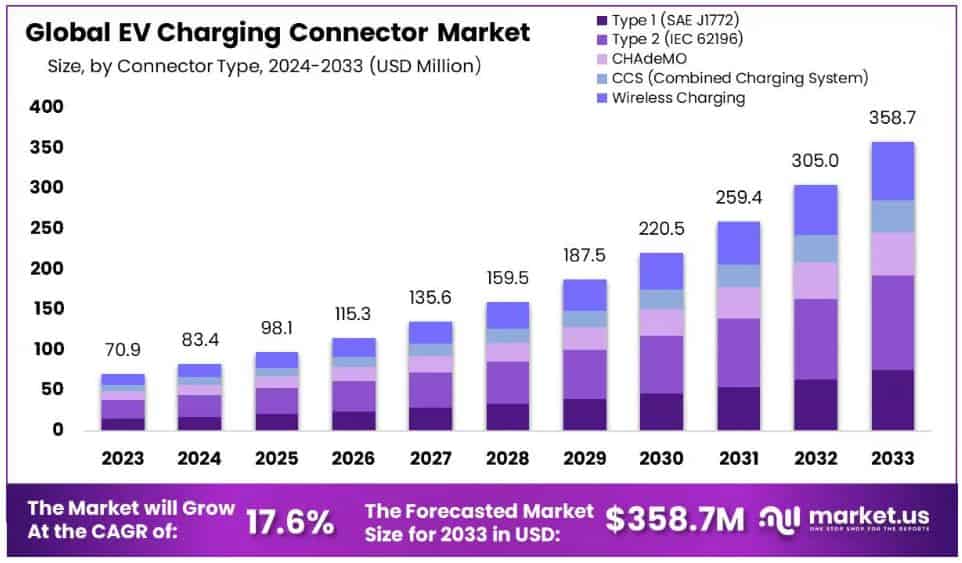
- The global EV charging connector market is expected to grow from USD 98.1 million in 2025 to USD 358.7 million by 2033, at a strong annual growth rate of 17.6%.
- Type 2 connectors led the market in 2023 with a 32.7% share, mainly because they work well with most European EVs, while Type 1 connectors remained popular for their reliability.
- Level 2 (240V) charging stations were the most widely used in 2023, holding 58% of the market, as they offer a good balance between charging speed and convenience for homes and businesses.
- AC charging connectors dominated in 2023 with a 70% market share, though DC connectors, known for faster charging, are expected to grow quickly in the coming years.
- Commercial charging led the market in 2023 with a 45% share, driven by more businesses adopting electric fleets and expanding public charging networks.
- Individual consumers made up the largest user group in 2023 at 42%, thanks to rising EV ownership among everyday drivers, while fleet operators and government infrastructure projects also saw strong growth.
(Source: market.us)
EV Charging Connectors by Companies in the UK
- According to Zapmap, InstaVolt leads the UK market for rapid and ultra-rapid EV chargers, operating 2,054 high-speed chargers as of July 2025, about 12% of the total market.
- Tesla Supercharger comes in a close second with 2,026 chargers, just 28 fewer than InstaVolt but nearly 700 more than BP Pulse, which ranks third with 1,380 chargers.
- Only three other companies have crossed the 1,000-charger mark: Osprey with 1,351, MFG EV Power with 1,166, and GRIDSERVE Electric Highway with 1,055 rapid or ultra-rapid chargers.
Types of EV Charging Connectors
- Type 1 (SAE J1772 or J-plug) is primarily used for AC charging in North America and parts of Asia. It is a single-phase connector and is commonly found on older electric vehicles and plug-in hybrids; Feyree notes that the modern version can support charging power of up to 19.2 kW.
- Type 2 (Mennekes) is the main AC charging connector standard across Europe. Developed around the IEC 62196 specifications, it supports three-phase charging and includes an automatic locking mechanism, making it well suited to public, workplace, and residential AC charging applications.
- GB/T is China’s national EV charging connector standard, developed under the supervision of the Guobiao Standardization Commission. A single domestic standard simplifies charger deployment, vehicle compatibility, and infrastructure planning across the country’s large EV ecosystem.
- Tesla connectors have historically varied by region and model, with Tesla operating proprietary charging infrastructure in several markets. However, Tesla vehicles can use adapters for other connector formats, and Tesla adopted CCS Type 2 for the European Model 3 to enable use of the wider European public-charging network.
Global EV Charging Connectors Setup Cost
- Charging costs scale sharply with power, per the DOE, Level 2 hardware/installation runs about USD 3,500/USD 2,500 per connector, while DC fast chargers cost USD 38,000-90,000 for hardware and USD 20,000-60,000 for installation; ICCT data pegs total costs at USD 28,401 for 50 kW, USD 75,000 for 150 kW, and USD 140,000 for 350 kW chargers.
- Residential setups are far cheaper, with Level 1 installation at USD 400-600 and Level 2 at USD 1,300 per connector (before labor/permits), though panel upgrades can raise costs.
- Grid connection is the most unpredictable expense, sites with spare capacity need only cabling and commissioning, while constrained sites may require transformers or utility upgrades that can exceed the charger’s hardware cost, especially for DC fast charging.
- Deploying multiple connectors at one site can lower per-unit costs by spreading fixed expenses like permitting and utility studies, though larger hubs may need higher transformer capacity, offsetting some savings.
- With the IEA reporting global public charging points surpassed 5 million after more than doubling from 2022, investors must weigh full installed costs against utilization, tariffs, and grid capacity to ensure strong returns.
U.S. EV Charging Industry
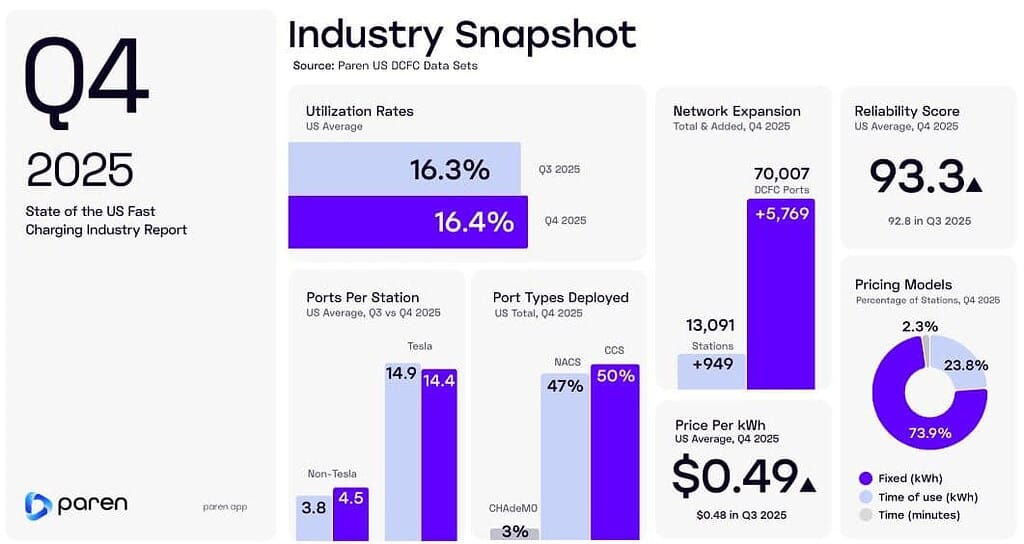
- The U.S. added 18,041 new DC fast charging (DCFC) ports in 2025, pushing the total number of DCFC ports past 70,000 by year’s end.
- Another 19,500 new DCFC ports are expected to open in the U.S. in 2026, continuing the rapid pace of expansion.
- According to the U.S. EV Fast Charging 2025 Report, new fast-charging stations grew 30% compared to the previous year.
- By 2027, the U.S. is expected to have 100,000 total DCFC ports, doubling the number that existed in 2024.
- As of February 2026, there are more than 326,000 publicly available Level 2 and DC fast charging ports across the country.
- Drivers used public fast chargers around 141 million times in 2025, marking another 30% increase from the year before.
- More new charging ports now offer 250 kW or higher power, allowing EVs to charge faster and reducing wait times at stations.
- California, Texas, and Florida added the newest fast chargers in 2025, while government-funded NEVI stations contributed just 497 ports, only about 3% of all new additions that year.
(Source: paren.app)
EV Charging Infrastructure in Europe and UK
- Europe is expected to have around 2.7 million public EV chargers by 2035, up from just 730,000 in 2023, and about 80% of them will be in the EU alone (around 2.3 million).
- New EU rules (AFIR) require more charging stations, at least 1.3 kW per battery electric car and 0.8 kW per plug-in hybrid, unless 15% of all cars are electric.
- By 2035, fast chargers (150 kW or more) will become much more common on major highways, every 60 km along key transport routes, helping drivers go farther without long waits.
- The UK plans to install at least 300,000 public chargers by 2030, even though growth might be slower than elsewhere.
- In some scenarios, there could be over 60 electric cars for each charger by 2035 (up from 30 in 2023), so expanding infrastructure stays urgent as more people switch to EVs.
Revenue Generated by UK EV Industry
- According to Statista, the UK’s electric vehicle market is projected to generate USD 41.0 billion in revenue in 2026.
- This market is expected to grow at a rate of 8.10% each year between 2026 and 2031, reaching a total value of USD 60.6 billion by 2031.
- By 2031, EV unit sales in the UK are expected to hit 1.23 million vehicles.
- Globally, China is set to lead the EV market with the highest revenue, reaching USD 579 billion in 2026.
- Growing government incentives and rising concerns about air pollution are driving strong demand for electric vehicles across the UK.
EV Charger Speed Statistics
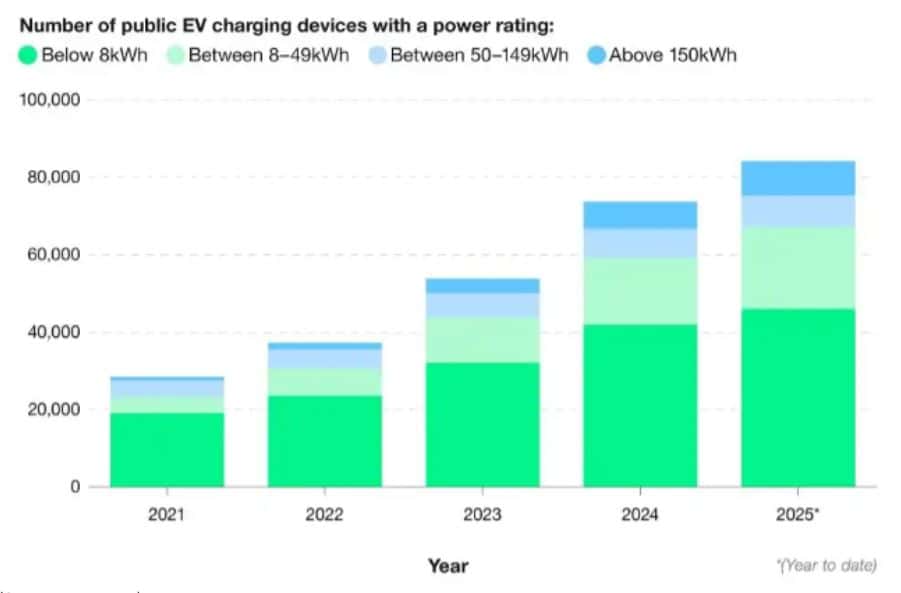
- In the UK, Zapmap classifies public chargers as: Slow (3–7 kW), Fast (8–49 kW), Rapid (50–149 kW), and Ultra-Rapid (150+ kW).
- Slow chargers are the most common, with over 46,000 devices across the UK as of July 2025, making up 55% of all public charging devices, according to Zapmap.
- Fast chargers are the second most common type, with over 21,000 devices, an 82% rise since 2023, now accounting for about a quarter of all public chargers in the UK.
- Rapid chargers are the least common, with 8,095 devices, though this is nearly double the total from 2021 and represents around 10% of all public charging points.
- Ultra-rapid chargers have overtaken rapid chargers to become the third most common type, with 8,842 devices, a massive 131% increase since 2023, signaling a clear shift toward faster, more powerful charging technology.
(Source: zapmap.com)
EV Charging Cost Statistics
- According to Zapmap’s July 2025 report, charging an EV on a public slow or fast charger costs an average of 52p per kWh, which works out to about 15p per mile.
- Rapid and ultra-rapid public chargers are more expensive, averaging 76p per kWh, around 23p per mile.
- Public charging prices have fluctuated over the past two years, with slow and fast charger costs moving between 48p and 57p per kWh between 2023 and 2025, before settling at 52p in July 2025, about 9% lower than the same time last year.
- Rapid and ultra-rapid charger prices followed a similar pattern, rising from 72p per kWh in March 2023 to a peak of around 81p, before dropping back to 76p by April 2025.
- EV drivers who charge at home 80% of the time and use public rapid chargers for the remaining 20% enjoy the lowest running costs, paying just 6p per mile on average.
- These drivers spent around £630 (USD 797) per year on charging in June 2025, less than half the £1,410 (USD 1,784) average annual fuel cost for petrol or diesel car owners, highlighting the significant cost savings of driving electric.
| Charger type | Average cost |
| 3 kWh EV charger – supply only | £375 (USD 474) |
| 7 kWh EV charger – supply only | £625 (USD 790) |
| EV charger with installation | £1,000 (USD 1,265) (£650 (USD 822) for those eligible for a government grant) |
Recent EV Charging Connector Statistics
- In March 2025, BYD launched its Super e-Platform with 1,000 kW Flash Charging; by 2026, its second-generation Blade Battery pushed that to 1,500 kW, adding 10–70% charge in 5 minutes, with a 15,000-station China rollout and a Europe debut planned for Q2 2026.
- On September 29, 2025, Germany’s HoLa project opened Europe’s first public MCS charge point at Lipperland Süd, delivering up to 1.2 MW.
- As of early 2026, no widely available adapter lets non-Tesla CCS vehicles use Superchargers, leaving Tesla’s Magic Dock program as the main workaround at select sites.
- On February 9, 2026, CharIN’s IEC TS 63379-megawatt connector standard was published, letting trucks and chargers from different manufacturers interoperate up to 3.75 MW.
- On March 26, 2026, Kempower’s Mega Satellite MCS completed the first megawatt truck charge in North America at EV Realty’s California hub, delivering up to 1.2 MW and 1,500 amps.
- In 2026, the Milence joint venture continued building out its MCS corridor, targeting 284-megawatt charge points across 71 sites in 10 EU countries for long-haul electric trucking.
- On May 26, 2026, US charging operators Voltera and Revel merged into a 1,000+ stall network across 11 metros, with EQT taking majority ownership and BlackRock’s Global Infrastructure Partners keeping a minority stake.
- On July 21, 2026, Einride acquired the 17-person EV-charging software startup Flipturn in an all-stock deal worth USD 38 million, its first acquisition as a public company.
Wrapping Up
EV charging connectors became one of the most important pieces of the EV story, and the numbers prove it, the connector market is set to jump from USD 98.1 million in 2025 to USD 358.7 million by 2033, US DCFC ports are racing past 70,000 toward 100,000 by 2027, and Europe’s public chargers are set to nearly quadruple by 2035. Charging speeds keep climbing too, with BYD hitting 1,500 kW and the new Megawatt Charging System pushing trucks past 1 MW, while standards keep converging around NACS, GB/T, and CCS.
At the end of the day, it’s this small connector that decides how smooth or stressful an EV owner’s charging experience feels, making it one of the clearest signals of where the EV revolution is truly headed.
FAQ
GB/T holds the largest share globally, an estimated 60% of the connector market in 2026, thanks to its mandatory use across mainland China, the world’s largest EV market. Outside China, NACS (Tesla’s connector, standardized as SAE J3400) has become the dominant fast-charging standard in North America since 2023, while CCS2 leads Europe.
Yes, almost everywhere outside Japan. Electrify America stopped installing new CHAdeMO plugs in January 2022, ChargePoint issued an end-of-life notice for CHAdeMO hardware in December 2025, and the connector made up just 4.4% of European charging sessions in 2024. Japan still runs about 12,600 CHAdeMO chargers, but even Japanese automakers plan to shift to NACS by 2026-2027.
The current mass-production record belongs to BYD’s Flash Charging system, which hit 1,000 kW in March 2025 and 1,500 kW in its 2026 second-generation version, adding a 10-70% charge in 5 minutes. For heavy trucks and buses, the new Megawatt Charging System (MCS) standard supports up to 3.75 MW, with working deployments already running at 1.2 MW in Germany and California.