









Opening Remarks
AI In Vision Statistics: Machines can now do more than process data. With AI in vision, they can also recognize objects, understand images, and spot details that people might miss. This technology uses AI to analyze photos and videos, turning visual information into useful insights. Its impact is already visible in many fields. Doctors use it to examine medical scans, factories rely on it to check product quality, and retailers use it to track products and improve customer service.
AI vision tools also support security systems and self-driving cars. As technology improves, more businesses are finding practical ways to use it to save time, reduce errors, and make everyday work easier.
Best Overall
- The global AI in vision market is projected to reach USD 28.4 billion in 2025 and USD 36.1 billion in 2026.
- Hardware systems account for 39% of the market, and deep learning leads with a 34% share.
- The North American region holds a 37% market share in 2026.
- In 2026, healthcare accounts for the largest share at 19.5%, followed by industrial manufacturing at 18.4%.
- Quality control accounts for 46% of projects, followed by infrastructure inspection at 22%.
- Imaging and diagnostics account for 66% of healthcare projects.
- Amazon Web Services generated USD 42.2 billion in Q2 revenue, up 37%, while AI exceeded a USD 25 billion annual run rate.
- AI detects defects with 90%-95% accuracy, compared with 70%- 80% for human inspectors, and can reduce scrap by 30%.
- The global AI in computer vision market is projected to grow from USD 22.85 billion in 2025 to USD 27.01 billion in 2026.
- Quality control accounts for 46% of projects, followed by infrastructure inspection at 22%.
- Automated systems can reduce the need for manual inspection by 40%- 70% through more efficient quality control.
- Around 75% of manufacturers use AI vision for inspection.
Global AI in Vision Market Size
(Source: market.us)
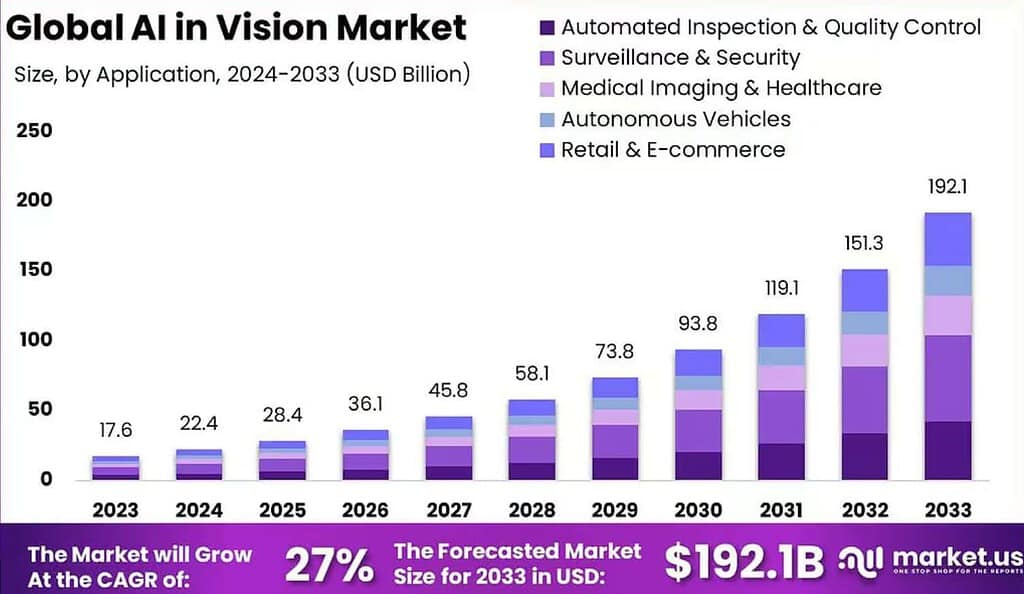
- The global AI in vision market is projected to reach USD 28.4 billion in 2025 and USD 36.1 billion in 2026.
- The market is forecast to grow at a 27% CAGR, reaching USD 192.1 billion by 2033.
Market Share Analysis by Offering
(Reference: ifactoryapp.com)
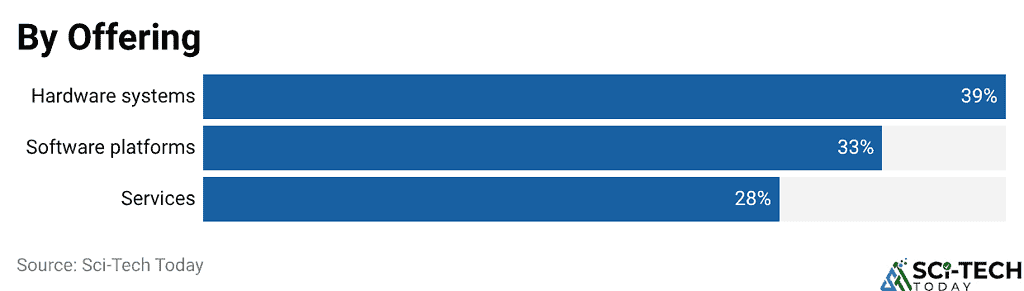
- Hardware systems account for 39% of the market, making them the leading offering.
- Software accounts for 33% of the market, while services account for another 28%.
By Technology
- Deep learning leads with a 34% share, followed by machine learning at 27%.
- Edge AI holds 22% of the market and is growing the fastest, while traditional computer vision accounts for 17%.
By Application
- iFactory reported that defect detection and quality control led with 41%.
- Assembly verification holds 26%, while packaging and labeling account for 19%.
- Other applications make up the remaining 14%.
By Deployment Mode
- Edge-based systems dominate with 58% because production lines require inspection results in under 100 ms.
- Hybrid edge-cloud solutions account for 27%, while cloud-based systems hold 15%.
AI Vision Inspection Market by Region
- According to ifactoryapp.com, North America holds 37% in 2026.
- Asia Pacific accounts for 32% and has the fastest CAGR.
- Europe represents 23%, supported by the automotive, pharma, and Industry 4.0 sectors.
- The rest of the world contributes 8%, with adoption rising across LATAM and MEA.
Industry Distribution of AI Vision Inspection Use Cases
(Source: ghost.io)
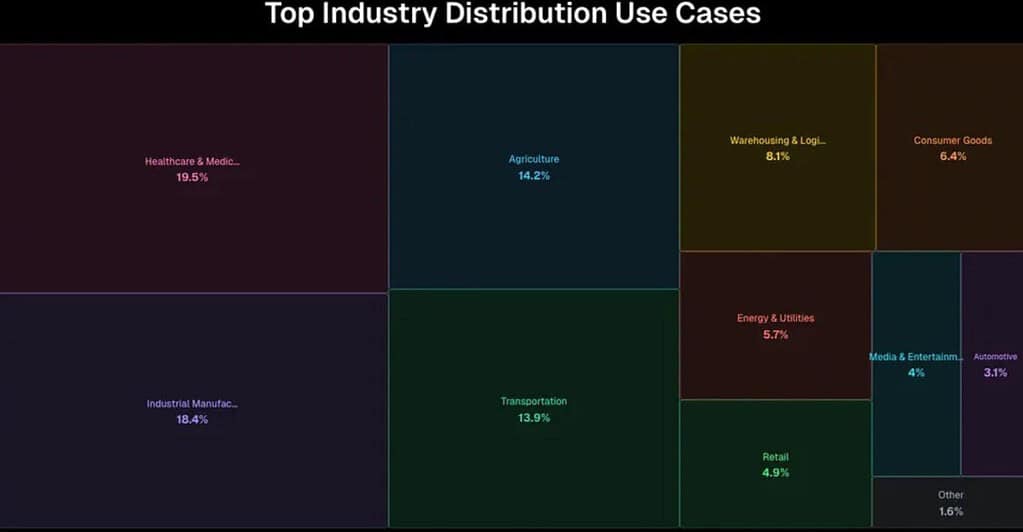
- In 2026, healthcare accounts for the largest share at 19.5%, followed by industrial manufacturing at 18.4%.
- Agriculture and transportation represent 14.2% and 13.9%, respectively.
- Meanwhile, warehousing and logistics account for 8.1%, consumer goods for 6.4%, and energy and utilities for 5.7%.
Visual AI in Manufacturing Statistics by Main Applications
(Reference: ghost.io)
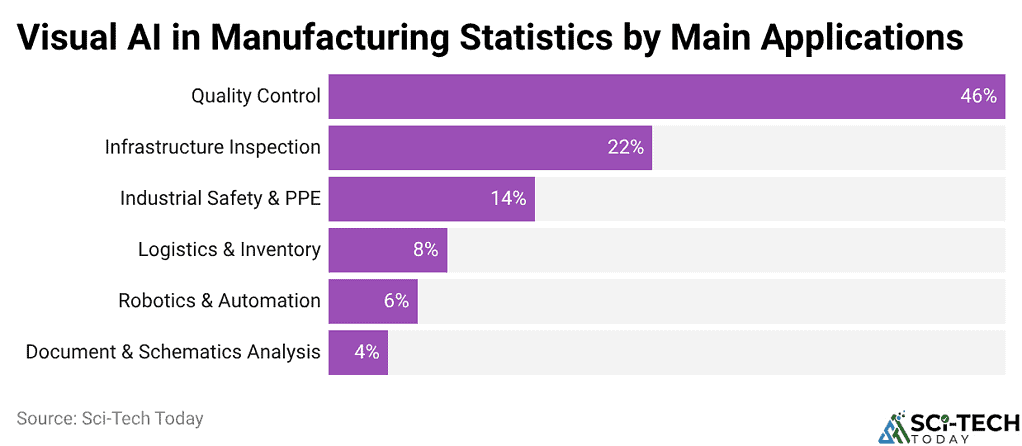
- Quality control accounts for 46% of projects, followed by infrastructure inspection at 22%.
- Industrial safety and personal protective equipment checks represent 14%, while logistics and inventory account for 8%.
- Robotics and automation contribute 6%, and document and schematic analysis represents 4%.
Other Industry Applications
- Roboflow further reported that imaging and diagnostics account for 66% of healthcare projects.
- Critical infrastructure inspection accounts for 32% of energy projects and supports predictive maintenance.
Top 10 AI Vision Companies Valuation in 2026
| Company | Key Statistics |
| Amazon Web Services | In Q2, revenue reached USD 42.2 billion, up 37% year over year; its AI business exceeded a USD 25 billion annual revenue run rate. |
| Basler AG | In H1 2026, revenue totaled EUR 152.4 million, up 36% year over year; full-year revenue guidance was EUR 270-290 million. |
| Clarifai | In 2026, its platform update introduced a USD 5 welcome credit and reasoning models with 3B and 14B parameters. |
| Cognex Corporation | In Q2, revenue reached USD 291 million, up 17% year over year, with a gross margin of 70.6%. |
| Everseen Limited | Its platform analyzed more than 15 million transactions and processed more than 6 petabytes of data daily. |
| Google LLC (Alphabet Inc.) | In Q2, Google Cloud revenue reached USD 24.8 billion, up 82% year over year. |
| Hailo Technologies Ltd. | Hailo’s Hailo-8 accelerator delivers up to 26 TOPS (tera-operations per second) of processing performance. |
| IBM Corporation | In Q2, revenue totaled approximately USD 17.2 billion, including USD 7.8 billion from software. |
| Intel Corporation | In Q2, revenue reached USD 16.1 billion, up 25% year over year. |
| Keyence Corporation | Ended March 20, 2026, net sales totaled JPY 1,169.289 billion, with operating income of JPY 595.759 billion. |
AI Vision ROI and Industry Performance
- AI detects defects with 90%-95% accuracy, compared with 70%- 80% for human inspectors, and can reduce scrap by 30%.
- Computer vision can reduce downtime by 30%-50%, with ROI achieved in 12-15 months.
- Footfall analytics can raise conversion rates by 10% to 15%.
- PPE monitoring can reduce safety violations by 60%-85%.
- Systems analyze 15 to 30 FPS and can trigger ANPR access controls in under 200 ms.
- Tapway reports that customers often achieve ROI within 6 to 12 months.
AI in Computer Vision Market Statistics
(Source: fortunebusinessinsights.com)
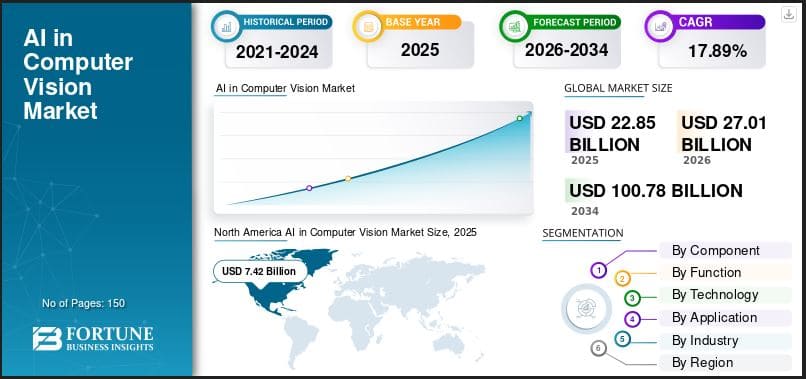
- The global AI in computer vision market is projected to grow from USD 22.85 billion in 2025 to USD 27.01 billion in 2026.
- At a CAGR of 17.89%, the market could reach USD 100.78 billion by 2034.
- North America held 32.47% of the global market in 2025, valued at USD 7.42 billion. Its value is projected to rise to USD 8.56 billion in 2026.
- The United States market is expected to reach USD 5.85 billion in 2026.
- Hardware is projected to hold 57.71% of the market in 2026, while inference is expected to capture 66.20%.
Technology Transformation in Computer Vision
- HTF Market Intelligence stated that automated systems can reduce the need for manual inspection by 40%-70% through efficient quality control.
- Deep learning, vision transformers, and multimodal AI can improve inspection throughput by 20%-50%.
- Predictive vision analytics can reduce inspection-related failures by 15%-30%.
- Edge processing can reduce unnecessary data transmission and cloud computing needs by 15%-30%.
- The top five companies held a combined market share of 57% in 2025.
Enterprise Vision AI Adoption Highlights
(Source: website-files.com)
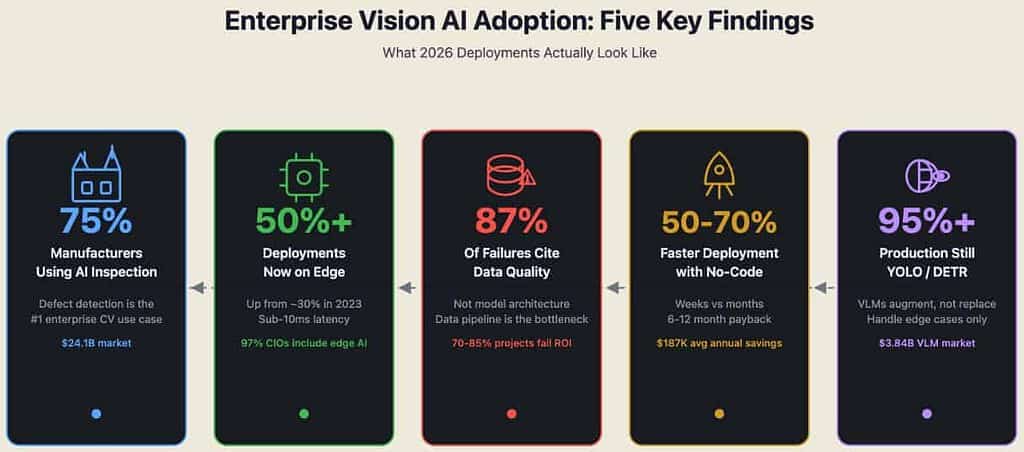
- Around 75% of manufacturers use AI vision for inspection.
- More than 50% of deployments now operate at the edge.
- 87% of failures occur during the data-quality stage.
- 50%-70% faster deployment is possible with no-code tools.
- More than 95% of projects meet production service-level objectives (SLOs).
Key Adoption and Performance Indicators for Industrial AI Vision
- Cognex stated that around 57% of manufacturers already use AI-powered vision, while 30% plan to adopt it soon.
- Logistics leads adoption at 72%, followed by electronics at 61% and automotive at 60%.
- Manufacturers with 3 or more years of AI use rate scaling 10.9 points higher than new adopters.
- About 81.5% report high confidence in AI accuracy for precision-focused production lines.
AI in Vision Business Benefits Statistics, 2026
- 84% of manufacturers report measurable operational value from AI, while core manufacturing KPIs could improve by approximately 20%.
- Only 20% of AI use cases scale consistently across sites or enterprises.
- AI adoption reaches 62% in quality, followed by 57% (production) and 49% ( logistics and supply chains).
- Process manufacturers could improve equipment availability by 27% and material planning by 23%.
- Discrete manufacturers could reduce maintenance costs and energy consumption by 22% each, while improving cycle time by 21%.
- 64% of surveyed organizations actively use AI, according to NVIDIA.
- AI improves employee productivity for 53% of respondents and operational efficiency for 42%.
- 34% report new revenue opportunities, 88% report revenue impact, and 87% report lower costs.
- AI contributes to revenue growth above 10% for 30% and growth of 5%-10% for 33%.
- 25% report cost reductions above 10%.
- Digital twins improve throughput by 20%, identify up to 90% of potential issues before physical changes are made, and may cut capital expenditure by 10%-15%.
- McKinsey reports positive EBIT impact for 37% of organizations, productivity gains for 80%, and identifies just 6% as AI high performers.
Ranking of the Most Popular AI Models for Understanding and Processing Visual Inputs (July 2026)
| AI Model | Developer | Arena Score | 95% Score Interval | Votes |
| Claude Fable 5 | Anthropic | 1,334 | 1,325-1,343 | 7,411 |
| Claude Opus 4.7 Thinking | 1,320 | 1,313-1,327 | 19,381 | |
| Claude Opus 4.7 | 1,315 | 1,308-1,322 | 19,867 | |
| Claude Opus 4.6 Thinking | 1,315 | 1,308-1,322 | 19,223 | |
| Claude Opus 4.6 | 1,313 | 1,306-1,319 | 23,584 | |
| Gemini 3.5 Flash Medium | 1,310 | 1,299-1,320 | 4,232 | |
| Muse Spark | Meta | 1,307 | 1,297-1,316 | 5,625 |
| Gemini 3 Pro | 1,305 | 1,297-1,313 | 13,183 | |
| Gemini 3.5 Flash High | 1,301 | 1,289-1,313 | 2,998 | |
| GPT-5.4 High | OpenAI | 1,299 | 1,292-1,306 | 19,375 |
(Source: statista.com)
Wrap-Up
AI in vision is making it easier for machines to identify and understand visual data. Today, it supports many tasks in healthcare, security, transport, and manufacturing. As this technology develops, businesses can expect better accuracy and faster results.
However, privacy concerns, mistakes, and high costs still need attention. Despite these challenges, AI in vision has strong growth potential and will play an increasingly important role in everyday life and future technological development.
FAQ
Vision AI helps with quality inspection, object detection, facial recognition, medical imaging, security monitoring, autonomous vehicles, and inventory tracking.
Vision AI requires cameras, a compatible computer, sufficient RAM, storage, and a GPU or AI accelerator.
Main types include image classification, object detection, image segmentation, facial recognition, and optical character recognition.