








Intro
Digital Vault Statistics: As digital information grows in value, secure storage has become a basic need for individuals and businesses alike. A digital vault is an encrypted online space designed to protect sensitive items such as legal papers, financial records, passwords, identity documents, and other digital assets, keeping them safe from loss, theft, and unauthorized access. Rising cyber threats, remote work habits, and stricter privacy rules are encouraging wider use of these platforms. Cloud adoption and the shift from paper to digital records have further increased the need for trusted storage. Banking, healthcare, legal, insurance, and government sectors rely on features like multi-factor authentication, access controls, audit trails, and safe document sharing.
This report presents key statistics on adoption trends, user behavior, security concerns, and technology developments. Together, these figures show how digital vault solutions are shaping the way sensitive data is stored, managed, and protected.
Key Takeaways from the Editor
- The global digital vault market is projected to reach USD 1,333.8 million in 2026, and USD 3,276.4 million by 2033.
- India’s DigiLocker reported over 735.3 million registered users and 9.3603 billion issued documents in September 2026.
- France’s Digiposte reported over 13 million digital vaults and nearly 17,000 business customers in January 2026.
- Denmark’s Digital Post registered 4,880,886 residents aged 15+, representing 95.6% of that population, in the second half of 2026.
- On October 27, 2026, LexisNexis expanded Vault capacity from 500 to 100,000 documents, supporting 500 MB files across 14 formats.
- FutureVault delivered 9 releases and 100+ improvements between July 9 and September 29, 2026, and has raised USD 31 million in cumulative funding.
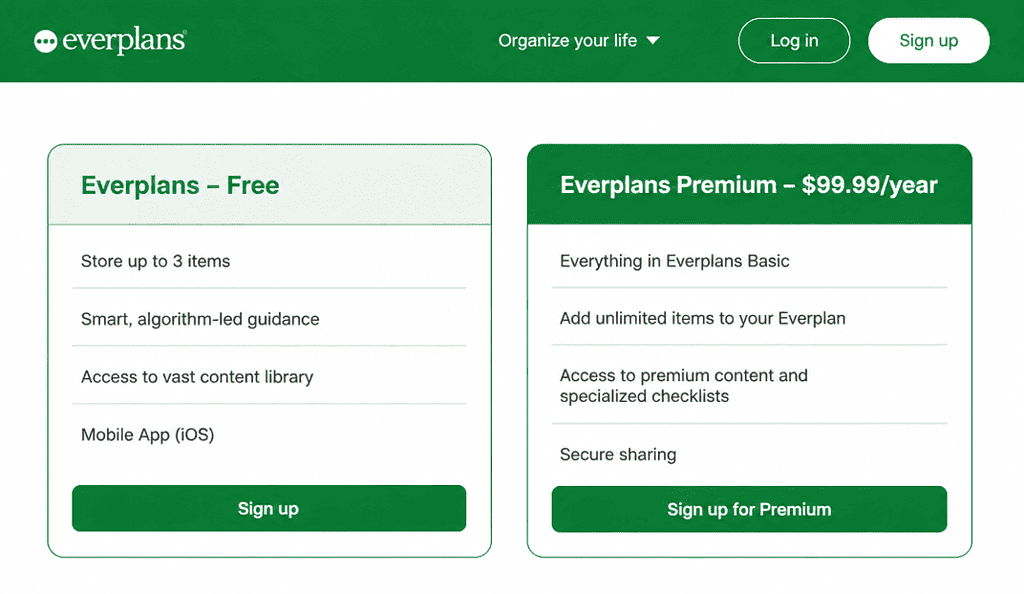
- Annual personal vault pricing ranges from USD 45 for Prisidio Starter to USD 99.99 for Everplans Premium.
- Thales reports that 61% of organizations cite harvest-now-decrypt-later concerns, while 59% are evaluating post-quantum cryptography.
Recent Digital Vault Stats
- On October 27, 2026, LexisNexis expanded Vault capacity from 500 to 100,000 documents, supporting 500 MB files across 14 formats.
- FutureVault’s October 6, 2026 update detailed 9 releases (5.45–5.53) and 100+ improvements delivered July 9–September 29, including governed AI querying.
- On September 14, 2026, Avalanche announced UAEPASS’s Digital Vault upgrade; UAEPASS supported 12.5 million users and 15,000+ services.
- On June 10, 2026, DigiLocker announced onboarding 68 electricity utilities across 35 states and union territories, enabling secure access to digital electricity bills.
- On November 12, 2025, Delaware awarded Prismm USD 1 million through SSBCI and USD 125,000 through EDGE to expand its inheritance-focused digital vault.
- On January 21, 2026, GDS reported 15,000+ digital Veteran Cards added to GOV.UK One Login, advancing government credential storage and driving-licence testing.
- On March 6, 2025, FutureVault raised USD 3 million, bringing cumulative funding to USD 31 million to advance AI-powered digital vaults and automation.
- On January 20, 2025, MeitY introduced Entity Locker with 10 GB encrypted storage, digital signatures and government-system integrations to streamline business-document management.
Digital Vault Adoption Rate
- Software solutions represent approximately 64% of digital-vault demand, according to PMR.
- 2026 industry share: Banking, financial services, and insurance account for approximately 31% of the digital-vault market.
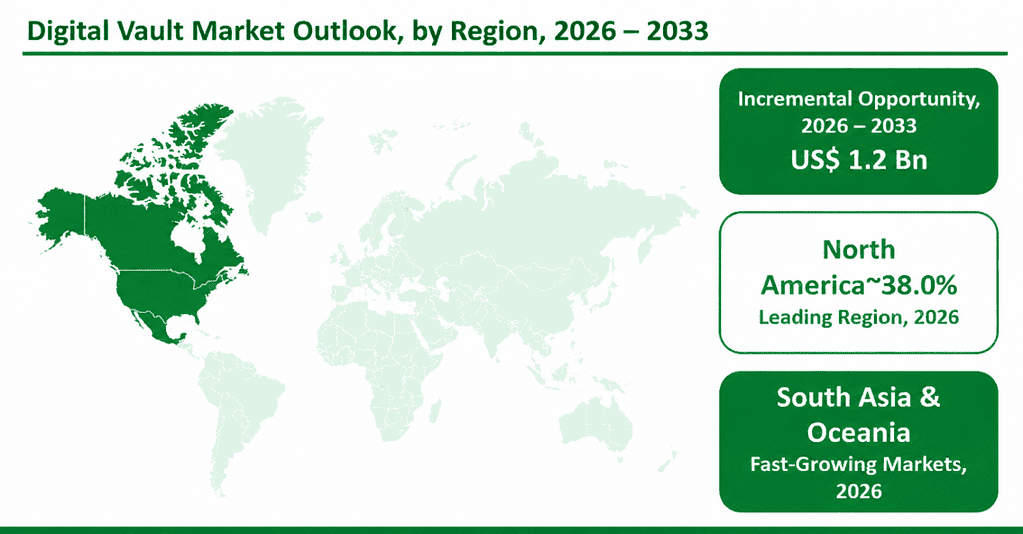
- PMR estimates North America at approximately 38%, Europe 27%, and East Asia 24% of the global market.
Leading Countries in Digital Vault Adoption
- India: DigiLocker reported over 735.3 million registered users and 9.3603 billion issued documents in September 2026.
- France: Digiposte reported over 13 million digital vaults and nearly 17,000 business customers in January 2026.
- United Arab Emirates: UAE PASS, incorporating Digital Vault, exceeded 12 million registered platform users in July 2026; this measures overall platform adoption.
- Sweden: Kivra served over 6 million users and more than 50,000 organizations, according to EY’s 2026 profile.
- Denmark: Digital Post registered 4,880,886 residents aged 15+, representing 95.6% of that population, at the beginning of 2026’s second half.
- Belgium: Doccle reported nearly 4 million Belgian account holders in 2026; 40% of municipalities distributed payroll documents through its platform.
- Finland: Suomi.fi Messages exceeded 4 million users in August 2026; OmaPosti reported 2.8 million registered users in October 2026.
Personal Digital Vault Statistics
- Fact.MR projects 2026 shares of 38% for wallet issuance/integration and 42% for government digital IDs.
- For the combined 2026 market, 45% government-agency share by customer type and 40% government-led share by delivery model.
- As of 31 July 2026, DigiLocker offered 5,437 document types/services: 661 central-government and 4,776 state-government.
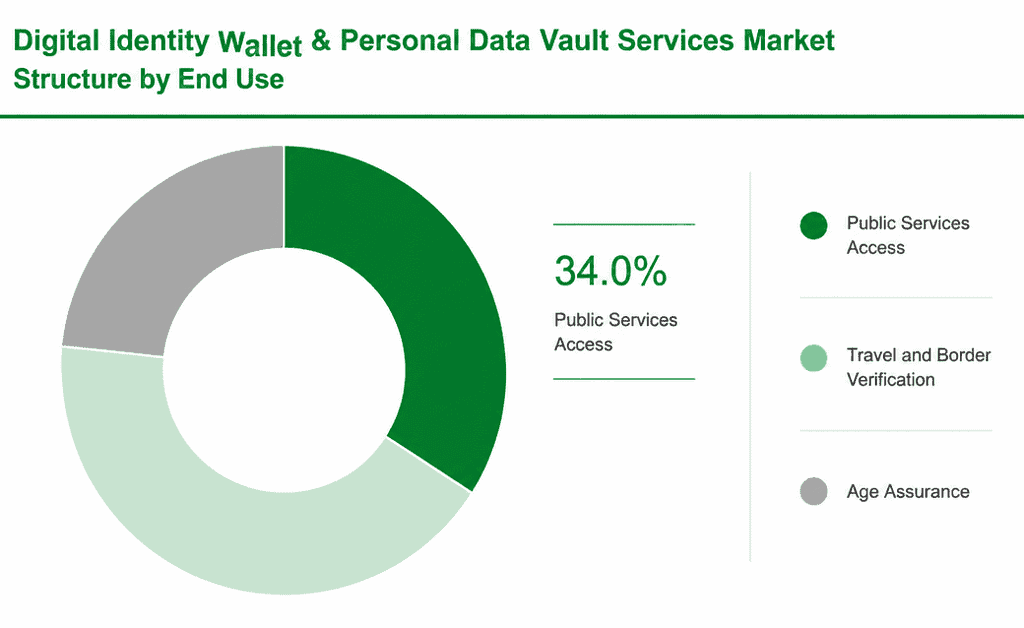
- Public-services access is projected to represent 34% of the combined digital-identity-wallet/personal-data-vault market by end use in 2026.
Digital Vault Subscription Pricing Insights
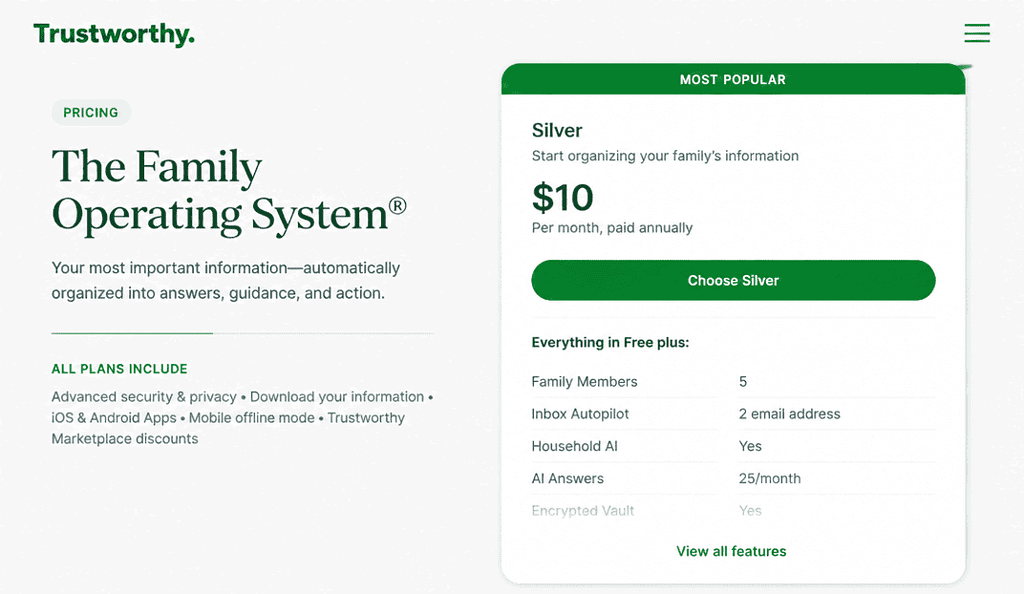
- Trustworthy: Silver USD 10, Gold USD 20, Platinum USD 40 per household/month, billed annually; free accounts include 2GB.
- Prisidio Starter: USD 4.99/month or USD 45/year; includes a personal digital vault, mobile app, and invitations for three people.
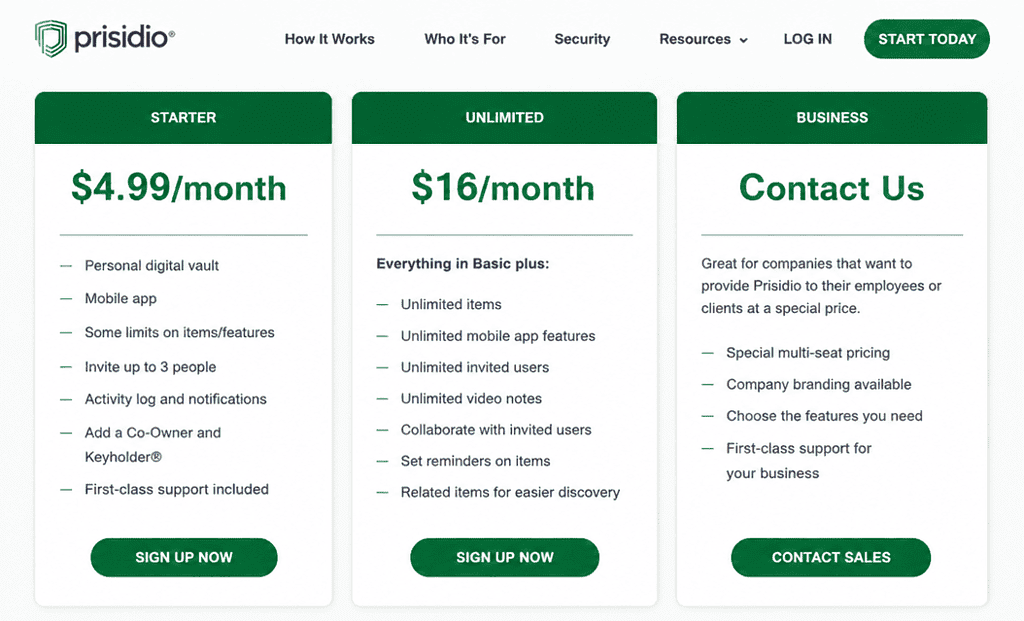
- Prisidio Unlimited: USD 16/month or USD 150/year; includes unlimited items, invited users, and video notes.
- Everplans: Premium costs USD 99.99/year with unlimited items and secure sharing; the free plan stores three items.
- AARP Digital Vault: Standard costs USD 20/year; Unlimited costs USD 95/year. Both require an active, separately paid AARP membership.
- GoodTrust Estate+: USD 149 initially, then USD 39/year for continued updates; bundles a digital vault with estate-planning documents.
Digital Vault Market Size
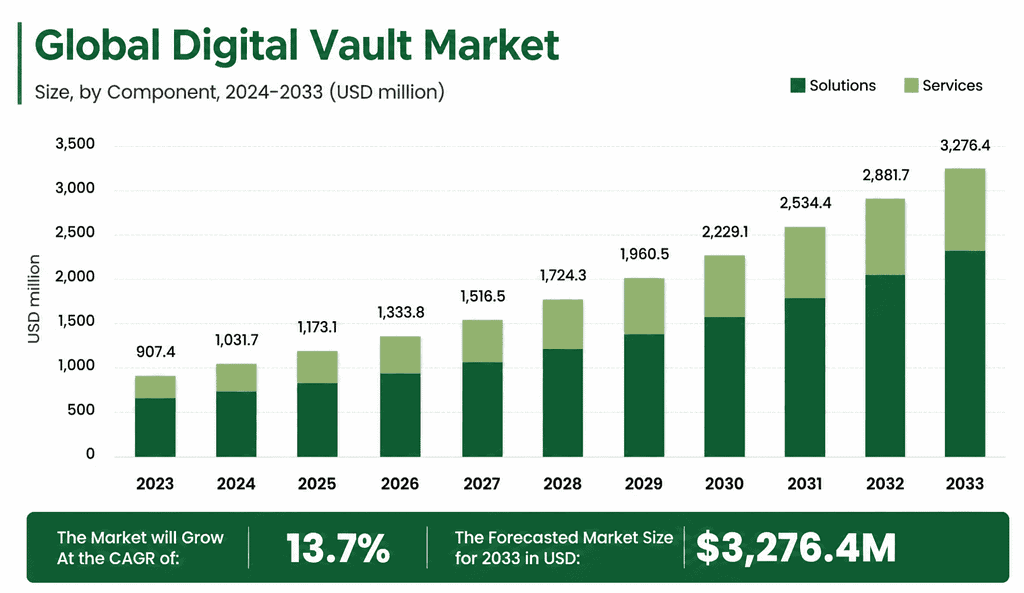
- The global digital vault market is forecast to grow at a compound annual growth rate of 13.7% during 2024–2033, reaching USD 3,276.4 million by 2033.
- The market covers 2 components: solutions and services, with solutions accounting for the larger share throughout the period shown.
- The market is projected to reach USD 1,173.1 million in 2025 and USD 1,333.8 million in 2026.
- By 2033, the market is forecast to reach USD 3,276.4 million, continuing the steady growth projected across both components.
Impact of End-to-End Encryption in Digital Vaults
- Tresorit uses RSA-4096 key sharing alongside client-side encryption, keeping plaintext files and unencrypted keys inaccessible to its servers.
- Proton Drive includes E2EE with 5GB free; 200GB costs USD 4.99/month when billed monthly.
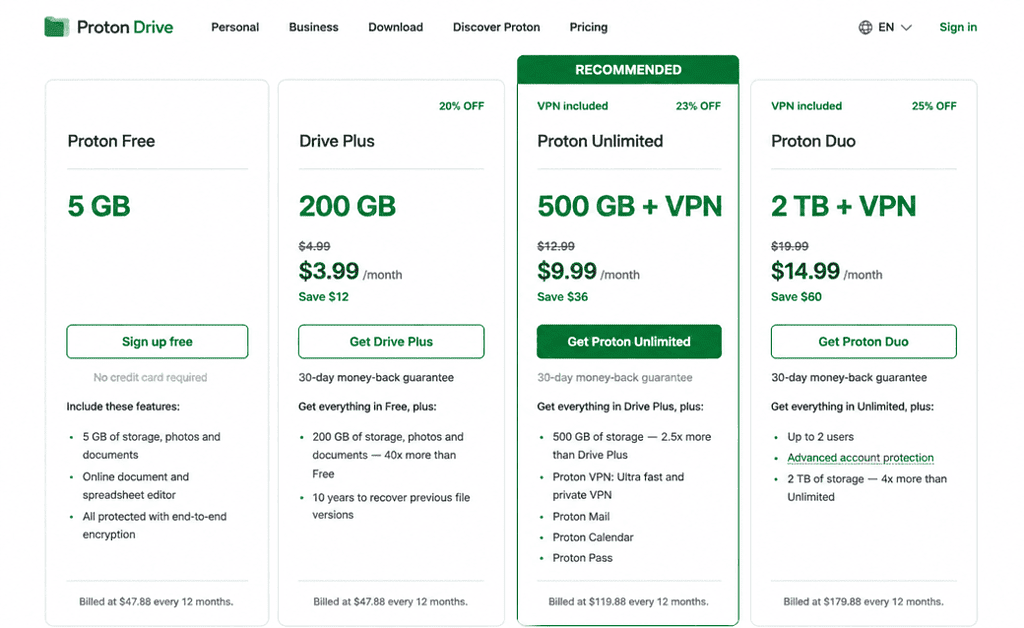
- Proton Drive divides large files into 4MB chunks, using cryptographic signatures to detect modification, removal, or reordering.
- Proton offers a 12-word recovery phrase; password resets alone may leave previously encrypted vault files inaccessible.
- A 2026 password-vault study demonstrated 31 attacks across four providers under malicious-server conditions; these findings are not document-vault failure rates.
- A 2026 research prototype shared a 1GB file in 3.27 seconds using a 128-byte re-encryption key.
- Thales reports 61% cite harvest-now-decrypt-later concerns; 59% evaluate post-quantum cryptography.
How API Keys, Tokens, and Certificates Work in Digital Vaults
- Digital vaults centrally protect API keys, tokens, and certificates through encrypted storage and controlled access; HashiCorp Vault shows these mechanisms.
- API keys authenticate applications to external services. Vault stores them as encrypted key-value secrets; authorized applications retrieve them rather than hardcoding credentials.
- Token lifetimes limit access. HashiCorp Vault’s configurable system maximum is 32 days; expiring non-root tokens revoke associated leases, while renewable tokens support extensions.
- Secure delivery can use response wrapping: a 1-use token references the secret, expires independently, and releases its contents through an unwrap operation.
- Certificates support identity verification. Vault’s PKI engine issues or signs certificates through authenticated endpoints, with policies controlling access to issuance operations.
- From March 15, 2026, newly issued publicly trusted TLS certificates have a 200-day maximum validity; this requirement does not universally govern private-vault certificates.
- AWS Secrets Manager’s published 2026 pricing provides a vault-cost example: USD 0.40 per secret monthly plus USD 0.05 per 10,000 API calls.
Role-Based and Attribute-Based Access Control in Digital Vaults
| Aspect | Role-based access control (RBAC) | Attribute-based access control (ABAC) |
| How access works | Assigns permissions through roles such as Secrets User, Secrets Officer, or Administrator. | Evaluates resource or request attributes at runtime to narrow permissions granted by a role. |
| 2026 default-model change | Becomes the default permission model for newly created Azure key vaults using the specified API version. | Requires the vault to use Azure RBAC; legacy access policies do not support these conditions. |
| Supported attributes | Access follows the permissions and scope of the assigned role. | Can restrict access by vault name or secret name, including prefixes and patterns. |
| Practical access example | A Secrets User role permits reading secret contents within its assigned scope. | A condition can permit only secrets beginning api- inside vaults beginning. |
| Secret-listing limitation | An unconditional metadata permission can allow users to list secret names. | A secret-name condition on metadata reads blocks collection-list requests rather than filtering individual results. |
Quantum-Resistant Vault Design
- For a quantum-resistant vault in 2026, start by listing everything that uses encryption, login checks, recovery, and backups.
- Keep using AES-256 to encrypt the vault’s contents. Post-quantum methods for sharing keys work alongside this encryption and do not replace it.
- Use FIPS 203 ML-KEM-768 to create the secrets that wrap and protect the vault. NIST recommends it as the default choice, and the other options are ML-KEM-512 and ML-KEM-1024.
- Plan for the storage and bandwidth that ML-KEM-768 needs: public keys of 1,184 bytes, private keys of 2,400 bytes, ciphertexts of 1,088 bytes, and shared secrets of 32 bytes.
- Verify vault updates with FIPS 204 ML-DSA digital signatures, which come in 3 options: ML-DSA-44, ML-DSA-65, and ML-DSA-87.
- Protect network access with TLS 1.3 and hybrid post-quantum key exchange where it is supported. Also check login and identity separately, because quantum-resistant data transfer alone leaves gaps.
Digital Vault Security Breach Stats
- Across crypto vaults, wallets, and exchanges, reported 2026 losses reached USD 8.734 billion across 322 incidents by October 30.
- Excluding Binance, 321 reported crypto breaches accounted for USD 2.374 billion, averaging USD 7.4 million per incident.
- Binance’s October 2026 breach reportedly affected USD 6.3 billion; approximately USD 3 billion was frozen, not necessarily recovered.
- Bitget’s September 24, 2026 hot-and-warm-wallet breach reportedly drained approximately USD 387.5 million.
- Ledger hardware-wallet supply-chain compromises reportedly caused USD 86–102 million in losses during 2026; malicious implants captured recovery phrases.
- Fence Finance’s October 27, 2026 vault exploit reportedly drained approximately USD 1.01 million through manipulated share accounting.
Impact of AI and Automation in Digital Vaults
- FutureVault’s 2026 publication estimates AI document processing costs USD 0.50–2 versus USD 6–25 manually; these aren’t vault-specific benchmarks.
- Automated document processing reportedly reduces costs 70–90%, potentially lowering digital-vault filing expenses; actual savings depend on implementation.
- Financial-services document automation reportedly delivers 300–400% returns within 18–24 months; these figures aren’t guaranteed digital-vault outcomes.
- IBM’s 2026 research associates extensive use of security AI and automation with USD 1.93 million lower breach costs; findings aren’t vault-specific.
- AI also amplifies threats: 25% of malicious breaches were AI-enabled, increasing 56%; average costs reached USD 6 million across organizations.
Closing
Digital vaults are becoming a key tool for storing private documents, passwords, and identity records. Government platforms such as DigiLocker already have hundreds of millions of users. The market is expected to keep growing until 2033 as more people use the cloud and need better security.
At the same time, data breaches, AI-powered attacks, and future quantum computers are raising the standard for protection. Vault providers that offer strong encryption, tight access controls, and protection against quantum threats are most likely to earn lasting trust.
FAQ
Files are encrypted before or during upload and stored on secure servers. You access them through an account protected by a password, multi-factor authentication, or biometrics. Many vaults also log access activity and let you share specific items with set permissions and expiry dates.
A well-built digital vault is generally safer than keeping documents on a personal device or in email, because it uses strong encryption, authentication, and monitoring. Safety still depends on the provider’s security practices and on your own habits, such as using unique passwords and enabling multi-factor authentication.
General cloud storage is built for convenient file storage and syncing. A digital vault adds stronger security layers, such as end-to-end encryption, strict access controls, audit trails, and controlled sharing, and is designed specifically for sensitive or regulated information.
Individuals use them to protect personal documents and prepare for emergencies. Businesses, banks, law firms, and healthcare providers use them to store confidential records, meet compliance requirements, and share documents securely with clients.
Many providers offer emergency or legacy access, letting you name trusted contacts who can access the vault under conditions you set. Without this setup, family may face delays or legal hurdles, so check each provider’s policy and set it up in advance.


