









Introduction
Smart Learning Statistics: Smart learning means using technology to teach each learner in the way that suits them best, instead of giving everyone the same lessons. It uses adaptive software, AI tutors, learning data tools, virtual and augmented reality, mobile access, and online content. These tools watch how a learner is doing, change the difficulty level, and suggest what to study next. This makes learning more personal and easier to measure.
Schools, universities, company training teams, and self-learners all use it. Institutions like better engagement, higher course completion, and stronger skills, but they also think about cost, content quality, and teacher readiness. Common problems include unequal access to devices and internet, data privacy rules, and the difficulty of proving that learning has improved. The sections ahead explain how these factors shape the smart learning industry.
Key Takeaways
- Smart learning is projected to grow from USD 80.69 billion in 2025 to USD 178.62 billion by 2030.
- Digital Education Council’s 2026 survey of 45,398 respondents found 88% of students used AI for learning.
- Only 15% of students reported AI integration across many courses in 2026, while 43% experienced none.
- Synthesia’s 2026 survey found 73% of L&D respondents integrated AI into workflows; early adopters were overrepresented.
- ZipRecruiter found 62.8% of US workers received employer AI training, but only 28.9% received extensive training.
- European Commission’s platform survey: 81% of respondents use AI; only 22% use adaptive learning and 7% agentic AI.
- Only 15% of students with Khanmigo access used it, though weekday interactions reached 269,000 in April 2026.
- Top Hat’s 2026 AI-assistant users reported 93% engagement, versus 83% overall; findings were self-reported.
- Preply raised USD 150 million at a USD 1.2 billion valuation; Gizmo raised USD 22 million.
Smart Learning Market Growth
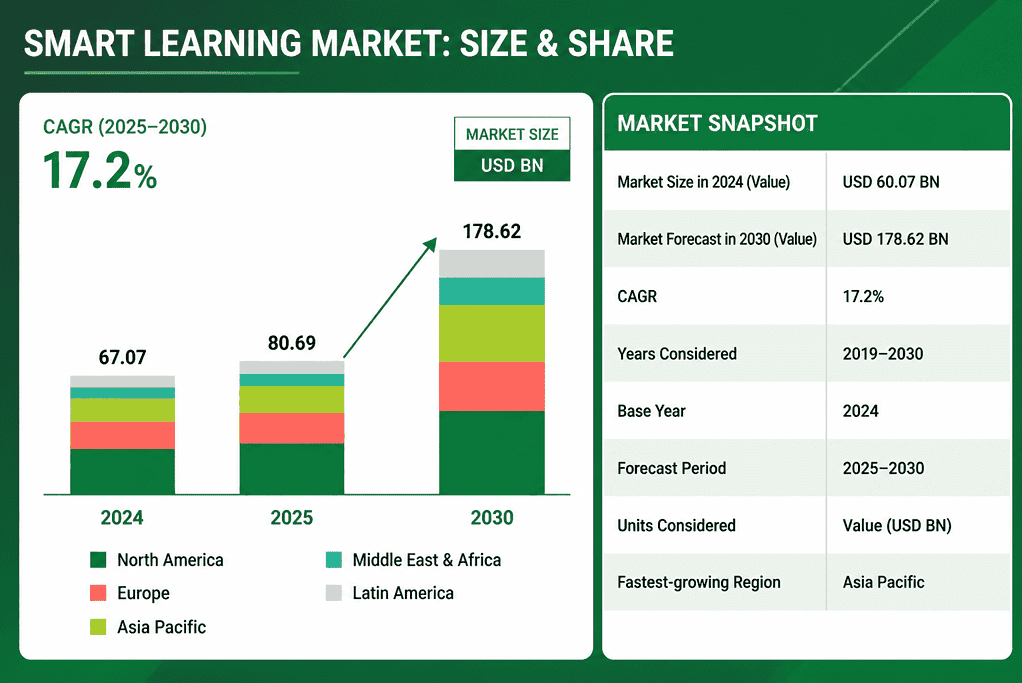
- The smart learning market is expected to grow at a compound annual growth rate (CAGR) of 17.2% during the forecast period of 2025–2030.
- The market size chart shows a value of USD 67.07 billion in 2024, rising to USD 80.69 billion in 2025 and reaching USD 178.62 billion by 2030.
- The regional breakdown includes North America, Europe, Asia Pacific, the Middle East & Africa, and Latin America. Asia Pacific is identified as the fastest-growing region.
Smart Learning in Higher Education
- Digital Education Council’s 2026 higher-education survey collected 45,398 responses: 27,284 students and 18,114 faculty across 35 countries.
- In that 2026 survey, 88% of students used AI for learning; 77% of faculty used AI in teaching.
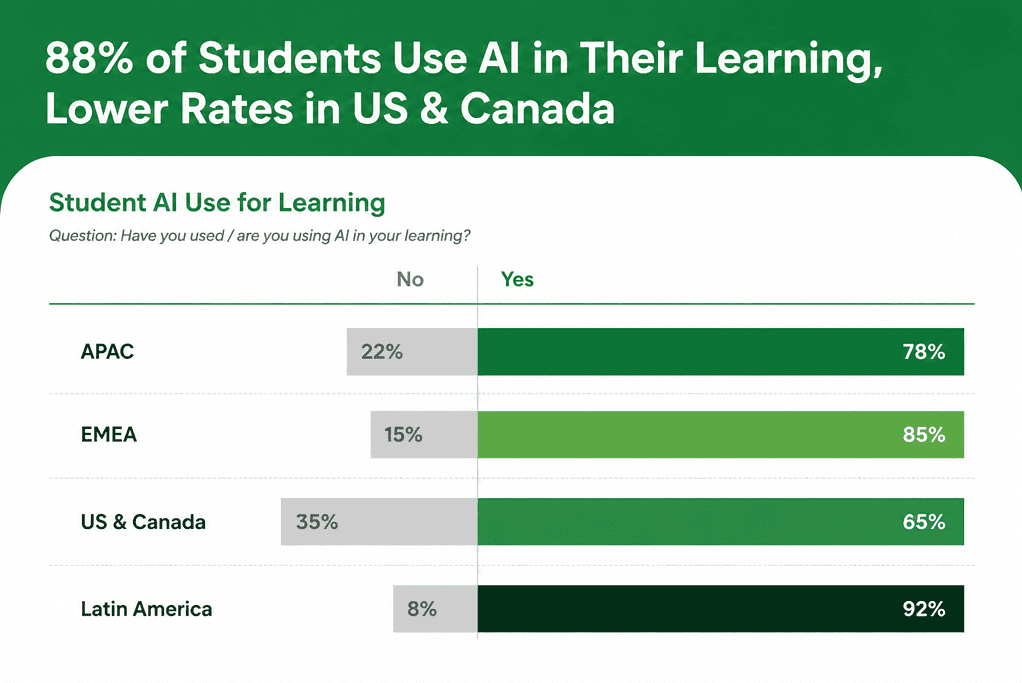
- Only 15% of students reported AI integration across many courses in 2026; 43% experienced none.
- In 2026, 50% of faculty said AI improved teaching quality; only 37% found institutional AI guidelines practical.
- HEPI’s 2026 report, surveying 1,054 UK undergraduates in December 2025, found 95% used AI; 94% supported assessed work.
- HEPI’s 2026 findings showed 49% reported improved student experiences, 65% significant assessment changes, and 38% institutional AI-tool provision.
- Coursera’s 2026 survey covered 4,200 students and educators across five countries; only 28% of educators reported curricular AI-literacy integration.
- In November 2026, Mount Saint Mary’s and St. Catherine universities announced USD 4,998,260 for five-year ethical AI education development.
Smart Learning in Corporate Training Statistics
- In Synthesia’s survey, conducted September–October 2026, 73% of L&D respondents integrated AI into workflows; early adopters were overrepresented.
- Among Synthesia’s 2026 AI-using L&D respondents, 87% generated content, 73% created videos, and 56% created assessments.
- Synthesia’s 2026 fieldwork found 29% used AI for personalized guidance or tutoring; 75% identified faster content creation.
- In Gallup’s 2026 survey, 78% of participating CHROs encouraged AI peer learning; 57% provided manager-specific AI training.
- Gallup’s 2026 survey found 49% of participating CHROs offered role-specific AI learning or certification programs.
- ZipRecruiter’s September 2026 US worker survey found 62.8% received employer AI training, but only 28.9% received extensive training.
- In ZipRecruiter’s 2026 survey, 44.5% pursued self-paced AI learning outside work, including video tutorials and online courses.
- ACE’s February 2026 survey found 63% of AI-using US workers learned skills through AI their employers never formally taught.
Smart Interactive Learning Device Statistics
| Device or initiative | 2026 announcement | Numeric specifications or deployment figures |
| ViewSonic interactive display series | Bett 2026 | 2 series; Android 16; 64-point multitouch |
| ViewSonic IFP41-1 classroom displays | January 2026 | 5 screen sizes, ranging from 55 to 98 inches |
| Samsung WAFX-P screen options | February 2026 | 65-, 75-, and 86-inch displays |
| Samsung WAFX-P audiovisual features | February 2026 | Built-in 4K camera; 2 speakers rated at 20 watts each |
| Samsung WAFX-P touch and brightness | February 2026 | Up to 50 simultaneous touch users; 450-nit brightness |
| Samsung WAFX-P screen sharing | February 2026 | Simultaneous screen sharing from up to 9 devices |
| Samsung additional interactive displays | June 2026 | 3 additional models; WAF-S and WAFX-PS upgrade to Android 16 |
| Uttar Pradesh student tablet initiative | November 2026 | Target: 2.5 million additional tablets during financial year 2026–27 |
| AAGO interactive classroom display | November 2026 | 98-inch 4K touchscreen; 48-megapixel camera; 40-point multitouch |
Smart Learning Student Engagement Statistics
- Top Hat’s 2026 survey covered 9,172 students across 550+ institutions; 83% said the platform supported engagement.
- In Top Hat’s 2026 survey, live-question participants reported 88% engagement, versus 83% among respondents overall.
- Top Hat’s 2026 AI-assistant users reported 93% engagement, compared with 83% among survey respondents overall.
- Among Top Hat’s 2026 outside-class users, 87% reported improved course understanding, versus 75% overall; findings were self-reported.
- Inside Higher Ed’s October 2026 survey found 34% of undergraduates reported AI helped them complete coursework and study more efficiently.
- In that 2026 survey, 33% reported AI increased confidence in understanding difficult concepts; 30% reported reduced reliance on professors or tutoring.
- Digital Education Council’s 2026 survey found 28% of students experiencing course-integrated AI reported enhanced understanding and learning outcomes.
- The same 2026 survey found 5% reported transformative learning benefits; 42% found course-integrated AI somewhat helpful, limiting broader impact claims.
Generative AI in Smart Learning Content Creation
- Royal Society of Chemistry’s 2026 survey found 79% of AI-using science teachers created resources with AI.
- The same 2026 survey found 66% of AI-using science teachers used it to write questions.
- Among surveyed science teachers using AI in 2026, 41% with under five years’ experience used it for lesson planning.
- Sanoma’s 2026 survey found 63% of European teachers expected to use AI to prepare learning materials.
- Sanoma’s 2026 survey found teachers’ confidence using generative AI reached 42%, compared with 28% the previous year.
- TPT’s 2026 survey found 44% of respondents identified creating instructional resources as their primary generative AI use.
- TPT’s 2026 survey found 20% of respondents identified brainstorming ideas as their primary generative AI use.
- TPT’s 2026 survey found 58% used generative AI regularly or occasionally; another 22% had experimented once or twice.
Smart Learning Teacher Adoption Statistics
| Scope | Year | Metric | Numeric data |
| Gallup, U.S. educators | 2026; 2025–2026 school year | K–12 educators using AI professionally | 59% |
| European Commission platform survey; predominantly teacher respondents | 2026 | Respondents using AI extensively or partially | 81% |
| European Commission platform survey | 2026 | Respondents using AI at least partially for lesson planning and teaching materials | 73% |
| European Commission platform survey | 2026 | Respondents using AI for assessment preparation | 67% |
| European Commission platform survey | 2026 | Respondents using AI-generated explanations or practice exercises to support pupils | 63% |
| European Commission platform survey | 2026 | Respondents using AI for administrative tasks, including emails and reports | 53% |
| European Commission platform survey | 2026 | Adoption of adaptive learning systems; adoption of agentic AI | 22%; 7% |
| Odisha government-secondary-school teacher study | 2026 | Sample size; weekly DIKSHA usage; daily DIKSHA usage | 288 teachers; 42.7%; 25.3% |
AI Learning Assistants in Smart Learning
- In April 2026, Khan Academy reported 269,000 weekday Khanmigo interactions, demonstrating substantial AI-assisted learning activity.
- Khan Academy’s April 2026 disclosure showed only 15% of students with Khanmigo access engaged with it, highlighting adoption challenges.
- In May 2026, Khan Academy reported approximately 20 product tests covering over 15 million tutoring threads across six months.
- Khan Academy’s 2026 tests found learning-history personalization improved next-question correctness by 3.4% across 608,000 tutoring threads.
- Khan Academy’s 2026 tests found prerequisite reviews improved next-question correctness by 2.7% across 1.36 million tutoring threads.
- A 2026 meta-analysis covering 35 studies and 4,193 participants reported moderately positive ChatGPT learning effects, with g=0.670.
- A 2026 Lucknow study surveyed 100 students, documenting ChatGPT support for writing, grammar, vocabulary, summarization, and comprehension.
Smart Learning Investment and Funding Statistics
| Organization | Announcement date | Funding amount (USD) | Funding details and additional numeric data | Learning focus |
| Preply | January 2026 | USD 150 million | Series D; valuation reached USD 1.2 billion | Human-led, AI-enhanced learning |
| Scholé AI | January 2026 | USD 3 million | Funding for personalized, role-based workforce learning | AI-powered workforce learning |
| Chalkie | March 2026 | USD 4 million | Funding from TriplePoint Ventures | AI-powered lesson planning |
| Gizmo | April 2026 | USD 22 million | Series A, led by Shine Capital | AI-powered studying |
| Digital Promise | June 2026 | USD 26 million | Multiyear initiative; 4 initial grantees | Classroom AI infrastructure |
| DeweyLearn | July 2026 | USD 5 million | Series A, led by SJF Ventures | AI-based skills assessment |
| Aristotle | September 2026 | USD 5 million | Seed funding, led by True Ventures | Voice-first AI tutoring |
| Astral | November 2026 | USD 5.5 million | Cumulative funding; expansion across 50 U.S. states | Personalized AI tutoring |
| Hyundai | November 2026 | USD 150,000 | 15 schools receiving USD 10,000 each | Hands-on STEM learning |
Recent Smart Learning Statistics
- On November 10, 2026, OpenAI highlighted ThinkYoung findings: 79% of surveyed students used AI for assignments, but only 47% received guidance.
- On October 20, 2026, Microsoft recognized over 54,000 educators, more than 1,100 Showcase schools, and 20 Beacon schools and systems advancing digital learning.
- On September 9, 2026, Coursera announced 16 new partners and 25 Professional Certificates; micro-credential enrollments grew 33%, while its catalog expanded 90%.
- On August 26, 2026, OpenAI expanded ChatGPT for Teachers to 55 additional school systems across 20 states, covering over 100,000 more educators and staff.
- On May 28, 2026, Pearson launched AI learning modules across more than 20 disciplines internationally, with US availability planned by August 1, 2026.
- On January 26, 2026, the UK announced AI tutoring plans potentially supporting up to 450,000 disadvantaged pupils annually, with school availability by end-2027.
- On August 6, 2025, Google committed USD 1 billion over 3 years to US AI education, training, and research; over 100 universities joined.
- On April 30, 2025, Duolingo launched 148 AI-supported courses, offering 7 popular non-English languages across 28 interface languages and more than doubling course availability.
Wrap Up
Smart learning is moving from experiment to everyday practice, with most students and many teachers already using AI, and funding and product launches accelerating across schools, universities, and workplaces. Yet results are uneven: course-level integration is limited, guidance gaps persist, and many benefits are self-reported.
Training remains shallow, and adoption of advanced tools such as adaptive systems is still low. Institutions that pair AI tools with clear policies, teacher training, and measurable learning outcomes will gain the most.
FAQ
Common tools include adaptive learning platforms, artificial intelligence tutors, learning management systems, virtual and augmented reality, gamified modules, and analytics dashboards. The right mix depends on the subject, audience, and available infrastructure.
Research suggests it can improve engagement and help learners master material at their own pace, especially when it is combined with strong instructional design and teacher guidance. Results vary, however, and outcomes depend heavily on content quality, implementation, and how well learners and educators use the tools.
No. Smart learning is designed to support educators rather than replace them. Teachers interpret data, provide mentorship, address social and emotional needs, and make decisions that technology cannot fully handle.
Smart learning platforms often collect detailed data on student behavior, performance, and sometimes biometric or location information. Schools and providers should follow data protection laws, limit data collection to what is necessary, clearly explain how information is used, and secure it against unauthorized access.
Start by identifying specific learning goals and gaps, then choose tools that align with them and fit existing systems. Piloting a small program, training staff or learners, and reviewing results regularly makes it easier to scale successfully.