









Preface
Smart Weapons Statistics: Modern warfare is becoming more advanced as smart weapons become more widely used. These weapons combine artificial intelligence, GPS, sensors, and advanced guidance systems to identify and strike targets with high accuracy. From guided missiles and laser-guided bombs to military drones and smart artillery, they are changing how defense forces plan and carry out operations.
Unlike conventional weapons, smart weapons can respond to changing conditions and improve targeting precision. As a result, they help military forces complete missions more effectively while reducing the risk of unintended damage.
Meanwhile, rising defense budgets and rapid technological progress are driving demand for smarter and more advanced weapon systems worldwide.
Featured Choice
- The global smart weapons market was valued at USD 19.7 billion in 2025 and is projected to reach USD 20.7 billion in 2026.
- In 2025, missiles led the market with a 40.3% share, followed by laser technology at 31.4%, while defense applications accounted for the largest application share at 70.1%.
- Military & Specialized Weapons remained the largest segment, reaching USD 10.74 billion in 2026.
- The North American smart weapons market is projected to reach USD 7.4 billion in 2026.
- The U.S. market is expected to account for USD 7.33 billion by year-end.
- Around 347 AI-enabled weapon systems across 31 countries as of October 2026, including 238 deployed systems.
- United States Department of Defense allocated USD 13.4 billion for autonomous systems in its 2026 budget plans.
- Moreover, the U.S. requested USD 35.7 billion for missile and munitions programs in 2026.
- Five major companies controlled 54.8% of the global smart weapons market in 2025.
Global Smart Weapons Market Size
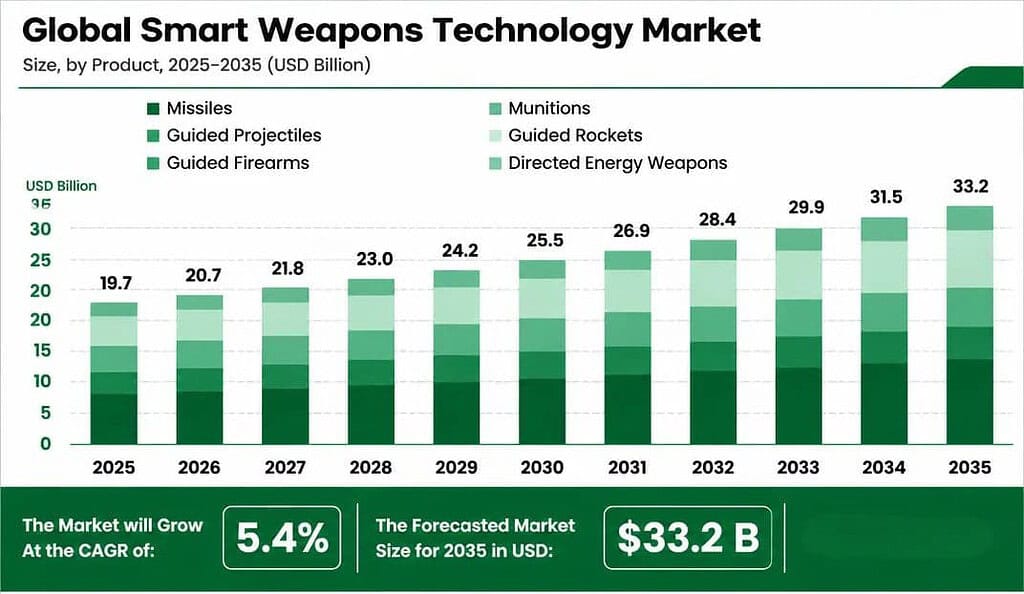
- The global smart weapons market was valued at USD 19.7 billion in 2025.
- The market is projected to grow from USD 20.7 billion in 2026 to approximately USD 33.2 billion by 2035.
- The market is expected to expand at a CAGR of 5.4% between 2025 and 2035.
Segmental Analysis
- As reported by Market.us, missiles dominated the market with a 40.3% share in 2025.
- The United States requested USD 29.8 billion for missiles and munitions.
- Meanwhile, the defense authorization approved USD 22.5 billion for selected programs, including 300 Precision Strike Missiles and 12 SM-3 Block IIA interceptors.
- Laser technology held a 31.4% share.
- The U.S. Air Force planned to procure approximately 1,500 JDAM guidance kits in FY2025.
- Land platforms accounted for 44.9% of the market.
- The U.S. Army requested USD 1.16 billion for GMLRS procurement to support 6,408 guided rockets.
- Defense applications dominated, with a 70.1% share.
- Japan allocated ¥8.47 trillion for defense, including ¥287.6 billion for ammunition and guided missiles and ¥293 billion for Hyper Velocity Gliding Projectiles.
By Weapon Type
- According to Global Market Insights, military & Specialized Weapons is the largest segment, valued at USD 10.11 billion in 2025 and USD 10.74 billion in 2026, and is projected to reach USD 18.4 billion by 2035 at a 6.16% CAGR.
- Handguns are expected to grow from USD 5.68 billion in 2025 to USD 6.25 billion in 2026, then to USD 15.4 billion by 2035, at a 10.53% CAGR.
- Rifle & Long Guns are projected to increase from USD 3.03 billion in 2025 to USD 3.21 billion in 2026 and USD 5.56 billion by 2035, at a 6.28% CAGR.
- Shotguns will grow from USD 2.25 billion in 2025 to USD 2.34 billion in 2026, then to USD 3.42 billion by 2035, at a 4.31% CAGR.
Regional Analysis of the Global Smart Weapons Market
- Fortune Business Insights reported that the North American region led the market with a 33.90% share and USD 6.8 billion in revenue in 2025.
- It is projected to reach USD 7.4 billion in 2026, while the U.S. market is expected to reach USD 7.33 billion.
- Asia-Pacific region accounted for 27.00% of the market, generating USD 6 billion in 2025.
- Revenue is projected to reach USD 7 billion in 2026, with China at USD 2.22 billion, India at USD 1.83 billion, and Japan at USD 1.22 billion.
- The European region accounted for 24.50% of the total, reaching USD 5.4 billion in 2025.
- It is expected to grow to USD 5.9 billion in 2026, with the UK and Germany reaching USD 1.16 billion and USD 1.07 billion, respectively.
- The rest of the World secured around 14.70% of the market, valued at USD 3.2 billion in 2025, and is projected to reach USD 3.5 billion in 2026.
Key Smart Weapons Trends
- The ArtificialWeapons.com database tracked 347 AI-enabled weapon systems across 31 countries as of October 2026, including 238 deployed systems.
- Of 153 systems with known first-use dates, 48 were first used after 2020.
- The database covered 313 systems with verified public sources, while the remaining entries are undergoing verification.
- The United States led with 112 systems, followed by Russia (45), Israel (42), China (30), Iran (17), and Türkiye (14).
- India and Germany each recorded 11 systems, followed by the UK (9), France (7), and North Korea (6).
- Autonomous drones represented the largest category with 149 systems, followed by interceptors (41), cyber weapons (37), and AI targeting systems (26).
- Other categories included autonomous naval systems (23), ground systems (20), AI command and control (19), electronic warfare (16), swarm systems (8), and information warfare (8).
- The U.S. Department of Defense allocated USD 13.4 billion for autonomous systems in its 2026 budget plans.
- This funding included USD 9.4 billion for aerial systems, USD 1.7 billion for maritime systems, and USD 210 million for ground vehicles.
- The U.S. requested USD 35.7 billion for missile and munitions programs in 2026.
- Enacted appropriations provided USD 23.9 billion for selected missile and munitions programs.
- In 2025, Ukraine’s Operation Spider’s Web deployed more than 100 attack drones against Russian airbases, damaging 41 aircraft.
- India’s SWAYAT experiment ran from April 23 to 25, 2025, showcasing 59 products from 36 industries and startups.
- The Indian demonstration covered four technology domains.
Global Military Expenditure Statistics, 2025
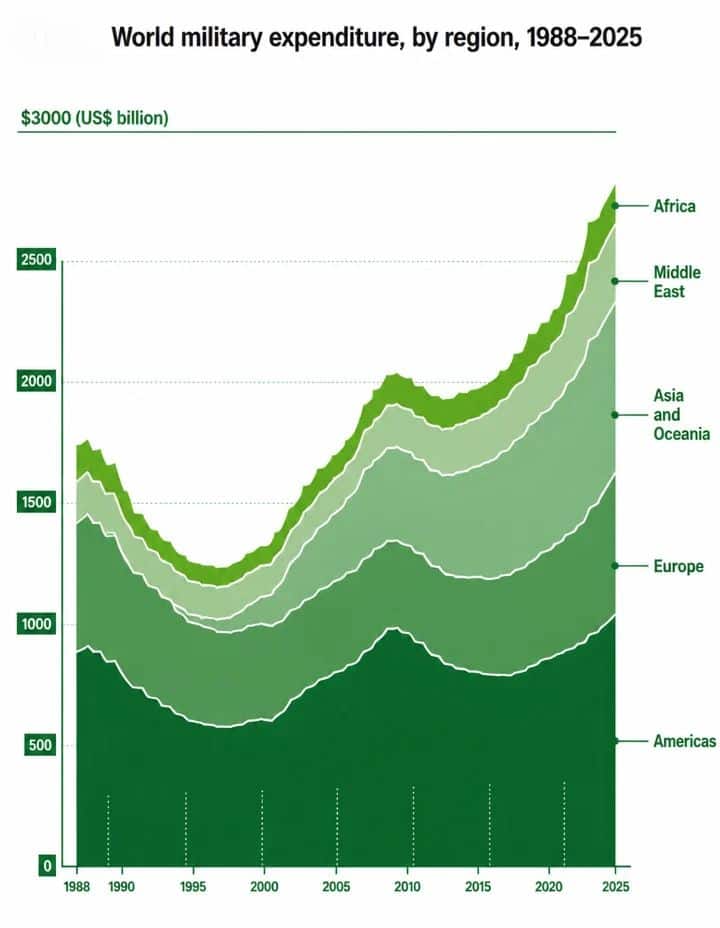
- Global military spending increased by 2.9% in real terms to USD 2.887 trillion in 2025, marking the 11th consecutive year of growth and the highest level recorded by SIPRI.
- Military expenditure accounted for 2.5% of global GDP in 2025.
- The five largest spenders were the United States, China, Russia, Germany, and India, together accounting for 58% of global military spending.
- The UnitedStates’s military spending declined by 7.5% to USD 954 billion, while China’s spending increased by 7.4% to USD 336 billion.
- Russia’s spending rose by 5.9% to USD 190 billion, equivalent to 7.5% of its GDP.
- Meanwhile, Ukraine’s expenditure increased by 20% to USD 84.1 billion, representing 40% of its GDP.
- European military spending grew by 14% to USD 864 billion, while Asia and Oceania recorded an 8.1% increase to USD 681 billion.
- NATO’s 32 members collectively spent USD 1.581 trillion, representing 55% of global military expenditure. European NATO members accounted for USD 559 billion, while 23 members spent at least 2.0% of GDP on defense.
Major Weapon Systems Funding, 2026
| Category | Program | System / Description | Fundings (USD Millions) |
| Aircraft and Related Systems-Joint Service | F-35 | Joint Strike Fighter Lightning II | 13,120.8 |
| V-22 | Osprey | 827.5 | |
| C-130J | Hercules | 999.2 | |
| MQ-1C | Gray Eagle | 15.8 | |
| MQ-9 | Reaper | 339.7 | |
| MQ-4C / RQ-4 | Triton/Global Hawk/NATO AGS | 690.8 | |
| OA-1K | Skyraider II | 158.6 | |
| Aircraft and Related Systems-USA | AH-64E | Apache: Remanufacture/New Build | 171.3 |
| CH-47 | Chinook | 708.8 | |
| UH-60 | Black Hawk | 756.1 | |
| FLRAA | Future Long-Range Assault Aircraft | 1,248.5 | |
| Aircraft and Related Systems-USN / USMC | MQ-25 | Stingray | 1,141.9 |
| F/A-18 | Super Hornet | 1,982.2 | |
| E-2D | Advanced Hawkeye | 2,124.1 | |
| CH-53K | Heavy Lift Replacement Helicopter | 2,477.7 | |
| Aircraft and Related Systems-USAF | B-21 | Raider | 10,290.3 |
| B-1, B-2, B-52 | Bombers | 1,475.0 | |
| KC-46A | Pegasus | 3,284.1 | |
| VC-25B | Presidential Aircraft Recapitalization | 675.7 | |
| F-47 | Next Generation Air Dominance | 3,479.4 | |
| F-22 | Raptor | 2,014.1 | |
| F-15 | Eagle / Eagle II | 3,800.2 | |
| HH-60W | Combat Rescue Helicopter | 166.8 | |
| T-7A | Advanced Pilot Training | 648.6 | |
| MH-139A | Grey Wolf | 170.4 | |
| CCA | Collaborative Combat Aircraft | 804.4 | |
| C4I Systems-USA | TNT | Tactical Network Technology | 723.9 |
| HMS | Handheld, Manpack, and Small Form Fit Radios | 481.7 | |
| Ground Systems- Joint Service | JLTV | Joint Light Tactical Vehicle | 203.4 |
| Ground Systems-USA | M-1 | Abrams Tank Modification/Upgrades | 1,464.0 |
| AMPV | Armored Multi-Purpose Vehicle | 565.4 | |
| NGSW | Next Generation Squad Weapon | 395.5 | |
| PIM | Paladin Integrated Management | 262.7 | |
| Stryker | Stryker Family of Armored Vehicles | 145.6 | |
| M10 | Booker (Mobile Protected Firepower) | 81.5 | |
| FMTV | Family of Medium Tactical Vehicles | 107.9 | |
| FHTV | Family of Heavy Tactical Vehicles | 148.5 | |
| XM30 | Combat Vehicle | 386.4 | |
| Ground Systems- USMC | ACV | Amphibious Combat Vehicle | 835.4 |
| Missile Defense Programs-Joint Service | GMD | Ground-based Midcourse Defense | 2,501.7 |
| THAAD | Terminal High Altitude Area Defense | 1,524.8 | |
| Aegis | Sea-Based Weapons System | 1,801.5 | |
| Missile Defense Programs-USA | PATRIOT / PAC-3 | PATRIOT Advanced Capability | 2,500.4 |
| PAC-3 / MSE | PAC-3/Missile Segment Enhancement | 1,358.9 | |
| IFPC | Indirect Fire Protection Capability | 1,267.2 | |
| MRIC | Medium-Range Intercept Capability | 714.4 | |
| Missiles and Munitions-Joint Service | JDAM | Joint Direct Attack Munition | 187.5 |
| SDB I | Small Diameter Bomb I | 50.8 | |
| SDB II | Small Diameter Bomb II | 442.6 | |
| JASSM | Joint Air-to-Surface Standoff Missile | 1,051.3 | |
| AIM-9X | Air Intercept Missile – 9X | 306.3 | |
| AMRAAM | Advanced Medium Range Air-to-Air Missile | 815.9 | |
| Chem-Demil | Chemical Demilitarization | 213.3 | |
| JAGM | Joint Air-to-Ground Missile | 217.9 | |
| LRASM | Long-Range Anti-Ship Missile | 1,167.9 | |
| AMMO | Ammunition | 6,330.7 | |
| AARGM-ER | Advanced Anti-Radiation Guided Missile | 759.6 | |
| GMLRS | Guided Multiple Launch Rocket System | 1,263.1 | |
| Javelin | Advanced Anti-Tank Weapon System | 371.6 | |
| Missiles and Munitions-USA | PrSM | Precision Strike Missile | 560.8 |
| SMRF/Typhon | Strategic Mid-Range Fires System | 500.1 | |
| Missiles and Munitions-USN | Trident II | Ballistic Missile Modifications | 3,742.0 |
| SM-6 | Standard Missile-6 | 1,262.5 | |
| RAM | Rolling Airframe Missile | 127.0 | |
| NSM | Naval Strike Missile | 219.1 | |
| Tomahawk | Tactical Tomahawk Cruise Missile | 946.1 | |
| Missiles and Munitions-USAF | LGM-35A | Sentinel | 4,157.7 |
| LRSO | Long Range Stand-Off Weapon | 1,050.6 | |
| Shipbuilding and Maritime Systems-USN | CVN 78 | Gerald R. Ford-class Nuclear Aircraft Carrier | 3,647.5 |
| SSBN 826 | Columbia-class Ballistic Missile Submarine | 11,480.2 | |
| SSN 774 | Virginia-class Submarine | 12,216.0 | |
| DDG 51 | Arleigh Burke-class Destroyer | 5,940.1 | |
| FFG(X) | Constellation-Class Guided Missile Frigate | 84.2 | |
| CVN | Refueling Complex Overhaul | 2,274.3 | |
| LPD 17 | San Antonio Class Amphibious Ship | 2,802.2 | |
| T-AO 205 | John Lewis Class Fleet Replenishment Oiler | 2,021.6 | |
| USV | Medium and Large Unmanned Surface Vessels | 129.6 | |
| LHA | America Class Amphibious Assault Ship | 4,043.8 | |
| LSM | Medium Landing Ship | 1,976.1 | |
| Space-Based Systems-USAF/SF | Launch | Launch Enterprise | 2,449.9 |
| PNT | Positioning, Navigation, and Timing | 702.6 | |
| MW/MT | Missile Warning/Missile Tracking | 12,966.8 | |
| SATCOM | Satellite Communications | 5,931.4 | |
| Hypersonic Warfare-Joint Service | Hypersonic Defenses | Hypersonic Defenses | 2,686.9 |
| LRHW | Long Range Hypersonic Weapon | 976.4 | |
| CPS | Intermediate Range Conventional Prompt Strike | 857.2 | |
| HACM | US Air Force Hypersonic Attack Cruise Missile | 802.8 |
Smart Weapons Market Share and Competitive Landscape
- Five major companies controlled 54.8% of the global smart weapons market in 2025, led by Lockheed Martin (16.9%), RTX Corporation (14.0%), Boeing (10.5%), Northrop Grumman (7.8%), and BAE Systems (5.6%).
- Global Market Insights further mentioned that Lockheed Martin recorded USD 71.04 billion in revenue in 2024, including USD 12.68 billion from Missiles and Fire Control, an 11% increase from USD 11.25 billion in 2023. Its backlog stood at USD 176 billion.
- RTX Corporation reported USD 80.8 billion in 2024 sales, growing 9%, while its total backlog reached USD 218 billion.
- Boeing held a 10.5% market share and won an NGAD fighter contract valued at over USD 20 billion.
- Northrop Grumman captured a 7.8% market share and generated approximately USD 39.3 billion in revenue.
- BAE Systems accounted for 5.6% of the market, with MBDA reporting a backlog of EUR 37 billion.
- General Dynamics generated approximately USD 42.3 billion in revenue through its broader defense business.
Factors Driving the Global Smart Weapons Market
- According to market.us, the global military expenditure reached USD 2,887 billion in 2025, up 2.9%, while the military burden stood at 2.5% of GDP.
- The U.S. Department of Defense requested USD 29.8 billion for munitions and USD 2.5 billion for microelectronics in 2025.
- NATO members committed to spending 5% of GDP on defense and security by 2035, including 3.5% on core defense and up to 1.5% on broader security.
- European Allies and Canada increased spending by nearly 20% in 2025, adding USD 139 billion.
- European military spending rose 14% to USD 864 billion, while Asia-Pacific spending increased 8.1% to USD 681 billion in 2025.
Bottom Line
Smart weapons are becoming an important part of modern defense systems. Their ability to improve targeting accuracy and reduce response time is changing how countries prepare for warfare. As a result, military spending on these technologies is expected to grow.
However, concerns about civilian safety, cyberattacks, and autonomous weapons remain. Balancing technological progress with strict regulations and human control will be key to their future development.
FAQ
Precision-guided missiles, smart bombs, guided rockets, torpedoes, and autonomous drones.
Smart weapons use AI, GPS, laser guidance, radar, infrared sensors, computer vision, and precision navigation systems.
Smart weapons use advanced guidance systems for precise targeting, while conventional weapons rely on less accurate targeting methods.