








Opening
Li-Fi Statistics: Li-Fi (Light Fidelity) is a wireless communication technology that uses light to transfer data. Unlike Wi-Fi, which relies on radio waves, Li-Fi uses LED bulbs to send information through rapid changes in light intensity. These changes happen so quickly that they are invisible to the human eye.
The technology offers a new way to access high-speed internet while reducing pressure on existing wireless networks. It also has potential applications in hospitals, aircraft, offices, and industrial environments where radio signals may cause interference or face restrictions.
Despite these advantages, Li-Fi still faces challenges such as limited signal coverage, poor performance through physical barriers, and the need for compatible devices.
Best of the Editor
- The global Li-Fi market is projected to rise from USD 2.6 billion in 2025 to USD 3.9 billion in 2026.
- In 2025, LED components dominate the market with a 40% share.
- Smart Lighting leads with a 35% share, driven by energy-efficient lighting, smart homes, IoT integration, and smart city projects.
- Healthcare led the market with USD 356.8 million and a 19.8% share in 2025.
- Asia Pacific accounted for the largest market share of 38.2%, generating USD 688 million in revenue.
- The U.S. Li-Fi market was valued at USD 420 million in 2025 and is expected to reach USD 454.90 million in 2026.
- Panasonic Holdings recorded a market capitalization of approximately USD 43.03 billion in November 2026, up 37.7% during the year.
- Optical spectrum offloading could add USD 5.6 billion to the FSO and VLC/Li-Fi market value by 2030.
- Li-Fi systems can maintain performance between 10% and 90% illumination and operate at light levels as low as 60 Lux.
- pureLiFi’s Kitefin XE provides secure wireless coverage across more than 80 m² (860 ft²) for defense applications.
Global Li-Fi Market Size
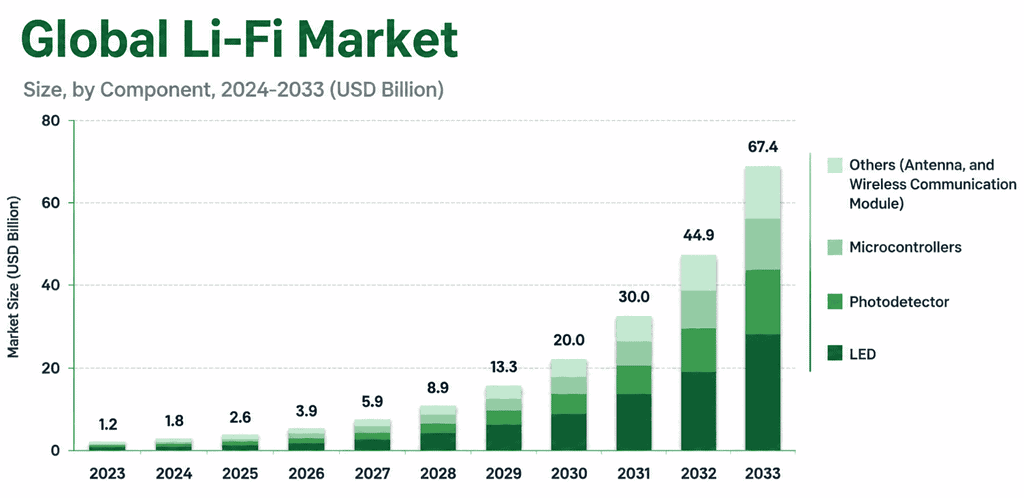
- The global Li-Fi market is projected to rise from USD 2.6 billion in 2025 to USD 3.9 billion in 2026.
- By 2033, the market is forecast to reach USD 67.4 billion, with a compound annual growth rate of 50% over 2024-2033.
- Li-Fi technology has demonstrated transmission speeds exceeding 224 Gbit/s.
- With operating costs 10 times lower than Wi-Fi, Li-Fi offers significant savings for large-scale industrial and corporate deployments.
- Its ability to support underwater communication over 200 meters also expands its potential applications.
Li-Fi Market Segmentation by Type
- Fortune Business Insights stated that LED components dominate the market with a 40% share, followed by photodetectors at 25% in 2025.
- Microcontrollers contribute 20%, while optical sensors hold 15%.
By Application
- Smart Lighting leads with a 35% share, driven by energy-efficient lighting, smart homes, IoT integration, and smart city projects.
- Cellular Communication & Vehicle Management account for 30% and 20%, respectively.
- Disaster Management holds a 15% share in 2025.
By Industry Vertical
- Healthcare led the market with USD 356.8 million and a 19.8% share in 2025.
- Electronics and Technology accounted for USD 312.6 million (17.3%).
- Retail and Defense captured USD 294.8 million (16.4%) and USD 278.6 million (15.5%), respectively.
- Automotive and Aerospace held 11.9% and 10.2% of the shares, respectively.
- Other industries contributed 8.6% (USD 155.6 million). The segment is projected to grow at a CAGR of 117.8% through 2033.
Li-Fi Regional Market Share
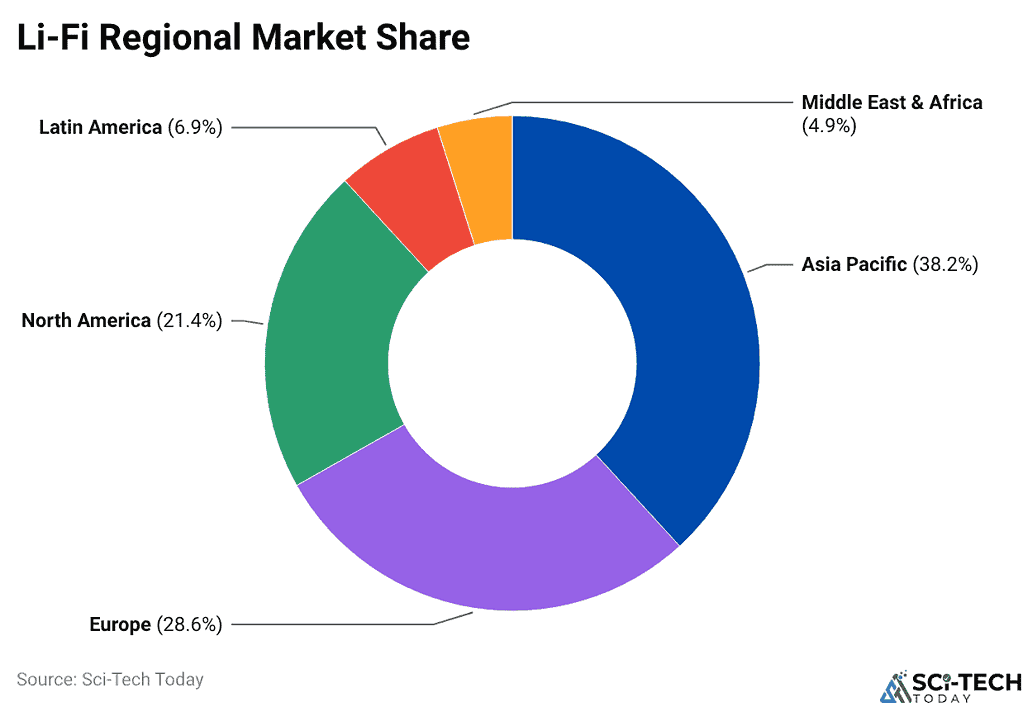
- Asia Pacific led the market in 2025 with USD 688 million in revenue and a 38.2% share.
- The region is projected to grow at a 118.4% CAGR through 2033, driven by smart cities, 5G infrastructure, and government investments.
- Europe held a 28.6% share, supported by defense, aerospace, and secure communication applications. It is expected to grow at a CAGR of 116.2%.
- North America accounted for 21.4%, driven by demand in defense, healthcare, and secure communications.
- Latin America held 6.9%, while the Middle East & Africa accounted for 4.9%.
United States Li-Fi Market Growth Outlook
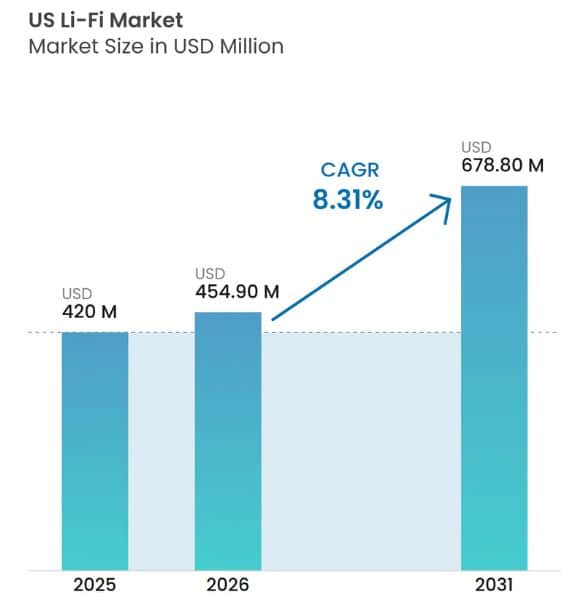
- The U.S. Li-Fi market was valued at USD 420 million in 2025 and is expected to reach USD 454.90 million in 2026.
- By 2031, the market is projected to reach USD 678.80 million, growing at an 8.31% CAGR.
- LED light sources accounted for the largest component share, at 49.12%, in 2025.
- Meanwhile, software and firmware are expected to grow fastest at a 10.08% CAGR through 2031.
- LED-based Li-Fi (VLC) systems dominated the technology segment with a 65.10% share in 2025.
- Hybridd Li-Fi/RF systems are projected to grow at a 10.78% CAGR.
- Retail and hospitality led end-user demand, accounting for 26.25% in 2025.
- Military and defense are expected to record the fastest growth at an 11.64% CAGR through 2031.
Financial Valuation of Key Li-Fi Market Players
- Panasonic Holdings recorded a market capitalization of approximately USD 43.03 billion in November 2026, up 37.7% during the year.
- Philips reached approximately USD 29.66 billion, recording 15.05% growth in 2026.
- Siemens AG reported a market capitalization of USD 232.90 billion, up 6.69%.
- Renesas Electronics recorded a market capitalization of approximately JPY 5.40 trillion on October 29, 2026. Its 2026 revenue forecast was JPY 1,659,281-1,674,281 million, with a 58.6% gross margin and 33.2% operating margin.
- GE Aerospace had a market capitalization of USD 336.03 billion and an enterprise value of USD 346.81 billion on November 16, 2026.
- Acuity Inc. has a market capitalization of approximately USD 9.75-9.82 billion on November 13, 2026.
- pureLiFi previously raised GBP 35 million but entered administration on August 31, 2026, resulting in 42 job losses.
Impact of Optical Spectrum Offloading on the Li-Fi Market
- Optical wireless technology shifts selected data traffic away from crowded radio-frequency networks, improving connectivity and reducing interference.
- According to Strategic Market Research, the FCC’s 6 GHz expansion and IEEE 802.11bb-2023 standard support the growth of light-based wireless communication.
- Optical offloading could reduce RF access-point loads by an estimated 18.5%, creating USD 4.2 billion in market value by 2030.
- NASA demonstrated optical communication speeds of 1.2 Gbps and 267 Mbps in space communication programs.
- Optical networks could improve data throughput by an estimated 22.8% compared with RF-only network expansion in high-interference environments.
- Optical spectrum offloading could add USD 5.6 billion to the FSO and VLC/Li-Fi market value by 2030.
Li-Fi Technology Statistics by Performance, Speed, and Technical Capabilities
- Li-Fi uses LED light bulbs to transmit data, turning lighting systems into wireless internet access points.
- According to information published by LiFi.co, researchers have demonstrated potential speeds of up to 224 Gbps, compared with WiGig’s maximum of 7 Gbps.
- Li-Fi can deliver up to 100 times faster speeds and 1,000 times higher data capacity per square meter than Wi-Fi.
- The technology uses Visible Light Communication instead of radio frequency signals.
- The visible light spectrum is approximately 1,000 times as large as the 300 GHz radio spectrum.
- Li-Fi offers lower interference risks and improved data security compared with conventional wireless networks.
- LED lights transmit binary data through rapid flickering that is invisible to the human eye.
- Li-Fi systems can maintain performance between 10% and 90% illumination and operate at light levels as low as 60 Lux.
- Researchers have demonstrated data rates of 3.5 GB/s using blue LEDs.
- White LED technology has achieved speeds of 1.7 GB/s.
Key Industrial and Commercial Applications of Li-Fi Technology
- Fraunhofer’s Grathus supports industrial data transmission at rates exceeding 1 Gbps over distances up to 10 meters.
- Fraunhofer’s TinySpot enables data transmission speeds of up to 20 Mbps for compact industrial sensors.
- Fraunhofer’s short-range optical technology delivers speeds of up to 10 Gbps across distances of up to 10 cm.
- pureLiFi’s Kitefin XE provides secure wireless coverage across more than 80 m² (860 ft²) for defense applications.
- pureLiFi’s Bridge XC offers speeds of up to 1 Gbps, 25 W wireless power transfer, and installation in under 5 minutes.
- At MWC 2026, pureLiFi showcased an optical networking architecture capable of delivering 10 Gbps speeds.
- Air France tested Li-Fi across 12 seats aboard an Airbus A321 on 30 October 2019.
- Perpignan Hospital began testing Li-Fi in 2014 and installed 12 lamps across 6 rooms in 2018.
Li-Fi Market Developments, Military Adoption, and 6G Opportunities
- According to a report published by the Manohar Parrikar Institute for Defense Studies and Analyses (MP-IDSA), visible light offers approximately 10,000 times more unlicensed bandwidth than radio.
- Li-Fi is gaining attention in hospitals, aircraft, factories, and underwater communication.
- Signify, pureLiFi, Oledcomm, Fraunhofer HHI, Panasonic, and Velmenni are key industry participants.
- Global Li-Fi market estimates range between USD 1 billion and USD 1.5 billion in 2025.
- Optical wireless technology is expected to support 6G networks, with the ITU agreeing on IMT-2030 requirements in 2026.
- Chinese researchers demonstrated underwater optical data transmission speeds of 170 Gbps in 2025.
- In October 2019, U.S. Army Europe tested optical wireless communication across approximately 16 km.
- The military link achieved 95% availability in rain and fog.
- The U.S. military committed USD 4.2 million to Li-Fi access points for Exercise Defender-Europe 21.
- In June 2025, pureLiFi introduced Kitefin XE for national security and defense applications.
Key Growth Drivers of the Li-Fi and Visible Light Communication Market
- As noted by DataIntelo, Li-Fi uses the 375-780 THz optical spectrum to overcome growing bandwidth congestion in 5G and Wi-Fi networks.
- By May 2026, over 2,400 locations had tested Li-Fi, with 156 more organizations planning deployments.
- The number of globally connected devices is expected to increase from 16.7 billion in 2026 to 28.4 billion by 2033.
- Over 8.7 million luminaires have integrated Li-Fi functionality, supporting the adoption of smart lighting.
- Advanced LED drivers achieve over 96% power efficiency.
- Li-Fi improves communication security by reducing wireless signal leakage, interception, and RF jamming risks.
- The healthcare and defense sectors are adopting Li-Fi as ransomware attacks surged by 287% from 2022 to 2026.
- Li-Fi offers theoretical speeds above 224 Gbps, compared with Wi-Fi 6 at 9.6 Gbps and 5G at 20 Gbps.
How Li-Fi Technology Works
- Data Input: The LED transmitter receives data from the internet via a modem or network connection.
- Light Encoding: A controller converts the data into binary signals (1s and 0s) by rapidly switching the LED on and off.
- Data Transmission: The LED sends encoded information through visible light. These rapid changes are too fast for the human eye to notice.
- Signal Reception: A photodetector (light sensor) receives light and converts it into an electrical signal.
- Data Decoding: The receiver converts the signals back into binary data and transfers the information to a connected device.
- Higher Data Speeds: Multiple LEDs and red, green, and blue light channels can transmit data simultaneously, increasing overall transmission capacity.
Final Thoughts
Li-Fi offers a new way to access the internet using light instead of traditional radio signals. Its high speed, better security, and low interference make it useful for homes, offices, hospitals, and industries.
However, limited coverage, installation costs, and the need for light sources remain key challenges. With further improvements, Li-Fi could work alongside Wi-Fi to deliver faster, more reliable internet. Rather than replacing Wi-Fi, it could become another important option for wireless communication.
FAQ
Wi-Fi uses radio waves to transmit data, while Li-Fi uses light signals, offering faster speeds and improved security.
Li-Fi offers faster speeds, better security, less interference, and efficient wireless connectivity.
Li-Fi requires direct line of sight, has limited range, struggles with obstacles, and depends on light sources.

Sources