









Starter
Vertical AI Statistics: Vertical AI is artificial intelligence built for one specific industry, not for general use. It is trained on data from that industry and follows its workflows and expert knowledge. It is used in areas like healthcare, finance, legal services, manufacturing, and agriculture. Its main strength is accuracy. It understands the words, rules, and processes of its industry, so its results are more useful, decisions come faster, and less custom setup is needed. Companies also like that it fits compliance rules better and connects more clearly to business results.
More available data, stronger cloud systems, and growing demand for practical AI tools are expanding its use. This report shares key statistics on adoption trends, industry use cases, and new technology to explain how vertical AI is changing specialized business work.
Best of the Best
- Vertical AI is projected to grow from USD 12.9 billion in 2024 to USD 115.4 billion by 2034.
- Harvey raised USD 550 million at a USD 15.5 billion valuation in September 2026.
- AMA’s 2026 survey of 1,692 physicians found 81% reported using AI professionally.
- 86% of responding financial firms used AI; banks reached 100% and insurers 93%, including general-purpose tools.
- A&O Shearman announced USD 1.1 billion over five years for specialist legal AI in November 2026.
- VA’s September 2026 contract set a USD 775.72 million five-year ceiling across ambient clinical AI vendors.
- Healthcare executives reported 3.5x average realized AI ROI in about 12 months, versus 24 months expected.
- Insurance claims agents cut average handling time from 29 days to 3.5 days, November 2026 findings show.
- EU AI Act Annex III high-risk duties begin December 2, 2027; Article 50 transparency applied August 2, 2026.
Recent Vertical AI Development
- In September 2026, legal AI provider Harvey raised USD 550 million at a USD 15.5 billion valuation to expand industry-specific intelligence capabilities.
- In May 2026, Harvey introduced over 500 lawyer-tested AI agents and upgraded its Agent Builder to support customized legal workflows.
- In March 2026, Harvey raised USD 200 million at a USD 11 billion valuation, supporting expansion of more than 25,000 customer-built legal agents.
- In October 2025, personal injury AI provider EvenUp raised USD 150 million, bringing total funding to USD 385 million and valuation above USD 2 billion.
- In August 2025, EliseAI announced USD 250 million in Series E funding to expand AI automation across healthcare and housing operations.
- In June 2025, Abridge announced USD 300 million in Series E funding, reporting partnerships with more than 150 enterprise health systems across the US.
- In June 2025, legal AI provider Harvey raised USD 300 million in Series E funding at a USD 5 billion valuation.
- In January 2025, Hippocratic AI raised USD 141 million at a USD 1.64 billion valuation to expand patient-facing, non-diagnostic healthcare AI.
Vertical AI Market Size
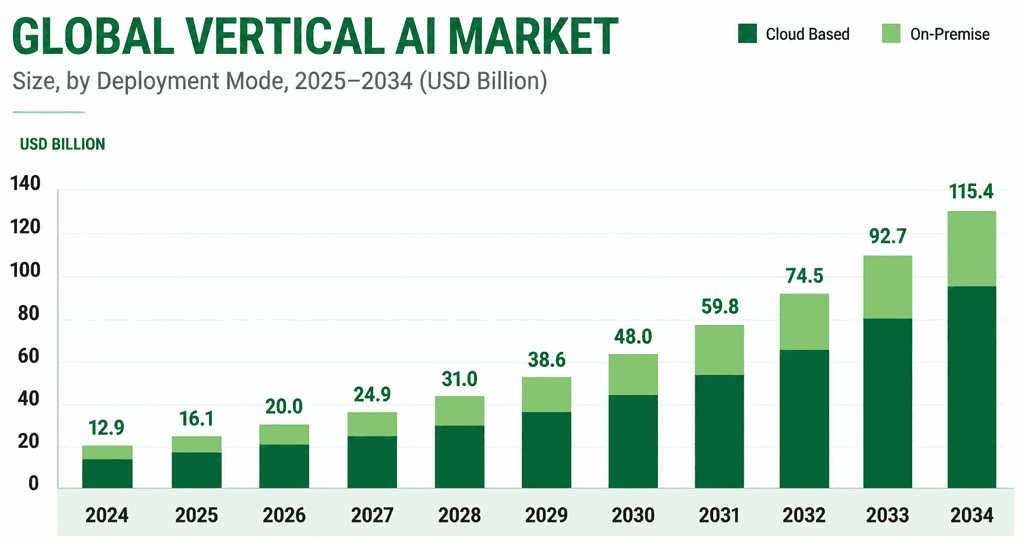
- The global vertical AI market is projected to grow from USD 12.9 billion in 2024 to USD 115.4 billion by 2034, with a compound annual growth rate (CAGR) of 24.5%.
- The market is expected to reach USD 16.1 billion in 2025 and rise to USD 20.0 billion in 2026.
- The market is forecast to grow to USD 92.7 billion in 2033 before reaching USD 115.4 billion in 2034.
Vertical AI Adoption Rate
- 2025 fieldwork found 42% legal-specific AI usage among professionals; 34% firmwide adoption.
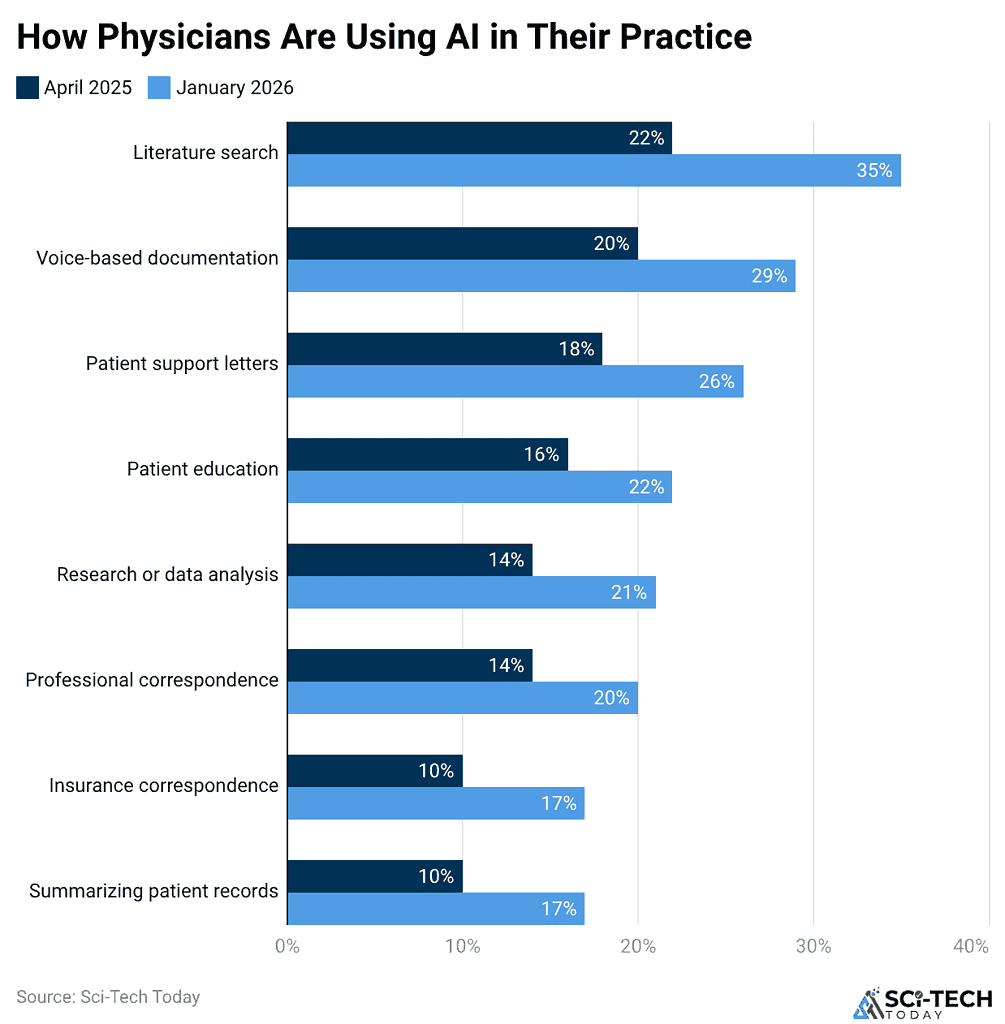
- 35% of surveyed US physicians used AI literature search; 29% used AI documentation tools.
- 88% used AI for client services, 86% for firm operations; 30% embedded it by default.
- 34% of operations were AI-augmented.
- 86% of responding financial firms used AI; banks reached 100%, insurers 93%, including general-purpose applications.
Vertical AI Enterprise Spending Statistics
- Kirkland & Ellis planned over USD 100 million for proprietary legal AI in 2026, within a USD 500 million commitment.
- A&O Shearman announced USD 1.1 billion over five years for specialist legal AI in November 2026.
- Merck announced an April 2026 pharmaceutical enterprise AI partnership worth up to USD 1 billion over multiple years.
- Lilly and NVIDIA announced up to USD 1 billion jointly over five years for drug-discovery AI in January 2026.
- VA’s September 2026 contract established a USD 775.72 million five-year ceiling across ambient clinical AI vendors.
Vertical AI Market by Use Case
| Use case | Company / solution | Numeric data reported in 2026 |
| Credit scoring | Revolut / PRAGMA | Model trained on 24 billion events across 26 million user records. |
| Payment optimization | Adyen / transaction foundation models | Deployed at scale across payment operations processing USD 1 trillion. |
| Banking compliance | GFT / Smaragd | Compliance engine reduces false positives by up to 75%. |
| Manufacturing optimization | PepsiCo / AI-powered digital twins | Initial deployments increased throughput by 20%. |
| Factory planning | PepsiCo / digital twins | Capital expenditure reduced by 10–15%. |
| Retail personalization | Instacart / Caper Carts | AI-powered in-store recommendations generated over 1% incremental sales lift. |
| Shopping assistance | Instacart / contextual reminders | Pre-checkout reminders generated nearly 1% additional sales lift. |
| Retail advertising | Instacart / GPU-powered ad ranking | Latency reduced by 65%; click-through rates increased by over 5%. |
| Automated checkout | Instacart / Caper Carts | AI-powered carts operated across more than 100 cities. |
Vertical AI in Healthcare and Life Sciences
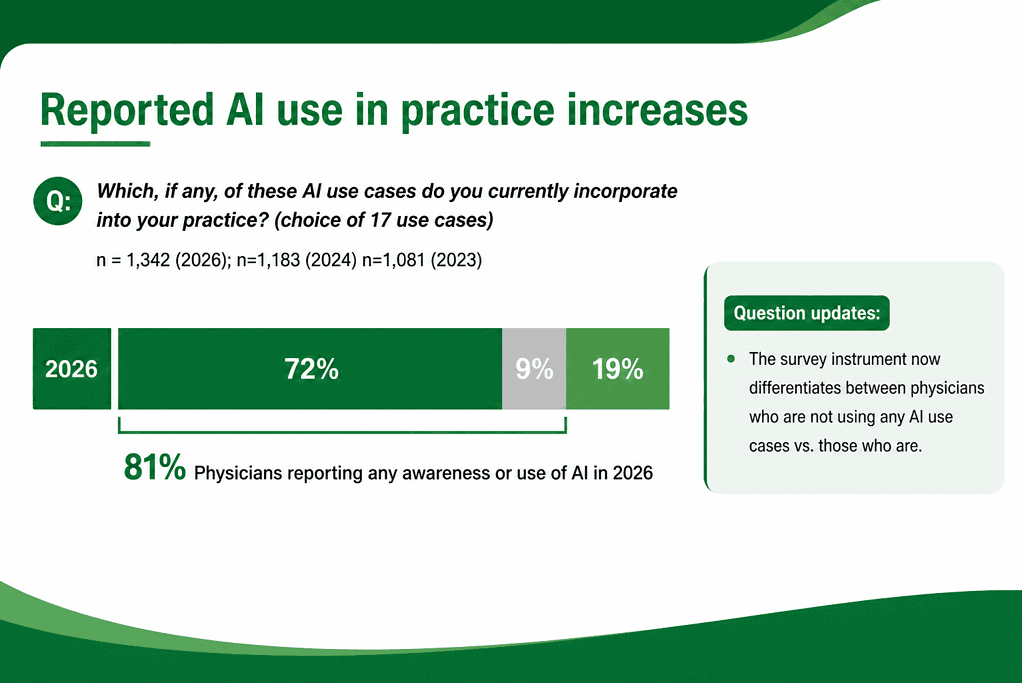
- AMA’s 2026 survey of 1,692 physicians found 81% reported using AI professionally, demonstrating healthcare’s expanding adoption.
- Research summarization supported specialized clinical workflows: 39% of physicians reported using AI for this purpose in 2026.
- Clinical decision support expanded: Doximity’s 2026 survey found 63% of physician respondents used AI for clinical decision-making.
- Medical-literature search became another major application: 70% of physicians in Doximity’s 2026 survey reported using AI.
- Administrative automation delivered self-reported benefits: 46% of Doximity’s 2026 physician respondents said AI reduced after-hours administrative work.
- Drug discovery attracted investment: Lilly and NVIDIA announced up to USD 1 billion jointly over five years in January 2026.
- Their planned laboratory targets 24/7 AI-assisted experimentation, connecting computational models with physical experiments under scientist oversight, NVIDIA announced in 2026.
Vertical AI in Banking, Financial Services, and Insurance
- In 2026, DBS reported generative AI processing approximately 65,000 payment forms monthly across five markets.
- DBS’s 2026 payment-processing deployment reduced manual effort by over 70%, while retaining human validation.
- For payment investigations, DBS reported over 90% AI classification accuracy during Singapore testing in 2026.
- DBS reported 78% accuracy in a parallel-run generative AI sanctions-screening implementation in 2026.
- In July 2026, DBS announced AI-enabled banking assistants reaching over 10 million customers across Singapore, Hong Kong, and Taiwan.
- During the first half of 2026, DBS digibot resolved 90% of queries digitally without customers needing follow-up calls.
- DBS reported over 1.5 million active digiWealth users in 2026, integrating AI-enabled assistance with investment services.
- In May 2026, Allianz reported AI boosting productivity by 30% in certain claims-management areas.
Vertical AI ROI Statistics
| Vertical AI application or metric | Reported 2026 numeric data |
| Survey scope | 226 healthcare executives; 65 use cases across providers, payers, and pharmaceutical enterprises |
| Average realized AI ROI | 3.5x |
| Time to realize returns | Approximately 12 months, compared with 24 months expected |
| Respondents reporting material first-year ROI | 54% |
| Use cases exceeding ROI expectations | Approximately 40% |
| Provider revenue-cycle AI | 4.0x realized ROI; rank 1 |
| Payer claims AI | 3.4x realized ROI; joint rank 2 |
| Pharmaceutical preclinical-discovery AI | 3.4x realized ROI; joint rank 2 |
| Payer provider-network AI | 3.3x realized ROI; rank 4 |
| Member-engagement AI | 3.2x realized ROI; rank 5 |
| Provider front-office AI | 3.1x realized ROI; rank 6 |
| Provider clinical AI | 2.9x realized ROI; rank 7 |
| Pharmaceutical commercial AI | 2.6x realized ROI; rank 8 |
| Clinical-development AI | 2.3x realized ROI; rank 9 |
Vertical AI Workforce Impact and Job Role Statistics
- U.S. AI-related openings reached 55,374 in Q1 2026, increasing 36% year-over-year.
- U.S. AI/ML engineers recorded 19,297 vacancies in Q1 2026, up 26.2% quarterly.
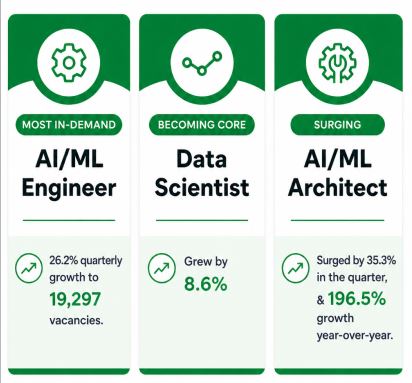
- U.S. AI/ML architect demand increased 196.5% year-over-year in Q1 2026.
- U.S. AI product/project manager demand grew 36% quarterly in Q1 2026.
- U.S. Big Data Engineer demand contracted 25.2% quarterly in Q1 2026.
- U.S. AI software developers averaged USD 169,052 in Q1 2026, a 16.1% premium over non-AI counterparts.
- AI-augmented professional services grew 72% in volume; earnings rose 22% year-over-year.
- North Carolina’s 2026 employer survey found 95% of AI-using businesses reported unchanged employment over the preceding year.
Vertical AI by Domain-Specific Foundation Models
- Genomics: scLong’s 2026 study reports 1 billion parameters, pretraining on 48 million cells, and coverage of 27,874 genes.
- Healthcare: Nature’s November 2026 review describes MedGemma’s 4-billion-parameter and 27-billion-parameter models spanning medical text and imaging.
- Finance: 2026 Kronos coverage describes pretraining on 12 billion financial records across 45 exchanges; variants span 4.1–499.2 million parameters.
- Clinical prediction: Knit Health’s November 2026 announcement reports USD 35 million financing supporting Med-BEAM deployment across healthcare organisations.
Agentic AI in Vertical Workflows
- Healthcare agents handled 40% of patient outreach in November 2026, eightfold 2025’s share, supporting over 2 million patients.
- November 2026 healthcare evaluations rated 99% of 325 clinical tasks safe; physicians rated 93% of 646 assessments highly helpful.
- Healthcare administrative agents scored 94.3% and 91.8% in 2026; lower-cost execution reached USD 0.085 per task, costing 98% less.
- Insurance claims agents reduced average handling time from 29 days to 3.5 days, according to November 2026 deployment findings.
- Insurance development teams using 16 agents reduced complex builds from 11 months to four weeks, reported in November 2026.
- Chemicals procurement agents improved staff efficiency 20–30% and value capture 1–3%, according to a February 2026 case study.
HIPAA, SOC 2, GDPR, and the EU AI Act in Vertical AI
| Framework | Vertical AI relevance | Numeric requirements and timelines |
| HIPAA Privacy Rule | Healthcare AI handling protected health information must accommodate applicable privacy-rule changes. | November 2026 rule: effective 60 days after publication; compliance required 180 days after effectiveness. |
| HIPAA breach reporting | Covered entities must notify HHS following qualifying breaches involving healthcare AI systems. | Breaches affecting 500 or more individuals: notify without unreasonable delay, no later than 60 days after discovery. Existing requirement applicable in 2026. |
| SOC 2 trust services categories | AI-service controls can be evaluated against relevant criteria. SOC 2 is an attestation framework, not legislation. | 5 categories: security, availability, processing integrity, confidentiality, privacy. Applicable in 2026, not newly introduced that year. |
| SOC 2 Type 2 reporting | Reports provide evidence about service-provider controls and their operating effectiveness over a specified period. | November 2026 illustrative report: 4 component groups—management assertion, system description, auditor report, and control tests/results. |
| GDPR breach notification | Vertical AI data controllers must assess whether personal-data breaches require supervisory-authority notification. | Notify without undue delay and, where feasible, within 72 hours of awareness, unless the breach is unlikely to risk individuals’ rights and freedoms. Existing requirement applicable in 2026. |
| GDPR administrative fines | Serious infringements involving AI processing can attract the higher statutory penalty tier. | Up to EUR 20 million or 4% of the undertaking’s preceding-year worldwide annual turnover, whichever is higher. Existing ceiling applicable in 2026. |
| EU AI Act transparency | Applicable chatbot and generative-AI deployments must meet disclosure and transparency obligations. | Article 50 transparency requirements apply from 2 August 2026. |
| EU AI Act high-risk timelines | Sector-specific AI may face high-risk obligations depending on its intended purpose and regulatory classification. | July 2026 amendments: Annex III high-risk obligations begin 2 December 2027; regulated-product AI obligations begin 2 August 2028. |
Wrapping Up
Vertical AI is moving from early trials to real, funded use in law, healthcare, finance, and manufacturing. Investors are backing industry-specific platforms at higher and higher values. Adoption is strongest among doctors, banks, and legal teams, and early returns look good, especially in billing and claims automation.
However, many of the gains are reported by the users themselves; results differ from one industry to another, and rules like HIPAA and the EU AI Act keep getting stricter. Providers that combine deep industry knowledge with strong governance and human oversight will lead.
FAQ
Vertical AI is artificial intelligence designed for one industry, such as medicine, insurance, logistics, or energy. It learns from sector-specific data and works within that field’s standards and daily practices.
General-purpose models handle a wide range of topics with broad competence. Vertical systems give up some of that breadth to gain precision in a particular field, drawing on specialized terminology, compliance rules, and established workflows.
It appears in areas such as radiology image screening, insurance claims processing, supply chain forecasting, equipment failure prediction, and farm yield analysis. In each case, the tool addresses a clearly defined task that matters to the people working in that sector.
Organizations value tools that fit their existing processes and meet regulatory expectations without extensive customization. Because the target problem is narrow, it’s often easier to define success criteria and measure the financial or operational benefit.
Common hurdles include gathering enough reliable data from a specialized field, satisfying strict regulations, building confidence among skeptical users, and connecting with older software systems. They also face competition from increasingly capable general-purpose models that can be adapted to similar tasks.
Trustworthiness depends on how the system was trained, how thoroughly it was tested, and whether its performance is tracked after launch. In sensitive areas such as healthcare or lending, professionals should verify results, keep records of decisions, and retain final authority over outcomes.