









Initial Assessment
Cloud-Based Apps Statistics: Cloud-based apps have made it easier for people and businesses to work, share files, and manage information online. Users no longer need to install heavy software or depend on a single device. Instead, they can open these apps through the internet whenever they need them. Platforms such as Google Workspace, Microsoft 365, Dropbox, and Salesforce help users handle everyday tasks, store data, and collaborate in real time.
Businesses also benefit from lower IT costs, simple updates, and easy access to digital tools. As more companies shift their work online, cloud-based apps are gaining wider use across industries. Their flexibility and convenience make them an important part of today’s digital workplace.
Featured Selection
- The global cloud applications market is expected to reach USD 792.8 billion in 2026, up from USD 689.4 billion in 2025.
- Global public cloud spending was projected to exceed USD 1 trillion in 2026.
- Around 27% of organizations expected public cloud spending to increase in 2026.
- In Q1 2026, AWS led the global cloud infrastructure market with a 28% share.
- Around 81.7% of organizations increased their SaaS usage over the past 12 months.
- Cost savings remained the leading measure of cloud adoption success at 81%.
- Google Workspace provides cloud-based Gmail, Docs, Sheets, Drive, and Meet services, supporting more than 3 billion monthly active users across Google’s productivity applications in 2026.
- Google Drive offers 15GB of free storage, with 100GB at USD 1.99/month and 2TB at USD 9.99/month.
- On October 13, 2025, developing a basic cloud-based app typically costs USD 40,000-60,000.
- AWS leads cloud adoption, with 49% of organizations running significant workloads, 29% using some workloads, 8% experimenting, and 4% planning adoption.
- AI-native application spending increased by 108%, with growth approaching 400% among large enterprises.
Cloud-Based Apps Market Size
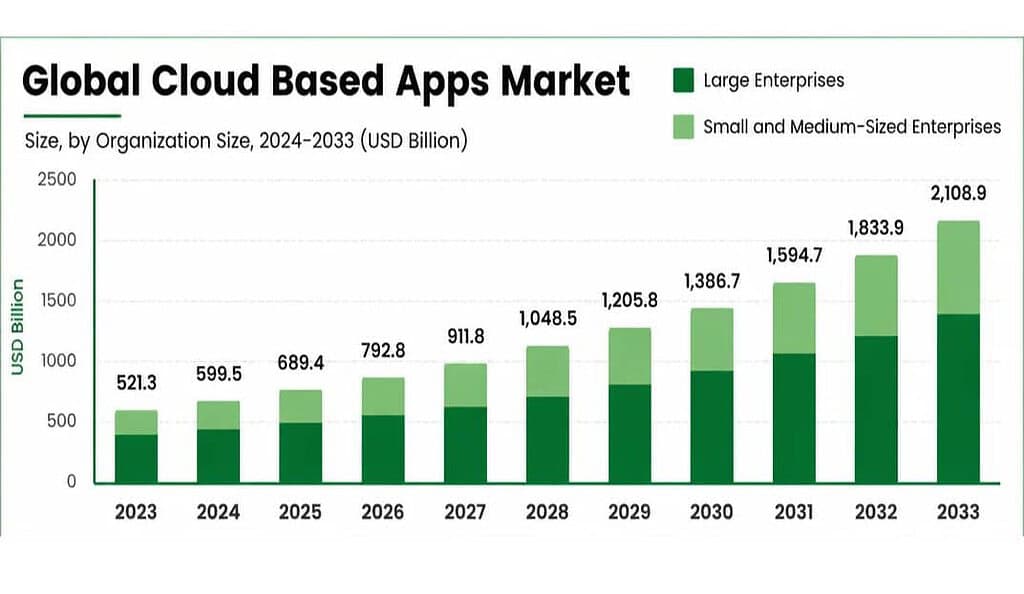
- The global cloud applications market is expected to reach USD 792.8 billion in 2026, up from USD 689.4 billion in 2025.
- The cloud applications market is expected to reach USD 2,108.9 billion by 2033, growing at a 15% CAGR from 2026 to 2033.
Cloud Computing Cost and Budget Statistics
- Global public cloud spending was projected to exceed USD 1 trillion in 2026, growing by 21% year over year, according to G2’s cloud cost management research.
- Organizations wasted an estimated 29% of cloud spending on unused or inefficient infrastructure resources, according to Flexera’s 2026 State of the Cloud Report.
- 85% of organizations identified cloud cost management as a major challenge, while 82% cited security and 78% highlighted software licensing concerns.
- 27% of organizations expected public cloud spending to increase in 2026.
- 69% of SMBs spent less than USD 50,000 per month on public cloud services.
- Meanwhile, 76% of large enterprises spent over USD 5 million per month, according to
- Cloud waste reached 29% of total spending in 2026, according to Flexera’s cloud cost analysis.
Cloud Infrastructure Market Share
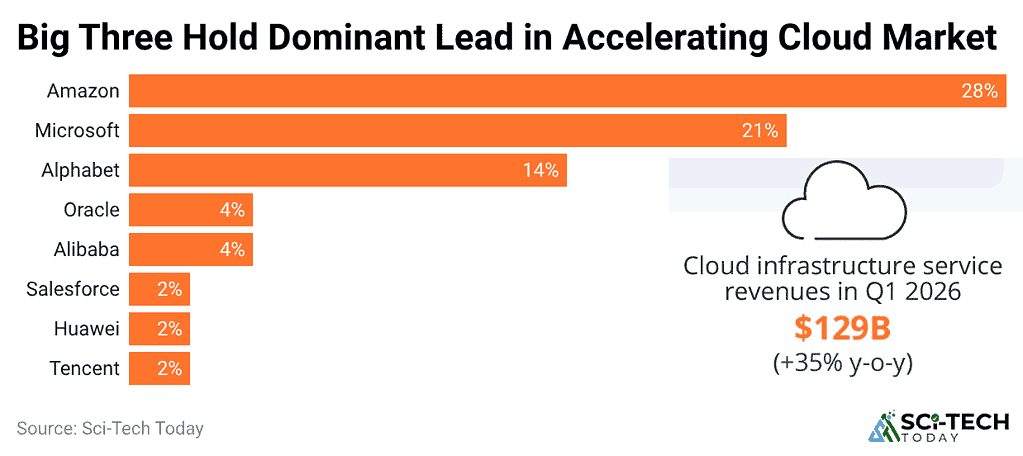
- In Q1 2026, AWS led the global cloud infrastructure market with a 28% share, followed by Microsoft Azure at 21% and Google Cloud at 14%.
- Oracle and Alibaba Cloud each held 4%, while Salesforce, Huawei Cloud, and Tencent each accounted for 2%.
- Global cloud infrastructure service revenue reached USD 129 billion, up 35% year over year.
Cloud-Based Apps Adoption Statistics
- According to Statistics Sweden’s 2026 ICT Usage in Enterprises report, 78% of Swedish enterprises with at least 10 employees used paid cloud computing services.
- Among Swedish enterprises using cloud services, 88% used cloud-based email, 86% used cloud file storage, and 78% used cloud office software.
- 52.7% of EU enterprises purchased cloud computing services in 2025, according to Eurostat’s 2026 report on cloud computing adoption among EU businesses.
- 73% of organizations used hybrid cloud environments in 2026, according to Flexera’s 2026 State of the Cloud Report
- 83% of organizations used AWS for some or significant workloads, compared with 79% using Microsoft Azure.
- 71% of organizations had a Cloud Center of Excellence (CCoE) in 2026, up from 69% in 2025.
- 63% of organizations had dedicated FinOps teams to manage cloud spending in 2026, compared with 59% in 2025.
SaaS and Cloud Application Usage Statistics
- The Parallels Cloud Survey 2026 found that 81.7% of organizations increased their SaaS usage over the past 12 months.
- Of these, 34% reported significant growth, while 47.7% experienced slight growth.
- 72.4% of organizations reported that employees frequently or occasionally used unauthorized SaaS, collaboration, or remote-access applications.
- Employees interacted with an average of 40 applications, according to Torii’s 2026 SaaS Benchmark.
- The average number of applications per organization increased by 11% year over year.
- MuleSoft’s 2026 report found that 1,050 IT leaders’ organizations managed 957 applications
- Shadow IT accounted for 61.3% of applications, while approved tools represented 15.5%.
Cloud Adoption Success Metrics and Business Performance
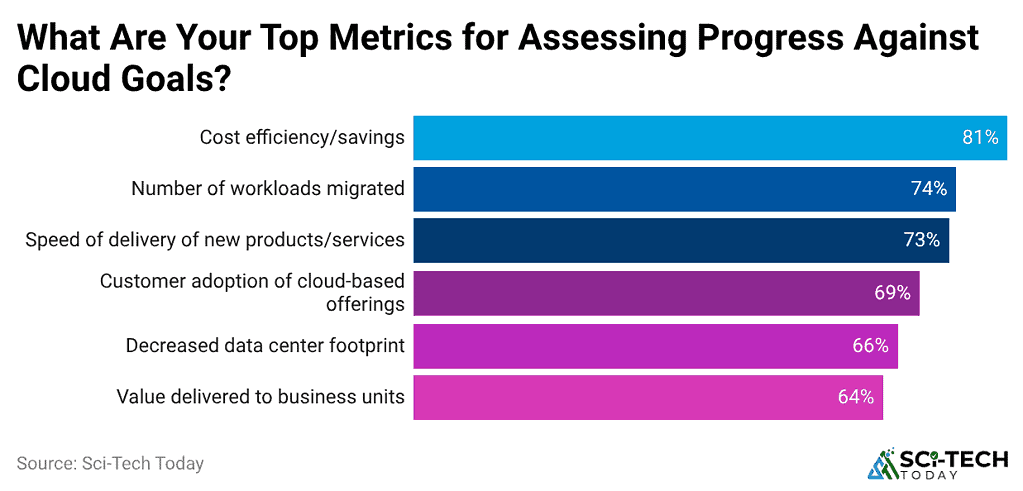
- Cost savings remained the leading measure of cloud adoption success at 81%, followed by the number of workloads migrated to cloud platforms at 74%.
- Faster delivery of new products and services ranked third at 73%, while customer adoption of cloud-based offerings reached 69%.
- Reducing the data center footprint accounted for 66%, while the value delivered to business units accounted for 64%.
Cloud-Based Applications: Examples and Key Statistics
- Google Workspace provides cloud-based Gmail, Docs, Sheets, Drive, and Meet services, supporting more than 3 billion monthly active users across Google’s productivity applications in 2026.
- Google Cloud generated USD 58.7 billion in revenue in 2025.
- Microsoft 365 offers cloud-based Word, Excel, PowerPoint, Teams, and OneDrive services for businesses and individuals.
- Microsoft 365 Commercial products and cloud services generated USD 102.0 billion in 2026, compared with USD 87.8 billion in 2025.
- Microsoft 365 Consumer revenue reached USD 9.2 billion in 2026, up from USD 7.4 billion in 2025.
- Salesforce generated USD 41.5 billion in revenue in 2026, representing approximately 10% year-over-year growth.
- Dropbox had more than 700 million registered users and 18.20 million paying users as of September 30, 2026.
- Dropbox generated USD 637.3 million in Q3 2026 revenue, while its annual recurring revenue reached USD 2.555 billion.
- Zoom generated USD 4.87 billion in revenue in 2026, representing 4.4% year-over-year growth.
- Zoom had 4,468 enterprise customers generating more than USD 100,000 in revenue as of January 31, 2026, an increase of approximately 9.3% year-over-year.
Cloud Storage Apps: Storage Limits and Pricing
| Cloud Storage App | Storage, Pricing, and User Limits |
| Google Drive | 15GB free; 100GB for USD 1.99/month; 2TB for USD 9.99/month. |
| iCloud | 5GB free; paid plans range from 50GB for USD 0.99/month to 12TB for USD 59.99/month. |
| OneDrive | 5GB free; 100GB for USD 1.99/month; 1TB for USD 9.99; 6TB for USD 12.99, shared across 6 users with 1TB each. |
| Dropbox | 2GB free; 2TB for USD 11.99/month; 3TB for USD 19.99/month. |
| Box | 10GB free for individuals; business plans start at USD 5/user/month. |
| Jottacloud | 5GB free; 1TB for USD 6.99/month, shared across 5 users; unlimited storage for USD 11.99/month for 1 user. |
| pCloud | 10GB free; 500GB for USD 4.99/month; 2TB for USD 9.99/month; lifetime plans range from USD 199 for 500GB to USD 1,190 for 10TB. |
| IDrive | 10GB free; monthly plans range from USD 11.99 for 5TB to USD 119.99 for 100TB. |
| Proton Drive | 1GB free; 15GB for USD 4.99/month; 500GB for USD 12.99/month; 2TB for USD 19.99/month for up to 2 users; 3TB for USD 29.99/month for up to 6 users. |
Estimated Development and Maintenance Costs of Cloud-Based Apps
- According to a QSS Technosoft report published on October 13, 2025, developing a basic cloud-based app typically costs USD 40,000-60,000.
- Applications with additional features cost approximately USD 61,000-120,000.
- Advanced cloud apps can cost more than USD 150,000.
- The estimated cost ranges from USD 50,000 to 200,000, depending on complexity and customization.
- Annual maintenance typically accounts for 15%-25% of initial development costs.
Long-Term Cost Comparison: Web-Based vs. Cloud-Based Apps
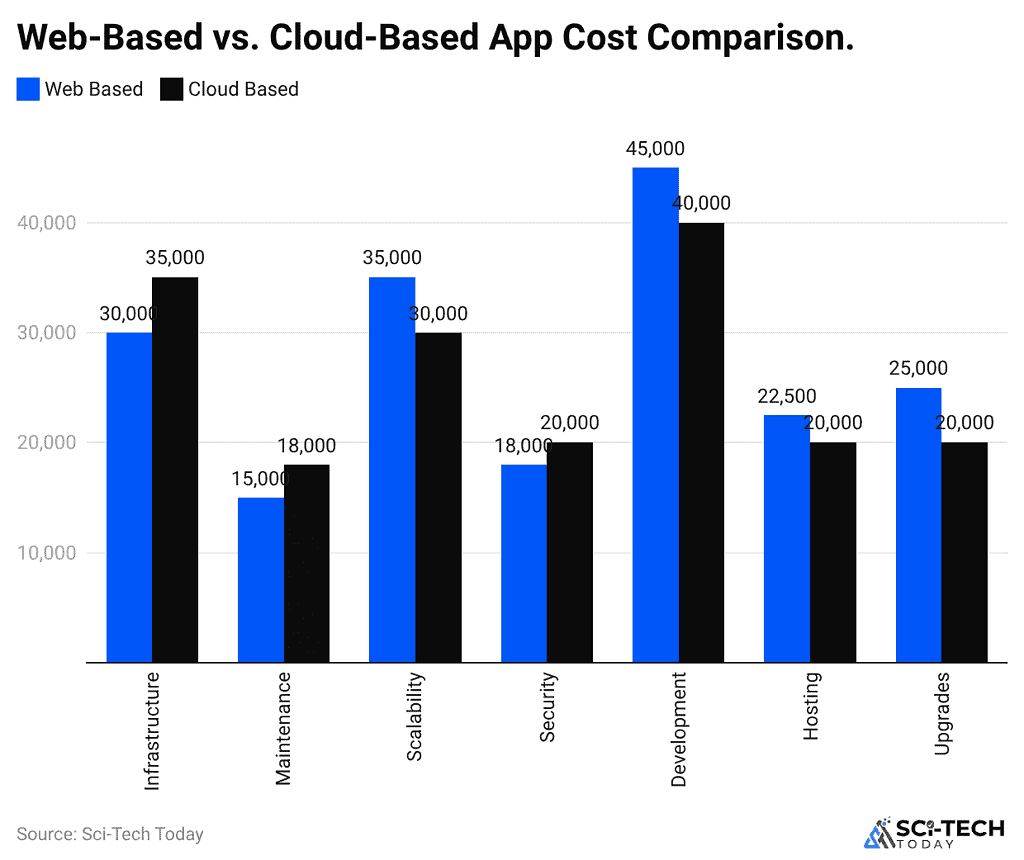
- Infrastructure: Web-based apps cost USD 30,000, while cloud-based apps cost USD 35,000.
- Maintenance: Costs reach USD 15,000 for web apps and USD 18,000 for cloud apps.
- Scalability: Web apps require USD 35,000, compared with USD 30,000 for cloud apps.
- Security: Costs are USD 18,000 and USD 20,000, respectively.
- Development: Web apps cost USD 45,000, while cloud apps cost USD 40,000.
- Hosting: Costs are USD 22,500 for web apps and USD 20,000 for cloud apps.
- Upgrades: Web apps require USD 25,000, compared with USD 20,000 for cloud apps.
Cloud-Based Apps Statistics: How Organizations Use Public Cloud Providers
| Public Cloud Provider | Running Significant Workloads | Running some Workloads | Experimenting | Planning to Use |
| AWS | 49% | 29% | 8% | 4% |
| Microsoft Azure | 45% | 35% | 9% | 3% |
| Google Cloud Platform | 21% | 29% | 17% | 6% |
| IBM Cloud | 7% | 14% | 13% | 7% |
| Oracle Cloud Infrastructure | 8% | 17% | 14% | 9% |
| Alibaba Cloud | 2% | 8% | 8% | 5% |
| Other providers | 4% | 7% | 2% | 4% |
Key Growth Drivers of the Cloud-Based Application Market
- Gartner forecasts USD 453.209 billion in AI software spending and USD 32.604 billion in AI model spending, with model spending growing 110% in 2026.
- Zylo reported that AI-native application spending increased by 108%, with growth approaching 400% among large enterprises.
- Global software spending is forecast to reach USD 1.47 trillion, up 15.5%.
- IaaS spending is projected to reach USD 287 billion, growing 29.3%.
- AI application development platforms are expected to attract USD 8.416 billion.
- Annual SaaS spending grew 8%, with average organizational spending of approximately USD 55 million.
Advantages of Cloud App Development
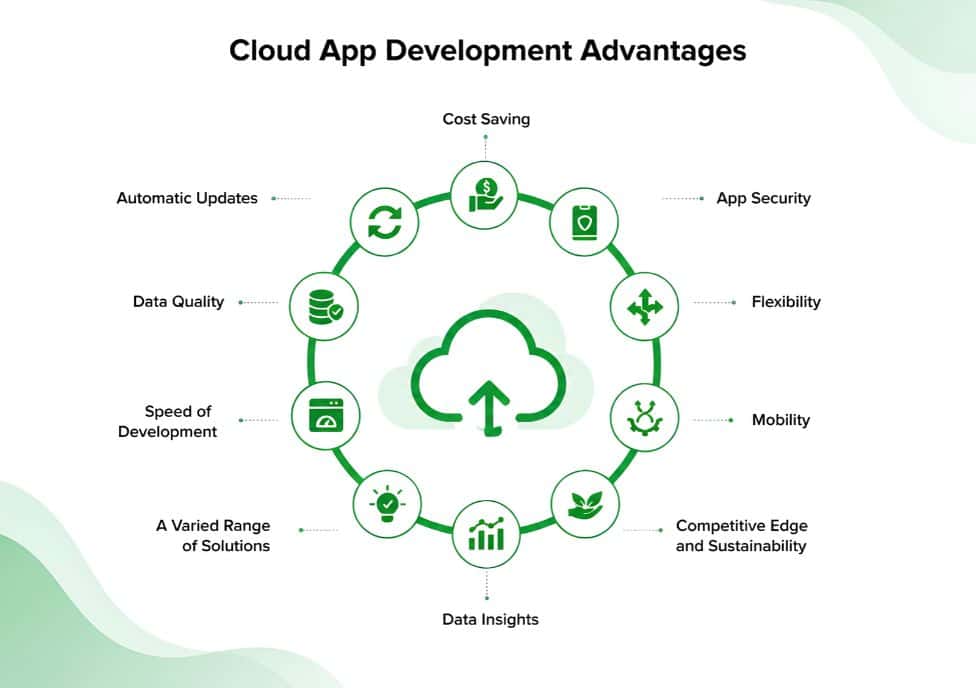
- Cloud app development can lower costs and improve flexibility as business needs change.
- Automatic updates help keep applications up to date and reduce manual maintenance.
- Security features help protect applications, while better data quality supports reliable information.
- Faster development and a wider choice of solutions help businesses respond to changing requirements.
- Mobile access and data insights support informed decisions, competitiveness, and sustainability.
Closing Remarks
Cloud-based apps are becoming an important part of everyday work and business operations. They allow users to access information, share files, and complete tasks without depending on a single device. Businesses also benefit from lower costs, easier teamwork, and flexible operations.
At the same time, concerns about data privacy, security, and internet access still need attention. As technology advances, cloud-based apps will continue to make digital services more accessible and efficient.
FAQ
Examples include Google Drive, Microsoft 365, Dropbox, Salesforce, Zoom, Slack, and Canva.
Cloud-based apps offer easy access, lower costs, automatic updates, flexible storage, better collaboration, and improved scalability.
Cloud-based apps run on remote servers and require internet access, while traditional software is installed and runs directly on local devices.

Sources