









Preliminary Note
AI In Epidemiology Statistics: Tracking diseases and preventing outbreaks have become major challenges for healthcare systems worldwide. Artificial Intelligence is helping experts tackle these challenges more efficiently. It can study health records, track infection trends, and spot early signs of disease outbreaks. These insights allow researchers and health officials to respond before infections spread further. AI also supports disease forecasting, risk assessment, and public health planning.
As new health threats emerge, its role in epidemiology continues to grow. By turning complex health data into useful insights, AI is helping experts make better decisions and improve disease control.
Editorial Spotlight
- The global AI in epidemiology market is projected to grow from USD 887 million in 2025 to USD 1,127.4 million in 2026.
- In 2026, disease surveillance and early warning lead with 38.6%.
- Software platforms are set to dominate the market, contributing 62.4% of revenue.
- North America will retain its leading position with a 43.5% revenue share in 2026.
- On July 2, 2026, 66% of field epidemiology fellows in Canada, the U.S., and Europe used AI for work.
- Adoption was highest in Europe at 89%.
- Around 49% of epidemiologists felt somewhat comfortable using AI, and 35% felt comfortable.
- IQVIA reported Q3 2026 revenue of USD 4.428 billion, marking an 8% year-over-year increase.
- On October 13, 2025, the World Health Organization launched EIOS 2.0 to improve AI-assisted detection of public health threats.
- The 2026 MASAI trial found AI-assisted breast screening achieved 80.5% sensitivity versus 73.8%, with 98.5% specificity in both groups.
AI in Epidemiology Market Size
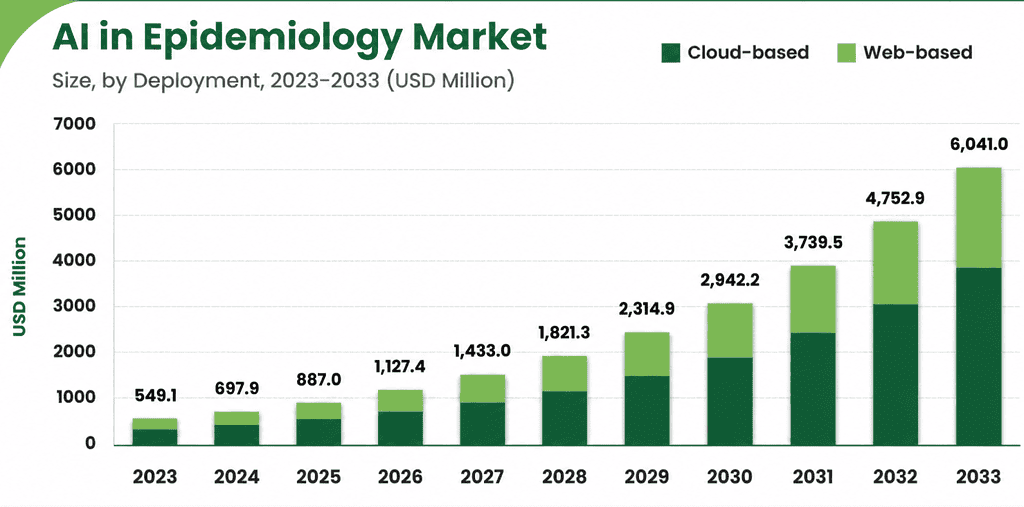
- The global AI in epidemiology market is projected to grow from USD 887 million in 2025 to USD 1,127.4 million in 2026.
- By 2033, the market is forecast to reach USD 6,041.0 million, with a 27.1% compound annual growth rate over 2023-2033.
Key Segment Highlights
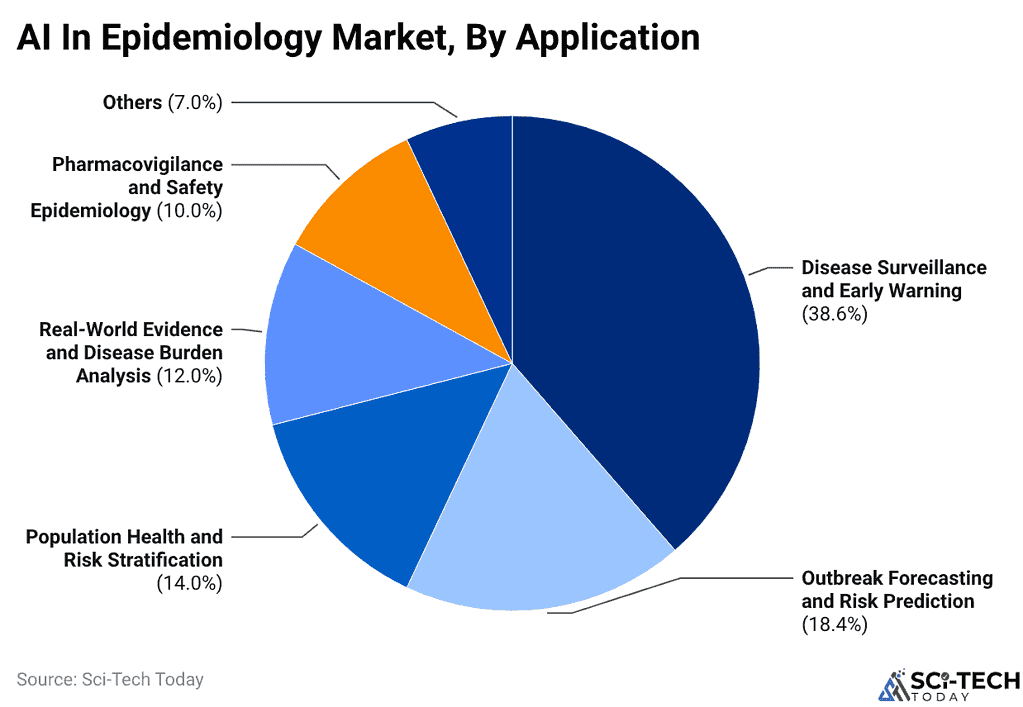
- Disease surveillance and early warning lead with 38.6%, followed by outbreak forecasting and risk prediction at 18.4%.
- Population health and risk assessment account for 14%, while real-world evidence and disease burden analysis represent 12%.
- Drug safety contributes around 10%, while other applications hold 7%.
- Demand for outbreak forecasting and risk prediction is expected to achieve a 29.4% CAGR between 2026 and 2035.
- Software platforms are set to dominate the market, contributing 62.4% of revenue in 2026.
- However, services are gaining momentum, with a projected CAGR of 27.8%.
- Machine learning and predictive analytics will remain the leading technology segment, accounting for 34.7% of revenue in 2026.
- Generative AI and LLM analytics are expected to record stronger growth at 31.2% CAGR.
- Clinical and public health data will maintain the largest share at 31.8% in 2026.
- Mobility, climate, and environmental data are forecast to grow at a 28.9% CAGR.
- Government and public health agencies are expected to generate 42.3% of revenue in 2026.
- Pharmaceutical and life sciences companies will see faster growth at a 27.1% CAGR.
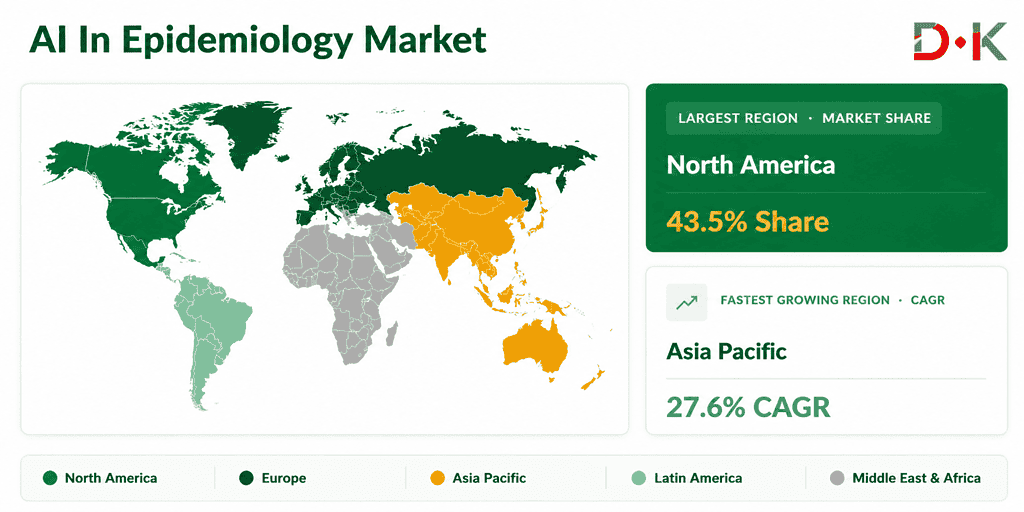
- North America will retain its leading position with a 43.5% revenue share in 2026.
- Asia-Pacific is projected to grow at the highest CAGR of 27.6% through 2035.
AI Adoption in Epidemiology Statistics
- According to a survey published in Eurosurveillance on July 2, 2026, 66% of field epidemiology fellows in Canada, the U.S., and Europe used AI for work.
- A WHO global survey found that 24.5% of professionals used AI-enabled or digital tools, 15.2% considered adopting them, and 60.3% did not use them.
- ASTHO reported that 14% of state and territorial agencies used AI for disease surveillance, anomaly detection, or predictive modeling.
- An Innovaccer report cited by ASTHO indicated that more than 75% used some form of AI, while 85% lacked AI governance policies.
- A study published in the International Journal of Environmental Research and Public Health found that 54.8% of Romanian healthcare professionals regularly used AI.
- Among public health specialists, adoption reached 55% in 2026.
AI Adoption and Usage Among Field Epidemiology Fellows
- A report published by the Center for Infectious Disease Research and Policy shows that 66% of 105 field epidemiology fellows used AI in their work.
- Adoption was highest in Europe at 89% (32/36), compared with 54% in the U.S. (30/56) and 54% in Canada (7/13).
- Among AI users, 42% used the technology weekly, 30% daily, and 26% occasionally.
- Around 49% felt somewhat comfortable using AI, 35% felt comfortable, 12% felt very comfortable, and 4% felt uncomfortable.
- ChatGPT led adoption at 87%, followed by institution-specific AI tools at 25%.
- AI was mainly used for troubleshooting coding errors (91%), writing code (75%), and improving work efficiency (42%).
Leading Companies in Epidemiology Analytics and AI
| Company | Financial Highlights |
| IQVIA | Generated USD 4.428 billion in Q3 2026 revenue, an 8% increase from last year. Revenue for the first nine months reached USD 12.947 billion, up 8.4%. |
| Palantir | Reported Q3 2026 revenue of USD 2.313 billion, up 96% YoY. The United States’ revenue rose 119% to USD 1.937 billion. |
| Alphabet | Recorded quarterly revenue of USD 127.58 billion, up 24.65% year over year, bringing trailing-12-month revenue to USD 471.10 billion. |
| Amazon Web Services | Generated approximately USD 46 billion in Q3 2026 revenue, up 39% from 2025, equivalent to an annualized revenue run rate of USD 184 billion. |
| Tempus AI | Reported Q3 2026 revenue of USD 411.5 million, up 23% YoY. Diagnostics contributed USD 303.5 million, while Data and Applications generated USD 108.1 million. |
| Databricks | Announced a revenue run rate exceeding USD 7 billion, with year-over-year growth above 80%, and a private funding-round valuation of USD 190 billion. |
| Clarivate | Generated USD 481.6 million in revenue from continuing operations in Q3 2026. |
| IBM | Recorded Q3 2026 revenue of USD 17.10 billion, up 4.7% year-over-year, with earnings per share of USD 2.95. |
| Microsoft | Reported quarterly revenue growth of 18%, while Microsoft Cloud revenue increased 27% and Azure revenue grew 43%. |
| Oracle | Recorded approximately USD 71.78 billion in trailing-12-month revenue. |
AI in Disease Surveillance and Outbreak Detection Statistics
- On October 13, 2025, the World Health Organization launched EIOS 2.0 to improve AI-assisted detection of public health threats.
- By the end of 2025, the system had expanded to 120 countries and 30 organizations and networks.
- A 2025 systematic review published in Frontiers in Public Health screened 600 records and selected 67 studies examining AI-based systems for early detection of infectious disease outbreaks.
- Published on June 6, 2025, the PandemicLLM study evaluated disease forecasting across 50 U.S. states over 19 months.
- A 2026 review published in PubMed reported that Random Forest models achieved an R² of 0.80 and an RMSE of 0.54 in wastewater surveillance.
- The same review found neural-network correlations of 0.81-00.92, while LSTM models recorded R² values of 0.94 (training) and 0.81 (testing).
- A 2026 study published in Emerging Microbes & Infections reported 87.9% accuracy in disease surge classification, compared with 80.4% and 81.8% accuracy for one-and two-week forecasts, respectively.
- Additionally, two grants provided USD 2 million for the development of AI-powered wastewater surveillance.
AI in Medical Imaging and Diagnosis Findings
- The 2026 MASAI trial found AI-assisted breast screening achieved 80.5% sensitivity versus 73.8%, with 98.5% specificity in both groups.
- Over 2 years, AI screening recorded 82 interval cancers in 53,043 patients, compared with 93 in 52,872 under standard screening.
- AI screening reduced interval cancer rates by 12%, but superiority remained unproven, with a rate-ratio confidence interval of 0.65-1.18.
- A November 2026 prostate MRI study detected significant cancer in 66 of 129 patients (51.2%).
- At a threshold of ≥4, the model achieved 48.5% sensitivity, 79.4% specificity, 71.1% positive predictive value, 59.5% negative predictive value, and an AUC of 0.667.
- Among 75 patients with MRI scores of 1-2, 28 (37.3%) had significant cancer.
- A July 2026 review analyzed findings from 9 randomized clinical trials.
- By September 2026, the FDA had authorized over 1,600 AI-enabled medical devices across multiple medical specialties.
Latest AI News for Epidemiologists
- July 30, 2026: Frontiers in Public Health explored how AI, digital health, and big data can improve nutritional research and disease prevention.
- July 27, 2026: A CIDRAP report highlighted that 66% of surveyed field epidemiology fellows used AI, while training remained limited.
- February 6, 2026: A medRxiv preprint introduced an AI agent designed to automate causal inference in epidemiological research.
- January 10, 2025: A Nature review examined how AI can improve traditional epidemiological models.
- April 2, 2024: Infection Control Today discussed AI’s benefits and risks in epidemiology and infection prevention.
Final Observations
AI is changing how researchers study and control diseases. Analyzing health data helps identify outbreaks, predict disease trends, and support early action. These tools also help health authorities make better decisions and respond to health threats more quickly. Although data privacy and accuracy remain concerns, AI has strong potential to improve epidemiological research. Its growing role can make disease tracking easier and help protect public health worldwide.
FAQ
AI analyzes health data, detects disease outbreaks, tracks infections, and predicts emerging public health threats.
AI supports disease surveillance, outbreak prediction, risk assessment, epidemic modeling, contact tracing, and tracking disease transmission patterns.
Machine learning, deep learning, natural language processing, predictive analytics, and computer vision.